Top PressRush Alternatives in 2026: 6 Picks Ranked
Looking for PressRush alternatives? I compare six PR and media outreach tools on features, free plans and limits, based on vendor docs and public sources.
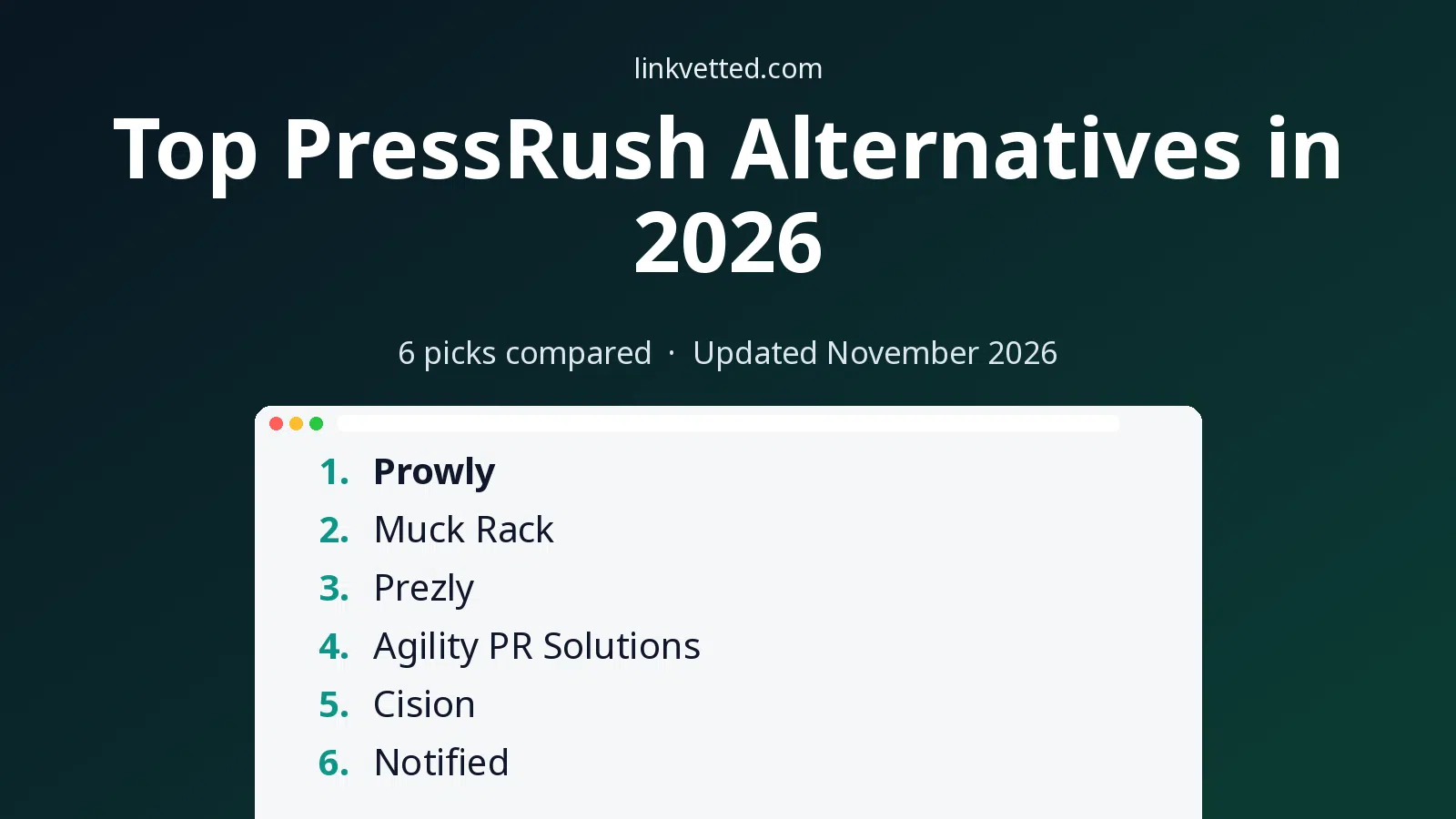
- Editor's choice
 Prowly
All-in-one PR workflow for small teams
Starts atSee websiteVisit prowly.comFull review - Great alternative
 Muck Rack
Journalist research and media monitoring
Starts atSee websiteVisit muckrack.comFull review - Also consider
 Prezly
Agencies running client newsrooms
Starts atSee websiteVisit prezly.comFull review
Direct answer
My first pick is Prowly, because it combines media database search, contact management and press release publishing in one workflow that suits small PR and SEO teams. If budget is the main concern, Muck Rack is a strong fit for teams that need a large journalist database and monitoring, while Prezly works well for agencies that publish brand newsrooms. People look for PressRush alternatives when they want different database coverage, pricing structure or extra features.
TL;DR:
- PressRush alternatives usually differ most in media database size, contact data quality and how releases are distributed.
- Prowly covers contact discovery, outreach and release publishing in a single tool, which reduces tool switching for small teams.
- Muck Rack leans toward monitoring and journalist research, so it fits teams that track coverage closely.
- Prezly is built around brand newsrooms and story publishing, which suits agencies managing several client sites.
- Check contract terms, contact export limits and data-refresh policies before you commit to any PR platform.
Last checked November 2026. Plan prices are not quoted in this guide because they change often; see each vendor's own pricing page for current figures before you buy.
Quick comparison
| Tool | Best for | Starts at | Free plan? | |
|---|---|---|---|---|
| Prowly | All-in-one PR workflow for small teams | See website | Free trial | Visit |
| Muck Rack | Journalist research and media monitoring | See website | Not stated | Visit |
| Prezly | Agencies running client newsrooms | See website | Free trial | Visit |
 Agility PR Solutions | Media monitoring with contact discovery | See website | Not stated | Visit |
 Cision | Large communications departments | See website | Not stated | Visit |
| Notified | Press release distribution and disclosure | See website | Not stated | Visit |
The best PressRush alternatives compared
I put this comparison together from vendor documentation and public sources such as product pages, help centres and published feature lists. I did not run hands-on tests of these platforms, so treat the notes below as a starting point for your own trial. The aim is to help you shortlist tools that match how your team actually does outreach.
Prowly is a PR platform from Semrush that combines a media database, a contact relationship manager and a press release editor. It fits small agencies and in-house teams that want one place to find journalists, send pitches and publish releases. The workflow is built around projects, so you can keep separate contact lists and coverage records for each client.
For someone leaving PressRush, Prowly is the closest match in day-to-day use: you search for journalists, save them to lists, pitch from the platform and track opens and coverage. The release editor also gives you a public newsroom page, which helps when a client wants a linkable home for announcements. If your main need is a large database plus monitoring at scale, compare it with Muck Rack before deciding.
The main limit is that contact allowances and features depend on the plan you choose, so map your monthly outreach volume to the tiers before signing. Teams that mostly distribute releases through wires may find the outreach side more than they need.
- Media database with contact management
- press release builder and publishing
- coverage monitoring in one place
- Contact limits depend on your plan
- less depth for very large enterprise teams
Muck Rack is a PR software platform known for its journalist database and media monitoring. Reporters maintain profiles that show their beats, outlets and recent work, which helps when you need to check whether a contact is still active and relevant. It suits PR teams that spend most of their time researching journalists and reporting on coverage.
As a PressRush alternative, it is strongest when your priority is finding the right contact rather than distributing a release. You can build media lists, pitch contacts and set up monitoring for client names, and the coverage reports are useful for monthly client updates. The trade-off is that it is generally positioned toward larger teams, so smaller agencies should check whether the plan they can afford covers their contact needs.
Skip it if you mainly need a simple release publishing tool or if your outreach volume is low and you want a lighter, cheaper setup.
- Large journalist database with profiles
- monitoring and coverage reports
- media list building tools
- Pricing aimed at larger teams
- less emphasis on release publishing
Prezly is a PR and storytelling platform built around online newsrooms. Each client can have a branded newsroom page where releases, images and contacts live, which is useful for agencies that want a consistent public home for announcements. It also includes contact management and outreach features so you can pitch from the same place.
If you are moving away from PressRush because you want more than a database and a send button, Prezly is worth a look. The newsroom gives you a page you can link to from client sites and social profiles, and the outreach tools cover list building and pitching. It fits agencies with several clients who each need their own public presence.
The limit is that newsroom setup takes time, and the platform is less focused on very high-volume cold pitching. Solo consultants who only send occasional releases may not need the newsroom layer.
- Branded newsroom pages
- contact and outreach management
- collaboration features for teams
- Less built around high-volume cold pitching
- newsroom setup takes initial work
Agility PR Solutions is a media monitoring and PR software provider. It combines a media database with monitoring, coverage analysis and reporting, which suits teams that need to show clients what was published and where. It is often used by agencies and in-house communications teams that want monitoring and contact discovery from one vendor.
As an alternative to PressRush, it makes sense when monitoring matters as much as outreach. You can search for journalists, build lists and then track coverage of client names and campaigns. Because plans are quoted, you need to talk to sales to understand what contact volume and monitoring scope you get.
The main drawback is the learning curve: the platform has many modules, so budget time for setup. Small teams that only need a contact list and a send tool may find it heavier than necessary.
- Media database and monitoring combined
- coverage measurement tools
- analyst support options
- Interface takes time to learn
- plans are quote-based
Cision is one of the largest PR and media software companies, covering media databases, monitoring, distribution and analytics. It is built for organisations with dedicated communications teams that need wide coverage across markets and formats. Many large brands and agencies use it as their main PR platform.
For anyone comparing PressRush alternatives at a bigger scale, Cision is the enterprise option. It can handle contact research, release distribution and coverage measurement across regions, and the reporting is designed for teams that answer to stakeholders regularly. The trade-off is that it is generally sold through quotes and contracts, so it is not a quick self-serve purchase.
Skip it if you are a small agency or solo consultant: the scope and contract structure usually outweigh what a small team needs.
- Broad media database and monitoring
- press release distribution
- analytics and reporting
- Enterprise-oriented pricing
- long contracts are common
Notified
Best for: Press release distribution and disclosure
Notified is a PR and investor relations platform built around press release distribution. It is often used for earnings releases, regulatory disclosures and company announcements that need a wide, reliable distribution network. It also offers media monitoring and contact tools as part of its wider suite.
If your PressRush use was mostly about getting announcements out, Notified is a relevant alternative. You can draft and distribute releases through its network and add monitoring to see pickup. For agencies, it can be a useful distribution layer alongside an outreach tool rather than a full replacement for contact research.
The limit is that it is not built around day-to-day pitching to journalists. If most of your work is personalised outreach, pair it with a contact-focused tool or choose one of the earlier options.
- Press release distribution network
- investor and earnings release support
- media monitoring add-ons
- Focused on distribution rather than outreach
- less suited to small agency pitching
How I chose
I selected these tools by reading vendor documentation, product pages and public help articles, then matching each platform to common reasons people move away from PressRush. The main factors were media database coverage, contact management, release publishing, monitoring and how the platform is sold. I also noted where a tool is clearly aimed at larger teams, because that affects fit for small agencies.
I did not run hands-on tests, and I have not included any pricing figures, ratings or review scores. Where a vendor does not clearly state whether a free plan exists, I marked it as not stated rather than guessing. The result is a shortlist to help you book demos and ask better questions, not a definitive ranking. Your own trial and a look at contract terms should decide the final choice.
What to check before you buy
- Confirm how many contacts you can store and export per month, and whether unused contacts roll over.
- Ask how often the media database is refreshed and how the vendor handles bounced or outdated contacts.
- Check whether press release publishing and newsroom pages are included or sold as add-ons.
- Ask about monitoring scope: which outlets are covered and how coverage reports are delivered.
- Read the contract length and cancellation terms, especially for quote-based enterprise plans.
- Request a trial or demo using your own client list so you can judge contact accuracy before committing.
FAQ
Why do people look for PressRush alternatives?
People usually look for alternatives when they want a different media database, more monitoring features, a newsroom layer or a pricing structure that fits a smaller team. Some teams also want an all-in-one platform that covers contact research, outreach and release publishing without adding another subscription. The right choice depends on whether your priority is contacts, distribution or coverage reporting.
Is there a free option among these PressRush alternatives?
Prowly and Prezly list free trials, which let you check the workflow before paying. The other tools in this list do not clearly state a free plan on their public pages, so I marked them as not stated. A trial is useful, but check what limits apply to contacts and exports during the trial period.
Can I use these tools for link building outreach?
Some of them, yes. Prowly and Muck Rack are the most relevant for journalist and editor outreach, which overlaps with digital PR link building. Notified is more about distribution. If link building is your main goal, look for contact search, list management and pitch tracking rather than release distribution alone.
How long does it take to switch from PressRush?
It depends on how much contact history and coverage data you have. Export your lists first, then check whether the new platform can import them cleanly. Plan for a short overlap period where you keep the old account active while you test the new workflow on a few campaigns.
Do I need a media database at all?
Not always. If you already have a reliable list of journalists and editors you work with, a simpler outreach and publishing tool may be enough. A database helps most when you are expanding into new beats or markets and need to find contacts you do not already know.
Sources
- https://prowly.com
- https://muckrack.com
- https://www.prezly.com
- https://www.agilitypr.com
- https://www.cision.com
- https://www.notified.com