Best Page One Power Alternatives for 2026 (6 Compared)
A practical look at Page One Power alternatives for link building and digital PR in 2026, compared from vendor documentation and public sources.
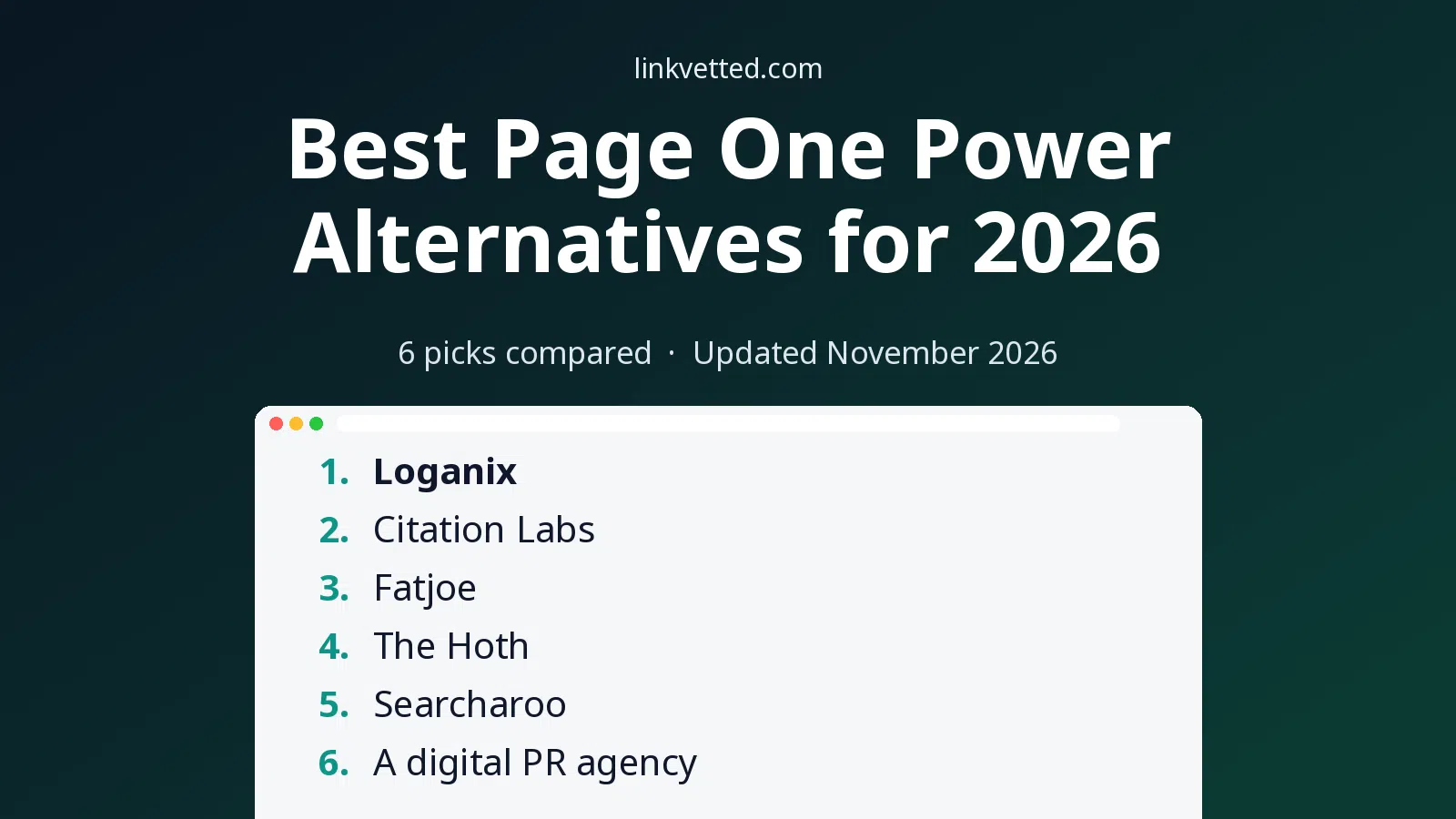
- Editor's choice
 Loganix
Individual link and content orders
Starts atSee websiteVisit loganix.comFull review - Great alternativeCitation Labs
Managed outreach campaigns
Starts atSee websiteVisit citationlabs.comFull review - Also consider
 Fatjoe
Simple, low-budget link orders
Starts atSee websiteVisit fatjoe.comFull review
Direct answer
My first pick is Loganix, because it sells individual link placements and content with a menu you can read before you commit. For ongoing outreach at volume, Citation Labs fits teams that want a managed campaign, while Fatjoe suits smaller budgets and simple orders. People look for Page One Power alternatives because its model is a custom, retainer-style engagement, which does not suit every budget, timeline or in-house workflow.
TL;DR:
- Page One Power alternatives range from self-serve link marketplaces to fully managed outreach campaigns.
- The right pick depends on whether you want to place orders yourself or hand a campaign to a team.
- Always ask how a vendor sources links and whether it discloses the sites it will use.
- A link vendor cannot replace your own content, internal linking and technical work.
- Compare deliverables and reporting, not just headline prices, before you commit.
Last checked November 2026. Plan prices are not quoted in this guide because they change often; see each vendor's own pricing page for current figures before you buy.
Quick comparison
| Tool | Best for | Starts at | Free plan? | |
|---|---|---|---|---|
| Loganix | Individual link and content orders | See website | Not stated | Visit |
| Citation Labs | Managed outreach campaigns | See website | Not stated | Visit |
| Fatjoe | Simple, low-budget link orders | See website | Not stated | Visit |
 The Hoth | Productised SEO packages | See website | Not stated | Visit |
| Searcharoo | Buying individual links directly | See website | Not stated | Visit |
| A digital PR agency | Earned coverage and brand mentions | See website | Not stated | Visit |
The best page one power alternatives compared
I compared these options from vendor documentation and public sources, not from hands-on tests. I looked at what each one sells, how the ordering or campaign process works, and where the limits sit. This is a reading of published material, so treat it as a starting point for your own questions to each vendor.
Loganix sells link building, content writing and related SEO services as separate products. You can order a set number of placements, add content, and combine them as you like. It fits small agencies and in-house teams that already know what they want and prefer to buy pieces rather than a full campaign.
For someone moving away from a custom retainer, the appeal is control. You pick the service, the quantity and the add-ons, then place the order. The workflow is closer to a shop than a consulting engagement, which makes it easier to test a small batch before scaling up.
The limit is that you own the strategy. If you need someone to research competitors, build a target list and run outreach on your behalf, this is not that. Skip it if you want a managed campaign with a named strategist.
- Menu of separate services
- Content and links in one place
- Clear product pages
- You assemble the plan yourself
- Less hand-holding than a retainer
Citation Labs
Best for: Managed outreach campaigns
Citation Labs runs outreach campaigns to earn links and citations, aimed at agencies and teams that want the work handled rather than placing individual orders. The model is a campaign with a brief, not a shopping cart.
If your reason for leaving a retainer is cost rather than the managed approach, this is a middle path. You still get a team running prospecting and outreach, but the engagement is framed around a defined campaign. That suits agencies that want to resell or supplement client work.
The trade-off is that you need to write a clear brief and agree on targets up front. If you want to pick every site yourself, this will feel indirect. Skip it if you prefer full control over each placement.
- Campaign-based outreach
- Built for link acquisition at scale
- Suited to agencies
- Less self-serve
- Needs a clear brief from you
Fatjoe sells link placements and content in simple packages. The ordering process is short, which helps if you want to try a batch without a long sales cycle.
For a first step away from a custom engagement, this keeps things small. You order, you receive, you review the placements. It works for local businesses and small agencies that want a handful of links rather than a full programme.
The limit is flexibility. If you need specific site types, niche edits with particular criteria, or detailed reporting, the simpler packages may not cover it. Skip it if your campaign needs a bespoke target list.
- Straightforward ordering
- Content and links bundled
- Good for small tests
- Less customisation
- Not built for complex campaigns
The Hoth offers link building and other SEO services as packaged products. It is a known name in the space, and the packaging makes it easy to understand what you are buying before you start.
If you are leaving a custom retainer and want something predictable, packages help. You can see the scope, order it, and get a defined deliverable. That suits teams that want less back-and-forth and a repeatable process.
The drawback is that packages rarely fit an unusual brief. If your niche needs specific site types or you want to approve each target, the structure may frustrate you. Skip it if you need a fully custom campaign.
- Established product range
- Links plus other SEO services
- Clear package structure
- Packages can feel rigid
- Less bespoke strategy
Searcharoo
Best for: Buying individual links directly
Searcharoo is a marketplace where you can browse sites and order placements. It puts the choice in your hands, which is useful when you want to see the site before committing.
For teams that want to move away from a managed retainer, this is the most hands-on option. You review the listing, check the site yourself, and order. The workflow is quick, and you can start with one placement to see how it goes.
The downside is that vetting is your job. A marketplace shows you what is listed, not what fits your strategy. Skip it if you want someone else to screen sites and handle outreach.
- Direct placement ordering
- Browse before you buy
- Suits one-off needs
- Smaller catalogue
- You do the vetting
A digital PR agency
Best for: Earned coverage and brand mentions
A digital PR agency works on stories, pitches and coverage rather than selling placements. The output is earned mentions and links that come from editorial interest. This is a different model from a link vendor, and it fits brands that want visibility as well as links.
If your goal is authority and brand recognition, this can complement bought links. The work is slower and needs a story worth pitching, but the coverage tends to sit on sites that would not sell a link.
The limit is commitment. Agencies usually work on retainers, and results depend on having something newsworthy. Skip it if you need a set number of links on a fixed timeline.
- Earned media rather than bought links
- Brand visibility alongside links
- Story-led approach
- Retainer commitment
- Not a quick link order
How I chose
I built this list from vendor documentation and public sources. I read each vendor's own pages to understand what it sells, how ordering or onboarding works, and what it says about reporting. I did not run hands-on tests, so I cannot vouch for placement quality or turnaround from personal use. Where a vendor's public material was thin, I said less rather than guessing.
The second filter was fit. Page One Power is known for a custom, retainer-style approach, so the alternatives here cover the gaps that model leaves: self-serve ordering, small test batches, campaign-based outreach and earned media. I also weighed limits, because a vendor that suits a small agency may not suit a brand with a complex brief. Use this as a shortlist to question each vendor, not as a final verdict.
What to check before you buy
- Ask how the vendor sources sites and whether it will share the list before placement.
- Confirm what reporting you get: URLs, metrics, dates and any follow-up checks.
- Check whether content is included or billed separately, and who writes it.
- Ask about replacement policy if a link is removed or a page changes.
- Confirm the minimum order or contract length before you start.
- Ask how the vendor handles niches with strict editorial rules, such as regulated industries.
FAQ
Why do people look for Page One Power alternatives?
The most common reasons are budget and buying model. Page One Power works on custom engagements, which suits some teams but not those who want to place small orders, test a batch, or run outreach in-house. Others want a different mix of services, such as content plus links, or earned media rather than bought placements.
Are these alternatives cheaper than Page One Power?
I cannot compare prices here because vendors publish different scopes and I do not quote figures. What I can say is that the models differ. Marketplaces and packaged products let you start with a small order, while campaign and agency options usually involve a larger commitment. Ask each vendor for a written scope before comparing.
Can I just buy links and skip content?
You can buy placements on their own from several vendors on this list, but links without content rarely do much. The pages that earn links need to be worth linking to. Most teams get better results by pairing a small link order with improvements to their own pages first.
How many links should I order to start?
There is no universal number, and I would not give one without knowing your site. A sensible approach is a small first batch so you can review quality, check the sites and see how the vendor communicates. Scale only after you are satisfied with the process and the placements.
Do these vendors guarantee rankings?
No reputable vendor should guarantee rankings, and you should be cautious with anyone who does. Links are one input among many, alongside content, technical health and competition. Treat any vendor as a supplier of a service, not a promise of position changes.
Sources
- https://loganix.com
- https://citationlabs.com
- https://fatjoe.com
- https://thehoth.com
- https://searcharoo.com
- https://www.ogilvy.com