The 6 Best Tools for Digital PR Campaign Ideation in 2026, Ranked
A practical guide to the best tools for digital PR campaign ideation in 2026, compared from vendor documentation and public sources by Shihab Mia.
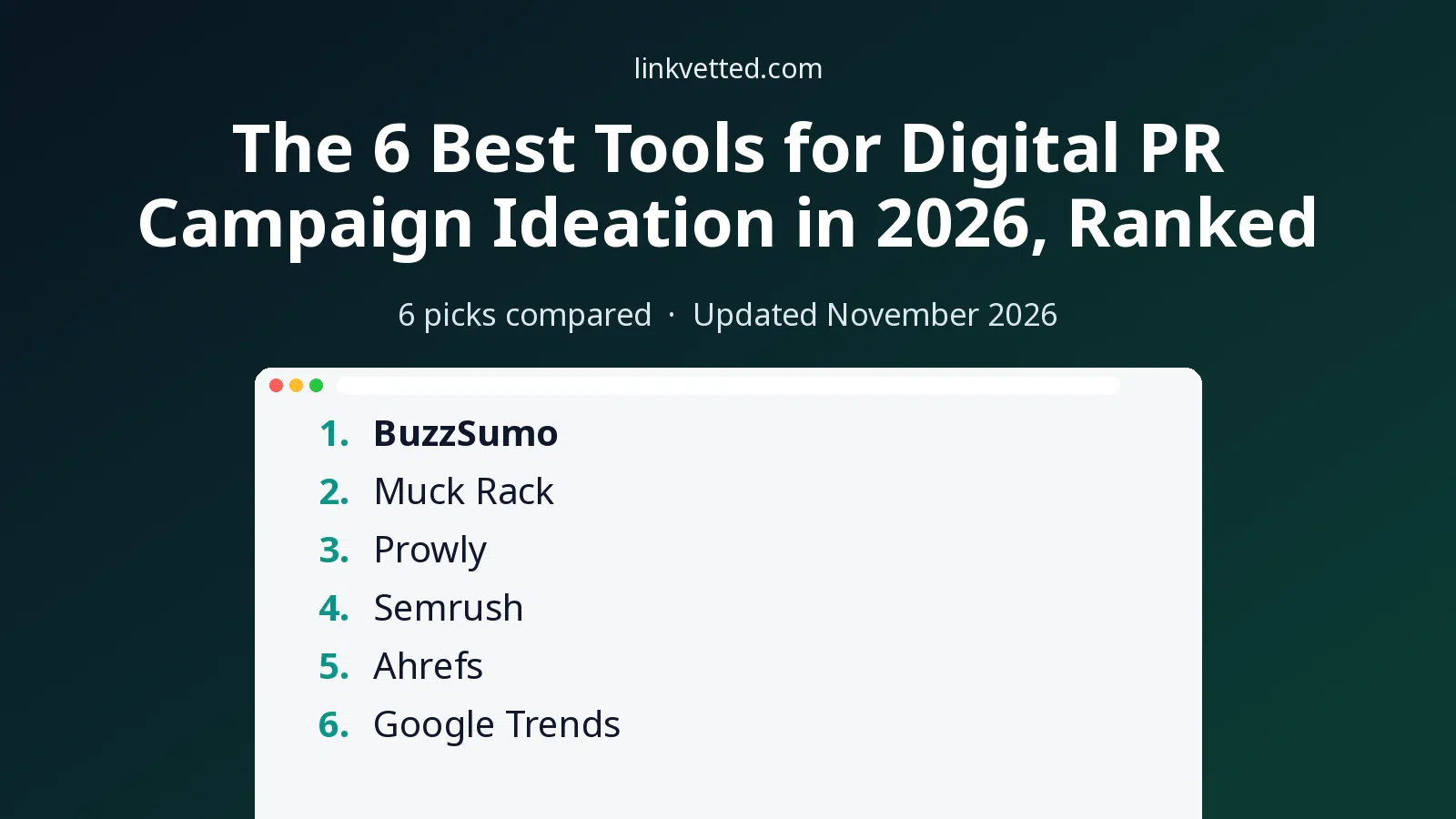
- Editor's choice
 BuzzSumo
Content and trend research for angles
Starts atSee websiteVisit buzzsumo.comFull review - Great alternative
 Muck Rack
Journalist and media context
Starts atSee websiteVisit muckrack.comFull review - Also consider
 Prowly
Campaign workflow from idea to pitch
Starts atSee websiteVisit prowly.comFull review
Direct answer
My top pick for digital PR campaign ideation is BuzzSumo, because its content and trend research gives you a starting point for angles before you write a pitch. For teams that need journalist and media context, Muck Rack and Prowly are the other two I would look at first. Each fits a different part of ideation: finding what people already share, understanding who covers a beat, and organising outreach around a campaign concept.
TL;DR:
- Ideation tools help you find angles and evidence, but they do not replace a clear story or a reason for a journalist to care.
- Content research tools such as BuzzSumo are useful for spotting themes that already get attention, not for copying competitors.
- Media database tools help you check whether a campaign idea fits the journalists and outlets you plan to pitch.
- Most of these products bundle ideation with outreach, monitoring or reporting, so check what you actually need before paying.
- Free plans and trials vary a lot, so confirm current access on each vendor's site rather than relying on older reviews.
Last checked November 2026. Plan prices are not quoted in this guide because they change often; see each vendor's own pricing page for current figures before you buy.
Quick comparison
| Tool | Best for | Starts at | Free plan? | |
|---|---|---|---|---|
| BuzzSumo | Content and trend research for angles | See website | Free trial | Visit |
| Muck Rack | Journalist and media context | See website | Not stated | Visit |
| Prowly | Campaign workflow from idea to pitch | See website | Free trial | Visit |
 Semrush | SEO data to support campaign ideas | See website | Free plan | Visit |
 Ahrefs | Backlink and content gap research | See website | Not stated | Visit |
 Google Trends | Checking demand and seasonality | See website | Free plan | Visit |
The best tools for digital PR campaign ideation compared
I compared these tools from vendor documentation and public sources, not from hands-on tests. I looked at what each product says it does, which parts of ideation it covers, and where the limits sit. The list mixes content research, media databases and broader SEO platforms, because digital PR ideation usually needs more than one kind of input.
BuzzSumo is a content research platform that lets you look at what is being published and shared around a topic. For digital PR ideation, that is useful at the very start: you can see which themes attract attention, which formats appear often, and where a subject may be crowded. It suits SEO and content teams that want evidence before they commit to a campaign concept.
In a workflow, you would use BuzzSumo to map a topic, note recurring angles, and then decide where your campaign can add something different. Its journalist-related features can help you connect an idea to the people who might cover it. That makes it a reasonable first stop when you are moving from a broad subject to a specific pitch.
The limit is that BuzzSumo is not a campaign management tool. If you need full media list management, approvals and reporting in one place, you will likely pair it with something else. Skip it if you already have a research process and only need outreach software.
- Content research and trend views
- journalist and outreach features
- alerts for topics you follow
- Ideation depends on how well you set queries
- not a full PR management suite
Muck Rack is a PR platform centred on a database of journalists and media outlets, with monitoring and reporting features. For ideation, its value is context: before you settle on a campaign angle, you can check which reporters and publications already cover related subjects. That helps you avoid pitching an idea that has no natural home.
The workflow is less about generating ideas and more about testing them. You can build lists around a beat, review recent coverage, and use that to shape a concept that fits a real conversation. For agencies that pitch regularly, that context can save wasted effort on angles that no one is likely to pick up.
Muck Rack is probably more than a small team needs if ideation is the only goal. It also requires a proper setup to be useful. Skip it if you want a lightweight brainstorming tool rather than a media intelligence platform.
- Large journalist and outlet database
- media monitoring features
- useful for checking who covers a beat
- Priced and built for professional PR teams
- ideation is indirect rather than a headline feature
Prowly is a PR software platform that combines a media database, outreach, campaign planning and a newsroom feature. For digital PR ideation, its strength is keeping the idea and the execution together. You can sketch a campaign, attach the media contacts you plan to approach, and keep the story consistent as it moves from concept to pitch.
That matters because many good ideas fail at the handover between research and outreach. Prowly gives you one place to record the angle, the target list and the materials. For small agencies and in-house teams that run several campaigns a year, that structure is often more useful than a separate brainstorming tool.
The drawback is that Prowly makes most sense if you will use its outreach side. If you already have a media list process, you may be paying for features you ignore. Check the current plan details on the site before deciding.
- Media database and outreach in one place
- campaign planning features
- brand newsroom option
- Ideation support is tied to its outreach workflow
- less useful if you only want research
Semrush is a large SEO and marketing platform with keyword research, content tools, competitor analysis and more. For digital PR ideation, it is useful when you want data behind an idea: search demand around a theme, related questions, and gaps in existing coverage. That can turn a vague concept into something with a measurable hook.
In practice, you might use Semrush to find topics with steady interest, then check whether the angle is already well covered. The data helps you argue for one idea over another internally. It does not tell you what journalists will find interesting, so it works best alongside media research.
The main caution is scope. Semrush is a big product and ideation is one use among many. If you only need campaign brainstorming, a narrower tool may be easier to justify. Teams already paying for Semrush can get extra value from it without a new subscription.
- Broad SEO and content toolkit
- keyword and trend data
- competitive research views
- Digital PR ideation is a small part of a large platform
- needs interpretation to become a story
Ahrefs is an SEO platform known for backlink analysis, keyword research and site auditing. For digital PR ideation, its backlink data can show which kinds of content attract links in a niche. That is a practical input: if a format or topic consistently earns references, it is worth considering as a campaign direction, provided you can add something new.
The workflow is research-led. You look at competitor link profiles, find content gaps, and use that to shape a concept. It suits teams that already think in terms of search and links. The output is data, not a story, so you still need to turn it into a pitch.
Ahrefs is not a PR tool and does not offer a media database. Skip it if your ideation is driven by newsroom relationships rather than search and link data. Confirm current plan access on the site, since packaging changes.
- Strong backlink data
- content gap and keyword tools
- useful for finding linkable topics
- No dedicated PR or media database
- ideation requires SEO knowledge
Google Trends is a free tool that shows how interest in a search term changes over time and across regions. For digital PR ideation, it is a quick way to check whether a topic is rising, flat or seasonal. That can help you time a campaign or decide whether an angle has enough public interest to support a pitch.
It is best used as a sanity check rather than a source of ideas on its own. You might compare a few related terms, look at regional differences, and use that to refine a concept. Because it shows relative interest rather than absolute numbers, it needs careful interpretation.
The limits are clear: no media data, no outreach, and no context about why interest changed. Skip it if you need a full research platform. As a free first check before you invest in a bigger tool, it is hard to argue with.
- Free to use
- shows relative interest over time
- useful for seasonal timing
- Limited context
- no media or outreach data
- can be misread without care
How I chose
I built this list from vendor documentation and public sources. I did not run hands-on tests, and I am not claiming benchmark results. Instead, I looked at what each product says it does, which parts of digital PR ideation it covers, and how it fits into a real workflow. That means content research, media context, campaign planning and SEO data all count, because ideation rarely comes from one place.
I also weighed the limits. A tool that is excellent for research but weak on outreach is still useful, as long as you know that going in. I left out products where I could not confirm the official site or where the fit with ideation was too thin. Where a product is broad, I noted that ideation is only one use. The aim is a shortlist you can check yourself, not a ranking based on tests I did not do.
What to check before you buy
- Confirm whether the tool covers research, media context or outreach, and which of those you actually need for ideation.
- Check the current free plan or trial directly on the vendor site, since access and limits change.
- Look at whether the tool exports data or lists, so your research can move into your pitch process.
- Ask whether the product includes journalist or outlet information, or whether you will need a second tool.
- Review how the tool handles saved searches and alerts, because ideation often depends on monitoring over time.
- Check the contract terms and cancellation process before committing, especially for team plans.
FAQ
What is digital PR campaign ideation?
It is the stage where you turn a broad topic into a specific campaign concept and a reason for journalists to cover it. Tools help by showing what already gets attention, who covers the subject, and whether there is data to support the angle. The idea still has to come from you; software mainly provides evidence and context.
Do I need a paid tool to come up with digital PR ideas?
No. Free options such as Google Trends can help you check interest and timing, and many teams start with manual research. Paid tools become useful when you need scale, saved searches, media databases or a shared workflow. Decide based on how often you run campaigns and how much research you can do by hand.
Can SEO tools replace PR software for ideation?
They can support ideation, but they do not replace media context. SEO tools show search demand, content gaps and link patterns. PR software shows journalists, outlets and coverage history. Many teams use both: SEO data to shape the idea, PR tools to check whether it fits the people they will pitch.
How do I judge whether a campaign idea is worth pitching?
Look for a clear story, a reason it matters now, and evidence that the subject already has some public interest. Check whether similar angles have been covered recently and whether your version adds something new. A tool can give you the inputs, but the judgement about newsworthiness is still yours.
Are these tools suitable for a small agency?
Yes, with care. A small agency can start with free or lower-cost research options and add a media database only when outreach volume justifies it. Check plan limits and whether you can cancel. Avoid paying for a large platform if you will only use its ideation features.
Sources
- https://buzzsumo.com
- https://muckrack.com
- https://prowly.com
- https://semrush.com
- https://ahrefs.com
- https://trends.google.com