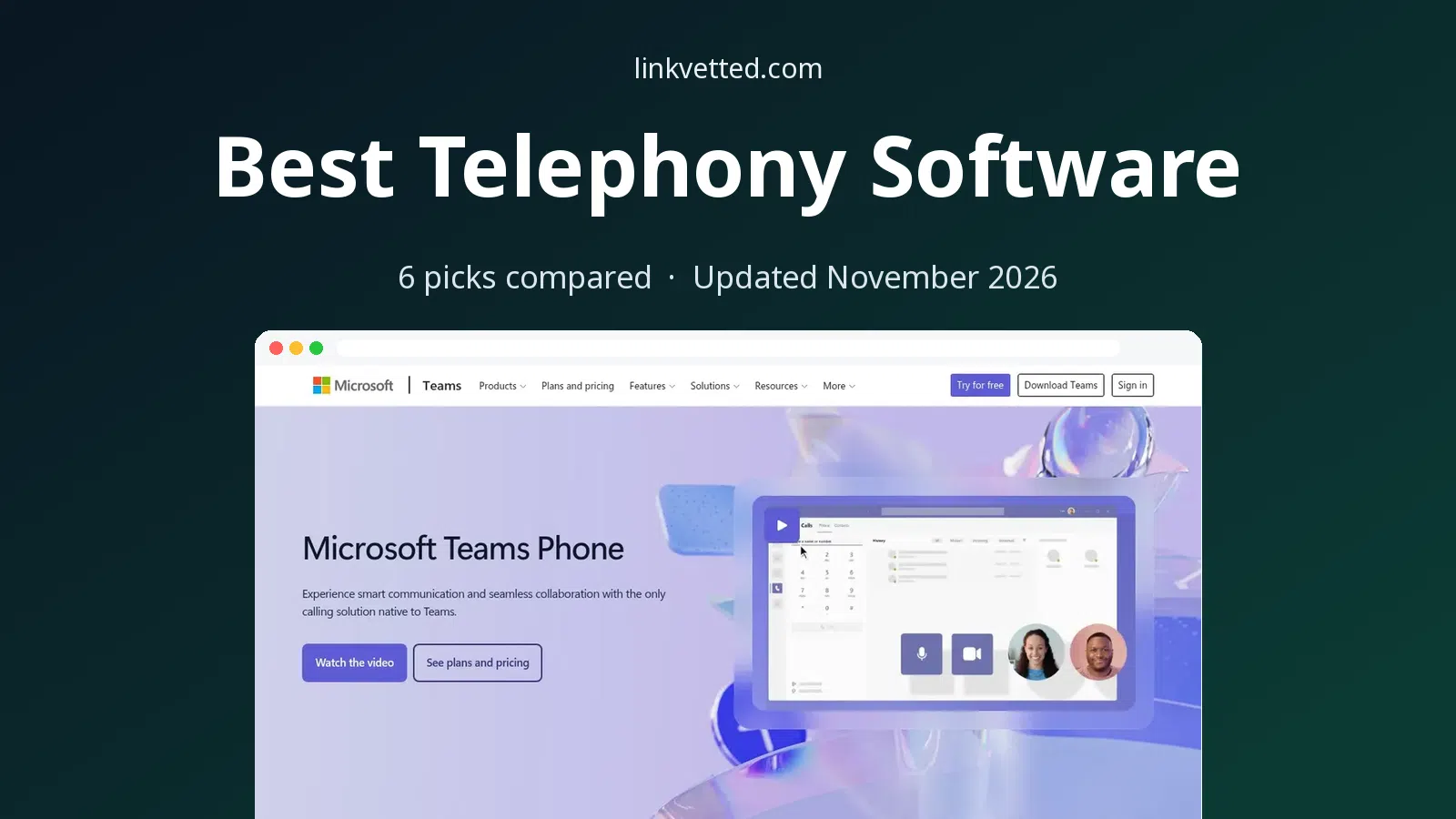
Best Telephony Software (2026): 6 Picks Checked on Vendor Pages
Best telephony software: 6 contenders ranked by fit, with entry costs and free tiers. Strengths and gaps are listed per tool. Last reviewed November 2026.
- Editor's choice
 Microsoft Teams Phone
Cloud calling inside Microsoft Teams
Starts atSee websiteVisit microsoft.comFull review - Great alternative
 Nextiva
Unified customer experience with business phone
Starts at$15 per user per monthVisit nextiva.comFull review - Also considerVonage Business Communications
Unified communications with APIs and contact center
Starts atSee websiteVisit vonage.comFull review
Direct answer
Microsoft Teams Phone comes first here, mainly for cloud calling inside Microsoft Teams. Listed starting prices: Nextiva from $15 per user per month, RingCentral MVP from $52 per month and Dialpad from $15 per user per month. Look at Nextiva for unified customer experience with business phone, and at Vonage Business Communications for unified communications with APIs and contact center. Details, prices and limits for the rest of the 6 tools are below.
TL;DR:
- Microsoft Teams Phone takes the first slot, best suited to cloud calling inside Microsoft Teams.
- For the cheapest start, look at Nextiva: $15 per user per month.
- Twilio comes with a trade-off: needs development work to assemble.
- None of the 6 tools, from Microsoft Teams Phone to Dialpad, has a free plan, so budget for a subscription or use a trial.
Last checked November 2026. Prices and plan details were read from the vendors' own pages in November 2026; vendors change plans often, so confirm the current price on the vendor site before you buy.
Quick comparison
| Tool | Best for | Starts at | Free plan? | |
|---|---|---|---|---|
| Microsoft Teams Phone | Cloud calling inside Microsoft Teams | See website | Not stated | Visit |
| Nextiva | Unified customer experience with business phone | $15 per user per month | No | Visit |
| Vonage Business Communications | Unified communications with APIs and contact center | See website | Not stated | Visit |
 Twilio | Programmable voice and messaging APIs | See website | Free trial | Visit |
| RingCentral MVP | Hosted business phone with AI voice tools | $52 per month | Free trial | Visit |
 Dialpad | AI-driven customer experience and business communications | $15 per user per month | Free trial | Visit |
The best telephony software
Choosing telephony software usually comes down to price, fit and limits. This LinkVetted guide sets 6 tools side by side on those three points, with the facts kept short and checkable.
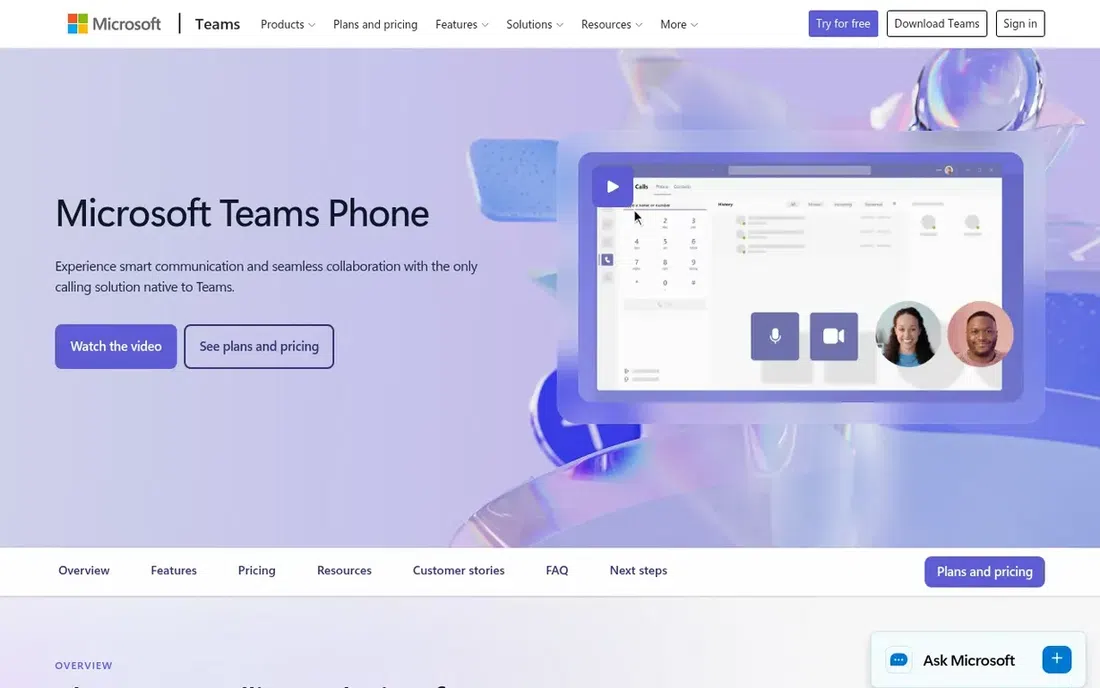
Choose Microsoft Teams Phone for cloud calling inside Microsoft Teams. Microsoft Teams Phone is a cloud-based phone system that lets users make Teams calls and dial external numbers to reach colleagues and customers. IT teams familiar with Microsoft administration will find the model familiar.
For everyday use, evaluate it when consolidating calling into an existing Teams environment. Teams Phone is most compelling inside a Microsoft-centered stack; organizations on other productivity suites may prefer a standalone telephony provider. This comparison lists no price for Microsoft Teams Phone; ask the vendor. As for free access: Not stated.
Limits to weigh: Telephony admin may need Microsoft expertise.
- Cloud-based phone system within Teams
- Supports internal calls and external dialing
- Tied closely to the Microsoft ecosystem
Nextiva makes the most sense for unified customer experience with business phone. Mapping which capabilities matter for your workflows takes some effort.
Where it is weaker: CX breadth may exceed straightforward phone needs.
On cost, Nextiva starts like this: $15 per user per month. There is no free plan with Nextiva.
What Nextiva does well: Business phone.
- Unified CX positioning
- Aims to optimize each customer journey
- Buyers must map features to their workflows
Vonage Business Communications
Best for: Unified communications with APIs and contact center
Vonage Business Communications makes the most sense for unified communications with APIs and contact center. Confirm which components fit your use case on the vendor site.
Best features of Vonage Business Communications: video and data capabilities.
Pricing for Vonage Business Communications is not stated here, so ask the vendor for current figures. Free access: Not stated.
What to check first: Setup varies across the product lines.
- Spans unified communications and contact centers
- Communications APIs for custom builds
- Breadth can complicate product selection
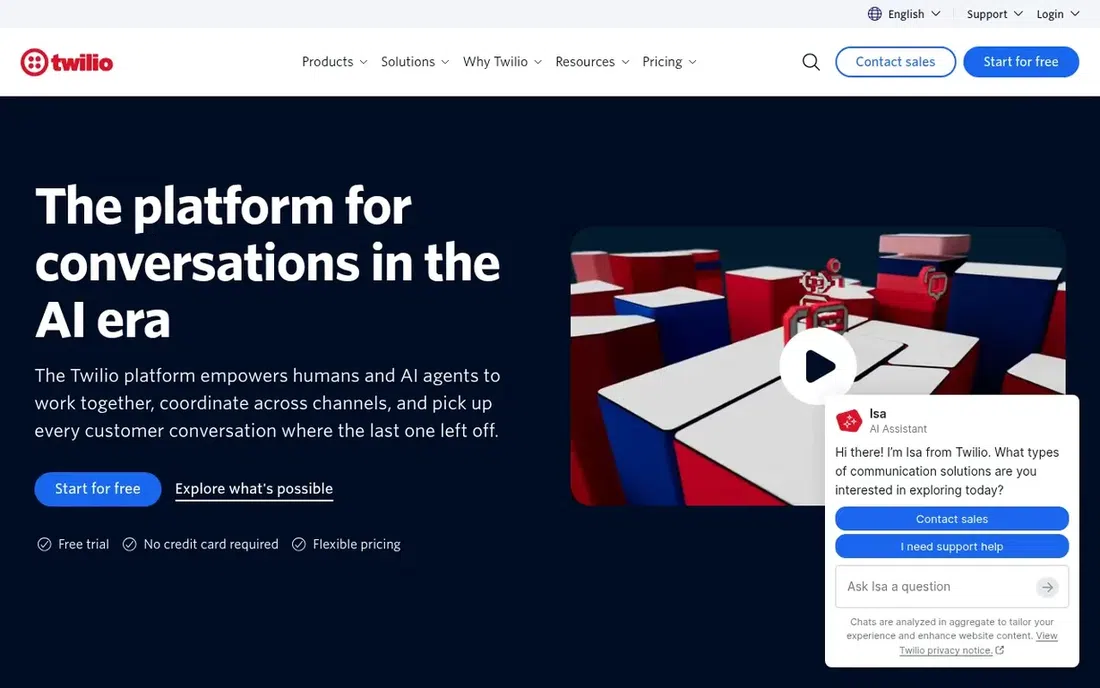
Twilio serves programmable voice and messaging APIs. Since Twilio is API-first, teams without development resources may find it slower to stand up than a packaged hosted phone system.
Also, the system's strength is adaptability: you compose the channels and flows you need. In practice, Twilio is a communications system built around APIs for SMS, RCS, voice and email, with conversational AI and identity verification layered on top. No starting price is listed for Twilio here; confirm pricing on the vendor site. On free options: Free trial.
Honest limits: Needs development work to assemble.
- Conversational AI and identity verification tools
- Email and RCS APIs
- Less of a turnkey phone system
RingCentral MVP
Best for: Hosted business phone with AI voice tools
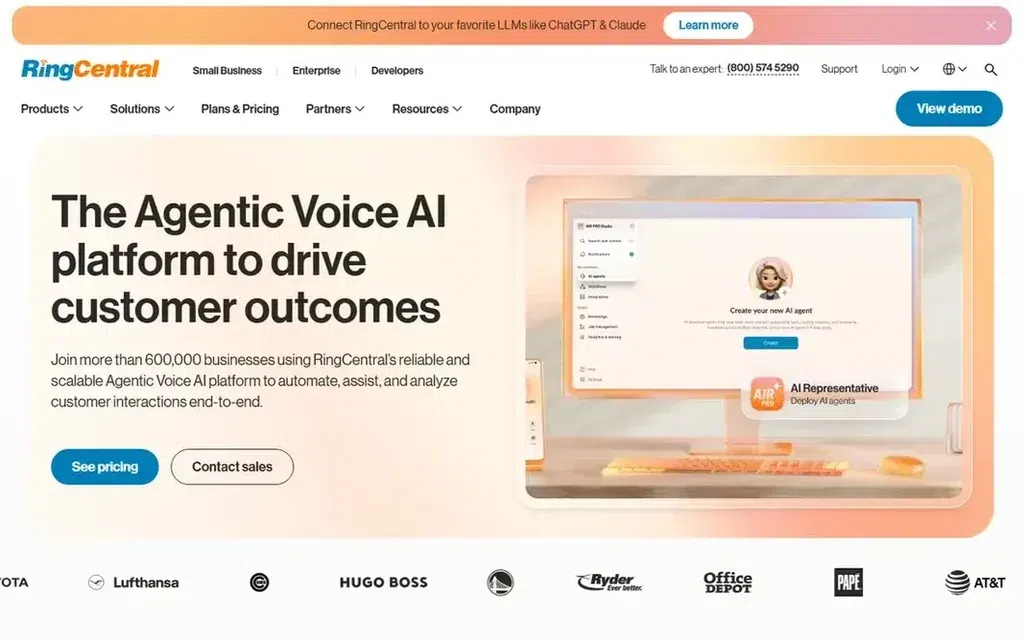
RingCentral MVP targets hosted business phone with AI voice tools. The AI voice features bring setup decisions around call flows and routing that take time to tune. In daily use, RingCentral MVP is a hosted business communications offering centered on voice, promoted with AI Receptionist, AI Virtual Assistant and AI Conversation Expert capabilities.
Downsides: AI features add configuration overhead.
If your organization already standardizes on Microsoft Teams for calls, Teams Phone can be the more natural fit. Smaller teams with straightforward calling needs may pay for capability they will not configure. Entry price for RingCentral MVP: $52 per month. On free options: Free trial.
- Business voice positioned as a core offering
- Suited to teams wanting a managed phone system
- Feature depth may exceed small team needs
Dialpad was built for AI-driven customer experience and business communications. Teams should review how the AI features fit existing workflows before committing. Compare with a straightforward hosted phone system if analytics is not a priority.
Dialpad presents itself as an AI customer experience product that brings AI agents, contact center, sales and business communications together, turning customer conversations into intelligence that drives resolution. Dialpad's emphasis on AI and customer experience means its value relies on how much you use those capabilities. Internal-only phone needs may be served more just elsewhere. The starting price for Dialpad: $15 per user per month. Free access: Free trial.
Where it falls short: AI-centric positioning may not suit every buyer.
- AI agents alongside contact center and sales tools
- Focus on turning conversations into intelligence
- Feature set skews toward customer-facing teams
What went into this list
LinkVetted looked at what each vendor publishes: pricing, plan limits, feature coverage for telephony software and stated drawbacks. No hands-on testing is claimed. Prices and plan limits come from vendor pages and can change, so confirm them on the vendor site before you buy. Order on the page follows fit for the typical buyer first, then price transparency and free access. Your own requirements should decide the final pick.
A buyer's checklist
- Get a written quote from Microsoft Teams Phone, Vonage Business Communications and Twilio; the list shows no starting price for them.
- Run a trial of Twilio, RingCentral MVP and Dialpad with real work before paying for a year; your own workflow is the best test.
- Before choosing Microsoft Teams Phone, weigh its main limit: tied closely to the Microsoft ecosystem.
- Run a one or two week pilot of Microsoft Teams Phone with the people who will use it every day.
- Total up the real monthly cost of Dialpad, including add-ons, extra users and usage-based fees.
FAQ
What is the cheapest option for telephony software in this list?
On published monthly entry prices, Nextiva is the lowest here at $15 per user per month. Entry price is only part of the cost, because seats, add-ons and billing terms can change the total. For the full picture, the cards above cover all 6 entries of this telephony software list, including price, free plan and limits.
Can I try these options before paying?
Often, yes. Twilio, RingCentral MVP and Dialpad offer a free trial. Use your own data and a real task during the test, and check what the free tier or trial limits before you rely on it.
When should a Microsoft-centered organization choose Teams Phone?
Microsoft Teams Phone makes sense when calling should live inside Teams alongside chat and meetings, avoiding a separate application for employees. Organizations outside the Microsoft ecosystem may get more value from a standalone telephony provider instead.
How are the tools for telephony software ordered?
The order follows typical fit for telephony software, with Microsoft Teams Phone first and Dialpad last, then price clarity and free access. It is editorial judgement, not a score, so another team could rank the tools differently.
Do these tools publish their prices?
Not all of them. Microsoft Teams Phone, Vonage Business Communications and Twilio publish no starting price, so expect a quote request for those. The rest, Nextiva included, show a starting price, though seats and billing terms still change the final cost.
How do AI features fit into business telephony?
Vendors for example RingCentral, Dialpad and Nextiva promote AI receptionists, virtual assistants and conversation intelligence as part of their voice offerings. These features generally help with call handling, routing and post-call insight.
Sources
- https://www.microsoft.com/en-us/microsoft-teams/microsoft-teams-phone
- https://www.nextiva.com
- https://www.vonage.com/business
- https://www.twilio.com
- https://www.ringcentral.com
- https://www.dialpad.com