Best TCG Scanner App in 2026: 8 Apps Compared
Looking for the best TCG scanner app? We compared 8 card scanner apps for Pokemon, Magic, Yu-Gi-Oh and Lorcana, with prices, accuracy and buying tips.
- Editor's choice
 Shiny
Fast scanning and wide game coverage
Starts atFreeVisit getshiny.ioFull review - Great alternative
 TCGplayer
Scanning tied to a marketplace
Starts atFreeVisit tcgplayer.comFull review - Also consider
 CollX
Scanning, tracking and trading
Starts atFreeVisit collx.appFull review
TL;DR:
- Shiny is our pick for most collectors, thanks to fast scanning, wide game coverage and free price data from major marketplaces.
- TCGplayer suits buyers and sellers who want a scanner tied directly to a large marketplace.
- CollX is a good all-round choice for collectors who scan, track and trade in one app.
- Ludex suits collectors who manage both trading card games and sports cards in a single collection.
- Scanner prices are market estimates, not appraisals, and they move fast, so check sold listings before you buy, sell or trade.
Quick comparison
| Tool | Best for | Starts at | Free plan? | |
|---|---|---|---|---|
| Shiny | Fast scanning and wide game coverage | Free | Yes | Visit |
| TCGplayer | Scanning tied to a marketplace | Free | Yes | Visit |
| CollX | Scanning, tracking and trading | Free | Yes | Visit |
 Ludex | TCG plus sports cards in one app | Free | Yes | Visit |
 Grailry | Vault-style collection tracking | Free | Yes | Visit |
 CardIQ | AI grading hints and portfolio value | Free | Yes | Visit |
 ManaBox | Magic collection management | Free | Yes | Visit |
 Delver Lens | Fast Magic card scanning | Free | Yes | Visit |
The best TCG scanner apps
A good trading card game scanner does three things: it identifies the card correctly, it shows a useful market price, and it saves the card to a collection you can actually manage. Speed matters when you scan a binder, but accuracy matters more, since a wrong set or condition can change a price by a large amount. We compared official feature pages, pricing pages and app store listings, and we favoured apps with wide game coverage, clear scan limits and honest notes about price sources.
Shiny is our pick for most collectors because it covers the main games in one app and scans quickly. You point your camera at a card, confirm the match, and see market values based on major sources such as TCGplayer and eBay completed sales. Collection tools, folders, wish lists and price alerts make it useful beyond a single scan.
The centring tool helps you check a card before sending it for professional grading, but it is only a guide, not a grade. Prices also vary by region and condition, so treat the shown value as a starting point. For everyday scanning and collection tracking, Shiny gives you the most complete free package here.
- Fast card recognition
- Pokemon, Magic, Yu-Gi-Oh, One Piece and Lorcana coverage
- Price alerts and centring tool
- Some advanced features sit behind a paid tier
- Price data varies by region
- Grading tool is a guide, not a grade
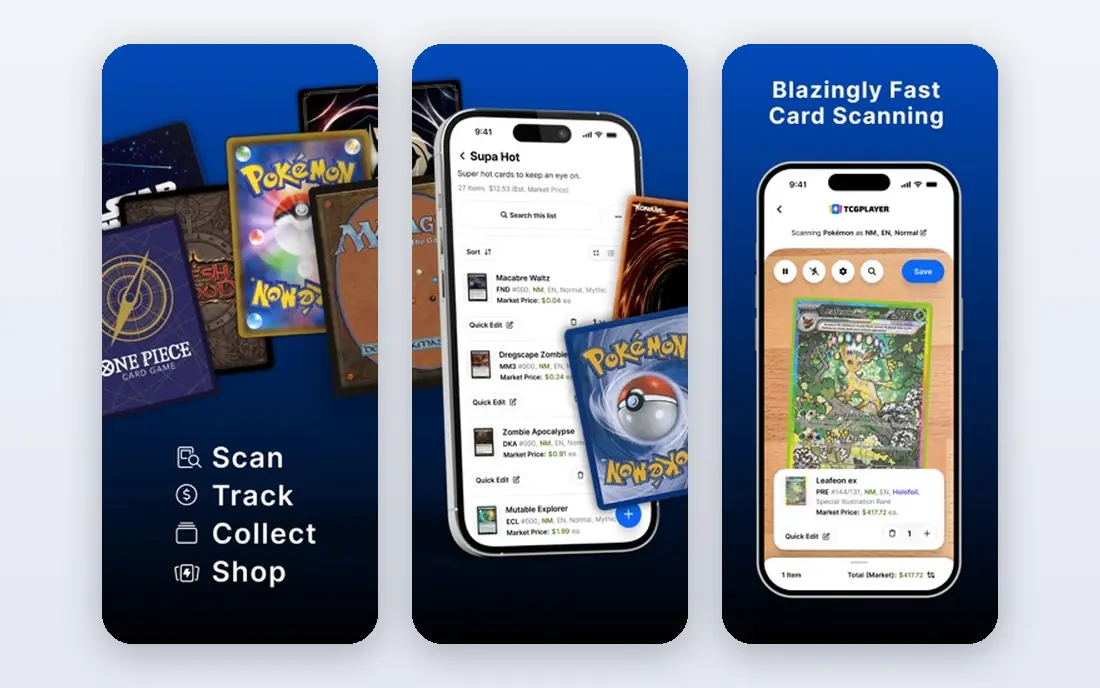
TCGplayer suits collectors who buy and sell, not just track. Its scanner identifies cards and ties them to live marketplace prices, so you can move from a scan to a listing without switching apps. Sales history and market price data help you judge whether a price is fair, rather than relying on a single asking price.
The marketplace focus is also a limit for pure collectors. If you only want a private collection vault, a dedicated tracker may feel cleaner. Marketplace fees also apply when you sell. If your collection feeds a shop or a regular selling habit, TCGplayer is the most practical scanner on this list.
- Scanner linked to a large marketplace
- Market prices and sales history
- Buy and sell in the same system
- Best for US buyers and sellers
- Marketplace fees apply on sales
- App is less focused on pure collection analytics
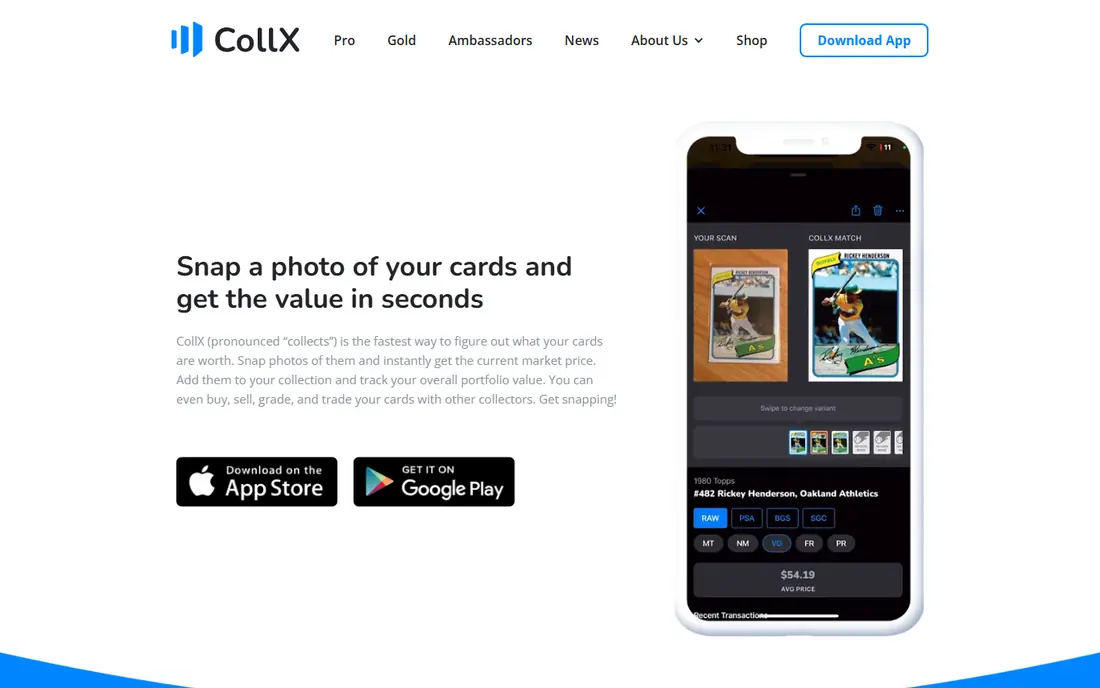
CollX is a good all-round choice for collectors who want scanning, tracking and trading in one place. It covers Pokemon, Magic and other major games, tracks total collection value, and lets you connect with other collectors for trades. That social layer suits hobbyists who enjoy the community side of collecting.
The free tier covers basic scanning, but full features sit behind CollX Pro at 9.99 dollars per month. Lighting and card condition can also affect scan accuracy, so confirm each match before saving. If you trade often and want one app for the whole hobby, CollX is worth trying on its free tier first.
- Fast scanning for major games
- Collection value tracking
- Trading features with other collectors
- Pro subscription at 9.99 dollars per month for full features
- Sports card focus can crowd TCG tools
- Scan accuracy varies with lighting
Ludex suits collectors with mixed binders. It scans trading card games and sports cards in one app, tracks portfolio value, and exports collections to CSV. That breadth is rare, and it saves you from maintaining two separate collections for two hobbies.
Bulk scanners will hit the free tier limits sooner, and Premium at 4.99 dollars per month is needed for unlimited scans. Sports pricing also lacks the grade breakdown some sports collectors want. For a mixed collector who values one vault over perfect sports detail, Ludex is a strong fit.
- Pokemon, Magic, Yu-Gi-Oh and Lorcana plus sports cards
- Portfolio tracking and CSV export
- Community sharing
- Premium at 4.99 dollars per month for unlimited scans
- Free tier scan limits affect bulk users
- Sports pricing lacks some grade detail
Grailry takes a vault approach: scan a card, confirm it, and watch your vault reprice daily. The first 50 scans are free, and free accounts keep full access to their vault afterwards, with extra scans available through in-app gems. That model suits collectors who catalogue a box, then add cards slowly over time.
Heavy bulk scanners will find the ongoing free limit of 5 scans per month restrictive, and full price history sits behind Grailry Plus. As a newer app, its community is smaller than Shiny or CollX. If you want a tidy, private vault with daily values, Grailry is a clean and honest option.
- First 50 scans free, then ongoing free access
- Daily repricing of your vault
- PDF valuation exports on Plus
- Free accounts scan only 5 cards per month after the first 50
- Full price history needs Plus
- Newer app with a smaller community
CardIQ aims at collectors who want grading guidance before they pay for a professional grade. It scans a card, estimates condition, shows market value, and gives a view of total portfolio value and top cards. Coverage spans Pokemon, Magic, Yu-Gi-Oh, One Piece, Lorcana and sports cards, which makes it useful for mixed collections.
Premium pricing is steep, with a weekly option at 4.99 dollars, monthly at 9.99 dollars, and yearly at 49.99 dollars. Grading hints are estimates, so do not treat them as a guaranteed grade. If you send cards for grading often and want a pre-check tool, CardIQ can help you choose which cards are worth the grading fee.
- AI identification and condition hints
- Portfolio value at a glance
- Wide game and sports coverage
- Premium from 9.99 dollars per month
- Grading hints are estimates, not professional grades
- Subscription prompts are frequent
ManaBox is the specialist pick for Magic players. It focuses on Magic: The Gathering collection management, with deck building, card search and price tracking built around that one game. For a Magic player, that focus means better set data, better deck tools, and less clutter from other games.
The single-game focus is the limit. Pokemon, Yu-Gi-Oh and Lorcana collectors need another app, and the interface can feel dense if you only want a quick scan. Paid tiers add extra features, so check what the free version covers. If Magic is your main game, ManaBox is the most tailored choice here.
- Strong Magic: The Gathering focus
- Deck building and collection tools
- Price tracking for Magic cards
- Magic only, so no Pokemon or Lorcana
- Some features need a paid tier
- Interface is dense for casual users
Delver Lens is a fast, focused tool for Magic collectors who sort in bulk. It scans Magic cards quickly, builds a collection list, and exports it for use elsewhere. For a player sorting a draft box or a trade binder, speed is the main benefit, and Delver Lens delivers it.
It is Magic only, and Android users get the fullest experience, so iOS Magic players should check current availability first. Price tracking is also less central than in Shiny or TCGplayer. Use Delver Lens for fast Magic cataloguing, and pair it with a marketplace app when you need a firm price.
- Very fast Magic card scanning
- Collection import and export
- Works well for bulk Magic sorting
- Magic only
- Android focus, with limited iOS options
- Price data is less central than in Shiny or TCGplayer
How we picked these
We compared official feature pages, pricing pages and app store listings for TCG scanner apps still available in the United States in October 2026. We favoured accurate identification, clear price sources, honest scan limits and collection tools that work after the first scan. We left out apps that were no longer maintained, that hid scan limits, or that presented estimates as professional grades.
We did not claim hands-on testing that did not happen. Our comparison rests on published features, pricing and public reviews. Scanner prices are market estimates, not appraisals, and they change with condition, set, language and recent sales. Always confirm a card match, condition and recent sold prices before you buy, sell or trade.
What to look for in a TCG scanner app
Start with game coverage. An app that covers your main game well beats an app that lists many games poorly. Check that it handles your sets, languages and card types, such as reverse holos, promos and graded slabs. Scan a few known cards first, and check that the app picks the right set and number, not just the right name.
Next, check scan limits and price sources. Free tiers often cap scans per day or month, which matters if you scan a whole binder at once. Ask where prices come from, such as TCGplayer market prices or eBay completed sales, and whether the app shows a range or a single number. A range, plus recent sales, is more useful than a single optimistic figure.
Condition, grading and storage
Condition drives value more than any app feature. Learn the basics of centring, corners, edges and surface wear before you trust a price, and use a grading pre-check tool only as a guide. Store valuable cards in sleeves and top loaders, keep them out of sunlight and humidity, and photograph high-value cards before trading or shipping them.
Trading safely
When you trade through an app, use its trade tools and records rather than informal messages alone. Confirm card condition with photos, agree on values before shipping, and use tracked shipping for valuable cards. For in-person trades, meet in a public place and check each card on the spot. A scanner helps you price a trade, but it does not replace basic care with other people and your cards.
FAQ
What is the best TCG scanner app for Pokemon cards?
Shiny is our pick for most Pokemon collectors, thanks to fast scanning, English, Japanese and Chinese support, and price data from major marketplaces. CollX and Ludex are good alternatives if you also collect other games. Scan in good light and confirm the set and number before saving a card.
Can a TCG scanner app tell me the exact value of my card?
No. Scanner apps show market estimates based on recent listings or sales, and the true value depends on condition, set, language, grading and buyer demand. Use the app price as a guide, then check recent sold listings for the same card in the same condition before you set a price.
Are TCG scanner apps free?
Most TCG scanner apps on this list are free to install, with scan limits or paid tiers for unlimited scans and advanced features. Shiny, TCGplayer and CollX all offer useful free tiers. Check the scan limit before a bulk session, so you do not run out halfway through a binder.
What is the best TCG scanner app for Magic: The Gathering?
ManaBox is the best specialist choice for Magic collection management and deck building, while Delver Lens is the fastest for bulk Magic scanning. Shiny and TCGplayer are good general choices if you also collect other games. Pick the specialist app if Magic is your only game.
Do TCG scanner apps work for graded cards?
Many scanner apps show graded slab prices and let you track graded cards, but coverage varies by game and grading company. Check whether your app supports PSA, BGS and CGC slabs for your game. A scanner estimate is still not a grade, and a graded card value depends on the grade shown on the slab.
How accurate are TCG card scanners?
Accuracy is usually good for common cards in good light, with a clear photo and a flat card. Glare, sleeves, bent cards and similar art across sets can cause mistakes, so always confirm the match before saving. If a scan looks wrong, try again in better light or search by name, set and number.