6 SERP Scrapers for Link Building Worth Shortlisting in 2026
A practical guide to the best SERP scrapers for link building in 2026, compared from vendor documentation and public sources, with limits and buying checks.
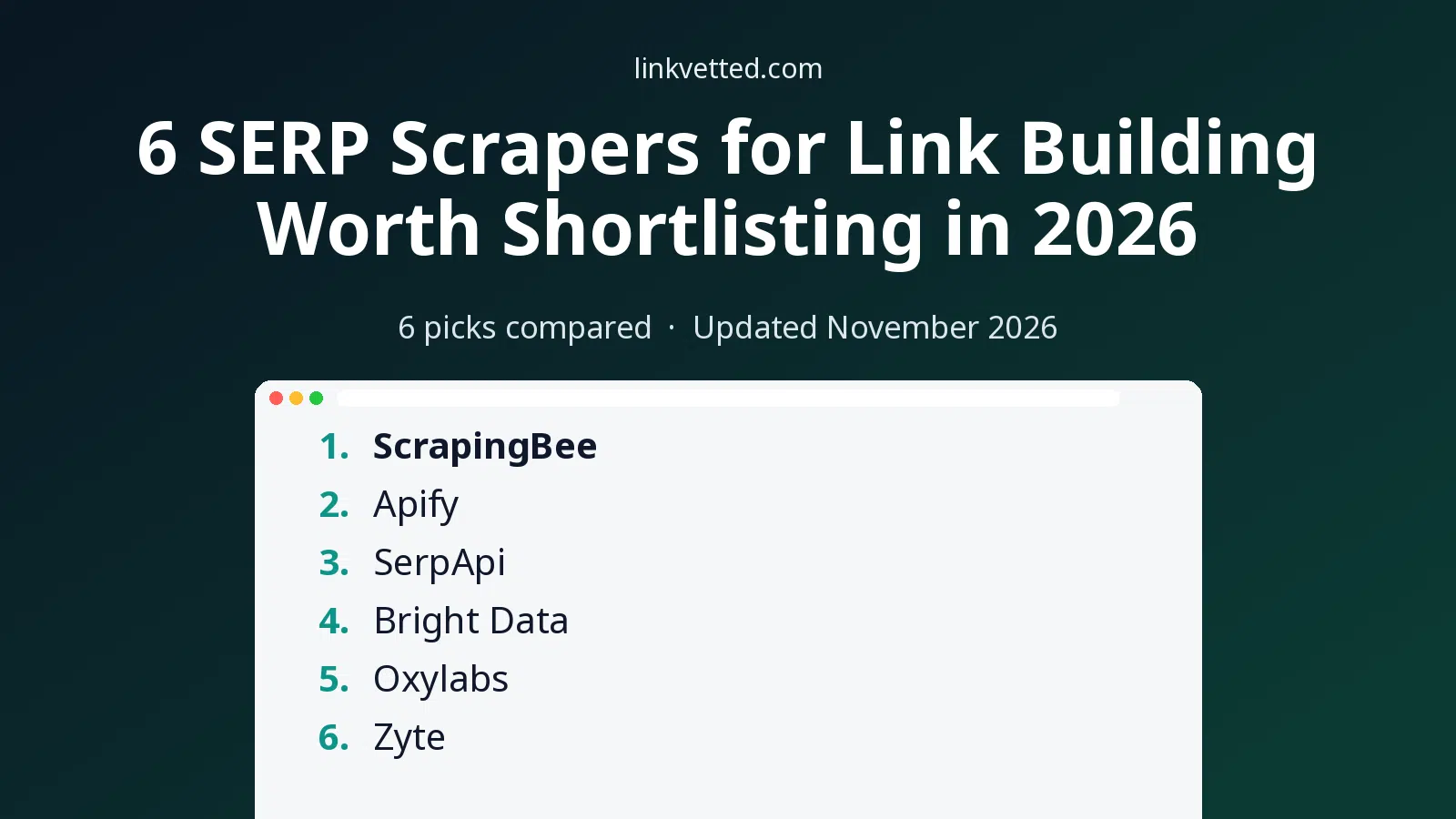
- Editor's choice
 ScrapingBee
Developers building custom prospecting pipelines
Starts atSee websiteVisit scrapingbee.comFull review - Great alternative
 Apify
No-code teams that want ready-made scrapers
Starts atSee websiteVisit apify.comFull review - Also consider
 SerpApi
Clean search data without building a scraper
Starts atSee websiteVisit serpapi.comFull review
Direct answer
My first pick is ScrapingBee, because it handles JavaScript-heavy search pages and proxy rotation through one API, which suits link prospecting at scale. For teams that want a no-code scraper, I point to Apify. For pure search data without building a scraper, I suggest SerpApi. All three are compared from vendor documentation and public sources, not from my own tests.
TL;DR:
- SERP scrapers help you collect search results for prospecting, but they do not replace outreach or editorial judgement.
- JavaScript rendering and proxy handling are the two features that decide whether a scraper works on search pages.
- Managed search APIs cost more per query but save engineering time compared with running your own scraper.
- Check each vendor's terms and the search engine's terms before you scrape at volume.
- A scraper only feeds your workflow; you still need to qualify sites and verify contact details.
Last checked November 2026. Plan prices are not quoted in this guide because they change often; see each vendor's own pricing page for current figures before you buy.
Quick comparison
| Tool | Best for | Starts at | Free plan? | |
|---|---|---|---|---|
| ScrapingBee | Developers building custom prospecting pipelines | See website | Free trial | Visit |
| Apify | No-code teams that want ready-made scrapers | See website | Free plan | Visit |
| SerpApi | Clean search data without building a scraper | See website | Free trial | Visit |
 Bright Data | High-volume, compliance-focused operations | See website | Free trial | Visit |
 Oxylabs | Technical teams needing proxy plus scraping | See website | Free trial | Visit |
 Zyte | Managed extraction with vendor support | See website | Free trial | Visit |
The best SERP scrapers for link building compared
I compared these tools from vendor documentation and public sources. I did not run hands-on tests, so treat this as a starting point for your own trial, not a lab result. The focus is on how each tool fits a link building workflow: finding prospect pages, checking who ranks, and exporting lists you can qualify.
ScrapingBee is a scraping API aimed at developers. You send a URL and it returns the page, with options for JavaScript rendering and proxies. For link building, that means you can pull search result pages for queries like "write for us" or resource pages and parse the results yourself.
In a link building workflow, ScrapingBee fits the prospecting stage. You script queries, collect result pages, extract titles and URLs, then push them into a spreadsheet or CRM for qualification. Because you control the parsing, you can shape output to match your outreach process rather than adapting to a fixed export format.
The limit is that it is a building block, not a finished tool. If nobody on your team writes code, skip it and look at a no-code option instead.
- JavaScript rendering for search pages
- built-in proxy rotation
- simple REST API
- Needs coding knowledge
- you manage your own parsing logic
Apify is a platform for running small scraping programs, which it calls actors. Many actors are published for search engines and general web extraction, so you can start a job without writing code. It suits marketers who want scheduled prospect list refreshes.
For link building, you can run an actor on a set of search queries, schedule it weekly, and export results for review. That keeps a steady flow of new prospect pages without manual searching. You still need to check each site for relevance and whether it accepts contributions.
The main limit is that actors are community-built, so reliability differs. Test any actor on a small query set before you rely on it, and check what data it actually returns.
- Large library of prebuilt actors
- runs in the cloud on a schedule
- exports to common formats
- Quality varies between actors
- costs depend on how often you run jobs
SerpApi is a search data API. Instead of scraping pages yourself, you send a query and get back structured results such as organic listings, related questions and pagination. That removes most of the maintenance work around proxies and page changes.
In link building, this is useful for competitor and prospect research. You can pull who ranks for a target keyword, compare result sets across regions, and build lists of sites that already cover a topic. Structured output means less cleaning before you qualify prospects.
The main limit is cost at volume, since you pay per search. If you need to scrape non-search pages too, a general scraper may cover more ground.
- Returns structured search results
- handles proxies and rendering for you
- supports many search engines
- Priced per search
- less flexible than a general scraper
Bright Data offers proxies, scraping APIs and ready datasets. It is built for organisations that need scale and clear compliance processes, and its documentation covers legal and ethical use in detail.
For link building at agency scale, it can support large prospect pulls and monitoring of search results over time. You can combine proxy access with scraping tools to collect result pages across many queries and regions, then feed them into your qualification process.
Small teams will likely find it more than they need. The setup and commercial terms suit bigger operations with technical staff.
- Large proxy network
- scraping APIs and datasets
- documented compliance controls
- Aimed at larger operations
- setup takes time
Oxylabs provides proxy services and scraping APIs, including options for search engine results. It is aimed at teams that need reliable access at volume and are comfortable with technical configuration.
For link building, it fits agencies that run frequent prospect searches and want the collection step handled by an API. You can request result pages for many queries, then parse and qualify the output in your own system.
If you only need a few hundred results a month, this is more infrastructure than you need. It rewards teams with engineering support.
- Proxy network and scraper APIs in one place
- documented search engine scraping
- support for structured output
- Overkill for small projects
- requires technical setup
Zyte offers a managed scraping API and related data extraction services. It is designed for teams that want the collection layer handled and prefer a vendor relationship over running their own infrastructure.
In a link building context, Zyte can collect search result pages and other prospect sources on a schedule, leaving your team to focus on qualification and outreach. The managed approach reduces maintenance work when pages change.
It is not the cheapest route for occasional jobs, and smaller teams may prefer a simpler tool. It makes more sense when scraping is a recurring part of your process.
- Managed scraping API
- documented extraction features
- support options for teams
- Less suited to quick one-off jobs
- pricing suits ongoing use
How I chose
I built this list from vendor documentation and public sources. I read each vendor's product pages, API docs and help content to understand what the tool does, how it handles JavaScript and proxies, and what limits it states. I did not run hands-on tests, so I am describing documented capabilities rather than measured performance.
I then judged each tool on fit for link building work: collecting search results, exporting lists, and supporting a qualification step. I also weighed stated limits, such as coding requirements, per-search pricing and setup effort. Where a tool is aimed at larger operations, I say so rather than presenting it as a default choice.
This is a starting point. Trial the shortlist against your own queries and check terms of use before you commit.
What to check before you buy
- Confirm the tool can render JavaScript, since search result pages often depend on it.
- Check how proxies are handled and whether the vendor documents rotation and blocking.
- Read the vendor's terms and the search engine's terms on automated access before you scrape at volume.
- Test output format: can you export structured fields you can qualify, not just raw HTML?
- Ask how pricing scales with volume, and whether failed requests are billed.
- Confirm data handling and storage terms if you collect contact or site data.
FAQ
What is a SERP scraper used for in link building?
It collects search result pages for queries you care about, such as resource pages or guest post terms. You then qualify the sites and decide who to contact. The scraper handles collection; outreach and editorial checks stay with your team.
Do I need coding skills to use these tools?
It depends on the tool. ScrapingBee and Oxylabs expect some technical setup, while Apify offers prebuilt actors you can run without code. SerpApi returns structured data through an API, which usually needs a developer to integrate.
Is scraping search results allowed?
Rules vary. Search engines set terms on automated access, and vendors publish their own usage policies. Check both before you scrape, keep volume reasonable, and avoid collecting personal data you do not need.
Can a SERP scraper replace my outreach process?
No. It only gathers prospect pages. You still need to check relevance, verify contact details and write outreach. A scraper saves collection time but does not judge whether a link opportunity is worth pursuing.
Which tool is best for a small agency?
For a small agency without developers, Apify is the easier start because of its prebuilt actors. If you have technical support, ScrapingBee gives more control over parsing and output. Trial both on a small query set first.
Sources
- https://www.scrapingbee.com
- https://apify.com
- https://serpapi.com
- https://brightdata.com
- https://oxylabs.io
- https://www.zyte.com