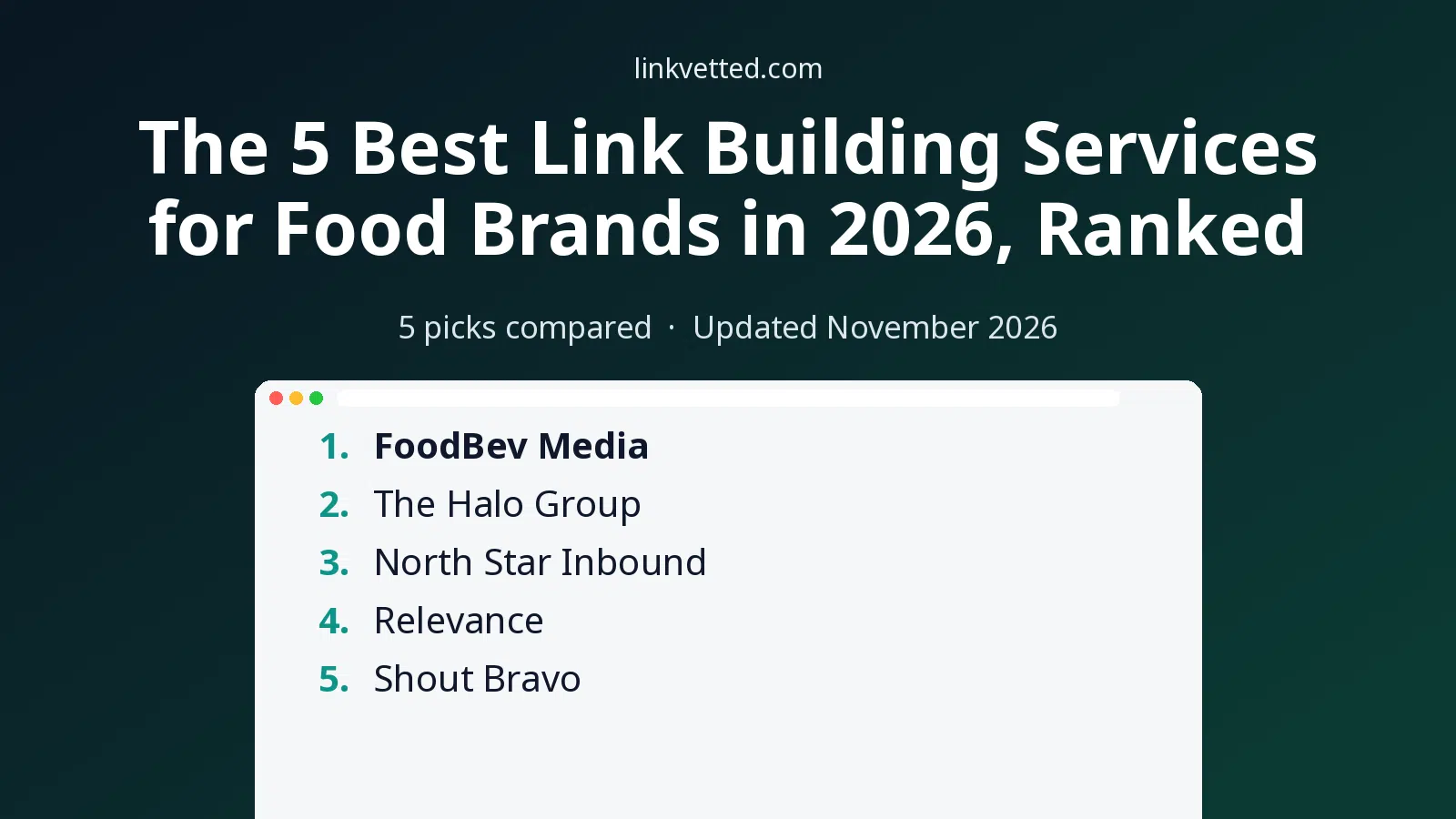
The 5 Best Link Building Services for Food Brands in 2026, Ranked
A practical guide to the best link building services for food brands in 2026, compared from vendor documentation and public sources.
- Editor's choiceFoodBev Media
Food and drink trade news coverage
Starts atSee websiteVisit foodbev.comFull review - Great alternativeThe Halo Group
Consumer and lifestyle digital PR
Starts atSee websiteVisit thehalogroup.netFull review - Also considerNorth Star Inbound
Done-for-you outreach and link building
Starts atSee websiteVisit northstarinbound.comFull review
Direct answer
My first pick is FoodBev Media, because it is a food and drink trade publisher whose editorial team covers brand news and product launches, which fits how food brands actually earn coverage. For digital PR with a wider lifestyle and consumer press reach, I would look at The Halo Group. For a smaller brand that needs help with outreach planning and execution rather than pure PR, North Star Inbound is a sensible third option.
TL;DR:
- Food brands earn links mostly through product news, launches, retail expansion and expert commentary, so pick a provider that understands trade and consumer food media.
- A trade publisher like FoodBev Media gives you editorial context but usually works as a news and advertising relationship, not a link vendor.
- Digital PR agencies are better when you want coverage in national, lifestyle and grocery press rather than trade-only mentions.
- Ask every provider how they handle nofollow links, sponsored labels and disclosure, because food and drink coverage often carries commercial relationships.
- Budget for content and assets, not just outreach, since food journalists need product samples, images, data or a clear story to work with.
Last checked November 2026. Plan prices are not quoted in this guide because they change often; see each vendor's own pricing page for current figures before you buy.
Quick comparison
| Tool | Best for | Starts at | Free plan? | |
|---|---|---|---|---|
| FoodBev Media | Food and drink trade news coverage | See website | Not stated | Visit |
| The Halo Group | Consumer and lifestyle digital PR | See website | Not stated | Visit |
| North Star Inbound | Done-for-you outreach and link building | See website | Not stated | Visit |
| Relevance | Digital PR for established brands | See website | Not stated | Visit |
| Shout Bravo | Creative digital PR campaigns | See website | Not stated | Visit |
The best link building services for food brands compared
I put this list together by reading vendor websites, service pages and public material about how each provider works. I did not run hands-on tests, did not buy their services and did not ask for client references. The comparison is about fit for food brands, what each provider says it does and where the limits are.
FoodBev Media
Best for: Food and drink trade news coverage
FoodBev Media is a trade publisher covering the food and beverage industry, with news, analysis and awards across categories like dairy, bakery, plant-based and drinks. For a food brand, it is the kind of outlet where a genuine product launch, factory investment or category report can become an article. That article is the link opportunity, not a bought placement.
In practice, you work with the editorial or commercial team, send a clear news angle, and supply images, quotes and product details. If the story fits, you get a mention on a site that food industry people read. That is useful for both referral traffic and relevance, even though trade coverage rarely produces the kind of consumer-facing link that moves a brand's main category pages.
The limit is obvious: this is a publisher, not an outreach agency. If you have no news, no new product and no data, there is little to pitch. Skip it if you want someone to run a link campaign for you.
- Deep food and drink trade audience
- publishes daily industry news
- covers launches, packaging and retail
- Not a link building service
- coverage depends on newsworthiness
The Halo Group
Best for: Consumer and lifestyle digital PR
The Halo Group is a London-based PR and digital PR agency that works with consumer brands, including food and drink clients. It focuses on earned media, campaign ideas and coverage in national, lifestyle and trade outlets. For a food brand that wants links from publications shoppers actually read, that is a closer fit than a pure SEO vendor.
The workflow usually starts with a campaign concept, then assets such as survey data, seasonal angles or product-led stories, then outreach to journalists. Links come as part of coverage, which means they are often editorial and sometimes nofollow. You should ask upfront how the agency reports on link value versus coverage volume.
The drawback is cost and fit. Retainers are not small, and a small producer with one product line may not have enough story material to sustain a campaign calendar. Skip it if you need a one-off placement rather than an ongoing PR programme.
- Consumer lifestyle press relationships
- campaign-led approach
- works across food and drink categories
- Retainer model
- results depend on campaign quality
North Star Inbound
Best for: Done-for-you outreach and link building
North Star Inbound is a link building and digital PR agency that runs outreach campaigns for clients across sectors. It publishes detail about its process, including prospecting, content creation and outreach, which makes it easier to judge fit before you enquire. For a food brand that wants someone else to handle the pitching, it is a reasonable option to shortlist.
For food specifically, the value is in the outreach engine rather than a ready-made list of food journalists. You would need to brief them on your category, your spokespeople and the assets you can supply, such as product samples, nutrition data or seasonal recipes. The agency then builds angles and pitches.
The limitation is category depth. If your brand lives or dies on coverage in grocery trade titles, a generalist agency may need time to learn the media landscape. Skip it if you want a food-only specialist.
- Outreach-focused service
- content and link strategy combined
- transparent process pages
- Not food-specific
- smaller agency capacity
Relevance
Best for: Digital PR for established brands
Relevance is a digital PR agency that builds campaigns around data, creative assets and media outreach. It is the kind of provider a food brand might use for a larger seasonal campaign, such as a study on shopping habits or a survey on home cooking, where the story is the linkable asset and coverage follows.
The workflow is campaign-based: research, asset production, outreach and reporting. That suits brands with a marketing budget and an internal team that can approve claims and supply data. It is less suited to a producer who just wants a handful of recipe blog mentions.
The main limit is scale and cost. This is not a low-volume placement service, and the work depends on having a story worth pitching. Skip it if you cannot commit to a campaign cycle.
- Digital PR and content focus
- campaign reporting
- works with larger consumer brands
- Premium pricing
- less suited to very small brands
Shout Bravo
Best for: Creative digital PR campaigns
Shout Bravo is a digital PR agency that creates campaigns for consumer brands and pitches them to journalists. Its model is built around ideas that travel, which can work well for food brands with a distinctive product, a founder story or a strong seasonal hook.
For a food brand, the useful part is the creative input. Many food businesses have good products but weak stories, and an agency that can turn a product into a survey, a ranking or a seasonal angle gives journalists a reason to write. Links then come from the coverage.
The limit is that campaign creativity is hard to judge before you buy, and generalist agencies may not know which grocery and trade titles matter to you. Skip it if you want pure link prospecting rather than campaign work.
- Campaign ideation
- consumer media outreach
- reporting on coverage
- Generalist client mix
- not food-only
How I chose
I started from the question a food brand actually asks: who can get us mentioned in places that matter to food shoppers and food trade buyers? That ruled out generalist link vendors with no food media knowledge and ruled in trade publishers, food PR specialists and digital PR agencies that publicly list food and drink work. I read service pages, about pages and public descriptions of how each provider works, and I checked that each site was live and described an operating service.
I then weighed fit, not size. A trade publisher is useful for news but is not an outreach service. A digital PR agency is useful for consumer coverage but may not know grocery trade titles. A specialist food PR firm knows the sector but may have limited capacity. I have not claimed any results, rankings or client outcomes, because I did not test these providers and cannot verify performance claims. Treat this as a shortlist to research, not a scorecard.
What to check before you buy
- Ask whether the provider has actually placed coverage in food, grocery or hospitality titles you recognise, and ask for examples you can open yourself.
- Clarify how links are labelled: editorial, nofollow, sponsored or affiliate. Food coverage often sits alongside commercial relationships.
- Check whether product samples, photography and nutritional or sourcing claims are your responsibility or theirs.
- Ask how they handle seasonal calendars, since food coverage peaks around Christmas, summer and specific category moments.
- Confirm what reporting you get: coverage volume, link URLs, referral traffic or just clippings.
- Make sure any claims about your products, health benefits or sourcing can be substantiated before a journalist repeats them.
FAQ
Do food brands need a specialist link building service?
Not always, but specialism helps. Food coverage depends on trade titles, grocery press, recipe sites and consumer food desks, and a provider that already knows those outlets spends less time learning your market. A generalist digital PR agency can still work if you supply strong assets and a clear brief.
Are trade publication links worth it for a food brand?
They can be. Trade links rarely sit on high-traffic consumer pages, but they reach buyers, distributors and journalists who shape category coverage. For a brand selling into retail or food service, a mention in a trade title can matter more than a lifestyle listicle.
How do food brands earn links without a big budget?
Product news, founder stories, seasonal recipes, sourcing details and simple data studies are all pitchable. The cheapest route is usually to give journalists something concrete: good images, a clear claim you can support, and a reason the story matters now. A small specialist agency can help shape that into a pitch.
Should I pay for sponsored placements in food media?
Sometimes, but treat them as advertising, not earned links. Sponsored content should be labelled, and you should not expect it to carry the same weight as editorial coverage. Ask how the placement is marked and whether it will be indexed or nofollow.
How long does food PR take to produce links?
It depends on the campaign and the news cycle. Product launches and seasonal pitches can move quickly if the timing is right, while data-led campaigns take longer to build. Ask any provider for a realistic timeline and how they report progress before you commit.
Sources
- https://www.foodbev.com
- https://thehalogroup.net
- https://www.northstarinbound.com
- https://www.relevance.com
- https://www.shoutbravo.com
Related guides
- Choosing Link Building Services for Agriculture Brands in 2026: 6 Options Compared
- 6 Best Link Building Services for Fitness Brands for 2026, Vetted and Compared
- Best Link Building Services for Jewelry Brands for 2026: Our 6 Vetted Picks
- 6 Link Building Services for Pet Brands Worth Shortlisting in 2026