Best Influencer Outreach Tools for 2026: Our 6 Vetted Picks
A practical guide to the best influencer outreach tools in 2026, compared from vendor documentation and public sources to help you pick the right fit.
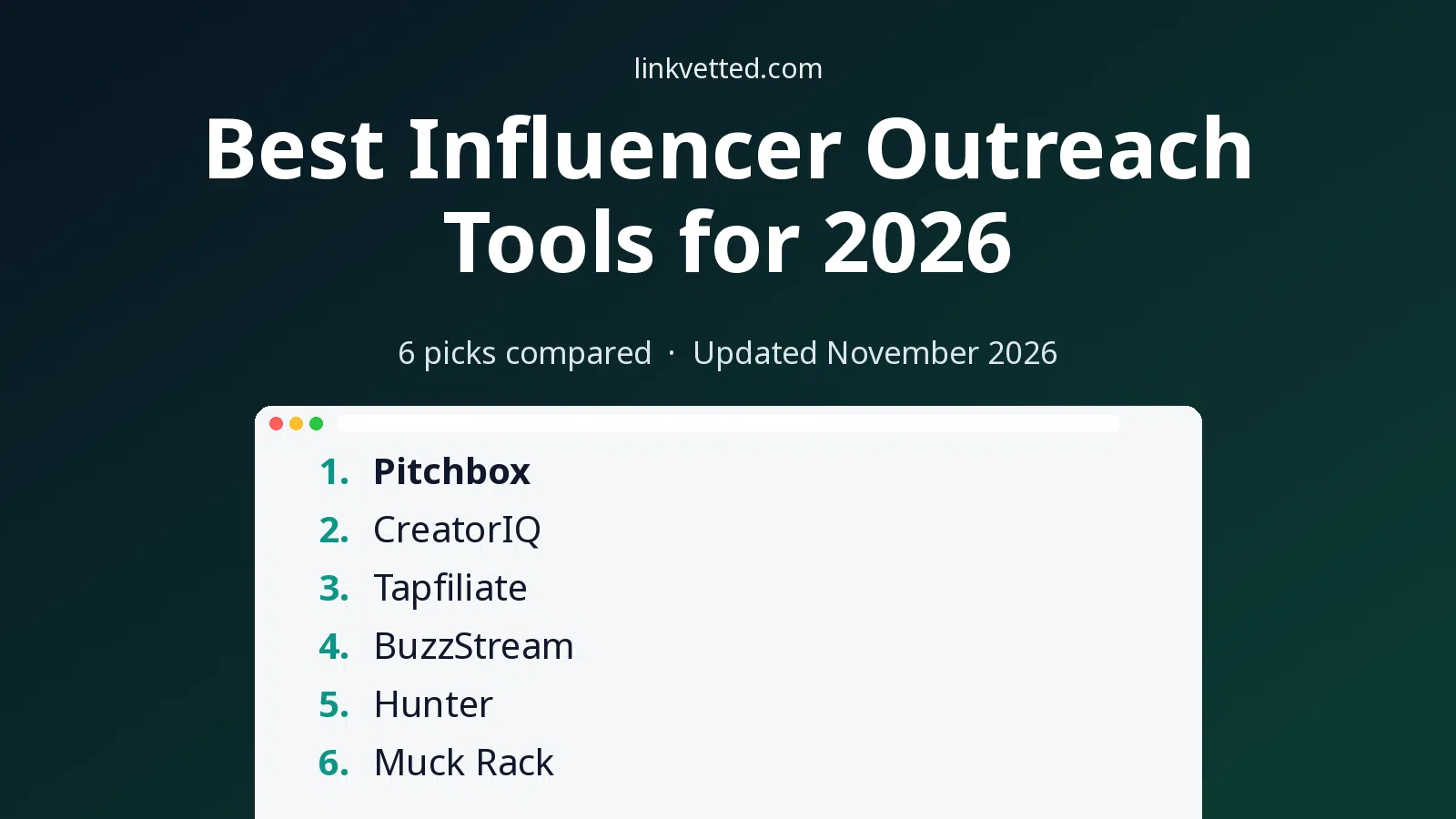
- Editor's choice
 Pitchbox
Outreach prospecting and email sequencing
Starts atSee websiteVisit pitchbox.comFull review - Great alternative
 CreatorIQ
Creator discovery and campaign management
Starts atSee websiteVisit creatoriq.comFull review - Also consider
 Tapfiliate
Affiliate and creator relationship tracking
Starts atSee websiteVisit tapfiliate.comFull review
Direct answer
My top pick is Pitchbox, because it covers prospect discovery, contact management and email sequencing in one place and is built for outreach teams rather than social listening. For teams that need a large creator database with built-in discovery, I suggest CreatorIQ. For affiliate and creator relationship tracking with a lighter setup, Tapfiliate is worth a look. The right choice depends on whether you need prospecting, outreach sending, or relationship management most.
TL;DR:
- Influencer outreach tools split into three groups: prospecting and email tools, creator databases, and relationship or affiliate platforms, so decide which job you need done first.
- A tool that finds contacts is not the same as one that sends and tracks sequences, and many teams end up pairing two products.
- Check how each tool handles contact data, unsubscribe rules and GDPR before you import a list.
- Integration with your CRM or spreadsheet matters more than a long feature list for small teams.
- Vendor documentation changes often, so confirm current features and limits directly before you commit.
Last checked November 2026. Plan prices are not quoted in this guide because they change often; see each vendor's own pricing page for current figures before you buy.
Quick comparison
| Tool | Best for | Starts at | Free plan? | |
|---|---|---|---|---|
| Pitchbox | Outreach prospecting and email sequencing | See website | Not stated | Visit |
| CreatorIQ | Creator discovery and campaign management | See website | Not stated | Visit |
| Tapfiliate | Affiliate and creator relationship tracking | See website | Free trial | Visit |
 BuzzStream | Link and influencer outreach CRM | See website | Free trial | Visit |
 Hunter | Finding and verifying email addresses | See website | Free plan | Visit |
 Muck Rack | PR and journalist outreach | See website | Not stated | Visit |
The best influencer outreach tools compared
I compared these tools from vendor documentation and public sources, not from hands-on tests. I looked at what each product says it does, who it is built for, and where the limits sit. That means my notes reflect published features and positioning rather than my own trial runs, so treat them as a starting point for your own evaluation.
Pitchbox is an outreach platform that brings prospect discovery, contact management and email campaigns into one workflow. It fits agencies and in-house teams running repeat influencer or blogger campaigns where you need to find people, store their details and send tracked emails from a single place. It is closer to a campaign tool than a social network.
For influencer outreach, the useful part is the sequence builder and the ability to keep prospects organised by campaign. You can search for relevant creators, save them to a list, and run follow-ups on a schedule. Reporting on opens and replies helps you see which segments respond, which is the kind of feedback you need to refine a creator list over time.
The main limit is scale and budget. It is built for teams running many campaigns, so a single person doing occasional outreach may find it more than they need. Skip it if you only send a handful of emails a month and already have a contact list.
- Combines prospect search with email sequences
- built for outreach teams
- supports campaign reporting
- Not aimed at solo users
- pricing needs a sales conversation
CreatorIQ is a creator marketing platform aimed at brands and agencies that manage ongoing influencer programmes. It centres on discovering creators, organising them, and running campaigns with reporting. If your outreach is about building a roster of creators you work with repeatedly rather than one-off emails, this is the type of product to look at.
The platform helps by giving you a structured place to store creator profiles, campaign history and performance notes. That matters when you are coordinating several people across a programme and need a shared view. Outreach and relationship tracking sit alongside discovery, so the workflow stays in one system rather than across spreadsheets.
The drawback is fit. It is designed for larger brand programmes, so small teams or those doing mostly link-focused outreach may find it heavy. Skip it if you need a simple email sequencer rather than a creator management system.
- Large creator discovery focus
- campaign and relationship management
- built for brand teams
- Enterprise positioning
- not a general link outreach tool
Tapfiliate is an affiliate and partner marketing platform. It fits teams that work with creators on a referral or commission basis and need to track who sent what. If your influencer outreach leads to tracked links and partner payouts, this handles the relationship and reporting side rather than the initial prospecting.
For outreach, its value is in the follow-through. Once a creator agrees to work with you, Tapfiliate gives you a place to manage the partnership, track referrals and see which creators actually drive activity. That closes the loop between outreach and results, which is often where spreadsheet-based programmes fall down.
The limit is that it does not find creators for you. It assumes you already have partners to onboard. Skip it if you need discovery or cold email sequencing, and look at a prospecting tool instead.
- Tracks affiliate and creator referrals
- clear partner management
- integrates with common platforms
- Affiliate-first, not a discovery tool
- limited for pure PR outreach
BuzzStream is an outreach CRM used widely by SEO and content teams for link building and blogger outreach. It fits people who run relationship-based campaigns and want to track contacts, conversations and follow-ups in a structured way. It sits between a spreadsheet and a full marketing platform.
For influencer outreach, it helps you build prospect lists, record contact details and manage email conversations with reminders. Because it is built around relationships rather than one-off sends, it suits campaigns where you expect to contact the same creators again. That makes it a reasonable fit for teams already doing link outreach who want to extend into creator work.
The main limit is that it is not a creator database and its interface is not the most modern. Skip it if you need large-scale discovery or a polished social-style experience, and treat it as a workflow tool for people you have already identified.
- Built around outreach relationship tracking
- supports list building and sequences
- familiar to SEO teams
- Interface can feel dated
- not a creator discovery database
Hunter is an email finding and verification tool. It fits anyone who has identified creators or sites but needs a reliable way to find and check contact addresses. It is a supporting tool rather than a full outreach platform, and many teams use it alongside a CRM or sequencer.
In an influencer workflow, Hunter helps at the list-building stage. You can look up addresses for a domain, verify them before sending, and reduce the number of emails that bounce. That keeps your sender reputation cleaner and means your outreach tool is working with better data rather than guessing at contacts.
The limit is scope. It does not manage campaigns, track replies or store relationships. Skip it if you expect one tool to run the whole outreach process, and use it as a companion to a CRM or sequencer.
- Straightforward email finding
- verification to reduce bounces
- works alongside other tools
- Contact finding only
- no campaign management
Muck Rack is a media relations platform used by PR teams to find journalists, manage outreach and track coverage. It fits campaigns where influencer outreach overlaps with press and media work, such as launches where you want both creators and publications involved.
For outreach, it gives you a database of media contacts, a way to manage pitches and a record of coverage. If your influencer programme sits inside a wider PR effort, keeping both in one system avoids duplicating contact lists. That is its main advantage over creator-only tools.
The limit is that it is built for media relations, not creator marketing. It will not give you the creator discovery or affiliate tracking that dedicated platforms offer. Skip it if your outreach is purely creator-focused, and consider it only when press and creators are managed together.
- Media database and monitoring
- useful for PR-led campaigns
- supports coverage tracking
- Media relations focus, not creator marketing
- pricing needs a conversation
How I chose
I picked these tools by reading vendor documentation and public sources, then comparing what each product says it does against common influencer outreach jobs: finding creators, finding contacts, sending sequences, and managing relationships. I did not run hands-on tests, so my notes reflect published features and positioning rather than personal trial experience. Where a vendor does not state something clearly, such as free plan availability, I have marked it as not stated rather than guessing.
I also weighed fit and limits. A tool that suits a large brand programme is not the same as one built for a solo marketer, and a contact finder is not a campaign manager. The aim was to cover different jobs rather than rank similar products against each other. Before you commit, check current features, data handling and terms directly with each vendor, because documentation and plans change.
What to check before you buy
- Confirm whether the tool finds creators, finds contact details, sends emails, or manages relationships, and whether you need more than one.
- Check how contact data is sourced and whether the vendor explains GDPR and unsubscribe handling.
- Ask how sequences and follow-ups work, including any sending limits on your plan.
- Confirm integration with your CRM, spreadsheet or reporting setup before you import lists.
- Check what reporting you get on replies and campaign activity, not just opens.
- Read the current terms and feature list on the vendor site, since plans and limits change.
FAQ
What are influencer outreach tools used for?
They help you find creators, collect contact details, send and track outreach emails, and manage relationships over time. Some focus on discovery, some on sending sequences, and others on tracking partnerships. Most teams combine a contact finder with a CRM or sequencer rather than relying on one product for everything.
Do I need a paid tool for influencer outreach?
Not always. If you contact a small number of creators occasionally, a spreadsheet and a contact finder with a free plan may be enough. Paid tools make more sense when you run repeat campaigns, need shared records across a team, or want reporting on replies and activity. Match the tool to the volume you actually handle.
How is influencer outreach different from link building outreach?
Both involve contacting people, but the goals differ. Link outreach usually asks for a mention or link on a site, while influencer outreach often involves a ongoing relationship, content collaboration or affiliate arrangement. Some tools, like outreach CRMs, serve both, while creator databases are built for influencer programmes specifically.
Can these tools find creator email addresses for me?
Some can, and some cannot. Contact finders like Hunter are built for finding and verifying addresses, while creator platforms focus on discovery and management. Check each vendor's documentation to see whether contact discovery is included or whether you need a separate tool for that step.
What should small teams prioritise?
Start with the step that takes the most time. If list building is the bottleneck, prioritise a contact finder. If follow-ups and record keeping are the problem, prioritise an outreach CRM. Keep the stack small, confirm data handling, and add tools only when a clear task is not covered.
Sources
- https://www.pitchbox.com
- https://www.creatoriq.com
- https://tapfiliate.com
- https://www.buzzstream.com
- https://hunter.io
- https://muckrack.com