Best Guest Posting Services for Tech Blogs for 2026: Our 6 Vetted Picks
A practical guide to the best guest posting services for tech blogs in 2026, compared from vendor documentation and public sources by Shihab Mia.
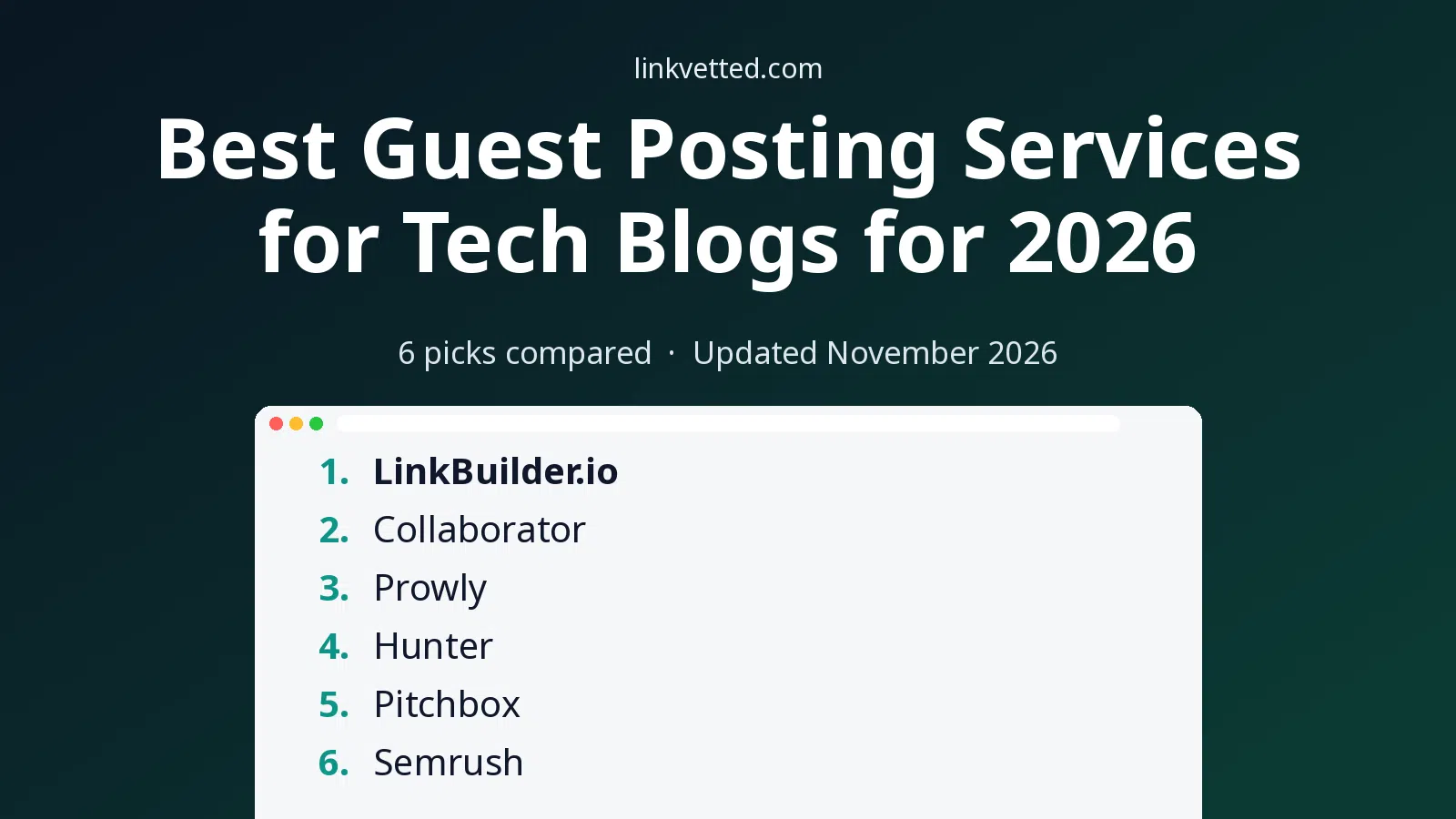
- Editor's choiceLinkBuilder.io
Managed outreach to tech publishers
Starts atSee websiteVisit linkbuilder.ioFull review - Great alternativeCollaborator
Self-serve marketplace browsing
Starts atSee websiteVisit collaborator.proFull review - Also consider
 Prowly
Digital PR pitching to tech media
Starts atSee websiteVisit prowly.comFull review
Direct answer
My top pick is LinkBuilder.io, because it is built around publisher outreach and editorial placements rather than open marketplace listings, which suits tech blogs that guard their editorial standards. For teams that want a self-serve marketplace where they browse sites and pick placements themselves, Collaborator is a solid second choice. If you mainly need digital PR and journalist-style pitching for developer and SaaS publications, Prowly fits that job better.
TL;DR:
- Tech blogs usually reject generic content, so services that pitch a specific angle to a named editor tend to work better than bulk marketplace orders.
- A guest posting service is only as good as its publisher relationships, so ask how sites are vetted before you pay.
- Editorial links from relevant tech publications are worth more than volume, which is why niche fit should drive your choice.
- Most services sell placements, not guaranteed acceptance, so plan for some pitches to be declined.
- Always ask whether content is written by the vendor or by you, because tech editors often want a named author with subject knowledge.
Last checked November 2026. Plan prices are not quoted in this guide because they change often; see each vendor's own pricing page for current figures before you buy.
Quick comparison
| Tool | Best for | Starts at | Free plan? | |
|---|---|---|---|---|
| LinkBuilder.io | Managed outreach to tech publishers | See website | Not stated | Visit |
| Collaborator | Self-serve marketplace browsing | See website | Not stated | Visit |
| Prowly | Digital PR pitching to tech media | See website | Free trial | Visit |
 Hunter | Finding editor email addresses | See website | Free plan | Visit |
 Pitchbox | Running outreach campaigns in-house | See website | Not stated | Visit |
 Semrush | Research before you pitch | See website | Not stated | Visit |
The best guest posting services for tech blogs compared
I put this comparison together from vendor documentation, public product pages and published descriptions of how each service works. I did not run hands-on tests of these tools, and I have not measured results from any of them. What follows is a fit-and-limits read, so you can shortlist based on how you like to work.
LinkBuilder.io
Best for: Managed outreach to tech publishers
LinkBuilder.io positions itself as a link building and outreach service where the team finds publishers, pitches them and manages placements on your behalf. That model fits tech blogs because editors there tend to respond to a specific, relevant pitch rather than a marketplace order. If you run an agency and want someone else to own the back-and-forth with editors, this is the kind of service to look at first.
In practice, a managed service like this handles the parts most in-house teams dislike: building a prospect list of tech publications, writing the pitch, following up and confirming placement details. You still supply the topic and usually approve the content. For guest posting on tech blogs, that division of labour works well when your team knows the subject matter but does not have time for outreach.
The limit is transparency before purchase. You will want a call to understand which kinds of tech sites they can reach and how they vet them. Skip it if you prefer to browse a live inventory and buy placements yourself without a conversation.
- Focused on publisher outreach rather than open listings
- handles prospecting and negotiation
- suited to editorial-style placements
- Inventory is not fully public before you speak to the team
- you rely on their publisher vetting
Collaborator
Best for: Self-serve marketplace browsing
Collaborator is a marketplace where publishers list their sites and buyers browse, filter and order placements. It suits people who want to see the inventory, compare options and make their own call rather than hand the process to an account manager. For tech blogs, the filters help you narrow to technology and software categories.
The workflow is simple: search the catalogue, shortlist sites that match your topic, check the placement terms and order. Because you choose each site, you keep control over relevance, which matters when a generic "technology" label can hide sites that have nothing to do with your niche. It is a practical option for smaller agencies that want to move quickly.
One limit: a marketplace puts the vetting burden on you. Listings vary in quality and editorial standards, so budget time to review each site's recent posts and audience before ordering. Skip it if you want a fully managed service with someone else accountable for publisher quality.
- You can browse publisher listings directly
- useful filters for niche and site type
- straightforward order flow
- Quality varies across listings
- you must vet each site yourself
Prowly is a PR platform with a media database, pitch composer and newsroom features. It is not a guest posting marketplace, but it is relevant here because many tech publications respond better to a PR-style pitch than to a link request. If your goal is coverage in developer, SaaS and startup media, this is the tool category to consider.
The way it helps with guest posting is indirect: you use the media database to find editors and writers at tech outlets, then pitch a contributed article or an interview. That approach takes more effort than buying a placement, but it can lead to relationships that produce repeat coverage. For agencies with a story to tell, that is often the better long game.
The limit is that Prowly does not guarantee placements and does not write your content. It is software for outreach, not a done-for-you service. Skip it if you want someone else to handle everything, or if you have no story or expert to pitch.
- Built around media relations and journalist outreach
- media database and pitch tools in one place
- useful for brand-led stories
- Not a link placement service
- results depend on your story and pitch quality
Hunter is an email finding tool. You enter a domain, and it returns public professional email addresses associated with that site. In a guest posting workflow, that makes it a useful first step: you identify tech blogs you want to write for, then use Hunter to find the right editor or content manager to contact.
It helps with tech guest posting mainly by removing the friction of finding contacts. The rest of the work, including the pitch, the writing and the follow-up, stays with you. For a small agency that already has a list of target publications, that is a reasonable and low-commitment way to start outreach.
Do not expect it to solve publisher quality or placement. It is one tool in a manual process, and it works best alongside a CRM or outreach tool. Skip it if you want a managed service, because Hunter will not place anything for you.
- Finds and verifies professional email addresses
- simple domain search
- works well as a first step in outreach
- No placement service or publisher database
- you build the entire process yourself
Pitchbox is an outreach platform for managing prospecting and email campaigns at scale. Agencies use it to run link building and guest posting campaigns with templates, follow-ups and reporting. For tech blogs, it works when you already know which publications you want and need a system to manage the conversation.
The value is in repeatability. You build a list of tech publishers, load it into a campaign, send personalised pitches and track replies. That structure helps when you are pitching many editors and need to keep track of who said what. It is a process tool, not a source of placements.
The limit is that everything depends on your list and your pitches. There is no built-in publisher marketplace, and the software will not fix a weak target list. Skip it if you are a solo operator with a handful of pitches a month, because a spreadsheet will do the same job.
- Outreach workflow with prospecting and follow-ups
- campaign management in one place
- suits agencies with repeat processes
- You supply the publisher list and content
- needs setup and process discipline
Semrush is an SEO platform with keyword, backlink and competitor research tools. It is not a guest posting service, but it belongs in this list because research is the step most people skip. Before you pitch a tech blog, you can check its traffic patterns, its existing backlinks and whether it covers your topic.
In a guest posting workflow, Semrush helps you build a better target list and check whether a publication is worth your time. You can also use it to find topics that tech audiences search for, which makes your pitch more likely to be accepted. That research layer improves every other tool on this list.
The limit is obvious: Semrush does not contact editors or place articles. It is a data tool, and it works best for teams that already have an outreach process. Skip it if you only want placements and have no interest in doing your own research.
- Broad SEO data for finding and checking publications
- useful for competitor and keyword research
- content tools alongside the data
- Not a guest posting service
- outreach and placement are still manual
How I chose
I started with the job itself: getting a contributed article accepted by a tech publication. That means finding relevant publishers, reaching the right editor, pitching a specific angle and delivering content that meets editorial standards. I looked for services that address one or more of those steps, then read vendor documentation and public product pages to understand how each one works. I did not test any of them, and I have not measured outcomes.
The second filter was fit and limits. A managed outreach service, a self-serve marketplace, a PR platform and an email finder solve different problems, so I grouped them by workflow rather than pretending they are interchangeable. I also noted where each tool leaves work with you, because that is where most disappointment comes from. If a service does not publish its inventory or process, I said so rather than guessing. Treat this as a shortlist to research further, not a verdict.
What to check before you buy
- Ask how publishers are vetted, and whether the service can show you recent examples of placements on real tech blogs.
- Confirm whether the vendor writes the article or you do, and who is credited as the author.
- Check whether placements are editorial or marked as sponsored, because tech editors and readers treat them differently.
- Ask what happens if a pitch is declined, and whether you get a replacement or a refund.
- Make sure the target publications actually cover your niche, not just a broad "technology" category.
- Read the terms on link attributes and removal, so you know what you are paying for over time.
FAQ
Are guest posting services worth it for tech blogs?
They can be, if the service reaches publications your team could not easily access and the placements are editorially relevant. The value depends on publisher quality and niche fit, not volume. A small number of well-matched placements on respected tech blogs is usually a better use of budget than a large batch of generic ones.
Can I do guest posting myself without a service?
Yes. Many agencies build a target list, find editor contacts, pitch and write the article in-house. Tools like Hunter and Pitchbox support that workflow, and Semrush helps with research. Doing it yourself takes more time but gives you full control over which publications you approach and what you publish.
How do I judge whether a tech blog is worth pitching?
Look at whether it publishes articles close to your topic, whether it has a named editor and clear contributor guidelines, and whether its recent posts get engagement. Check its backlink profile and audience signals with an SEO tool. If the site publishes anything for anyone, it is probably not worth your time.
Do these services guarantee placement?
Most do not. Managed services and marketplaces usually sell the placement or the outreach, and editors can still decline a pitch. PR platforms and email tools only help you reach people. Ask each vendor what happens when a pitch is rejected before you commit, and read the terms carefully.
What is the difference between a guest posting service and digital PR?
A guest posting service usually focuses on placing contributed articles to earn links. Digital PR is broader: it pitches stories, data and expert commentary to journalists, which can lead to coverage and links. For tech blogs, the two overlap, and some teams use both depending on the story they have.
Sources
- https://linkbuilder.io
- https://collaborator.pro
- https://prowly.com
- https://hunter.io
- https://pitchbox.com
- https://semrush.com