Best Enterprise Software in 2026: 8 Platforms Compared
Compare the best enterprise software platforms in 2026. See CRM, ERP, HR, and workflow suites, pricing, and which vendor fits your company. before you buy.
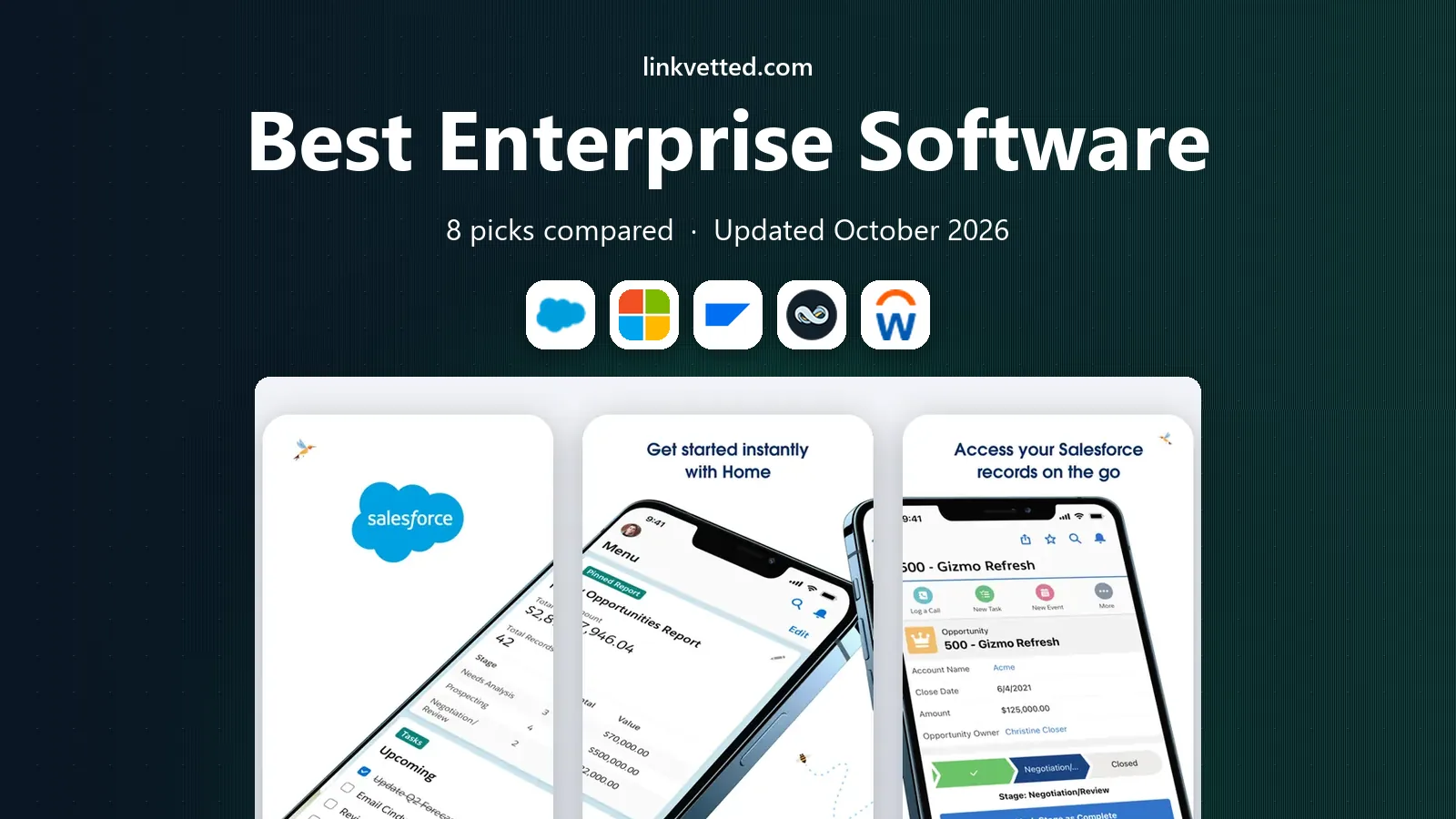
- Editor's choice
 Salesforce
CRM that scales widely
Starts at$25 per user per monthVisit salesforce.comFull review - Great alternative
 Microsoft Dynamics 365
companies on Microsoft 365
Starts at$65 per user per monthVisit dynamics.microsoft.comFull review - Also consider
 SAP
manufacturers and global supply chains
Starts atSee websiteVisit sap.comFull review
TL;DR:
- Salesforce is the most flexible enterprise CRM, scaling from small teams to global sales orgs.
- Microsoft Dynamics 365 suits companies already standardized on Microsoft 365 and Azure.
- SAP fits manufacturers and global companies with complex supply chains.
- Oracle NetSuite suits mid-size companies outgrowing basic accounting tools.
- Workday is the strongest pick for HR and finance in larger companies.
Quick comparison
| Tool | Best for | Starts at | Free plan? | |
|---|---|---|---|---|
| Salesforce | CRM that scales widely | $25 per user per month | Free trial | Visit |
| Microsoft Dynamics 365 | companies on Microsoft 365 | $65 per user per month | Free trial | Visit |
| SAP | manufacturers and global supply chains | See website | Free trial | Visit |
 Oracle NetSuite | mid-size companies outgrowing QuickBooks | See website | No | Visit |
 Workday | HR and finance for larger companies | See website | No | Visit |
 ServiceNow | IT and employee service workflows | See website | Free trial | Visit |
 HubSpot | marketing-led growing companies | Free | Yes | Visit |
 Zoho One | all-in-one suite on a budget | See website | Free trial | Visit |
The best enterprise software platforms
We compared enterprise software platforms on breadth, depth in core functions, integration, implementation effort, and pricing transparency, with a focus on buyers who will live with a choice for years.

Salesforce is the most flexible enterprise CRM in this list. It scales from a small sales team on Starter Suite to a global org with Sales, Service, Marketing, and custom apps on the same platform. Its integration ecosystem is unmatched, which helps companies connect CRM to finance, support, and data tools.
That breadth brings complexity and cost. Add-ons, AI features, and higher tiers raise the bill well above the entry price, and skilled admins are needed to keep the system clean. For companies that want a CRM that can grow for a decade, Salesforce is a strong default.
- Broad CRM and app platform
- Large integration ecosystem
- Starter tier for small teams
- Costs grow with add-ons and AI features
- Configuration needs skilled admins
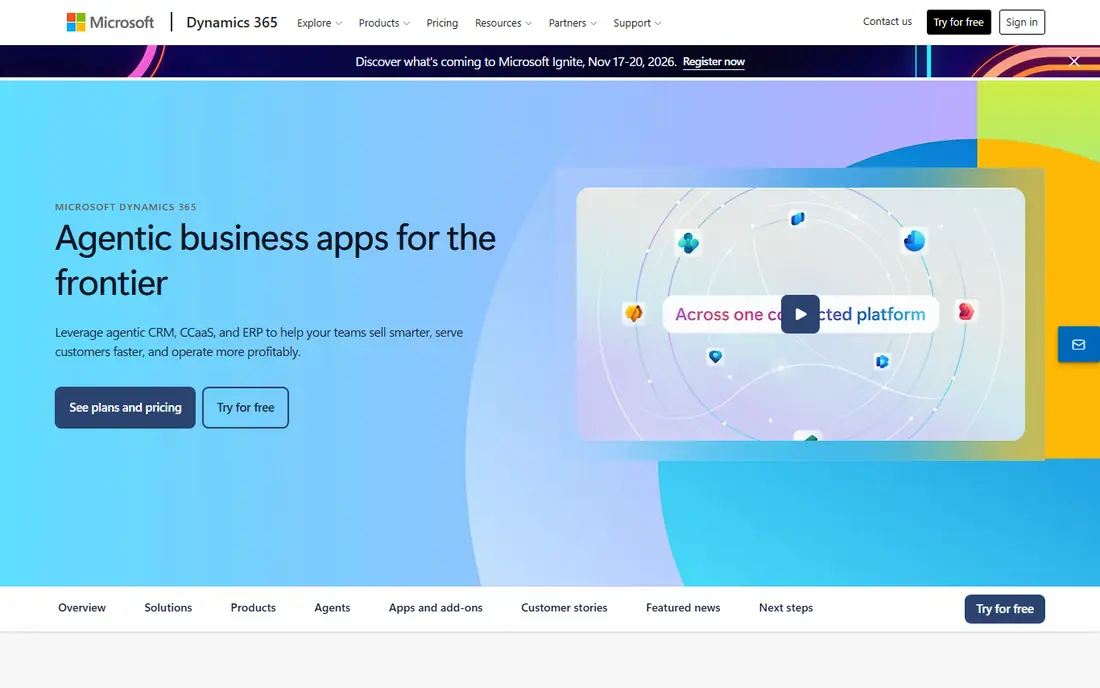
Microsoft Dynamics 365 suits companies already standardized on Microsoft 365, Teams, and Azure. Sales, Finance, Supply Chain, and Customer Service apps share data through Dataverse, and users work inside familiar Microsoft tools. Published tier pricing also makes early budgeting easier than quote-only rivals.
Value drops if your company does not use Microsoft widely, and large ERP or finance projects still need implementation partners. For Microsoft-centric companies, though, Dynamics 365 offers a coherent suite without the integration burden of a mixed stack.
- Native Microsoft 365 and Azure integration
- Sales, Finance, and Supply Chain apps
- Published tier pricing
- Best value mainly inside Microsoft stack
- Implementation still needs partner help

SAP is the enterprise ERP standard for manufacturers and global companies with complex supply chains. Its S/4HANA Cloud platform covers finance, procurement, manufacturing, and logistics in depth, with localization for many countries. That depth matters when processes span plants and borders.
Pricing is quote-based, and implementation projects are large, often taking many months with partner help. Smaller companies will find SAP too heavy. For large manufacturers, SAP depth and partner ecosystem remain hard to match.
- Deep ERP and supply chain depth
- Global compliance and localization
- Large partner ecosystem
- Quote-based pricing
- Implementation is large and complex
Oracle NetSuite suits mid-size companies that have outgrown basic accounting software. It unifies ERP, financials, CRM, and ecommerce in one cloud suite, which reduces the need for separate systems and manual reconciliation. That single-system view helps growing companies control finance and inventory together.
Pricing is quote-based, and customization requires skill or partner help. Companies with very complex manufacturing may need a larger ERP. For mid-size growth companies, NetSuite offers a practical step up from small-business accounting.
- Unified ERP, CRM, and ecommerce
- Strong financial management
- Cloud-native suite
- Quote-based pricing
- Customization needs partner or in-house skill
Workday is the strongest pick for HR and finance in larger companies. Its HCM and Financial Management apps share one data model, which helps leaders see workforce and financial plans together. Global HR compliance, payroll integration, and planning tools suit companies with hundreds or thousands of employees.
Pricing is quote-based and often tied to headcount measures, so buyers should read contract terms carefully. Implementation is a major project. For large companies that need unified HR and finance, Workday is a leading choice.
- Unified HCM and Financials
- Strong planning tools
- Global HR compliance
- Quote-based pricing with headcount-based terms
- Implementation is major
ServiceNow excels at workflow automation for IT service, employee service, and customer service. Its ITSM depth, catalog, and automation tools help large companies standardize requests and approvals. AI workflows now extend that automation to common service tasks.
Pricing is quote-based, and the platform breadth needs governance to avoid sprawl. Smaller companies may find it too much. For large service organizations that want one workflow platform, ServiceNow is a strong contender.
- Workflow automation for IT, HR, and customer service
- Strong ITSM depth
- AI workflows
- Quote-based pricing
- Platform breadth needs governance
HubSpot is the easiest enterprise-adjacent platform to start with, thanks to a genuinely useful free CRM tier. Marketing, Sales, Service, and CMS hubs share contact data, which helps growing companies align teams without a large IT project. Onboarding is faster than SAP or Workday.
HubSpot is not an ERP or HR suite, so companies needing deep finance or workforce tools will need other systems. Costs also rise as you add hubs and enterprise tiers. For marketing-led growth companies, HubSpot offers the best balance of power and ease.
- Free CRM tier
- Marketing, sales, and service hubs
- Easy onboarding
- Enterprise features cost more across hubs
- Depth in ERP and HR is limited
Zoho One bundles dozens of business apps, including CRM, finance, HR, support, and collaboration, into one subscription. That breadth at a bundle price makes it the strongest budget option for a company that wants one vendor for many functions. Small and mid-size teams can standardize without many separate contracts.
Depth in each app is thinner than Salesforce for CRM or Workday for HR, and polish varies across apps. Companies with deep needs in one function may still need a specialist tool. For budget-conscious all-in-one buyers, Zoho One is hard to beat.
- Dozens of apps in one bundle
- CRM, finance, HR, and support
- Low bundle price
- Depth in each app is thinner than category leaders
- Integration polish varies
How we picked these
We compared official product pages, pricing pages, and recent enterprise comparisons for each vendor. We checked which functions each suite covers, whether pricing was published or quote-based, and whether a free tier or trial existed. We gave extra weight to integration with common tools, since enterprise value often depends on how well a suite connects to the rest of the stack. We also noted implementation risk, since license cost is rarely the largest total cost.
How to pick enterprise software
Define the core job before the vendor shortlist
Enterprise suites cover CRM, ERP, HR, service, and more, but few do all of them equally well. Decide whether CRM, finance, HR, or service is the primary job, then shortlist vendors that lead in that area. A suite that is average everywhere can still lose to a focused leader in your core function.
Budget for implementation, not just licenses
Implementation partners, data migration, training, and integrations often cost as much as the first year of licenses. Ask vendors for total cost examples from similar companies, including partner fees. A low license quote can hide a large services bill.
Test integration with your current stack
Check native connectors for your email, productivity, finance, and data tools. Custom integrations add cost and maintenance, and they break during upgrades. A vendor with strong native integration will save time long after go-live.
Plan for change management
Enterprise software fails more often from low adoption than from missing features. Budget time for training, pilot groups, and feedback loops. A phased rollout with clear owners beats a big-bang launch for most companies.
Before you commit, run a short trial with a real task from your own work, not a demo example. A trial with your own guest list, route, keywords, devices, spend data, candidates, accounts, study goals, workflows, or app scope will reveal limits that a feature page hides. Note what felt slow, what needed support help, and what the total price would be at your real volume. That short test usually tells you more than a second round of comparison reading, and it protects you from paying for features you will rarely use.
FAQ
What is enterprise software?
Enterprise software is business software built for large companies, covering functions such as CRM, ERP, HR, finance, and service management. It usually runs on annual subscriptions, supports many users and roles, and integrates with other business systems.
Which enterprise software is best for small business?
HubSpot and Zoho One suit smaller companies best, thanks to free tiers and lower entry prices. Salesforce Starter and Microsoft Dynamics 365 also offer entry tiers, but enterprise suites such as SAP and Workday suit larger companies.
How much does enterprise software cost?
Costs vary widely. Salesforce starts at $25 per user per month, Dynamics 365 Sales starts at $65 per user per month, and SAP, Oracle, Workday, and ServiceNow are quote-based. Implementation and partner fees add substantially to license costs.
Is SAP or Oracle better for ERP?
Both suit large global companies, with SAP often favored for manufacturing and complex supply chains, and Oracle Fusion Cloud ERP favored for finance-led transformations. The right choice depends on industry, existing stack, and implementation partner strength.
Can enterprise software be used without an implementation partner?
Smaller deployments of HubSpot, Zoho, or Salesforce Starter can work without a large partner. Large ERP, HR, or ServiceNow projects almost always need partner help for configuration, migration, and training.