Best Employee Engagement Companies in 2026: 8 Companies Compared
Which are the best employee engagement companies in 2026? We compare 8 platforms for surveys, recognition, and action planning and manager tools at work.
- Editor's choice
 Culture Amp
Survey science and benchmarks
Starts atSee websiteVisit cultureamp.comFull review - Great alternative
 Lattice
Engagement plus performance
Starts at$4 per seat per monthVisit lattice.comFull review - Also consider
 15Five
Weekly check-ins
Starts at$4 per user per monthVisit 15five.comFull review
TL;DR:
- Culture Amp leads on survey science and benchmarking, but its custom pricing and longer setup suit mid-size and larger teams.
- Lattice and 15Five are the easiest buys for teams that want surveys tied to performance, goals, and manager check-ins.
- Bonusly is the cheapest credible start for recognition, with a free plan for small teams, but it does not replace a survey tool.
- Watch minimums and module pricing, since a low headline price can hide a $4,000 annual floor or stacked add-ons.
- The best companies for employee engagement pair listening with action, so check reporting, action planning, and manager tools before you buy.
Quick comparison
| Tool | Best for | Starts at | Free plan? | |
|---|---|---|---|---|
| Culture Amp | Survey science and benchmarks | See website | No | Visit |
| Lattice | Engagement plus performance | $4 per seat per month | No | Visit |
| 15Five | Weekly check-ins | $4 per user per month | Free trial | Visit |
 Bonusly | Peer recognition | $3 per user per month | Yes | Visit |
 Quantum Workplace | Surveys and action planning | See website | No | Visit |
 Leapsome | All-in-one people platform | See website | Free trial | Visit |
 Workleap | Fast pulse surveys | $4,999 per year | No | Visit |
 Achievers | Enterprise recognition | See website | No | Visit |
The best employee engagement companies
Employee engagement software is not one thing. Some tools run surveys, some run recognition, and some tie both to performance reviews and goals. The companies below are the strongest options we found for US teams in October 2026, based on official pricing pages, product documentation, and public reviews. We focus on what each tool actually does, what it costs to start, and where it falls short.
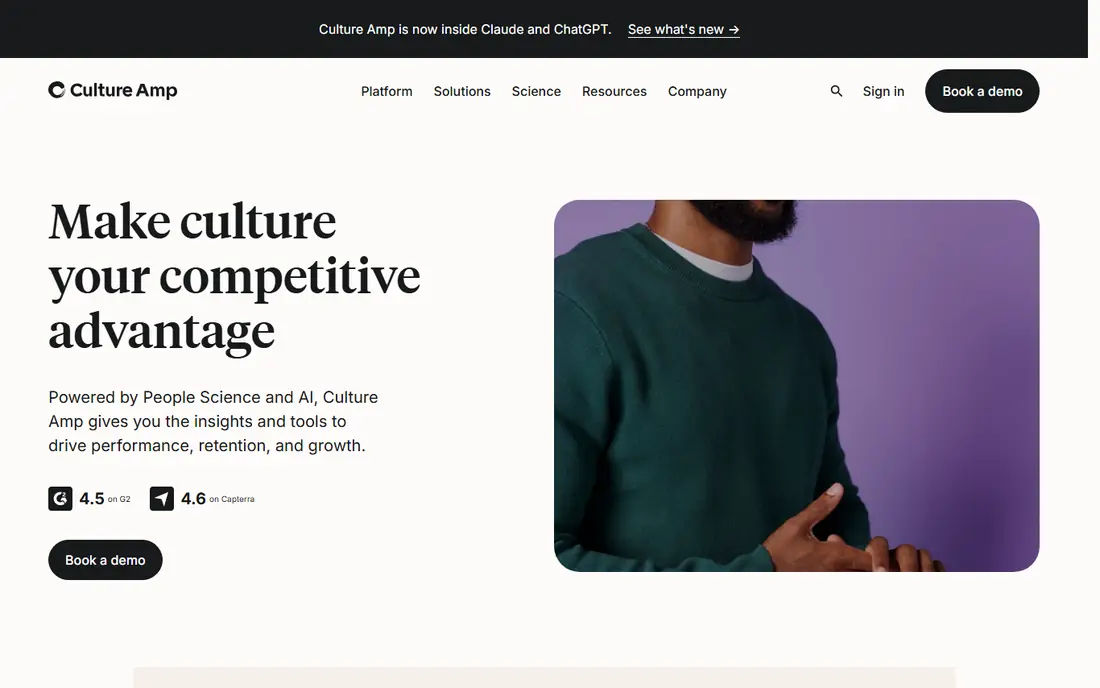
Culture Amp is the benchmark for engagement surveys. Its templates are built on research, its benchmarks let you compare results with similar companies, and its heatmaps show where engagement differs by team, location, or manager. Action planning tools help leaders turn a survey result into assigned follow-up work, rather than a report that sits in an inbox. For a people team that wants depth and defensible data, that combination is hard to match.
The cost is opacity and time. Pricing is custom, onboarding can take weeks, and smaller teams may find the platform more than they need for a simple pulse survey. If you run annual or quarterly surveys at scale and you need benchmarks you can present to leadership, Culture Amp is worth the demo. If you need a fast, cheap start, look at 15Five or Bonusly first.
- Research-backed survey templates
- Strong benchmarking
- Action planning and heatmaps
- Custom pricing only
- Setup can take weeks
- Performance tools are weaker than Lattice
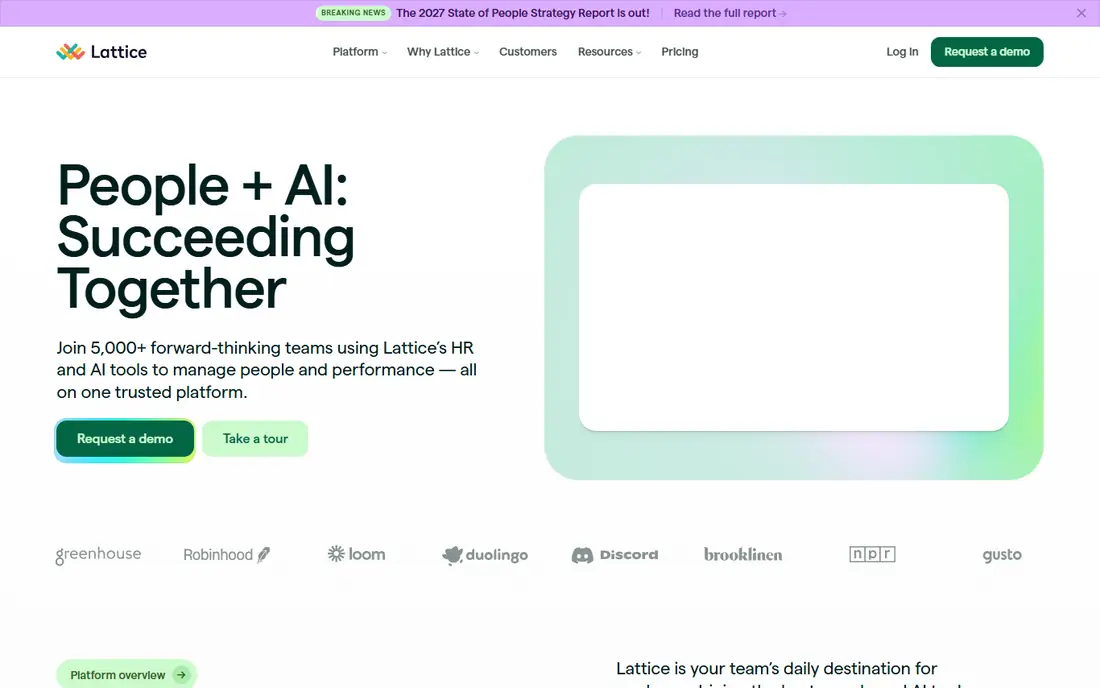
Lattice makes sense when engagement is not a standalone survey, but part of how you run performance. Engagement results sit next to goals, reviews, and feedback, so a manager can see whether a low-engagement team also misses goals or gets little feedback. That link is useful in review season, when people teams need a full picture, not just a survey score. Its dashboards are clear, and its survey tools cover pulses, onboarding, and exit surveys.
The headline $4 per seat per month for Engagement is only part of the cost. Guides in 2026 report a $4,000 annual minimum, and adding performance, goals, or compensation modules raises the total. Small teams should get a full quote before assuming the headline price. For mid-size teams that already want a performance platform, Lattice is one of the best companies for employee engagement.
- Surveys tied to reviews, goals, and feedback
- Clear manager dashboards
- Strong reporting
- $4,000 annual minimum reported in 2026 guides
- Module pricing can stack up quickly
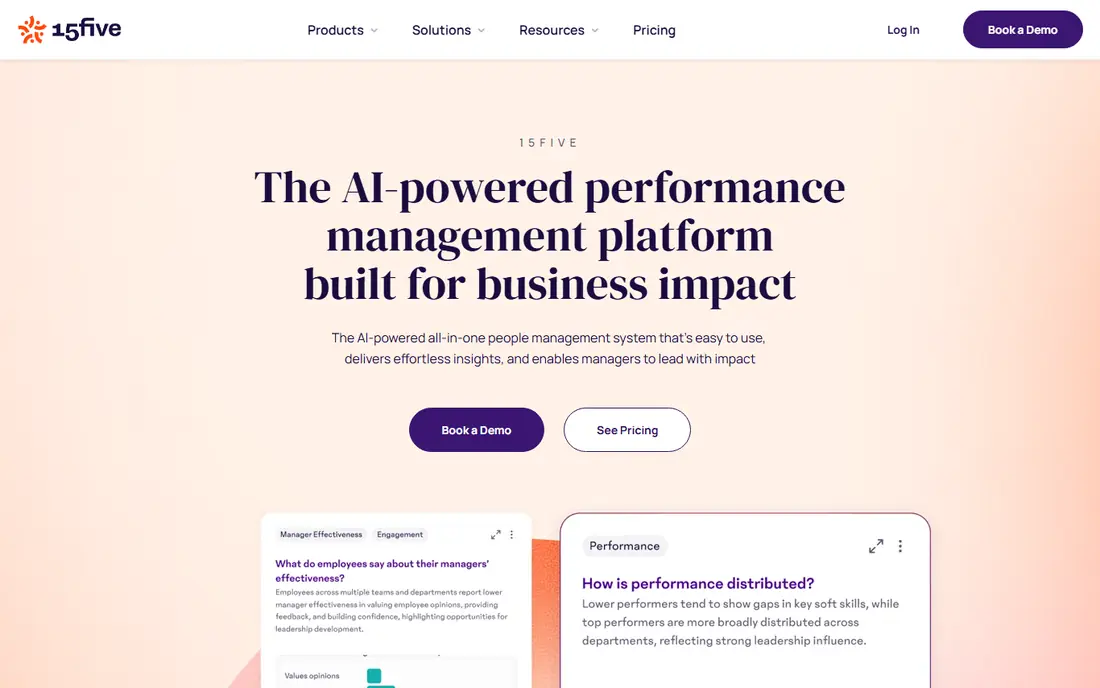
15Five is built around a simple habit: a short weekly check-in where employees share progress, blockers, and mood, and managers respond. That rhythm gives leaders a signal between annual surveys, and it helps new managers learn to coach without a heavy process. The Engage tier adds pulse surveys at $4 per user per month on annual billing, with a free trial to test the flow. For teams under 500 people, that ease of use is a real advantage over larger survey platforms.
The limits are scope and variety. 15Five is not a full HR system, and long-term users sometimes report that pulse questions repeat. If you want deep benchmarking or complex survey science, Culture Amp or Quantum Workplace fit better. If you want managers to hear from their teams every week, 15Five is a strong, affordable pick.
- Weekly check-ins managers actually use
- Engage surveys from $4 per user per month
- Coaching tools
- Pulse survey questions can feel repetitive over time
- Not a full HR suite
Bonusly does one job well: it makes good work visible. Employees give each other points with a public note, points can be redeemed for rewards, and managers can see who is recognizing whom. The free plan for up to 8 users and paid plans from $3 per user per month on annual billing make it the cheapest credible start on this list. Small teams can try recognition without a large contract.
It is not a survey tool, and it will not tell you why engagement is low. Pair Bonusly with a survey platform if you need both listening and recognition, or use it alone if recognition is the gap you are trying to close. For a first step into engagement, especially for a small or remote team, Bonusly is an easy yes.
- Simple peer recognition feed
- Points and rewards
- Free plan for up to 8 users
- Recognition only, no surveys or reviews
- Analytics are lighter than survey platforms
Quantum Workplace pairs engagement surveys with performance tools and a clear action planning flow. Leaders can see survey drivers, compare with benchmarks, and assign actions with owners and deadlines. That structure helps teams that have run surveys before but struggled to act on them. Its reporting is built for HR and leadership audiences, with team-level views that respect anonymity thresholds.
Pricing is the barrier. Guides in 2026 report a high annual minimum, so small teams should confirm cost early. The platform also suits teams that want a structured survey program, rather than a quick pulse tool. If you have the budget and you want surveys that lead to tracked action, Quantum Workplace is a serious option.
- Research-backed surveys
- Benchmarking
- Action planning tied to results
- Custom pricing with a high minimum reported in 2026 guides
- Setup suits larger teams
Leapsome appeals to mid-market teams that want one people platform instead of several point tools. Engagement surveys sit alongside performance reviews, goals, feedback, and learning, so data flows between areas without extra integrations. It is built with European and global teams in mind, with language and compliance features that suit multi-country companies. A free trial lets you test the survey and review flows before a sales conversation.
Module pricing is the catch. Each added area raises the total, and custom quotes make it hard to compare Leapsome with a published-price rival on paper. Get a quote for the exact modules you need, and check what is included in the base price. For teams that want one platform for engagement and development, Leapsome is worth a shortlist place.
- Surveys, reviews, goals, and learning in one platform
- Good for global teams
- Free trial
- Per-module pricing can stack up
- Custom quotes make comparison harder
Workleap changed its model in 2026 to flat annual tiers, starting from $4,999 per year for its Standard platform, according to recent guides. That flat price is a different buy from per-seat pricing: it can be good value for a growing team, since adding people does not raise the bill in the same way, but it can be steep for a team of 20. Setup is fast, pulse surveys are simple to run, and manager reports are clear without heavy training.
Depth is the trade-off. Workleap does not match Culture Amp on survey science or benchmarking, and its broader platform is lighter than Lattice or Leapsome. If your goal is a simple, regular pulse with minimal admin, Workleap fits. If you need deep driver analysis, look at the survey specialists above.
- Flat annual pricing from $4,999 per year
- Quick pulse setup
- Simple manager reports
- Flat price can be costly for very small teams
- Less survey depth than Culture Amp
Achievers runs recognition as a culture strategy, not as a side feature. Large companies use it for peer recognition, milestone awards, and global rewards, with analytics that show participation by team and location. Its reward catalog and program design support are stronger than a simple points feed, and it integrates with common HR systems. For a company with hundreds or thousands of employees, that scale matters.
Small teams will find it too much. Pricing is custom, implementation is enterprise-sized, and the platform assumes a program owner and a budget for rewards. If you are a large company and recognition is your main engagement lever, Achievers belongs on the shortlist. If you are small, Bonusly will give you most of the benefit at a fraction of the cost.
- Enterprise-scale recognition and rewards
- Global reward options
- Strong analytics
- Custom pricing only
- Built for larger companies, not small teams
How we picked these
We compared official pricing pages, product documentation, and public reviews for engagement platforms available in October 2026. We favored tools with a clear core job, published or widely reported pricing, and a track record with US teams. Where pricing is custom, we say so, and where guides report a minimum or a floor, we flag it so you can confirm it on a demo. We did not claim hands-on testing, and we did not rank by review scores alone, since those scores reflect different team sizes and use cases.
We also separated surveys from recognition. A recognition tool can lift morale, but it cannot diagnose why a team is disengaged. A survey tool can diagnose, but it cannot reward good work on its own. The best shortlist usually includes one of each, or a platform that covers both well.
How to choose the right platform
Start with the problem, not the feature list
If you do not know how people feel, start with surveys. If people do good work and no one notices, start with recognition. If managers lack a rhythm for talking with their teams, start with check-ins. A platform that solves the wrong problem will sit unused, however good its features look in a demo.
Check total cost, not headline price
Ask for the full annual cost, including minimums, modules, implementation, and reward budgets. A $4 per seat headline can become a much larger bill once modules and minimums are added. Get the quote in writing, and compare it with a flat-price option if your headcount is growing.
Test manager use, not just HR reports
Engagement tools fail when managers do not use them. In a trial, ask a few managers to run a survey, read a report, and set one action. If that flow feels heavy, the tool will struggle in daily use, even if the HR dashboard looks strong.
FAQ
What are the best companies for employee engagement?
Culture Amp leads on survey science, Lattice and 15Five lead on surveys tied to performance and check-ins, and Bonusly leads on simple recognition. The best choice depends on whether your main gap is listening, recognition, or manager rhythm.
How much does employee engagement software cost?
Prices range from free for small recognition teams to custom enterprise contracts. Recent guides list Lattice Engagement from $4 per seat per month, 15Five Engage from $4 per user per month, Bonusly from $3 per user per month, and Workleap from $4,999 per year. Always confirm minimums and module costs on a quote.
Is Bonusly enough on its own for engagement?
Bonusly is enough if recognition is your main gap. It does not run engagement surveys, so it cannot tell you why engagement is low or how it compares with benchmarks. Pair it with a survey tool if you need both recognition and listening.
What is the difference between Culture Amp and Lattice?
Culture Amp focuses on survey science, benchmarks, and action planning. Lattice ties engagement surveys to performance reviews, goals, and feedback in one people platform. Choose Culture Amp for survey depth, and Lattice when you want engagement and performance in the same system.
How often should we run engagement surveys?
Many teams run a longer survey once or twice a year, with short pulses in between. Weekly check-ins from a tool like 15Five add a signal between surveys. Avoid surveying so often that employees stop answering, and always share what changed after a survey.