Best Electronic Data Interchange Software in 2026: 8 Platforms Compared
Compare the best electronic data interchange software for 2026, from SPS Commerce and TrueCommerce for retailers to Cleo and IBM for complex EDI suppliers.
- Editor's choice
 SPS Commerce
Retail supplier compliance
Starts atSee websiteVisit spscommerce.comFull review - Great alternative
 TrueCommerce
Managed EDI for small suppliers
Starts at$20 per monthVisit truecommerce.comFull review - Also consider
 Cleo Integration Cloud
EDI plus APIs and files
Starts at$400 per monthVisit cleo.comFull review
TL;DR:
- SPS Commerce leads on retail network breadth, with connections to tens of thousands of trading partners.
- TrueCommerce is the best value managed EDI option for small and midsize suppliers, with a low published entry price.
- Cleo suits companies that need EDI plus APIs and file transfers in one platform, not EDI alone.
- Most EDI pricing is by quote based on partners and document volume, so compare the full contract, not a headline figure.
Quick comparison
| Tool | Best for | Starts at | Free plan? | |
|---|---|---|---|---|
| SPS Commerce | Retail supplier compliance | See website | No | Visit |
| TrueCommerce | Managed EDI for small suppliers | $20 per month | No | Visit |
| Cleo Integration Cloud | EDI plus APIs and files | $400 per month | No | Visit |
 IBM Sterling | Regulated and audit-heavy EDI | See website | No | Visit |
 OpenText | Large enterprise B2B integration | See website | No | Visit |
 eZCom Lingo | Fully managed supplier EDI | See website | No | Visit |
 Orderful | Modern API-first EDI | See website | No | Visit |
 DiCentral | Omnichannel and global EDI | See website | No | Visit |
The best electronic data interchange software
Electronic data interchange, or EDI, is how businesses exchange purchase orders, invoices, and shipping notices in a standard electronic format instead of email and paper. We compared official product pages, pricing reports, and public reviews for the leading EDI platforms, looking at trading partner networks, ERP integrations, service models, and pricing transparency.

SPS Commerce is the first name most retail suppliers hear when a big retailer demands EDI, and for good reason. Its network covers tens of thousands of retailers and trading partners, and its fully managed model means SPS staff handle mapping, testing, and compliance work rather than leaving it to your team. Integrations with NetSuite, QuickBooks, Shopify, and other systems keep orders flowing into the tools a supplier already uses.
Cost and onboarding are the trade-offs. SPS pricing is quote-based and typically sits above budget options, and setup involves testing with each retailer, which takes weeks for complex requirements. For a supplier whose retail business depends on staying compliant with major chains, that managed depth is worth it. For a supplier with one small retailer, a cheaper managed option may do.
- Network of more than 80,000 trading partners
- Fully managed service model
- Strong ERP and marketplace integrations
- Higher cost than budget rivals
- Onboarding can take time
TrueCommerce is our pick for small and midsize suppliers that want managed EDI without an enterprise bill. Published pricing starts near $20 a month, though the full cost depends on partners and volume, and its pre-built partner map library covers more than 92,000 connections, including Amazon, Walmart, and Target. The web-based Transaction Manager lets staff process documents from a browser without a heavy IT setup.
Reviewers note a dated, click-heavy interface and thin documentation when errors appear, which can frustrate a non-technical team. Support responsiveness gets mixed marks for the same reason. Still, for the price and the partner coverage, TrueCommerce is the easiest managed EDI yes for a growing supplier. Get the full quote, including per-partner and volume charges, before signing.
- Low published entry price
- Pre-built maps for 92,000 plus partners
- Web-based Transaction Manager
- Interface feels dated and click-heavy
- Support documentation is thin in places
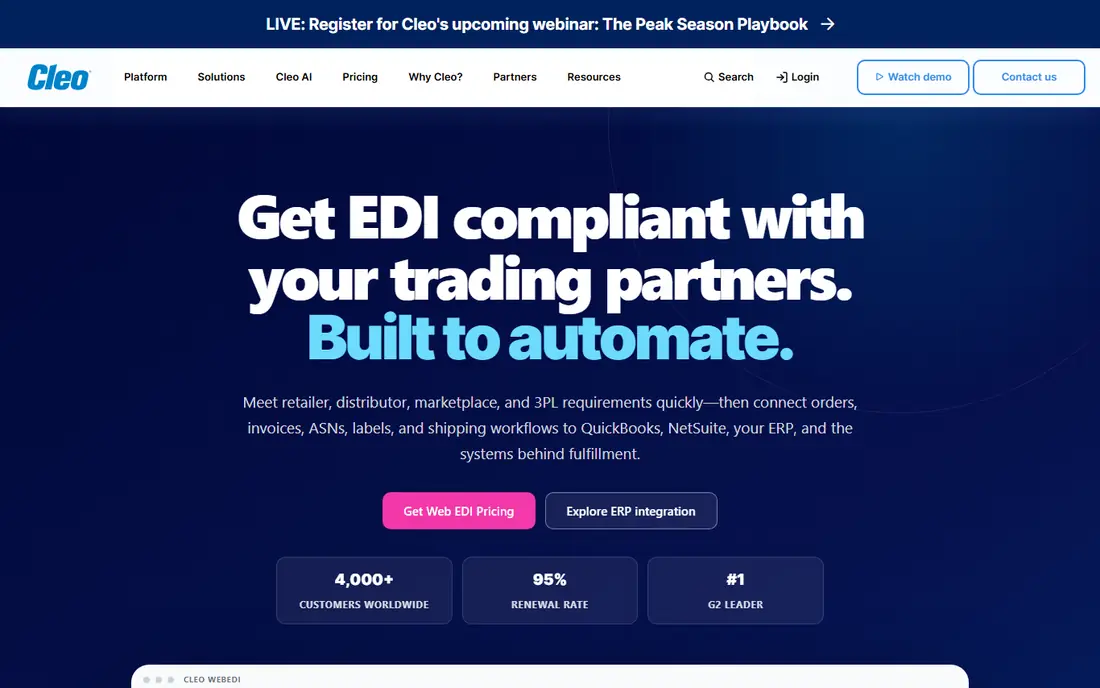
Cleo goes wider than pure EDI. Its Integration Cloud handles EDI, APIs, spreadsheets, and flat files in one platform with any-to-any transformation, which suits companies whose data flows mix old EDI partners with modern API systems. Deployment options cover cloud, hybrid, and private cloud, and visual transaction tracking helps teams find failed documents faster.
That breadth costs money and learning time. Published figures put entry pricing near $400 a month, and reviewers warn about training costs and a steep ramp for new users. A small supplier with only EDI needs will find TrueCommerce or SPS simpler. A manufacturer, distributor, or logistics company juggling EDI and APIs will find Cleo's single platform worth the investment.
- Any-to-any transformation across EDI, APIs, and files
- Cloud, hybrid, or private deployment
- Strong visibility into transactions
- Higher entry price
- Steep learning curve and training costs
IBM Sterling B2B Integration is the enterprise heavyweight for companies where audit trails, security, and compliance are non-negotiable. Banks, healthcare firms, and global manufacturers use it to exchange documents at scale with strong controls, encryption, and governance. Protocol support is broad, and the SaaS version removes some infrastructure work compared with the older on-prem edition.
Reviewers consistently call it expensive, particularly for small and midsize buyers, and implementation takes skilled staff and time. It is not a tool to buy for one retailer. For a regulated enterprise with complex partner requirements and strict audit duties, Sterling's depth justifies the cost. For most suppliers, a managed provider delivers compliance with far less effort.
- Deep security and compliance tooling
- Proven at global enterprise scale
- Broad partner and protocol support
- Expensive, especially for small businesses
- Implementation is a major project
OpenText offers B2B integration and managed EDI services on a large global network, serving enterprises that exchange high volumes of documents across many partners and formats. Its strength lies in combining EDI with document management and content tools, which suits companies whose trading documents feed wider business processes. A managed services option lets OpenText run much of the operation for the buyer.
Pricing and complexity are enterprise-grade, and a small supplier will find the sales and setup process heavier than TrueCommerce. OpenText fits companies that already run other OpenText systems or that need B2B integration at a scale where a point EDI tool falls short. Get a scoped quote tied to your partner count and document volume.
- Large global B2B network
- Managed services option
- Deep document and content handling
- Enterprise pricing and complexity
- Smaller suppliers may find it heavy
eZCom Lingo is built for brands that want EDI taken off their plate entirely. Its fully managed service handles mapping, testing, and ongoing compliance, with a US-based support team that reviewers praise for responsiveness. Integrations cover ERP systems, Shopify, warehouse systems, and 3PL partners, which suits consumer brands selling through retail and online at once.
Pricing is by quote, so small suppliers should ask for a full figure early, and the partner network, while solid, is smaller than SPS or TrueCommerce. For a brand team with no EDI specialist, eZCom's high-touch model is appealing: you focus on selling, and eZCom keeps the documents flowing. Compare its quote against TrueCommerce for your specific retailers before deciding.
- Fully managed service with high-touch support
- ERP, Shopify, and WMS integrations
- US-based support team
- Pricing is by quote
- Smaller partner network than SPS or TrueCommerce
Orderful takes a modern approach to an old problem: an API-first EDI platform that promises onboarding in days rather than months, with real-time compliance validation and flat-rate pricing. For retail brands with a modern tech stack, that speed is a real advantage over legacy EDI projects, and the API model fits developers building EDI into their own systems.
Legacy-heavy companies with deep existing EDI maps will need migration planning, and Orderful's model suits brands more than sprawling enterprise B2B networks. Pricing is by quote despite the flat-rate positioning, so confirm what the flat rate covers. For a modern retail brand starting EDI or replacing a painful legacy setup, Orderful is worth a serious look.
- API-first platform with fast onboarding
- Real-time compliance validation
- Flat-rate pricing model
- Newer approach suits modern stacks best
- Legacy-heavy setups need migration planning
DiCentral, now part of the TrueCommerce family, offers an API and EDI hybrid platform with modular scaling for omnichannel and global operations. Its strength is flexibility: companies can start with the modules they need and add more as partner counts and channels grow, without rebuilding the integration layer. Global coverage suits brands selling across regions.
The merger with TrueCommerce creates some feature overlap, so buyers should clarify which platform and support team they will actually get. Pricing is by quote. For a growing omnichannel brand that wants modular EDI with API options, DiCentral remains a credible choice, but compare it directly with TrueCommerce's own offering to avoid paying twice for the same coverage.
- API and EDI hybrid approach
- Modular scaling
- Strong omnichannel and global coverage
- Feature overlap after its merger with TrueCommerce
- Pricing is by quote
How we picked these
We compared official product pages, pricing reports, and public reviews for EDI platforms available in October 2026, plus the related searches readers use, including top EDI software and EDI software for wholesale business. We kept only platforms that genuinely handle EDI documents and trading partner compliance, and we covered managed, self-service, and enterprise models. Where a vendor does not publish a price, we wrote See website.
How to choose an EDI provider
Start with your retailers, not the software. List every trading partner that requires EDI, the document types each one needs, and your monthly document volume. A provider with pre-built maps for your exact retailers will onboard you in weeks, while a provider without them will charge for custom mapping. Ask for the onboarding timeline in writing, tied to your first retailer's launch date.
Web EDI versus integrated EDI
Web EDI processes documents through a browser portal and suits low volumes and few partners. Integrated EDI connects to your ERP or accounting system automatically and suits higher volumes and many partners. Most suppliers start with web EDI and move to integrated EDI as volume grows. Confirm the upgrade path and its cost before signing a web EDI contract.
FAQ
What is EDI software?
EDI software exchanges business documents like purchase orders, invoices, and advance ship notices in a standard electronic format between companies. It replaces manual email and paper handling, cuts errors, and lets retailers and suppliers trade automatically at scale.
Do small businesses need EDI software?
Yes, if a retailer requires it. Major retailers require EDI for purchase orders, invoices, and shipping notices, and a supplier that cannot comply cannot sell through them. Managed providers like TrueCommerce and eZCom exist so small teams can comply without hiring EDI specialists.
How much does EDI software cost?
Most vendors price by quote based on trading partner count, document volume, and service level. Published entry points include TrueCommerce near $20 a month and Cleo near $400 a month, but the full contract depends on your partners and volume. Always get a written quote for your exact setup.
What is the difference between web EDI and integrated EDI?
Web EDI uses a browser portal to process documents manually and suits low volumes. Integrated EDI connects to your ERP or accounting system and moves documents automatically, which suits higher volumes. Integrated EDI costs more to set up but saves far more staff time at scale.
How long does EDI implementation take?
Web EDI can go live in days for a simple partner. Integrated managed EDI typically takes weeks, including mapping and testing with each retailer. Plan around your first retailer's launch date, and ask the provider for a written timeline before you commit.