Best Dynamic Pricing Software in 2026: 10 Tools Compared
Best dynamic pricing software for 2026: 10 tools compared for ecommerce, retail and B2B pricing, from Pricefx and Competera to Prisync and Omnia Retail.
- Editor's choice
 Pricefx
Enterprise price management and optimisation
Starts atSee websiteVisit pricefx.comFull review - Great alternative
 Competera
AI-driven retail pricing
Starts atSee websiteVisit competera.aiFull review - Also consider
 Omnia Retail
Omnichannel retail repricing
Starts atSee websiteVisit omniaretail.comFull review
TL;DR:
- Pricefx and Zilliant suit large B2B and enterprise teams that need price management, optimisation and quote workflows in one platform.
- Competera and Omnia Retail suit retailers that need AI-driven or rule-based repricing across large catalogues and multiple channels.
- Prisync and Price2Spy suit smaller ecommerce teams that mainly need competitor monitoring and straightforward repricing rules.
- PROS and Vendavo suit manufacturers and distributors with complex B2B pricing, contracts and rebate structures.
- Most enterprise tools price by quote, so expect a sales conversation, while smaller tools publish monthly plans that are easier to compare.
Quick comparison
| Tool | Best for | Starts at | Free plan? | |
|---|---|---|---|---|
| Pricefx | Enterprise price management and optimisation | See website | No | Visit |
| Competera | AI-driven retail pricing | See website | No | Visit |
| Omnia Retail | Omnichannel retail repricing | See website | No | Visit |
 Zilliant | B2B price optimisation | See website | No | Visit |
 PROS | B2B pricing and quote management | See website | No | Visit |
 Vendavo | B2B pricing and rebate management | See website | No | Visit |
 Prisync | Competitor monitoring for ecommerce | See website | Free trial | Visit |
 Price2Spy | Price monitoring and repricing | See website | Free trial | Visit |
 Priceva | Competitor-based ecommerce pricing | See website | Free trial | Visit |
 Wiser | MAP monitoring and retail intelligence | See website | No | Visit |
The best dynamic pricing software
Dynamic pricing software adjusts prices based on rules, competitor moves, demand, inventory or margin targets, rather than leaving prices fixed until someone remembers to change them. The right tool depends on whether you sell to consumers or businesses, how many SKUs you manage, and whether competitor data or demand forecasting matters more. We compared vendor sites and feature descriptions, and we picked tools that are active in October 2026. Prices are stated as See website where vendors price by quote or where a published plan could not be verified at writing time.
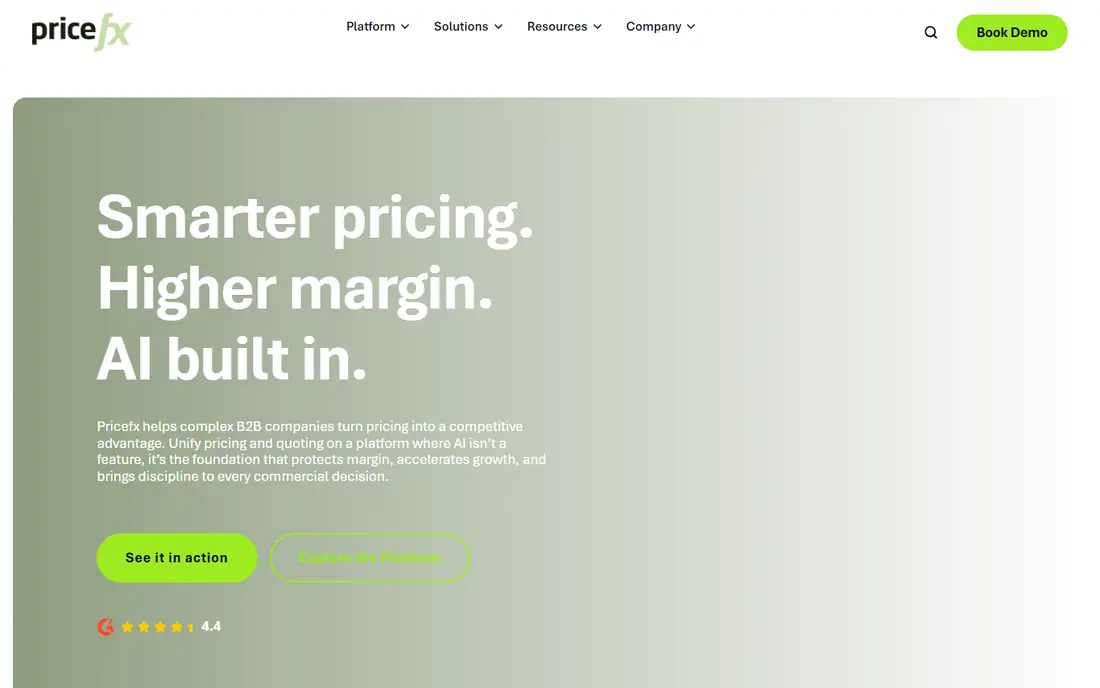
Pricefx is a cloud pricing platform used by retailers, manufacturers and distributors that need more than a repricer. Its modules cover price management, optimisation, rebate management and configure-price-quote, so a pricing team can move from strategy to execution in one system. Simulations let you test a price change against margin and revenue goals before it reaches customers, which reduces the risk of a costly mistake.
The cost is complexity and implementation effort. Pricefx suits organisations with a dedicated pricing team and enough SKUs or B2B complexity to justify an enterprise platform. Smaller ecommerce sellers will find it heavier than they need. Pricing is by quote on the vendor site, so budget requires a sales conversation and a clear scope.
- Modular suite covering price management, optimisation, rebates and CPQ
- Simulations to test price changes before rollout
- ERP and CRM integrations
- Enterprise implementation takes time and internal ownership
- Pricing is by quote, so small teams cannot compare a public plan
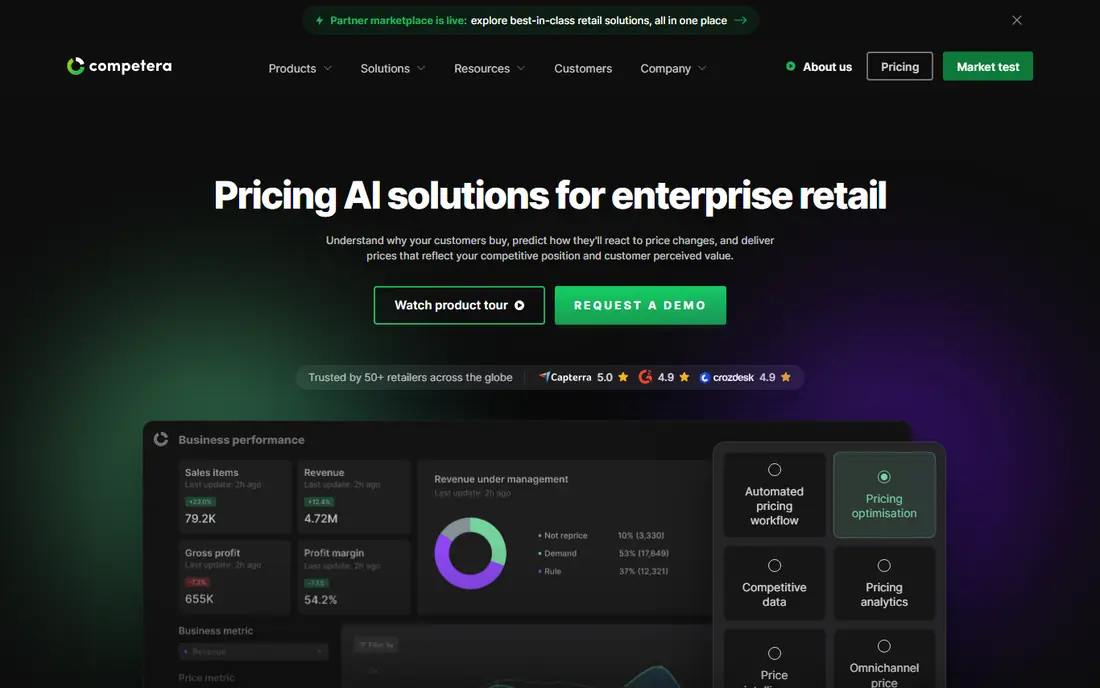
Competera combines competitive data with a pricing platform that uses contextual AI and demand drivers to recommend or apply prices in real time. The vendor describes more than 20 demand drivers and a high service level for competitive data, which helps retailers react to market changes without manually updating thousands of prices. That approach suits retailers with at least two years of sales history, where demand patterns are clear enough for a model to learn from.
Competera pricing is tailored by SKU count, deployment scope and setup, so there is no simple monthly plan to compare. Retailers with small catalogues or thin sales history may get less value from AI optimisation than from rule-based repricing. For a large retailer ready to invest in demand-based pricing, Competera is a strong enterprise option.
- Contextual AI pricing using demand drivers
- Competitive data with a stated service level
- Real-time optimisation across channels
- Pricing is tailored by SKU count and scope, so no public plan to compare
- AI pricing needs good sales history to work well
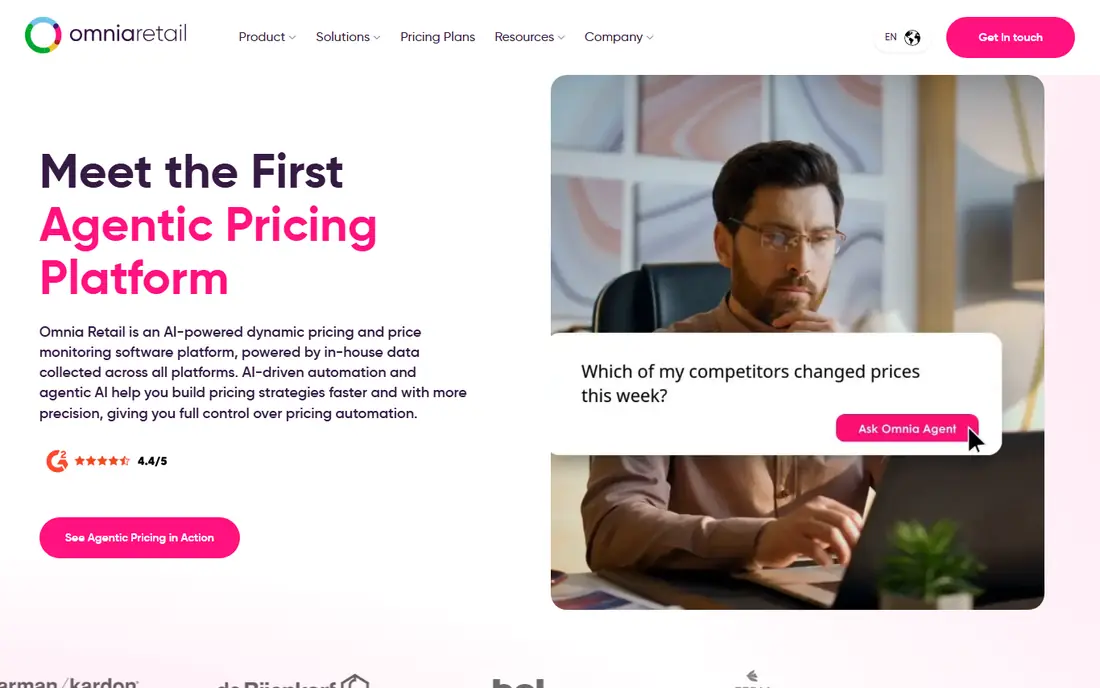
Omnia Retail, often called Omnia, gives retailers a dynamic pricing platform with a Pricing Strategy Tree that lets pricing teams build and view rules without IT help. It collects competitor pricing data from marketplaces such as Amazon and eBay and from comparison engines such as Google Shopping, then applies rules across channels. That combination suits omnichannel retailers who sell through their own store plus marketplaces.
Omnia pricing depends on organisation size, assortment size and product mix, so the vendor prefers a consultation before quoting. Very small merchants may find setup heavier than a light repricer such as Prisync. For a structured retail team with a large catalogue and multiple channels, Omnia offers a clear, rule-driven path to automated pricing.
- Dynamic pricing with a strategy tree for rule building
- Competitor data from marketplaces and comparison engines
- Strong European retail focus
- Pricing is by quote after a consultation
- Best suited to structured retail teams rather than very small merchants
Zilliant focuses on B2B pricing, where list prices, customer-specific agreements, discounts and rebates interact in ways a consumer repricer cannot handle. Its platform helps manufacturers and distributors set optimised prices, manage agreements and analyse deal performance, with analytics that show which prices actually improve margin. That depth matters when a wrong price can lock in a long contract.
Zilliant is an enterprise tool, with implementation and pricing by quote, and it is not a fit for a small online store. Teams that need B2B agreement handling and price optimisation across many customers will find Zilliant more relevant than a retail repricer. Smaller B2B sellers should ask whether the scope justifies an enterprise platform before committing.
- B2B price optimisation and management for manufacturers and distributors
- Deal and agreement handling
- Strong analytics
- Enterprise focus means longer implementation
- Pricing is by quote and not suited to small ecommerce sellers
PROS, formerly PROS Holdings, offers pricing and selling software for B2B companies, with AI-driven price guidance, quote management and revenue tools. It is widely used in manufacturing, distribution and travel, where prices depend on customer, volume, contract and market conditions. CRM and ERP integrations help keep quoted prices consistent with the prices in core systems.
Like other enterprise B2B tools, PROS prices by quote and requires implementation effort. A small ecommerce team does not need its quote workflows or B2B agreement logic. For a B2B seller with complex quotes and a large customer base, PROS is a proven, if expensive, choice.
- AI pricing and quote tools for B2B sellers
- Strong fit for airlines, manufacturing and distribution
- Integrates with CRM and ERP systems
- Enterprise pricing and implementation
- Complexity is overkill for simple ecommerce repricing
Vendavo serves manufacturers and distributors that need to manage list prices, customer prices, rebates and deal performance in one place. Its platform combines price management, optimisation and rebate handling with analytics that show how pricing decisions affect margin and revenue. That breadth helps B2B teams that currently manage prices in spreadsheets and want a governed, auditable system.
Vendavo is priced by quote and implemented as an enterprise platform, so it suits organisations with a pricing team and complex B2B structures. A retailer or small ecommerce seller should look at Competera, Omnia or Prisync instead. For a manufacturer with rebate complexity, Vendavo is a credible enterprise alternative to Zilliant and PROS.
- B2B price management, optimisation and rebate handling
- Commercial excellence analytics
- Fits manufacturers and distributors
- Enterprise scope and pricing by quote
- Smaller sellers will find it heavier than needed
Prisync is built for ecommerce retailers and brands that need to watch competitor prices and react with rules, rather than build a full enterprise pricing program. You track competitor products, set pricing rules based on competitor moves, margins or stock, and let Prisync adjust prices or alert you to changes. Setup is far lighter than Pricefx or Zilliant, and a free trial lets you test tracking on your own catalogue.
Prisync pricing has been published in tiers in the past, but plans change, so we state See website and recommend checking current tiers before budgeting. Its optimisation is rule-based rather than deeply AI-driven, which is a plus for transparency and a limit for demand forecasting. For a small to mid-size online store, Prisync is a practical first dynamic pricing tool.
- Competitor price tracking and dynamic pricing rules for online stores
- Simpler setup than enterprise platforms
- Free trial available
- Published plan details change, so check the site for current pricing
- AI optimisation is lighter than Competera or Pricefx
Price2Spy covers product matching, price monitoring, pricing analytics and repricing in one ecommerce tool. Brands can use its MAP workflows to spot sellers pricing below an approved advertised price, while retailers can set repricing rules that protect margin floors. A free trial helps a team test matching quality on its own products before committing, since matching accuracy decides whether repricing rules work at all.
Plan details and interface have changed over time, so check the Price2Spy site for current tiers and features. Very large catalogues or enterprise B2B needs may still favour Omnia, Competera or Pricefx. For an ecommerce team that wants monitoring plus repricing without an enterprise project, Price2Spy is a solid, focused choice.
- All-in-one price monitoring, analytics and repricing
- MAP monitoring for brands
- Free trial for testing
- Interface and plan details need checking on the site for current tiers
- Large catalogue needs may favour Omnia or Priceva
Priceva positions itself as a competitor-based pricing platform for ecommerce retailers selling through their own store plus marketplaces. It tracks competitor prices, applies rule-based and dynamic strategies, and includes MAP-aware workflows for brands that need to enforce advertised price floors. Vendor guides suggest it handles mid-size to large catalogues well, which suits growing retailers that have outgrown a simple tracker.
Priceva is less suited to a team that wants a quick, set-and-forget repricer for a tiny catalogue, since its value grows with pricing maturity. Check trial and pricing terms on the Priceva site, since plans are not fixed in this article. For a multi-channel retailer whose main pricing signal is competitor movement, Priceva is a direct, relevant option.
- Competitor-based pricing for multi-channel retailers
- MAP-aware workflows
- Catalogue handling up to large SKU counts in vendor guides
- Enterprise maturity needed for full automation value
- Pricing and trial terms need checking on the site
Wiser combines price intelligence, MAP monitoring and retail analytics for brands and retailers that need to protect channel pricing. Its MAP tools detect below-MAP pricing, send strike notices and show compliance status, while price intelligence tracks competitor and seller prices over time. That seller-level view helps brands see not just a market price, but which sellers are driving it down.
Wiser is enterprise-leaning, with pricing by quote, and it is more than a small ecommerce team needs for basic tracking. For a brand with MAP requirements or a retailer that needs structured channel intelligence, Wiser is a strong choice. Smaller sellers should start with Prisync or Price2Spy and move to Wiser when channel protection becomes a core job.
- MAP violation detection and compliance workflows
- Price intelligence for brands and retailers
- Seller-level visibility for channel protection
- Enterprise-leaning scope and pricing by quote
- More than a small seller needs for basic competitor tracking
How we picked these
We compared vendor sites and feature descriptions for tools that actively adjust or recommend prices based on rules, competitor data, demand or margin, not just tools that report a price once. We favoured a mix of enterprise B2B platforms, retail AI tools and smaller ecommerce repricers, so different business sizes can find a fit. We did not claim hands-on testing, and we stated prices as See website where vendors price by quote or where a plan could not be verified at writing time.
Choosing dynamic pricing well
Start with your main pricing signal
If competitor prices drive your decisions, start with Prisync, Price2Spy, Priceva or Omnia. If demand, elasticity and sales history matter more, look at Competera or Pricefx. If margin rules and MAP floors matter most, a rule-based repricer with MAP workflows is enough. Choosing the signal first prevents buying an AI platform for a competitor-tracking job, or vice versa.
Protect margin floors from day one
Automated repricing can move prices down faster than a human would, especially in a price war. Set cost-plus floors, MAP floors and minimum margins before turning on automation, and test rules on a small category first. A pricing tool should never be allowed to sell below cost without a deliberate override and an approval step.
Check data quality before automation
Price matching, competitor coverage and sales history decide whether automation helps or harms. Test matching on your top 100 products, check how often competitor data updates, and review a month of recommendations before letting a tool change live prices. Poor data with fast automation is worse than slow manual pricing.
Plan for catalog size and channels
A tool that handles 1,000 SKUs well may struggle at 100,000 SKUs, so ask vendors about SKU limits, channel coverage and integrations during a trial.
FAQ
What is dynamic pricing software?
Dynamic pricing software adjusts product prices automatically or through recommendations, based on rules, competitor prices, demand, inventory or margin targets. Instead of fixed prices that change only when someone edits them, prices respond to market and business signals. The exact logic varies by tool, from simple competitor rules to AI models based on sales history.
Is dynamic pricing legal?
Dynamic pricing itself is legal in most contexts, but it must not be used for price fixing with competitors, deceptive pricing or discrimination that breaks consumer law. MAP policies, advertised price rules and platform terms also limit how low a price can go. Check legal advice for your market, and set floors that keep automated pricing inside your own policies.
How much does dynamic pricing software cost?
Smaller ecommerce tools publish monthly plans or offer trials, while enterprise tools such as Pricefx, Zilliant, PROS and Vendavo price by quote based on SKU count, scope and implementation. That is why this article states See website for enterprise tools. Ask for total cost, including implementation, data and support, not just a licence fee.
Do I need AI pricing or are rules enough?
Rules are enough for many retailers, especially when competitor prices are the main signal and margins are protected by floors. AI pricing helps when demand, seasonality and elasticity drive results and you have enough sales history for a model to learn from. Start with rules, measure results, and add AI when rule results plateau.
Can dynamic pricing work for B2B?
Yes, but B2B pricing needs agreement, contract and rebate handling that consumer repricers do not offer. Tools such as Pricefx, Zilliant, PROS and Vendavo are built for that complexity, with customer-specific prices and deal analytics. A consumer repricer will not handle B2B contracts well, so choose a B2B platform if contracts drive your pricing.
Will dynamic pricing anger customers?
It can, if prices change too often, too sharply or without explanation, especially for loyal customers who notice a higher price on return. Set change limits, avoid intrusive intraday swings for stable products, and keep prices consistent across channels where customers compare. Transparent, gradual changes protect trust better than aggressive automation.