Which Data Replication Software Fits You? 8 Tools Compared
Best data replication software in 2026: 8 tools with starting prices, free plans and limits. The weak spots sit next to the strengths. Updated for 2026.
- Editor's choice
 Hevo Data
Small and mid-sized teams that want ELT running this week
Starts atSee website (plan-based on events processed)Visit hevodata.comFull review - Great alternative
 Estuary
Teams wanting live ELT without enterprise contracts
Starts atSee website (consumption-based)Visit estuary.devFull review - Also consider
 Airbyte
Engineering-led teams that want open-source control
Starts atSee website (consumption-based for Cloud; self-hosted is open source)Visit airbyte.comFull review
Direct answer
Hevo Data leads the list, best for small and mid-sized teams that want ELT running this week. Estuary fits teams wanting live ELT without enterprise contracts; Airbyte fits engineering-led teams that want open-source control. Details, prices and limits for the rest of the 8 tools are below.
TL;DR:
- Hevo Data is the opening pick, best for small and mid-sized teams that want ELT running this week.
- Hevo Data, Striim and the 6 others all sell by quote; expect sales conversations before you see a price.
- 2 of 8 tools offer a free plan: Airbyte, Portable.
- The main caution on Estuary: younger company with a smaller connector catalog than the leaders.
Quick comparison
| Tool | Best for | Starts at | Free plan? | |
|---|---|---|---|---|
| Hevo Data | Small and mid-sized teams that want ELT running this week | See website (plan-based on events processed) | Free trial | Visit |
| Estuary | Teams wanting live ELT without enterprise contracts | See website (consumption-based) | Free trial (30 days) | Visit |
| Airbyte | Engineering-led teams that want open-source control | See website (consumption-based for Cloud; self-hosted is open source) | Yes | Visit |
 Fivetran | Enterprises and mid-sized businesses wanting completely managed ELT | See website (consumption-based, billed on per month active rows) | Free trial (14 days) | Visit |
 Portable | Teams with niche or long-tail sources nobody else links | See website (fixed-fee plans; free plan for manual syncs) | Yes | Visit |
 Fivetran HVR | Enterprises with heavy, log-based CDC requirements | See website (quote-based) | No | Visit |
 Rivery | Data teams that want ELT plus orchestration in one tool | See website (credit-based) | Free trial | Visit |
 Striim | Live streaming replication and analytics use cases | See website (quote-based) | Free trial | Visit |
Our 8 picks for data replication software
LinkVetted compared 8 tools for data replication software. The goal is a practical shortlist: published prices, free plan facts, best-fit use cases and honest limits for every entry.

Choose Hevo Data for small and mid-sized teams that want ELT running this week. Hevo Data built its reputation on speed of setup.
Watch-outs: Very high volumes can push you into enterprise pricing rapidly.
Also, for the mainstream stack most SMBs run, that seldom matters. More specifically, the event-based pricing levels are simpler to reason about than pure consumption meters. Hevo Data shows no starting price here, so confirm the cost on the vendor site. Free access: Free trial.
- Quick setup with pre-built integrations for typical sources
- Reverse ETL features for pushing warehouse data back to SaaS apps
- Connector depth is thinner than Fivetran or Airbyte
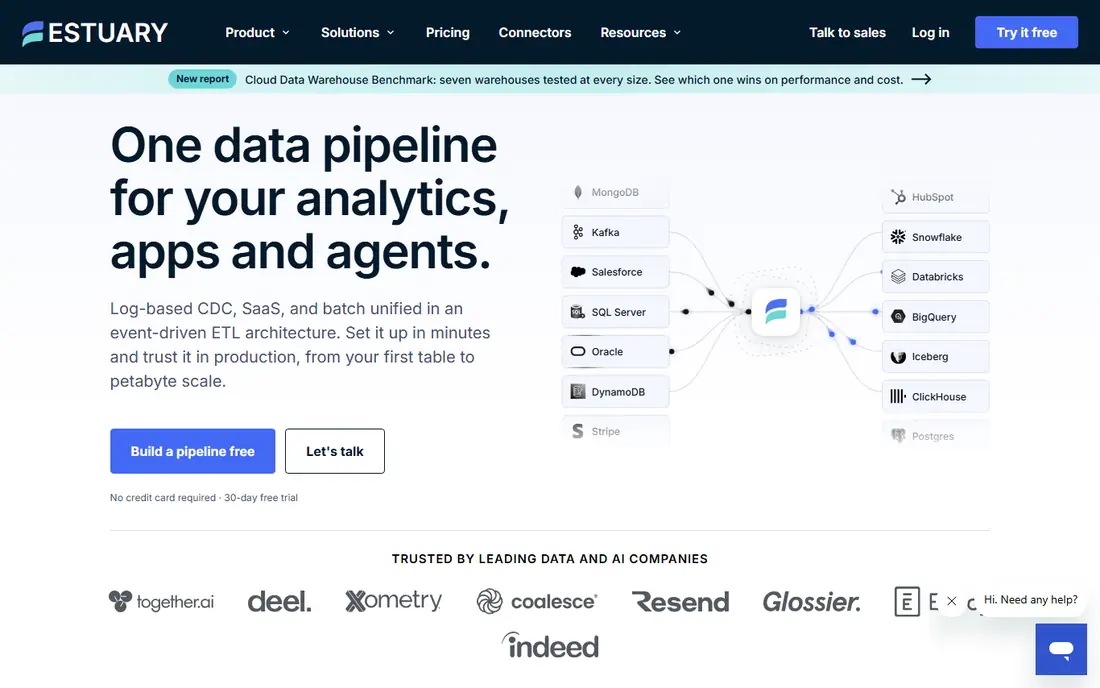
Estuary is a good fit for teams wanting live ELT without enterprise contracts. Estuary is the newest name here and the most interesting challenger.
More specifically, just verify your specific sources are supported before you build plans around it. Estuary does not show a starting price in this comparison, so check the vendor site for current pricing. On free options: Free trial (30 days).
Limits to weigh: Younger company with a smaller connector catalog than the leaders.
- Ample free level for getting started
- Open-source core (Flow) with a managed cloud
- Fewer public reference customers at enterprise scale
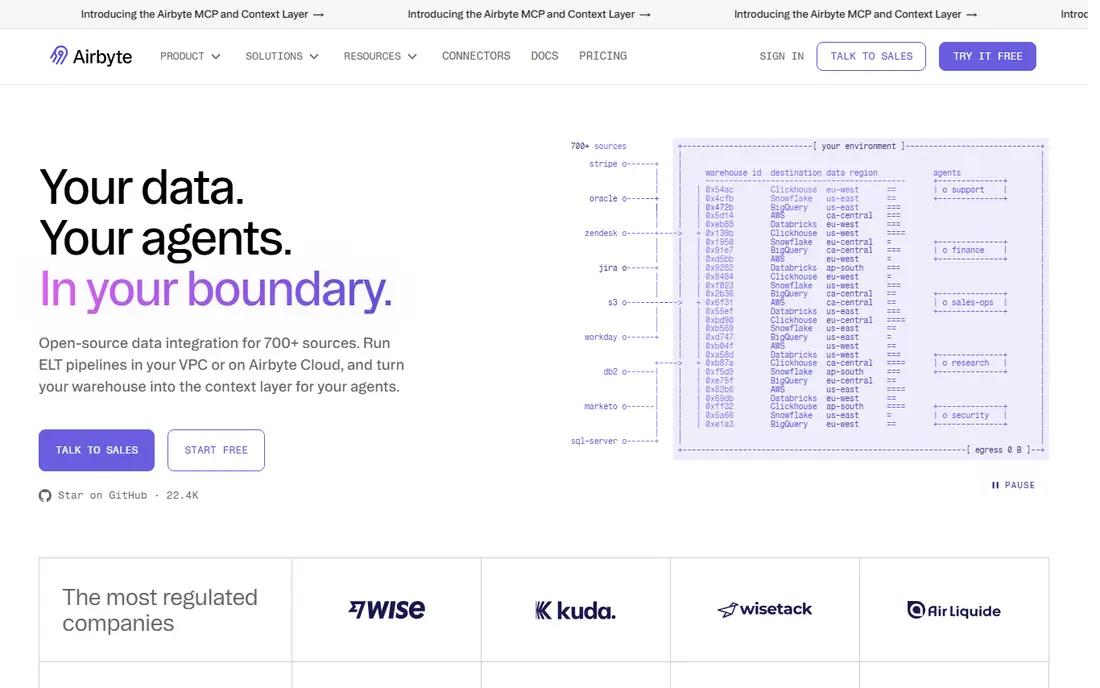
Think of Airbyte for engineering-led teams that want open-source control. If Fivetran's consumption meter makes you nervous, Airbyte is the natural counter-quote. More specifically, the connector builder and community contributions mean oddball sources get covered quicker than most vendors handle.
The trade is operational. Teams without it should price Airbyte Cloud against Fivetran before assuming self-hosted is less expensive once engineer time is counted. Check the vendor site for Airbyte pricing; none is listed in this comparison. A free plan is available with Airbyte.
Watch-outs: Self-hosting means you own upgrades, monitoring and scaling.
- Large and expanding connector catalog with community contributions
- Open-source core you can self-host and inspect
- The managed Cloud price still needs a quote for bigger volumes
Fivetran
Best for: Enterprises and mid-sized businesses wanting completely managed ELT
Fivetran works best for enterprises and mid-sized firms wanting completely managed ELT. The main limit is the meter.
In daily use, trial it on your heaviest tables, not your smallest, and ask sales for a realistic estimate based on your row counts before you sign anything annual. For a data team of two supporting an entire company, that hands-off quality is the entire pitch. Check the vendor site for Fivetran pricing; none is listed in this comparison. Free plan details: Free trial (14 days).
Points against: Restricted transformation (dbt-based) compared to full ETL suites.
- Largest connector library in the category (500-plus sources)
- Solid documentation and SOC 2 compliance story
- Consumption pricing can spike with high-volume or chatty sources
Choose Portable for teams with niche or long-tail sources nobody else links. Portable wins the connectors nobody else bothers with. In practice, for teams whose problem is "nobody links to our systems," that is a trade worth making.
Watch-outs: Smaller company with less brand recognition than the leaders.
Beyond that, the model is refreshingly straightforward: fixed-fee pricing with no data volume caps. So your bill does not move when your data grows. In practice, whereas every ELT vendor builds the same 150 widely used integrations, Portable built its business on the long tail: thousands of niche SaaS apps and APIs, plus custom connectors its team builds for you on request. Check the vendor site for Portable pricing; none is listed in this comparison. You can start on Portable without paying.
- Largest long-tail connector catalog in the category (1,500-plus prebuilt)
- Builds custom connectors on request in days
- No built-in transformation
Fivetran HVR is built with enterprises with heavy, log-based CDC requirements in mind. The technology is log-based capture built for serious volumes: big Oracle, SQL Server and DB2 estates where you cannot afford to hammer the source database with queries.
The main drawbacks: Enterprise sales process with no public pricing.
Check the vendor site for Fivetran HVR pricing; none is listed in this comparison. Fivetran HVR does not include a free plan.
- Log-based CDC designed for high-volume enterprise databases
- Agent-based architecture that keeps load off source systems
- More infrastructure to run than pure SaaS ELT
Where Rivery fits: Data teams that want ELT plus orchestration in one tool. Rivery's angle is consolidation. For lean data teams, fewer vendors means fewer contracts and fewer 2 a.m. alerts.
Teams that primarily need ingestion should compare it against a pure ELT tool. Teams that require the full bundle should trial the orchestration piece seriously, not just the connectors. Rivery shows no starting price here, so confirm the cost on the vendor site. Free plan details: Free trial.
Where it is weaker: Smaller connector catalog than the category leaders.
- Visual pipeline builder that stays readable at scale
- Credit-based pricing that includes ingestion and orchestration together
- The all-in-one scope means a steeper ramp-up time
Striim is built with live streaming replication and analytics use cases in mind. Striim sells speed. Its pitch is continuous, live data movement with processing applied to the stream itself.
So you can filter, enrich and transform data in flight rather than landing everything and cleaning it later. On top of that, if your latency requirement is measured in minutes, a batch tool is more straightforward and less expensive. On top of that, expect a bigger implementation effort and an enterprise contract. From a buyer's view, the honest catch is that Striim is a streaming system, not a plug-and-play ELT tool. Striim does not show a starting price in this comparison, so check the vendor site for current pricing. Free access: Free trial.
What to check first: More complicated to operate than batch ELT.
- Sub-second end-to-end latency for streaming pipelines
- Solid change data capture from enterprise databases
- Enterprise pricing with no public numbers
How much to budget for data replication software
Here is the blunt version of what vendors put on page six of their pricing docs: you do not pay for replication software, you pay for the volume and frequency of your own data. The real differences are latency (batch vs. Change data capture), how much pipeline babysitting each one demands, and what the meter runs on. Beyond that, pick your latency requirement first, then your budget tolerance, and the shortlist almost writes itself.
What went into this list
Pricing pages, product documentation and feature lists were the main sources, and every entry carries at least one honest drawback. Figures are shown as the vendors publish them. Billing terms, seat minimums and add-ons can change the real cost. The order reflects how well each tool fits the most common buying scenario for data replication software, then price clarity, then free plan access. It is a starting point, not a verdict.
What to check before you buy
- Request quotes from Hevo Data, Striim and the others; the list shows no fixed prices.
- Look at free plan limits closely: Airbyte and Portable have one, and the caps decide whether it is usable for real work.
- Take the trial from Hevo Data, Estuary, Fivetran and others and push a live task through it before you pay.
- Before choosing Hevo Data, weigh its main limit: connector depth is thinner than Fivetran or Airbyte.
- Ask Fivetran HVR which support channels and response times come with the plan you would buy.
- A short pilot of Estuary with your real workflow tells you more than a feature table.
FAQ
Do I need CDC or is batch ELT enough?
If your use case is analytics, dashboards refreshed hourly or daily, or data science, batch ELT is enough and less expensive. If you need operational systems in sync, sub-minute freshness or event-driven triggers, you need CDC.
Do these tools publish their prices?
No. None of the tools, from Hevo Data to Striim, shows a fixed starting price here, so budget time for quotes.
Is Hevo Data the right pick for everyone comparing data replication software?
No single tool suits every team. Hevo Data comes first because it fits small and mid-size teams that want ELT running this week, while Estuary suits teams wanting real-time ELT without enterprise contracts and Airbyte suits engineering-led teams that want open-source control. Match the tool to your own size, budget and workflow before deciding.
Can I try these options before paying?
Often, yes. Airbyte and Portable have a free plan and Hevo Data, Estuary, Fivetran and others offer a free trial. Use your own data and a real task during the test, and check what the free tier or trial limits before you rely on it.
What is the difference between data replication and ETL?
Replication keeps a target system continuously in sync with a source, commonly in live via change data capture. ETL extracts data on a schedule, transforms it, then loads it into a warehouse, normally for analytics.
How are the tools for data replication software ordered?
The order follows typical fit for data replication software, with Hevo Data first and Striim last, then price clarity and free access. It is editorial judgement, not a score, so another team could rank the tools differently.