The 6 Best Content Promotion Tools in 2026, Ranked
A practical guide to the best content promotion tools in 2026, compared from vendor documentation and public sources, with limits and fit for each.
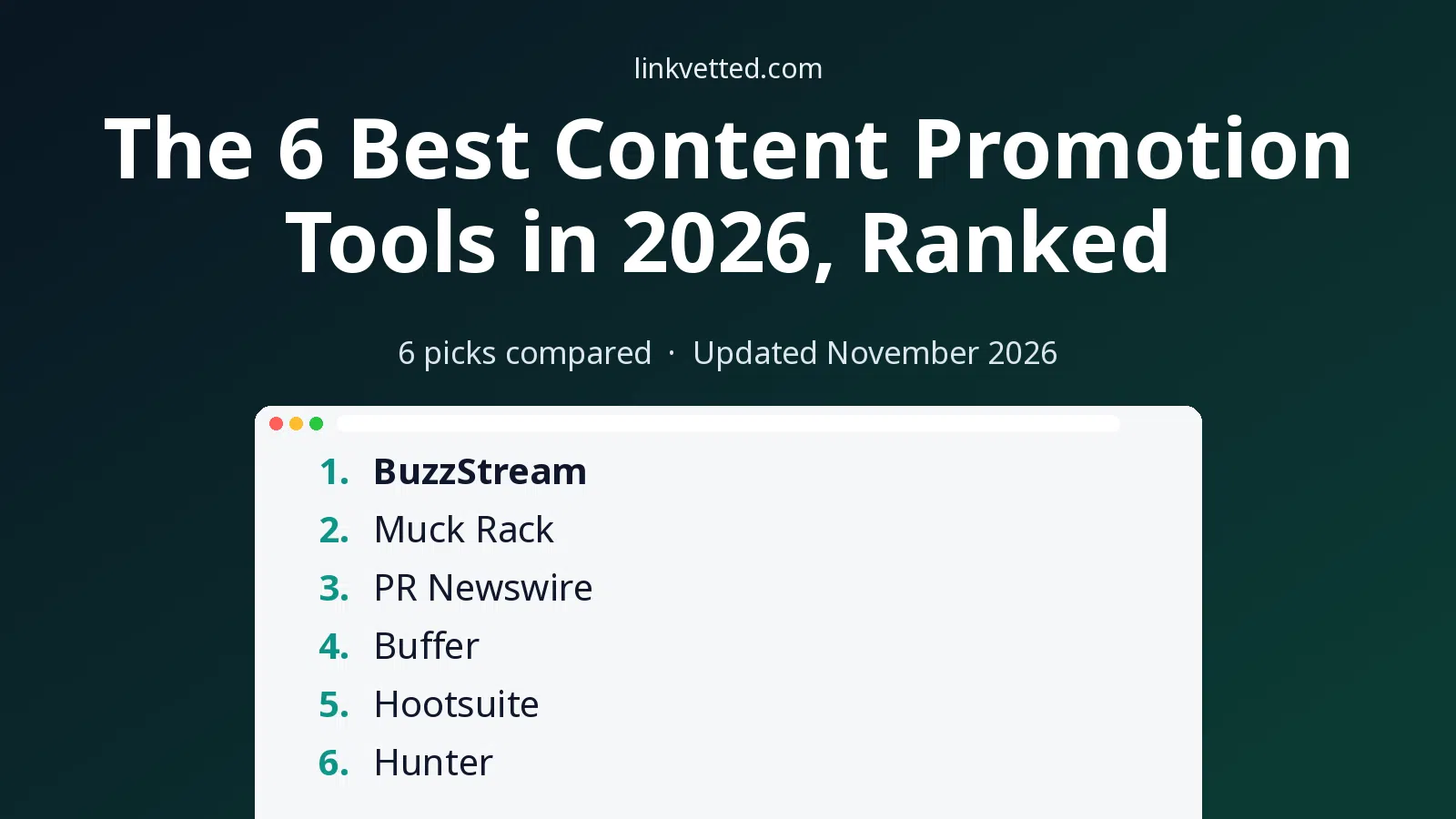
- Editor's choice
 BuzzStream
Link and blogger outreach
Starts atSee websiteVisit buzzstream.comFull review - Great alternative
 Muck Rack
Media relations and journalist outreach
Starts atSee websiteVisit muckrack.comFull review - Also consider
 PR Newswire
Press release distribution
Starts atSee websiteVisit prnewswire.comFull review
Direct answer
My top pick is BuzzStream for outreach-driven promotion, because it keeps prospect lists, contact history and follow-ups in one place, which is the core of most promotion work. For teams that want to find and reach journalists, Muck Rack is the stronger fit. For distributing and tracking a press release, PR Newswire covers the wire side. Each tool below suits a different part of promotion, so the right choice depends on whether you need outreach, media relations or distribution.
TL;DR:
- Content promotion is mostly outreach, so contact management and follow-up tracking matter more than a long feature list.
- Media database tools help you find the right journalists, but they cost more and are built for PR teams rather than solo SEOs.
- Social scheduling tools help you re-share content over time, which is a simple way to extend the life of one article.
- Wire services distribute a release, but they do not build relationships, so treat them as one channel rather than a full strategy.
- Check each vendor's current documentation for features and limits, because plans and interfaces change.
Last checked November 2026. Plan prices are not quoted in this guide because they change often; see each vendor's own pricing page for current figures before you buy.
Quick comparison
| Tool | Best for | Starts at | Free plan? | |
|---|---|---|---|---|
| BuzzStream | Link and blogger outreach | See website | Not stated | Visit |
| Muck Rack | Media relations and journalist outreach | See website | Not stated | Visit |
| PR Newswire | Press release distribution | See website | Not stated | Visit |
 Buffer | Scheduling social re-shares | See website | Free plan | Visit |
 Hootsuite | Managing several social accounts | See website | Not stated | Visit |
 Hunter | Finding contact emails | See website | Free plan | Visit |
The best content promotion tools compared
I put this list together from vendor documentation and public sources, not from hands-on tests. I looked at what each tool is built to do, how it fits a promotion workflow, and where it stops. The picks cover outreach, media relations, distribution and social re-sharing, because promotion usually needs more than one of these.
BuzzStream is a tool for managing outreach campaigns. You build lists of prospects, such as bloggers, editors or site owners, and record contact details and past conversations. It fits SEOs and small agencies that run link building and content promotion by email and need a record of who was contacted and what happened.
For content promotion, the useful part is the follow-up. You can group prospects, send outreach, and see which messages got replies. That keeps a campaign from turning into a messy inbox. If you promote several articles a month, having one place for contacts and history saves time and avoids contacting the same person twice.
The limit is that BuzzStream does not create content or distribute it. It is an outreach manager, so if you do not run email outreach, it adds little. Skip it if your promotion is mostly paid or social.
- Keeps prospect lists and contact history together
- supports outreach sequences and follow-ups
- helps track replies and outcomes
- Focused on outreach rather than content creation
- interface takes some learning
Muck Rack is a media relations platform. It helps you find journalists and outlets, build media lists, and monitor coverage. It fits PR teams and agencies that pitch stories to the press and need a structured way to manage those relationships.
For content promotion, it helps when your goal is earned media. You can look for journalists who cover your topic, pitch them, and track whether the story ran. That is useful for original research, data studies or expert commentary that news outlets might pick up.
The limit is scope and cost. Muck Rack is built for PR workflows, so a small SEO agency may find it heavier than needed. Skip it if you mostly do blogger outreach rather than press pitching.
- Large media database
- tools for monitoring coverage
- supports PR team workflows
- Priced for PR teams
- more than a solo operator needs
PR Newswire is a press release distribution service. You write a release, and the service sends it to its network of media outlets and websites. It fits companies that have news worth announcing, such as a product launch, funding or a major report.
For content promotion, a wire release can put an announcement in front of journalists and aggregators. It works best when the release has a clear news hook, not when it is used to push a routine blog post. Treat it as one channel in a wider plan.
The limit is that distribution is not relationship building. A release goes out, but it does not create ongoing contact with writers. Skip it if you have no news and only want to promote evergreen articles.
- Wide distribution network
- established wire service
- supports multimedia releases
- Distribution only
- results depend on the story itself
Buffer is a social media scheduling tool. You connect your accounts, add posts to a queue, and it publishes them at set times. It fits small teams and solo marketers who want to keep sharing content without posting manually every day.
For content promotion, the value is repetition. One article can be shared several times with different angles over weeks, and a queue makes that easy to plan. It also helps you keep a steady presence on the networks where your audience spends time.
The limit is reach. Scheduling does not create an audience, and Buffer does not help with email outreach or press. Skip it if social is not a channel you use.
- Simple scheduling across networks
- queue for regular posting
- easy for small teams
- Limited outreach features
- promotion depends on your own audience
Hootsuite is a social media management platform. It covers scheduling, monitoring and team workflows across multiple accounts. It fits organizations that run several profiles and need more control than a simple scheduler offers.
For content promotion, it helps coordinate sharing across accounts and track mentions of your brand or topic. If several people publish for your company, approval steps and roles keep the process consistent.
The limit is complexity. A solo operator or a very small team may not need the extra controls, and the setup takes time. Skip it if one scheduler and a content calendar are enough.
- Supports many networks in one place
- team roles and approvals
- monitoring streams
- Can be more than a small team needs
- setup takes time
Hunter is an email finding tool. You enter a company domain, and it returns public email addresses and patterns. It fits anyone who needs to find contact details before starting outreach.
For content promotion, Hunter helps you find the right person to email when you want to pitch a guest post, ask for a link or share a resource. It pairs well with an outreach tool that tracks the conversation.
The limit is that Hunter only finds addresses. It does not send outreach or track replies, so you still need a process for that. Skip it if you already have reliable contact lists.
- Finds and verifies email addresses
- works with a domain search
- helps build prospect lists
- Email finding only
- no outreach tracking
How I chose
I compared these tools from vendor documentation and public sources rather than hands-on tests. For each one, I checked what the vendor says it does, which part of promotion it covers, and where its scope ends. I also looked at who the tool is built for, because a PR platform and a social scheduler solve different problems even though both are called promotion tools.
My aim was to cover the main parts of a promotion workflow: finding contacts, managing outreach, pitching media, distributing news and re-sharing on social. No single tool does all of these well, so the list is meant to help you pick based on the gap in your current process. I left out tools where I could not confirm the vendor and its official site, and I did not include any ranking claims or performance figures. Check each vendor's current documentation before you commit, since features and plans change.
What to check before you buy
- Confirm which part of promotion the tool covers: contact finding, outreach, media pitching, distribution or social scheduling.
- Check whether it stores contact history and follow-ups, since that is the core of outreach work.
- Look at how it handles lists and segments, because promotion campaigns usually run by topic or audience.
- Check integration with your email and CRM so you are not copying data between systems.
- Review team roles and permissions if more than one person runs outreach.
- Read the vendor's current documentation for limits on contacts, sends or accounts before choosing a plan.
FAQ
What are content promotion tools?
They are tools that help you get content in front of people after it is published. That includes finding contacts, running email outreach, pitching journalists, distributing press releases and scheduling social shares. Most teams use more than one, because no single tool covers every channel well.
Do I need a paid tool to promote content?
Not always. A simple process with a spreadsheet and your email client can work for a small volume of outreach. Paid tools help when you run many campaigns, need contact history in one place, or want to coordinate a team. Start with the gap in your current process and add tools from there.
What is the difference between outreach tools and media databases?
Outreach tools manage the conversation: lists, emails, follow-ups and replies. Media databases focus on finding journalists and outlets and monitoring coverage. Some platforms combine both. If you pitch the press, a media database helps; if you do blogger outreach, an outreach tool is usually the better fit.
Can social scheduling tools help with promotion?
Yes, in a limited way. Scheduling lets you share one article several times with different angles, which extends its reach over weeks. It does not build an audience by itself, and it does not replace outreach. Use it alongside email and media work rather than instead of them.
How do I measure whether promotion worked?
Look at referral traffic, new links, mentions and replies to your outreach. Track these per campaign so you can see which channels brought results. Avoid judging a single article in isolation, since promotion often has a lag. Keep a simple record of what you sent and what came back.
Sources
- https://www.buzzstream.com
- https://muckrack.com
- https://www.prnewswire.com
- https://buffer.com
- https://www.hootsuite.com
- https://hunter.io