Best Company to Open a Roth IRA With in 2026: 8 Providers Compared
Looking for the best company to open a Roth IRA with? We compare fees, funds, tools and support at eight providers to help you pick the right account.
- Editor's choice
 Fidelity
Most people opening a Roth IRA
Starts atFreeVisit fidelity.comFull review - Great alternative
 Charles Schwab
Research and branch support
Starts atFreeVisit schwab.comFull review - Also consider
 Vanguard
Low-cost index fund investors
Starts atFreeVisit vanguard.comFull review
TL;DR:
- Fidelity, Schwab and Vanguard all offer $0 online stock and ETF trades and $0 account minimums for a Roth IRA, so cost alone rarely decides the winner.
- Your investing style matters more than the brand name, since self-directed traders, hands-off savers and advice seekers need different tools.
- Managed Roth IRA options from Fidelity, Schwab and Wealthfront can suit savers who want a portfolio built and rebalanced for them.
- Check fund fees, transfer fees and support hours before you open an account, because those small details add up over decades.
- This article is not financial advice. A Roth IRA has tax rules and contribution limits, so check current IRS rules or talk to a qualified adviser before you decide.
Quick comparison
| Tool | Best for | Starts at | Free plan? | |
|---|---|---|---|---|
| Fidelity | Most people opening a Roth IRA | Free | Yes | Visit |
| Charles Schwab | Research and branch support | Free | Yes | Visit |
| Vanguard | Low-cost index fund investors | Free | Yes | Visit |
 Robinhood | Simple mobile investing | Free | Yes | Visit |
 SoFi | Beginners who want guidance | Free | Yes | Visit |
 M1 | Automated pie investing | Free | Yes | Visit |
 E*TRADE | Active traders and options | Free | Yes | Visit |
 Wealthfront | Hands-off automated investing | See website | No | Visit |
The best company to open a Roth IRA with
A Roth IRA lets you contribute after-tax money and, if you follow the rules, withdraw qualified retirement money tax free. The provider you choose controls your fund choices, trading tools, fees and support, so it is worth comparing before you fund an account. We compared official pricing pages, fund lineups, account features and support options for the providers below.
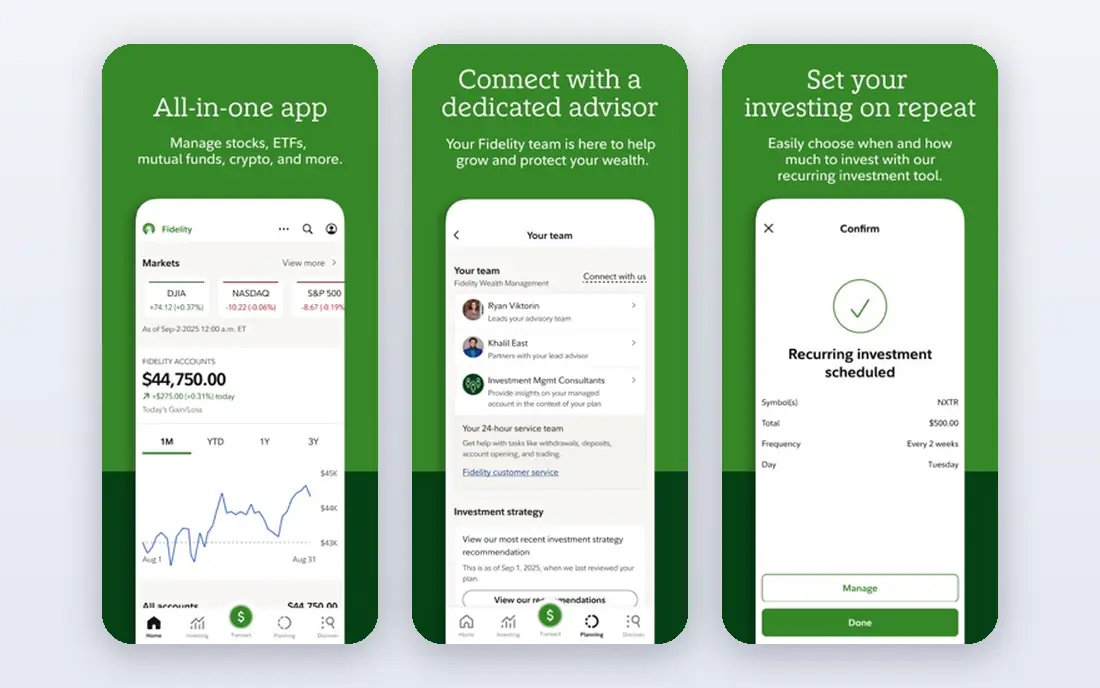
Fidelity is our pick for most people because it covers almost every Roth IRA need in one place. You can open an account with no minimum, trade stocks and ETFs online at $0, and choose from thousands of mutual funds, including Fidelity ZERO funds with no expense ratio. Fractional share trading lets small savers start with modest amounts, and retirement planning tools help you map contributions to a target date.
The catch is choice overload. Fidelity offers so many funds, tools and account types that a new investor can feel unsure where to start. Its managed option, Fidelity Go, helps here, with no minimum to open and automatic investing once the balance reaches $10. If you want a simple start, pick one diversified fund or a target-date fund, set up automatic contributions, and ignore the rest until you are ready to learn more.
- $0 account minimum
- $0 online stock and ETF trades
- Wide fund lineup including zero expense ratio funds
- The website and app can feel busy for first-time investors
- Some mutual funds carry transaction fees
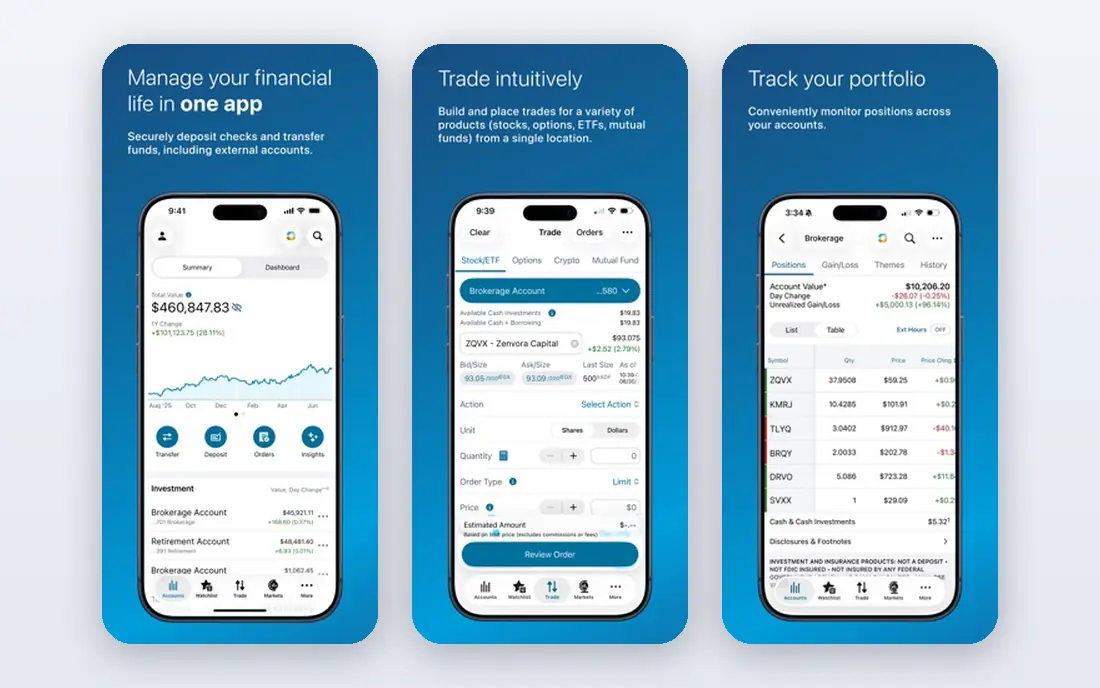
Schwab suits investors who like research, education and the option to talk to someone in person. Its Roth IRA has a $0 minimum and $0 online commissions for listed stocks and ETFs, and its research library covers funds, stocks and retirement planning in plain language. Branch access is a real advantage if you prefer face-to-face help with rollovers or beneficiary questions.
Schwab Intelligent Portfolios offers a managed path with no advisory fee, but it requires $5,000 and holds a cash allocation that some investors dislike. Stock Slices also work only for S&P 500 companies, so it is less flexible than broader fractional trading elsewhere. If you plan to buy individual stocks in small dollar amounts, check whether your picks qualify before you commit.
- $0 account minimum
- $0 online listed stock and ETF trades
- Strong research and in-person branches
- Fractional share buying is limited to S&P 500 stocks through Stock Slices
- Managed portfolios require a $5,000 minimum
Vanguard built its name on low-cost index investing, and that focus still shows in a Roth IRA. Its own index funds and ETFs carry low expense ratios, and its Target Retirement Funds give a one-fund option that adjusts its mix as you age. For a saver who wants to set up automatic contributions and leave the portfolio alone, Vanguard keeps the decision simple and the costs low.
The trade-off is polish. Vanguard's website and app are less modern than Fidelity or Schwab, and its trading tools are thinner for active traders. That rarely matters for a long-term Roth IRA, where you may trade only a few times a year. If low fees and a proven index approach matter most to you, Vanguard remains a strong, plain choice.
- $0 online stock and ETF trades
- Deep lineup of low-cost index funds
- Strong target-date funds
- The website feels dated next to newer apps
- Customer service hours and tools can feel limited
Robinhood is best for savers who want a Roth IRA that feels as simple as a phone app. Opening an account takes minutes, trades are commission free, and fractional shares let you start with $1. The app shows your holdings clearly and makes recurring investments easy to set up, which helps new savers build a habit.
The weakness is depth. Robinhood does not match Fidelity or Schwab on research, retirement calculators or fund screening, and its paid Gold tier gates some useful features. It also lacks the branch network and broad advisory services of older firms. If you want a simple self-directed Roth IRA and you already like mobile investing, Robinhood works well. If you want detailed guidance, pick a fuller-service provider.
- $0 commission stock and ETF trades
- Clean mobile app
- Fractional shares from $1
- Retirement planning tools are thinner than at full-service brokers
- Some features sit behind a paid Gold subscription
SoFi fits first-time Roth IRA savers who want a friendly start and some guidance along the way. Its self-directed IRA offers commission-free stock and ETF trades with no account minimum, and its app pairs investing with banking, loans and planning content. That all-in-one feel appeals to younger savers who want one app for several money tasks.
The limit is range. SoFi does not offer the same depth of mutual funds, research or trading tools as the large brokers, and serious traders will outgrow it. It also leans on automated portfolios for hands-off savers, which may not suit investors who want full control. For a first Roth IRA with simple investing and clear guidance, SoFi is a solid, low-friction start.
- $0 commission stock and ETF trades
- No account minimum
- Financial planning resources and member perks
- Fund lineup is narrower than at Fidelity or Schwab
- Advanced trading tools are limited
M1 takes a different approach to a Roth IRA. Instead of picking single trades all day, you build a pie of stocks and ETFs, set target percentages, and let M1 invest new money and rebalance toward those targets. That structure suits long-term savers who want a clear plan and less temptation to trade on news. Fractional shares mean every slice of the pie can be funded, even with small contributions.
The catch is timing. M1 runs trading windows rather than instant all-day trading, so it is a poor fit for anyone who wants to react to intraday price moves. Its research and screening tools are also basic next to Schwab or Fidelity. If you like the pie idea and you invest on a schedule, M1 is a neat, disciplined Roth IRA home. If you trade often, look elsewhere.
- $0 commission trades
- Visual pie portfolios with automatic rebalancing
- Fractional shares
- Trading happens in set windows rather than all day
- Research tools are basic
E*TRADE, now part of Morgan Stanley, suits Roth IRA holders who trade more actively or want better tools than a basic app. Its web and mobile platforms offer screeners, charts and research that go well past a simple buy button, and its fund and bond lineup is broad. A self-directed investor who follows markets closely will find more to work with here than at Robinhood or SoFi.
Beginners may find the range of platforms confusing at first, since ETRADE offers more than one way to trade. Options traders should also note the per-contract fee on top of $0 stock and ETF commissions. For a Roth IRA that you plan to manage actively, with occasional options or bond trades, ETRADE gives you room to grow without paying stock commissions.
- $0 online stock and ETF trades
- Strong trading platforms and screeners
- Wide fund and bond access
- The platform choice can confuse beginners
- Options contracts carry a per-contract fee
Wealthfront is for savers who want to answer a few questions, fund a Roth IRA, and let software handle the rest. It builds a diversified ETF portfolio based on your risk level, rebalances it automatically, and reinvests dividends without you placing trades. That hands-off model suits people who know they should invest for retirement but do not want to pick funds themselves.
The trade-off is control and cost. You pay an advisory fee, and you cannot build a fully self-directed stock portfolio in the same way you can at Fidelity or Schwab. Tax-loss harvesting, a headline Wealthfront feature, applies to taxable accounts rather than a Roth IRA, so do not count it as a Roth IRA benefit. If automation beats control for you, Wealthfront is a clean choice. If you like picking investments, a broker fits better.
- Automated diversified portfolios
- Automatic rebalancing
- Tax-loss harvesting in taxable accounts
- No self-directed stock picking in the IRA in the same way as a broker
- Advisory fee applies
How we picked these
We compared official pricing pages, account minimums, fund lineups, trading tools, managed options and support channels for well-known Roth IRA providers. We favored firms with $0 or low account costs, a broad choice of stocks, ETFs and funds, and clear fee pages. We also weighed the fit for different savers, from hands-off investors to active traders, rather than ranking on price alone. Prices and features change, so check the provider page before you open an account.
What to check before you open a Roth IRA
Start with how you want to invest. Self-directed savers need a broad fund lineup and low trading costs, while hands-off savers should compare managed portfolios, advisory fees and minimums. A provider that looks cheap for trading can still cost more if its managed fee is high or its fund expense ratios are steep, so read both layers.
Next, check contribution rules and account details. Roth IRA eligibility depends on income, and annual contribution limits change over time, so confirm the current IRS limits for your filing status. Ask about transfer-out fees, paper statement fees and fund transaction fees, and name beneficiaries when you open the account. Small setup steps now save your family paperwork later.
Match the provider to your habit
If you invest monthly and rarely trade, a low-cost index fund provider or an automated portfolio will serve you well. If you enjoy research and occasional stock picks, a full-service broker with screeners and fractional shares gives you more room. If you want in-person help, a firm with branches may be worth more than a slightly lower fund fee elsewhere.
Keep costs in view over time
Fund expense ratios matter more than a single trade commission over a 30-year retirement horizon. A fund charging 0.50 percent a year costs far more over time than one charging 0.05 percent, even if both sit in a $0 commission account. Compare the total cost of your planned portfolio, not just the headline account fee, and revisit it when your balance grows.
FAQ
What is the best company to open a Roth IRA with for beginners?
Fidelity is a strong starting point for most beginners because it has no account minimum, $0 online stock and ETF trades, fractional shares and a managed option if you want help. Schwab is close behind if you value branches and research. Pick the one whose app and support feel easiest to you, since you are more likely to keep contributing.
How much money do I need to open a Roth IRA?
Many providers on this list let you open a Roth IRA with no minimum, including Fidelity, Schwab, Vanguard, Robinhood, SoFi and M1. Managed portfolios may set their own minimums, such as $5,000 at Schwab Intelligent Portfolios. You can start small and add money over time, as long as you stay within IRS contribution limits.
Is a Roth IRA better than a traditional IRA?
It depends on your tax situation now and in retirement. Roth IRA contributions are made with after-tax money, and qualified withdrawals in retirement are generally tax free. Traditional IRA contributions may be tax deductible now, with withdrawals taxed later. Compare your current and expected future tax rates, and consider talking to a tax adviser.
Can I open a Roth IRA with more than one company?
Yes, you can hold Roth IRAs at more than one provider, but your total contributions across all IRAs must stay within the annual IRS limit. Spreading accounts can complicate record keeping and beneficiary updates. Most savers do better with one main Roth IRA and a clear investment plan.
Do Roth IRAs have fees?
Account fees are often $0 at the providers listed here, but fund expense ratios still apply, and some funds carry transaction fees. Managed portfolios charge an advisory fee, and options trades may carry per-contract fees. Read the fee schedule and fund prospectus before you invest, and favor low-cost diversified funds for long-term saving.