Best Community Engagement Software in 2026: 8 Platforms Compared
Compare the best community engagement software for local government and public projects, with surveys, mapping, forums, reporting, and pricing notes for 2026.

- Editor's choice
 EngagementHQ
Full civic engagement hubs
Starts atSee websiteVisit granicus.comFull review - Great alternative
 Go Vocal
Inclusive local government engagement
Starts atSee websiteVisit govocal.comFull review - Also consider
 Granicus
Large government digital services
Starts atSee websiteVisit granicus.comFull review
TL;DR:
- EngagementHQ and Go Vocal are the most complete civic platforms, with surveys, forums, mapping, and reporting in one hub.
- Granicus suits larger government teams that want engagement tied to wider digital services and communications.
- Smaller councils and nonprofits should start with a platform that offers a trial and a clear moderation workflow.
- Quote-based pricing is the norm here, so budget for implementation and staff time, not just a monthly fee.
- Good reporting matters as much as good surveys, because decision makers need to show what residents actually said.
Quick comparison
| Tool | Best for | Starts at | Free plan? | |
|---|---|---|---|---|
| EngagementHQ | Full civic engagement hubs | See website | Free trial | Visit |
| Go Vocal | Inclusive local government engagement | See website | Free trial | Visit |
| Granicus | Large government digital services | See website | No | Visit |
 Commonplace | Place-based project engagement | See website | Free trial | Visit |
 Social Pinpoint | Map-based community feedback | See website | Free trial | Visit |
 OpenGov | Engagement plus government operations | See website | No | Visit |
 Maptionnaire | Map surveys and spatial feedback | See website | Free trial | Visit |
 Hivebrite | Branded member communities | See website | Free trial | Visit |
The best community engagement software
Community engagement software is not just a survey tool. The platforms here let residents share ideas, comment on maps, join forums, and vote on options, while staff moderate, analyze, and report back. That full loop is what separates them from a simple form.
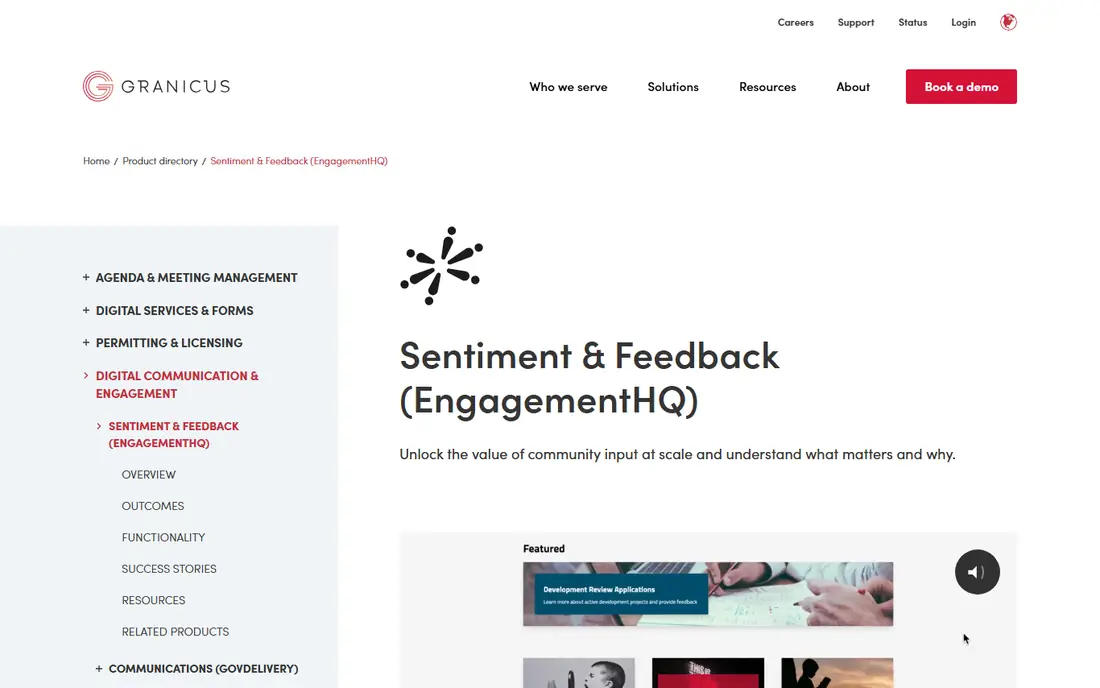
EngagementHQ, now part of Granicus, is built for governments that run many consultations at once. A single project page can host a survey, an idea board, a discussion forum, and a map, so residents do not have to chase separate links. Staff can moderate comments, track participation by project, and publish reports that show how feedback was used.
The main drawback is that pricing is not published, so small teams need a sales conversation before they can budget with confidence. Implementation also rewards a clear plan, because a hub with too many tools can confuse residents if the project page is not kept tidy. For a council with regular consultations, that depth is worth the effort.
- Surveys, forums, ideas, and mapping in one hub
- Strong moderation tools
- Detailed participation reporting
- Quote-based pricing
- Setup takes staff time for larger projects

Go Vocal, formerly CitizenLab, focuses on making public decisions more inclusive. Alongside surveys and idea collection, it supports participatory budgeting, option analysis, and workshops, which helps a council move from asking a question to letting residents weigh real trade-offs. Built-in analysis tools help staff sort large volumes of comments without reading every response by hand.
That government focus is both a strength and a limit. If you run a city, county, or public agency, the templates and workflows will feel familiar. If you run a private member community, a platform such as Hivebrite may fit better. Pricing is quote-based, so ask for a full quote that includes onboarding and training.
- Participatory budgeting and voting tools
- AI-assisted analysis of input
- Wide range of participation methods
- Quote-based pricing
- Best suited to government, not general brand communities
Granicus is the wider platform behind EngagementHQ, and it suits agencies that want engagement connected to websites, meetings, records, and resident communications. That breadth helps when the same team handles public notices, agendas, and service requests, because residents get a more consistent experience across services.
The trade-off is scale. A small town with one consultation a year may find Granicus heavier than a focused tool such as Commonplace or Social Pinpoint. Pricing is quote-based, and the value depends on how much of the wider suite you actually use. Ask which modules are included before you sign.
- Broad civic platform beyond engagement
- Strong communications tools
- Enterprise support and training
- No published price
- Can be more than a small team needs
Commonplace is built around place. Residents drop pins on a map, comment on a proposed development, and answer short surveys tied to a location, which is exactly what planning teams need. Project pages stay focused on one site or scheme, so feedback stays tied to a decision rather than drifting into general discussion.
That focus means Commonplace is less useful for an ongoing alumni or customer community. It also prices on request, so smaller projects should confirm costs early. For regeneration, transport, and housing consultations, its map-first design is a practical advantage.
- Strong map-based feedback for planning projects
- Clear project pages
- Good for developers and councils
- Less suited to general member communities
- Pricing on request
OpenGov is best known for budgeting, procurement, and permitting, and its engagement tools sit inside that wider system. That matters for a government that wants residents to comment on a budget or a service plan and then see the same data in its internal workflows. The reporting tools are stronger than those in a standalone survey app.
If you only need engagement, OpenGov may be more platform than you need, and you will pay for a suite rather than a single tool. For a city or county already using OpenGov, though, adding engagement in the same system can reduce duplicate work and keep records in one place.
- Wide government suite including budgeting and procurement
- Strong reporting
- Enterprise reliability
- Engagement is one part of a larger suite
- Quote-based pricing
Maptionnaire is a map survey tool first, and it does that job well. Planners can ask residents to mark routes, problem spots, and favorite places, then export the results for mapping and analysis software. That spatial detail is hard to get from a text survey alone, and it helps teams show residents that their local knowledge shaped a plan.
It is less of a full community hub, with less emphasis on ongoing forums and member management. If you need a long-running discussion space, pair it with a hub platform or pick a broader tool. For a focused consultation with a strong map component, it is a sharp choice.
- Map-based questionnaires
- Good data export for GIS teams
- Flexible survey design
- Less forum and community discussion depth
- Pricing on request
Hivebrite suits organizations that run a private community, such as an alumni network, a professional association, or a nonprofit membership base. Members get a branded portal, a directory, groups, events, and content, which keeps engagement inside your own space rather than on social media. That control helps with moderation and with keeping member data in one place.
Hivebrite is not a civic consultation platform, so it lacks the planning, budgeting, and public project tools that councils need. Pricing is quote-based, so ask about member count limits and support. For a membership community, its balance of branding and management tools is strong.
- Branded community portals
- Member directories and groups
- Events and content tools
- Less focused on public government consultations
- Pricing on request
How we picked these
We compared official product pages, feature lists, and public reviews, and we favored platforms that are still offered in October 2026 and that cover more than a single survey. We looked for moderation, accessibility, reporting, and a clear way for staff to close the loop with residents. Where pricing was not published, we wrote See website rather than repeating a third-party estimate as a vendor price.
How to choose a community engagement platform
Start with the decision you need to make, not the feature list. A planning consultation needs maps and location comments, a budget consultation needs voting and trade-off tools, and a member community needs groups and events. Match the tool to that decision, then check moderation, because a platform that cannot handle spam, abusive comments, and duplicate submissions will create more work than it saves.
Run a pilot with a real, low-stakes project and a real deadline. Invite a small group of residents, publish a short report at the end, and ask staff how long moderation and analysis took. That pilot will tell you more than a sales demo, and it will reveal whether residents found the page easy to use on a phone, which is where most of them will meet it.
FAQ
What is the best community engagement software?
EngagementHQ and Go Vocal are strong all-round picks for local government, while Commonplace and Social Pinpoint suit place-based projects. The best choice depends on whether you need a full hub, a map survey, or a private member community.
What apps are best for community engagement?
For public consultations, EngagementHQ, Go Vocal, Granicus, Commonplace, and Social Pinpoint are widely used. For private member communities, Hivebrite is a better fit, because it focuses on member portals, groups, and events.
How much does community engagement software cost?
Most civic platforms use quote-based pricing, so there is no single monthly price to compare. Ask for a quote that includes the number of projects, audience size, onboarding, training, and support, and check whether reporting and moderation tools are included.
Is there a free community engagement platform?
Some platforms offer free trials, but a fully free, full-featured civic hub is rare. A simple survey tool can be free, but moderation, mapping, reporting, and accessibility support usually sit in paid plans.
How do you keep online engagement fair and inclusive?
Offer more than one participation method, keep pages readable on phones, provide clear deadlines, and publish what changed as a result. Moderation rules should be public, and staff should report back even when the final decision does not match the most popular comment.
What is the difference between EngagementHQ and a survey tool?
A survey tool collects answers, while EngagementHQ hosts a project hub with surveys, forums, ideas, maps, and reports in one place. That hub lets residents follow a project over time and see how their input was used.
Social Pinpoint
Best for: Map-based community feedback
Social Pinpoint combines mapping with surveys, forums, and idea collection, which makes it a good fit for infrastructure and planning consultations. Residents can comment on a specific location, which gives staff feedback they can act on, rather than a pile of general opinions. The platform also supports participatory budgeting and project timelines.
As with most civic tools, pricing is not published, so the total cost depends on your project count and audience size. Smaller teams should test the trial with a real project, not a demo, to see whether moderation and reporting feel fast enough for daily use.