Best CDP Platforms in 2026: 8 Platforms Compared
Looking for the best CDP platforms? We compared 8 customer data platforms on identity, activation, warehouse support, and pricing for marketing teams.
- Editor's choice
 Twilio Segment
Broad integrations and fast setup
Starts at$120 per monthVisit segment.comFull review - Great alternative
 Hightouch
Warehouse-native activation
Starts atSee websiteVisit hightouch.comFull review - Also consider
 RudderStack
Warehouse-first event collection
Starts atFreeVisit rudderstack.comFull review
TL;DR:
- Twilio Segment is our pick for most teams, because it offers the broadest integration catalog, a free tier, and published entry pricing.
- Hightouch and RudderStack suit data-mature teams that want the warehouse to stay central, rather than a separate CDP database.
- Adobe Real-Time CDP and Salesforce Data 360 suit firms already invested in those suites, while Tealium suits compliance-heavy firms.
- CDP pricing scales with data volume, so model total cost, including overages, warehouse compute, and implementation, before signing.
Quick comparison
| Tool | Best for | Starts at | Free plan? | |
|---|---|---|---|---|
| Twilio Segment | Broad integrations and fast setup | $120 per month | Yes | Visit |
| Hightouch | Warehouse-native activation | See website | Yes | Visit |
| RudderStack | Warehouse-first event collection | Free | Yes | Visit |
 Tealium | Consent and tag management plus CDP | See website | No | Visit |
 mParticle | Mobile and web event data | See website | No | Visit |
 Treasure Data | Enterprise customer data and AI | See website | No | Visit |
 Adobe Real-Time CDP | Adobe Experience Cloud activation | See website | No | Visit |
 Salesforce Data 360 | Salesforce-wide customer data | See website | No | Visit |
The best CDP platforms
A customer data platform, or CDP, creates a persistent, unified customer database that other systems can use. It collects first-party data from websites, apps, and other sources, resolves identities across devices and channels, applies consent and governance rules, and sends audiences and events to marketing, analytics, and advertising tools. We compared official product pages, pricing pages, and public reviews for CDP platforms, with a focus on identity resolution, integrations, activation speed, governance, warehouse support, and total cost.
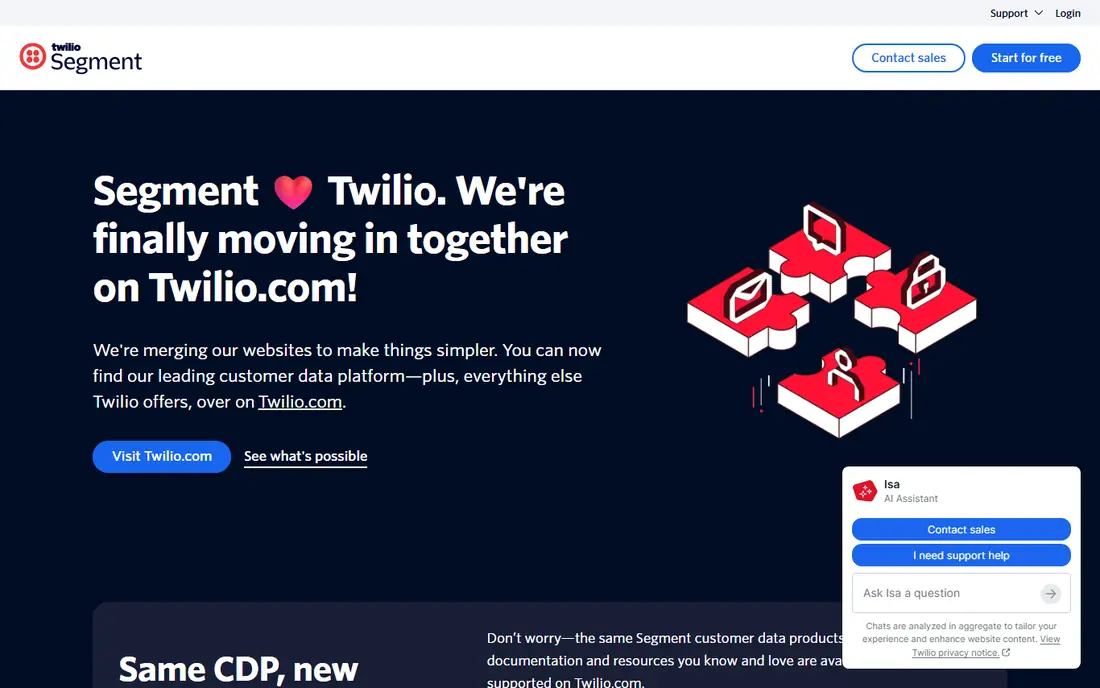
Twilio Segment is the default CDP for many marketing teams, and for good reason. Its Connections pipeline collects events from websites and apps, Unify builds customer profiles, and Engage sends audiences and journeys to downstream tools, with one of the broadest source and destination catalogs in the category. Setting up a new tool that needs CDP data often takes hours, not weeks, and team familiarity with Segment is high across marketing operations roles.
Pricing is the main watch point. The free tier covers up to 1,000 monthly tracked users, and the Team tier starts at $120 per month for up to 10,000 users, with overages and custom pricing above that. Real enterprise spend varies widely by volume, so model your monthly tracked users and event volume before signing, and negotiate overage caps where possible. For a team that wants the safe, well-integrated choice, Segment is the first platform to test.
- Largest integration catalog in the category in reviews
- Free tier up to 1,000 monthly tracked users
- Team tier at $120 per month for up to 10,000 users
- Costs scale with monthly tracked users and overages
- Enterprise spend can reach a wide range depending on volume and features
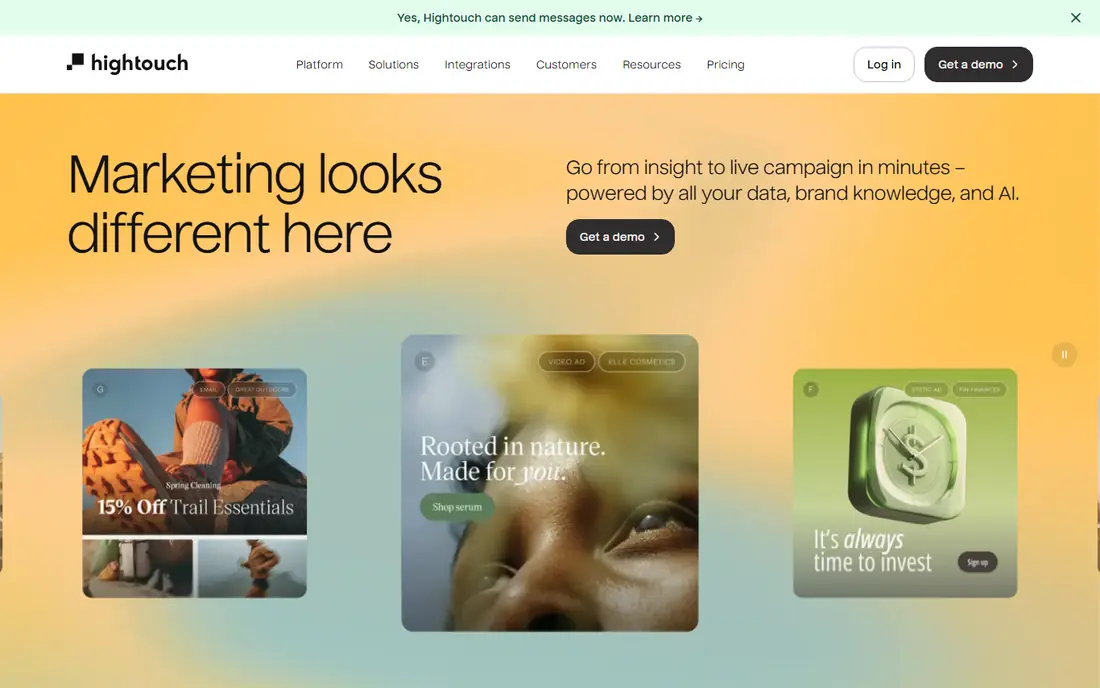
Hightouch takes a warehouse-native approach: instead of copying customer data into a separate CDP database, it reads models and tables from your existing warehouse, such as Snowflake, BigQuery, or Redshift, and syncs audiences to marketing tools. That model suits data-mature teams whose customer data already lives in a warehouse and who want marketers to use those models without waiting for engineering to export lists.
The trade is warehouse dependence. Hightouch works best when data models are reliable and maintained, and warehouse compute costs can rise as activation volume grows, even though platform storage fees are avoided. Pricing is quote-based for paid plans, with a free tier for smaller use. For a team with a strong warehouse, Hightouch is a cost-efficient and flexible CDP alternative.
- Activates audiences from an existing warehouse without copying data to a separate CDP store
- Marketer-friendly audience builder
- Avoids platform storage fees
- Needs a reliable warehouse and data models
- Warehouse compute costs can rise with activation volume
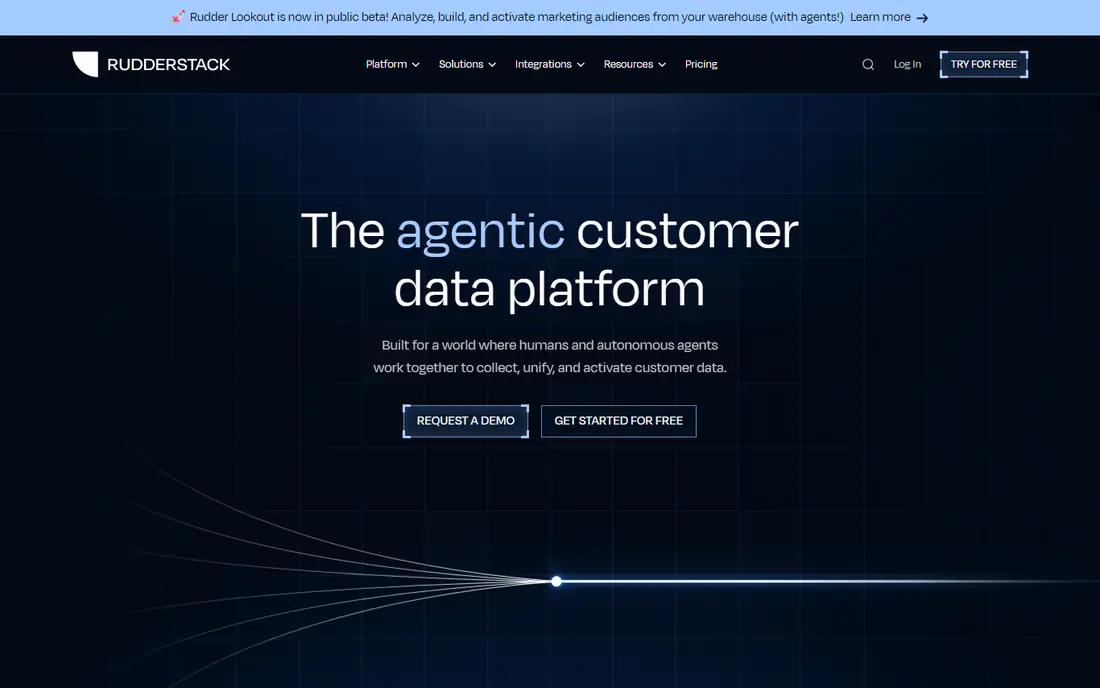
RudderStack is the warehouse-first CDP for engineering-led teams. It collects events from websites and apps, routes them to a warehouse and to downstream tools, and supports warehouse-based profiles and activation. That design keeps the warehouse central, which helps data teams that want one source of truth rather than a separate CDP store that can drift from warehouse models.
RudderStack needs more engineering involvement than Segment for setup and maintenance, and it suits product-led SaaS teams with serious data infrastructure. Pricing listings report a free tier up to 1 million events per month, Growth at $750 per month, and custom enterprise pricing. For a data-mature team that wants event collection plus warehouse activation, RudderStack is a strong pick.
- Free tier up to 1 million events per month in listings
- Warehouse-first design keeps the warehouse as source of truth
- Event collection plus activation
- Needs engineering involvement for best results
- Paid Growth tier listed at $750 per month, with enterprise pricing custom
Tealium combines tag management, a customer data hub, and consent management in one platform, which suits compliance-heavy firms that need to control what data is collected and where it goes. Its AudienceStream product builds audiences from web, mobile, and offline data, with over 1,300 integrations in its own materials, and its hybrid tag and API architecture supports both website tags and server-side collection.
Pricing is quote-based and event-based, which reviewers describe as less transparent than Segment's monthly tracked user model, so request a written quote tied to your event volume and use cases. Enterprise spend in third-party listings is reported in a wide range, so treat those figures as directional, not as a quote. For a regulated firm that needs consent plus CDP in one vendor, Tealium is a strong choice.
- Combines tag management, CDP, and consent management
- Strong governance and compliance features
- Hybrid tag and API architecture
- Pricing is quote-based and event-based, with less transparency than Segment in reviews
- Enterprise cost can be high
mParticle is built for mobile and web event data, with a single SDK that collects events once and forwards them to downstream tools, rather than loading many third-party SDKs into an app. Its data quality tools, governance controls, and identity graph help teams clean, validate, and unify customer data before activation, and its audience builder supports segmentation for campaigns.
Pricing is quote-based, with no published entry tier, and third-party listings report a wide annual range for enterprise deployments, so request a quote for your event volume and features. Implementation can be complex for smaller teams, and mParticle suits mid-size to enterprise firms with mobile apps at the center of their customer data. For mobile-first teams, mParticle deserves a place on the shortlist.
- Single SDK reduces third-party bloat on mobile
- Data quality and governance controls
- Audience builder with identity graph
- Pricing is quote-based, with no published entry tier
- Implementation can be complex for smaller teams
Treasure Data, now listed as Treasure AI in some materials, is an enterprise CDP that unifies online and offline customer records and supports AI-assisted marketing workflows. It suits large firms with complex data, many sources, and a need for governance, identity resolution, and activation across channels. Its enterprise focus includes security, compliance, and support for large data volumes.
Pricing is quote-based, and implementation can be long, especially when migrating from another CDP or unifying offline and online data. Smaller teams will find Segment, Hightouch, or RudderStack faster and cheaper to start. For a large enterprise that needs a full CDP with AI features, Treasure Data is a credible contender.
- Enterprise customer data platform with AI-assisted marketing features
- Unifies online and offline records
- Strong governance for large firms
- Pricing is quote-based
- Implementation and migration can be long for complex enterprise data
Adobe Real-Time CDP is part of Adobe Experience Platform, and it shines for firms already using Adobe tools. Audiences built in the CDP can be activated in Journey Optimizer, Target, and other Adobe applications with tight integration, and enterprise governance, identity, and data controls are strong. For a firm with a large Adobe footprint, that suite integration can be worth the cost.
Pricing is custom, with reviews reporting a high all-in cost once base platform and add-on products are included, so request a full quote for your Adobe stack, not just the CDP alone. Firms without Adobe tools will find Segment or Hightouch simpler and cheaper. For Adobe-centric enterprises, Adobe Real-Time CDP is the natural CDP choice.
- Audience activation within Adobe Experience Cloud
- Works with Journey Optimizer, Target, and other Adobe tools
- Strong enterprise governance
- Pricing is custom and high, with base plus add-on costs in reviews
- Best value only for firms already invested in Adobe
Salesforce Data 360, formerly Salesforce CDP, unifies customer data across Salesforce applications, including Sales, Service, and Marketing Cloud, and activates audiences through those tools. For a firm whose customer data already lives in Salesforce, Data 360 reduces the need for a separate CDP store and keeps profiles close to CRM records, campaigns, and service cases.
Pricing is custom and tied to your Salesforce stack, so request a quote that covers Data 360 plus any Marketing Cloud or add-on costs. Firms without a Salesforce footprint will find a standalone CDP such as Segment simpler to adopt. For Salesforce-centric firms, Data 360 is the most direct CDP path.
- Unifies customer data across Salesforce applications
- Activation through Marketing Cloud and other Salesforce tools
- Strong CRM integration
- Pricing is custom
- Best value only for firms already invested in Salesforce
How we picked these
We compared official product pages, pricing pages, and public reviews for customer data platforms, and we favored platforms that are actively maintained and support real identity resolution, governance, and activation, not just event forwarding. We looked for integration catalogs, warehouse support, consent and governance features, audience building, and published or quote-based pricing, and we checked whether each platform suits marketing-led, engineering-led, or suite-led buyers. We did not claim hands-on testing that did not happen; the picks reflect published features and public reviews.
How to choose the best CDP platform
Start with where your customer data already lives. If it lives in many tools with no central store, Segment is the safest starting point. If it lives in a warehouse with reliable models, Hightouch or RudderStack may be cheaper and more flexible. If it lives in Adobe or Salesforce, the matching CDP will usually integrate best, despite higher cost.
Next, run a proof of concept with your own data, not a vendor demo dataset. Test identity resolution with real edge cases, such as anonymous and known profiles, bot traffic, and schema changes, and test activation speed and audience accuracy in one downstream tool. Finally, model total cost: platform fees, overage charges, warehouse compute, implementation, and migration, plus the cost of switching later. A CDP migration can take months, so a careful proof of concept is worth the time.
CDP best practices for a first deployment
Start with one or two high-value use cases, such as unifying web and app profiles for email campaigns, rather than trying to unify all data at once. Define consent and governance rules early, including which identifiers can be used and how opt-outs flow to downstream tools. Document event names and schemas before implementation, since inconsistent events are a common cause of poor CDP results. Review data quality monthly, and confirm data export terms in your contract before signing.
FAQ
What is the best CDP platform?
Twilio Segment is our pick for most teams, because of its broad integrations, free tier, and published entry pricing. Hightouch and RudderStack suit warehouse-centric teams, Tealium suits compliance-heavy firms, and Adobe Real-Time CDP and Salesforce Data 360 suit firms already invested in those suites.
What is the best CDP software for small business?
Segment's free tier and $120 per month Team tier make it the most accessible CDP for a small team, while Hightouch and RudderStack offer free tiers for warehouse-led teams. Most other CDPs on this list are enterprise-priced and quote-based, so a small team should start with a free or low-cost tier and prove one use case first.
What are CDP platform best practices?
Start with one or two use cases, define consent and governance rules early, document event schemas, and test identity resolution with real data. Model total cost, including overages and warehouse compute, negotiate overage caps, and confirm free data export in your contract. Run a proof of concept with production-like data before a full rollout.
Is Segment or mParticle better?
Segment is better for broad integrations, fast setup, and team familiarity, with published entry pricing and a free tier. mParticle is better for mobile-first teams that want a single SDK, strong data quality controls, and a governance-focused platform. Compare both on your exact event types, identifiers, and campaign workflow, not on integration counts alone.
How much does a CDP cost?
Segment starts at $120 per month for Team, with a free tier up to 1,000 monthly tracked users, while RudderStack lists Growth at $750 per month. Most other CDPs are quote-based, with third-party listings reporting wide enterprise ranges, so your volume, features, and implementation needs will set the price. Always request a written quote tied to your data volume.
What is the difference between a CDP and a CRM?
A CDP creates a unified customer database from first-party data across channels and makes it available to other systems for activation, while a CRM tracks known customer interactions, such as sales and service cases. A CDP can feed a CRM, and a CRM can feed a CDP, but they serve different jobs: a CDP unifies data, while a CRM manages relationships and sales workflows.