Best Brand Protection Companies in 2026: 9 Compared
Best brand protection companies in 2026: we compared 9 firms for counterfeit takedowns, phishing defense, domain monitoring, and trademark enforcement.
- Editor's choice
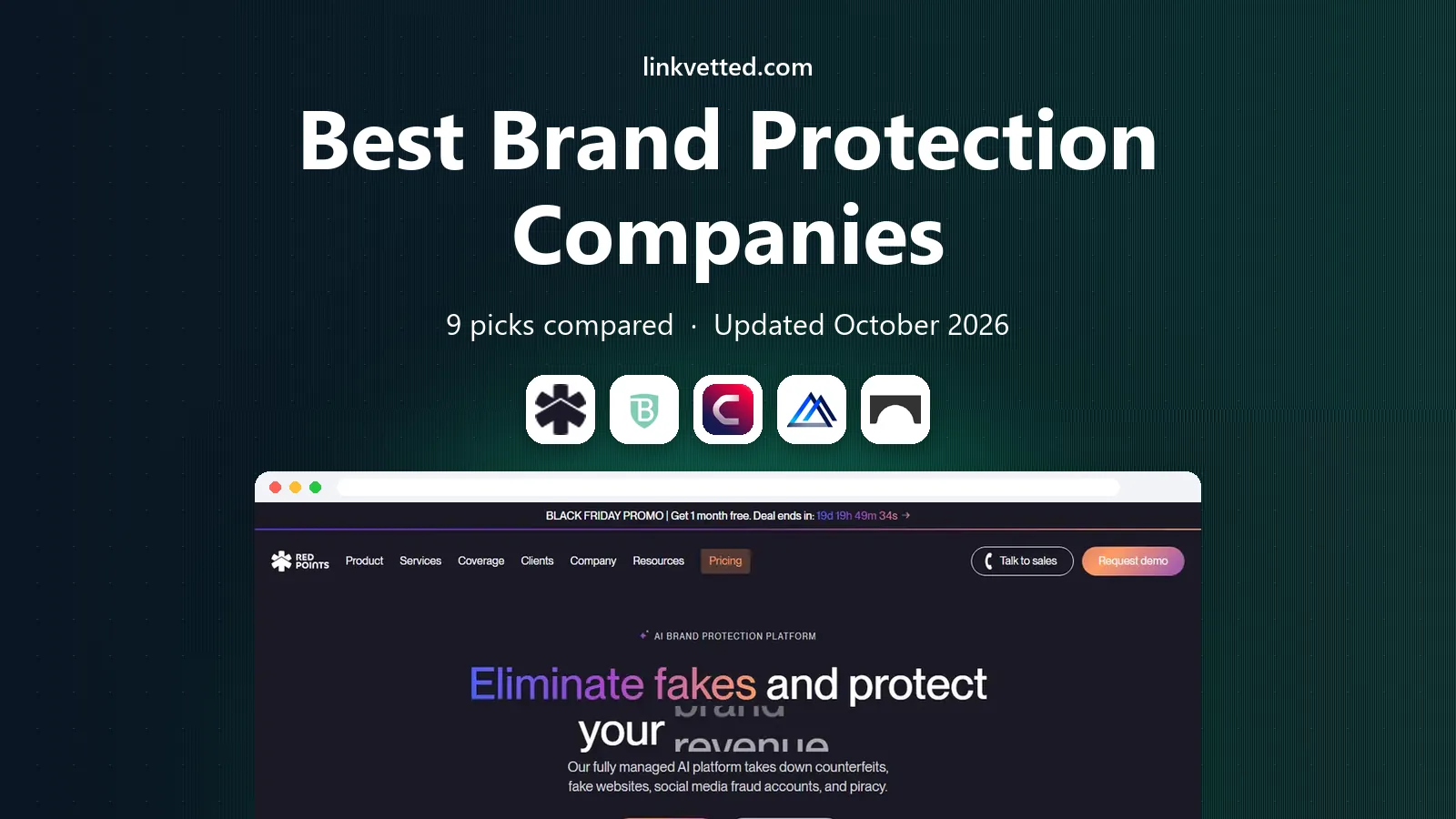
 Red Points
Marketplace counterfeit takedowns
Starts atSee websiteVisit redpoints.comFull review - Great alternative
 BrandShield
Phishing and impersonation defense
Starts atSee websiteVisit brandshield.comFull review - Also consider
 Corsearch
Trademark plus enforcement
Starts atSee websiteVisit corsearch.comFull review
TL;DR:
- Brand protection has two halves: finding fakes and getting them taken down, and vendors differ sharply on both.
- Red Points suits brands drowning in marketplace counterfeits, while BrandShield suits phishing and impersonation threats.
- Corsearch fits legal teams that need trademark lifecycle work plus enforcement in one place.
- Small brands should start with a published-price tool, since enterprise tools are quote-only and annual.
- Our pick for most mid-size consumer brands is Red Points for marketplaces, paired with BrandShield if phishing is a major threat.
Quick comparison
| Tool | Best for | Starts at | Free plan? | |
|---|---|---|---|---|
| Red Points | Marketplace counterfeit takedowns | See website | No | Visit |
| BrandShield | Phishing and impersonation defense | See website | No | Visit |
| Corsearch | Trademark plus enforcement | See website | No | Visit |
 MarkMonitor | Large domain portfolios | See website | No | Visit |
 Bolster | AI phishing detection | See website | No | Visit |
 ZeroFox | Enterprise digital risk protection | See website | No | Visit |
 Appdetex | Domain and marketplace enforcement | See website | No | Visit |
 OpSec Security | Physical plus digital protection | See website | No | Visit |
 BrandVerity | Paid search and affiliate compliance | See website | No | Visit |
The best brand protection companies
Brand protection covers counterfeit listings, fake websites, phishing domains, social impersonation, and trademark abuse. No single vendor covers every threat equally well. Some excel at marketplace takedowns, others at phishing defense, and others at trademark law. The companies below are active in October 2026 and cover the main threat types.
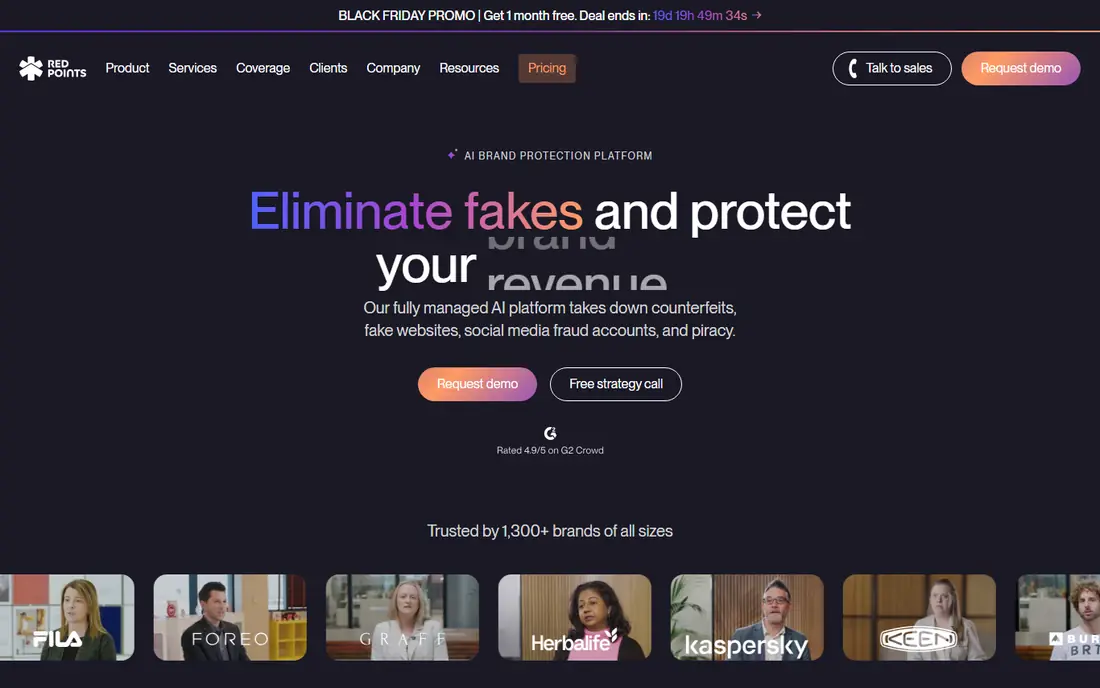
Red Points is built for brands fighting counterfeits across marketplaces and social channels. It detects infringing listings, validates them, and files takedowns, with flat-fee programs priced by scope rather than per takedown. That model helps budgeting when a counterfeit wave hits, since the bill does not jump with each removal.
Pricing is quote-only, and public benchmarks put professional programs in the tens of thousands of dollars a year. For a small brand with a handful of fakes, that may be too much. For a consumer brand with steady marketplace abuse, Red Points is a strong first call.
- Flat-fee programs by scope
- Unlimited takedowns within scope
- Strong marketplace coverage
- Quote-only pricing
- Enterprise budgets needed for full programs
BrandShield focuses on digital risk, including phishing sites, fake domains, and social impersonation. Its security operations team works around the clock, and its managed anti-phishing program has been listed at $22,000 for a 12-month term on a public marketplace. That phishing focus suits banks, tech firms, and any brand whose customers are targeted by fake login pages.
The catch is package detail. Enforcement limits and takedown types vary by plan, so get the numbers in writing before signing. BrandShield is less of a marketplace counterfeit tool and more of a phishing defense partner, so pair it with a marketplace tool if both threats matter.
- Phishing and fake domain takedowns
- Round-the-clock security operations
- Social impersonation coverage
- No published pricing page
- Enforcement caps vary by package
Corsearch combines trademark lifecycle work with brand protection enforcement. Legal and IP teams can search and watch trademarks, manage portfolios, and run enforcement against counterfeits, domains, and social abuse from one vendor. That combination suits companies where trademark law and takedown work sit in the same team.
Pricing is quote-based and annual, which makes Corsearch a poor fit for a small brand that just needs a few takedowns. For an enterprise IP team, the single-vendor approach can save coordination time and keep legal records in one place.
- Trademark search, watching, and management
- Enforcement across channels
- Legal team support
- Quote-only and annual contracts
- Complex for small brands
MarkMonitor is the domain specialist on this list, now under Com Laude ownership. It manages large domain portfolios, monitors for infringing and lookalike domains, and supports enforcement against domain abuse. For a company with hundreds or thousands of domains, that focus matters, since domain sprawl creates phishing and brand confusion risks.
It is not a full marketplace counterfeit suite. Brands that need heavy marketplace takedowns should pair MarkMonitor with Red Points or Corsearch, using MarkMonitor for the domain layer.
- Domain portfolio management
- Domain monitoring and enforcement
- Enterprise scale
- Narrower focus than full brand protection suites
- Enterprise pricing
Bolster uses AI to detect phishing sites, fake domains, and impersonation, then runs takedowns. Its speed on phishing matters, since a fake login page can harm customers within hours. Bolster suits security-led teams that need automated detection plus human-reviewed enforcement.
Pricing is negotiated, with third-party buyer data putting median annual costs around $37,500. Small brands may find that high, but for a company facing regular phishing waves, the detection speed can justify the spend.
- AI detection of phishing and impersonation
- Fast takedown workflows
- Brand monitoring
- Quote-only pricing
- Median enterprise costs reported in tens of thousands a year
ZeroFox covers brand, executive, and domain protection plus threat intelligence for enterprise security teams. It monitors social, web, and dark web sources for impersonation and threats, and supports takedowns. That breadth suits large companies with security teams that already manage risk programs.
For a small consumer brand, ZeroFox is likely more scope and cost than needed. Third-party buyer data puts average annual costs above $45,000. For an enterprise that needs brand and executive protection together, it is a credible shortlist option.
- Broad digital risk coverage
- Executive and brand protection
- Threat intelligence
- Enterprise pricing
- Broad scope can be more than a small brand needs
Appdetex offers domain monitoring, marketplace enforcement, and social takedown work from one platform. It suits brands that need domain and marketplace coverage without buying two separate tools. Its enforcement workflow covers the main channels where fakes appear.
As a smaller vendor than Corsearch or MarkMonitor, Appdetex may need a closer look at coverage in your regions and channels. Ask for takedown times by channel and for sample reports before committing.
- Domain monitoring and enforcement
- Marketplace and social takedowns
- Brand protection platform
- Quote-only pricing
- Less well known than larger rivals
OpSec Security stands out for brands that need both physical and digital protection. It offers product authentication, supply chain security, and digital brand monitoring, which suits luxury, pharma, and consumer goods brands where fake physical products are as big a problem as fake listings.
A digital-only brand may not need the physical layer, and enterprise pricing reflects the broader service. For a brand with counterfeit goods in stores and online, the combined approach can close gaps that a digital-only tool misses.
- Physical product authentication plus digital monitoring
- Supply chain protection
- Global reach
- Enterprise focus
- Physical services add complexity for digital-only brands
BrandVerity is a narrow specialist, and that narrowness is its value. It monitors paid search for trademark bidding, ad hijacking, and affiliate compliance violations. If partners or competitors bid on your brand terms or run misleading ads, BrandVerity finds it and documents it.
It does not replace a counterfeit or phishing tool. Use it as an add-on when paid search abuse is a real cost, alongside a broader brand protection vendor for marketplaces and domains.
- Paid search monitoring
- Affiliate compliance checks
- Trademark bidding detection
- Narrow scope
- Not a full counterfeit or phishing suite
How we picked these
We compared official product pages, marketplace listings, and independent 2026 brand protection comparisons. We favored vendors with a clear threat focus, a verifiable client base, and an active product in October 2026. We used See website where vendors do not publish prices, rather than inventing a rate, and we noted public price signals only where a marketplace or buyer dataset reported them.
How to choose by threat type
Start by listing your top three threats in the past year. Marketplace counterfeits, phishing domains, social impersonation, and paid search abuse need different tools. A vendor that excels at one may be weak at another, so shortlist by threat, not by brand size alone.
Ask who files takedowns, and how fast
Ask whether the vendor files takedowns itself, prepares them for you, or relies on a law firm. Ask for takedown times by channel, since a phishing site blocked in minutes is not the same as a marketplace listing removed in days. Get the takedown scope in writing, including whether reappearing fakes are rechecked.
Check verification before action
Ask how findings are verified before a takedown. A good vendor checks the final landing page and confirms infringement, rather than flagging every domain that matches your brand name. False takedowns harm partners and waste legal time, so verification quality matters as much as detection volume.
Price by scope, not by logo
Price moves with trademarks, countries, channels, and takedown limits. Get quotes on the same scope from each vendor, and ask what happens when a new threat channel appears. A flat-fee program with unlimited takedowns within scope is easier to budget than per-takedown billing during a counterfeit wave.
FAQ
What is the best brand protection software?
For marketplace counterfeits, Red Points is a strong choice. For phishing and impersonation, BrandShield and Bolster lead. For trademark plus enforcement, Corsearch fits legal teams. Pick by your main threat, not by a single overall ranking.
How much does brand protection cost?
Enterprise programs often run tens of thousands of dollars a year, priced by trademarks, channels, and takedown scope. Small brands can start with published-price tools at a few hundred dollars a month, while enterprise tools are quote-only and annual.
What does brand protection software do?
It finds counterfeit listings, fake websites, phishing domains, and social impersonation, then helps remove them. Some tools also manage trademarks, monitor paid search, and protect physical products with authentication.
Is MarkMonitor still a brand protection company?
Yes. MarkMonitor remains active as a domain portfolio and enforcement specialist, now under Com Laude ownership. It is strongest for large domain portfolios, paired with a marketplace tool for counterfeit listings.
How fast are takedowns?
Speed varies by channel. Phishing domains and browser blocks can be fast, while marketplace and social takedowns depend on platform review times. Ask each vendor for takedown times by channel, not just an average success rate.
Do small brands need brand protection software?
Not always. A small brand with a few fakes can start with platform reporting tools and a published-price scanner. Enterprise software makes sense when fakes appear regularly, across many channels, and start costing sales or customer trust.