Best AI Search Optimization Platform for Beginners in 2026: 8 Platforms Compared
Find the best ai search optimization platform for beginners, with simple prompt tracking, clear fixes, and prices that suit a first AI search tool in 2026.
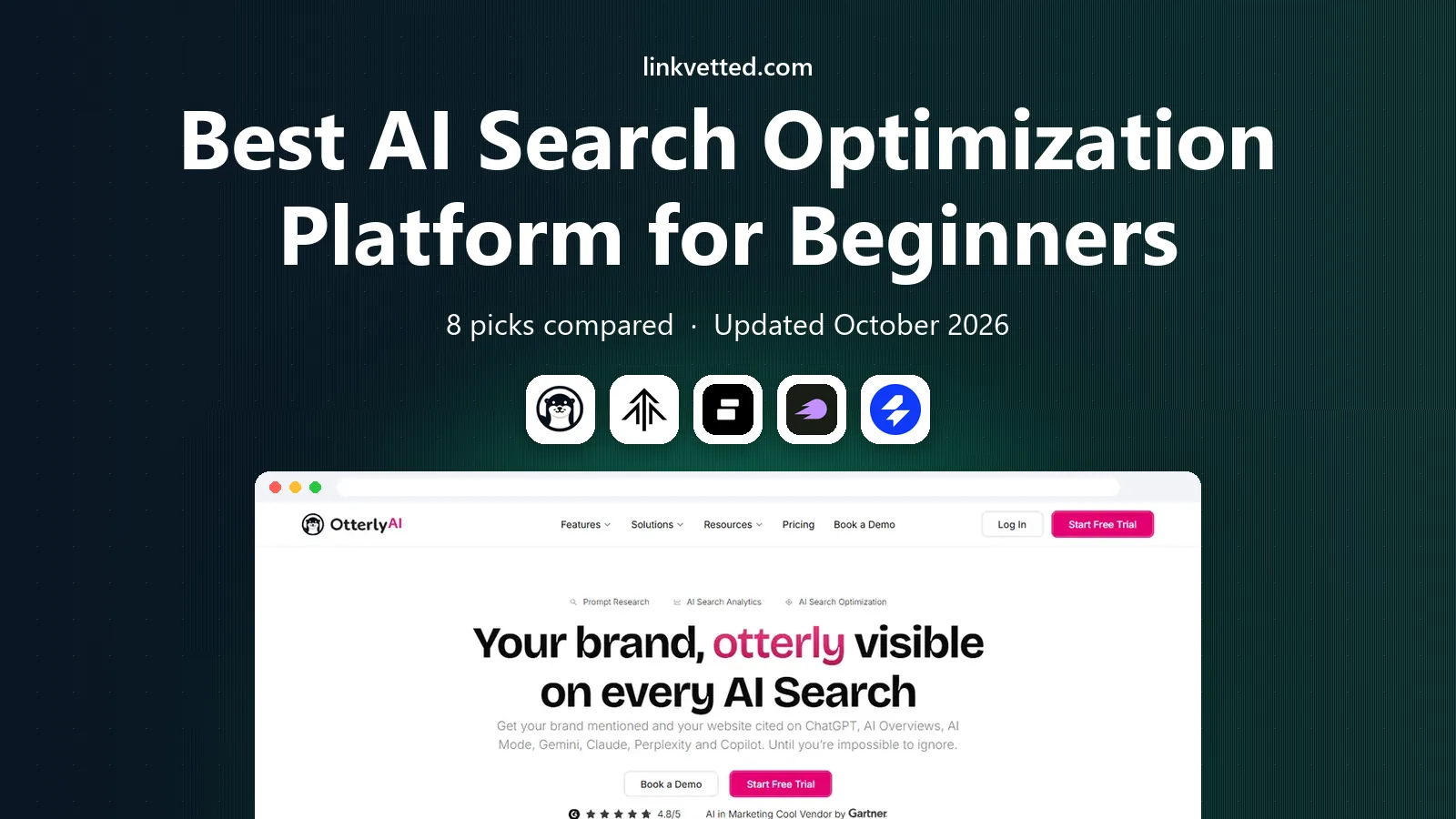
- Editor's choice
 Otterly.AI
Beginners who want a low-cost start
Starts at$29 per monthVisit otterly.aiFull review - Great alternative
 Rankscale
Startups that want flexible pricing
Starts at$20 per monthVisit rankscale.aiFull review - Also consider
 Peec AI
Small teams that want daily tracking
Starts at$95 per monthVisit peec.aiFull review
TL;DR:
- Otterly.AI and Rankscale give beginners the lowest-cost way to start tracking AI search visibility.
- Prompt count, not the headline price, decides whether a plan fits your site, so count your key topics first.
- Tools that add action steps beat score-only dashboards for beginners who must fix pages themselves.
- Free trials and free tiers are worth using before paying, because AI visibility scores are directional, not exact.
Quick comparison
| Tool | Best for | Starts at | Free plan? | |
|---|---|---|---|---|
| Otterly.AI | Beginners who want a low-cost start | $29 per month | Free trial | Visit |
| Rankscale | Startups that want flexible pricing | $20 per month | Free trial | Visit |
| Peec AI | Small teams that want daily tracking | $95 per month | Free trial | Visit |
 Semrush AI Visibility Toolkit | Teams already using Semrush | $99 per month | Free trial | Visit |
 SE Ranking AI Search | SEO teams that want AI data inside one suite | $79 per month | Free trial | Visit |
 AthenaHQ | Teams that want a free tier to test | Free | Yes | Visit |
 Scrunch AI | Teams that need crawler and agent data | $250 per month | Free trial | Visit |
 Profound | Larger brands that need deep data | See website | Free trial | Visit |
The best ai search optimization platform for beginners
We compared AI search tools on prompt tracking, engine coverage, ease of setup, and price for a beginner. The best ai search optimization tools for beginners are the ones that explain what to fix, not just show a score.

Otterly.AI is the easiest starting point in this list. Setup takes minutes, the dashboard is plain, and the entry plan tracks a small set of prompts across the main AI surfaces people actually use. For a beginner testing one brand or one small site, that scope is enough to learn how AI answers mention you.
The limit is prompt count. Fifteen prompts cover a handful of topics, not a full product catalog, so larger sites will need a higher tier quickly. Otterly.AI also focuses on monitoring, so you will still need to write the content fixes yourself.
- Simple setup
- Tracks ChatGPT, AI Overviews, Perplexity, and Copilot
- Clear prompt reports
- Lite plan covers only 15 prompts
- Action guidance is limited
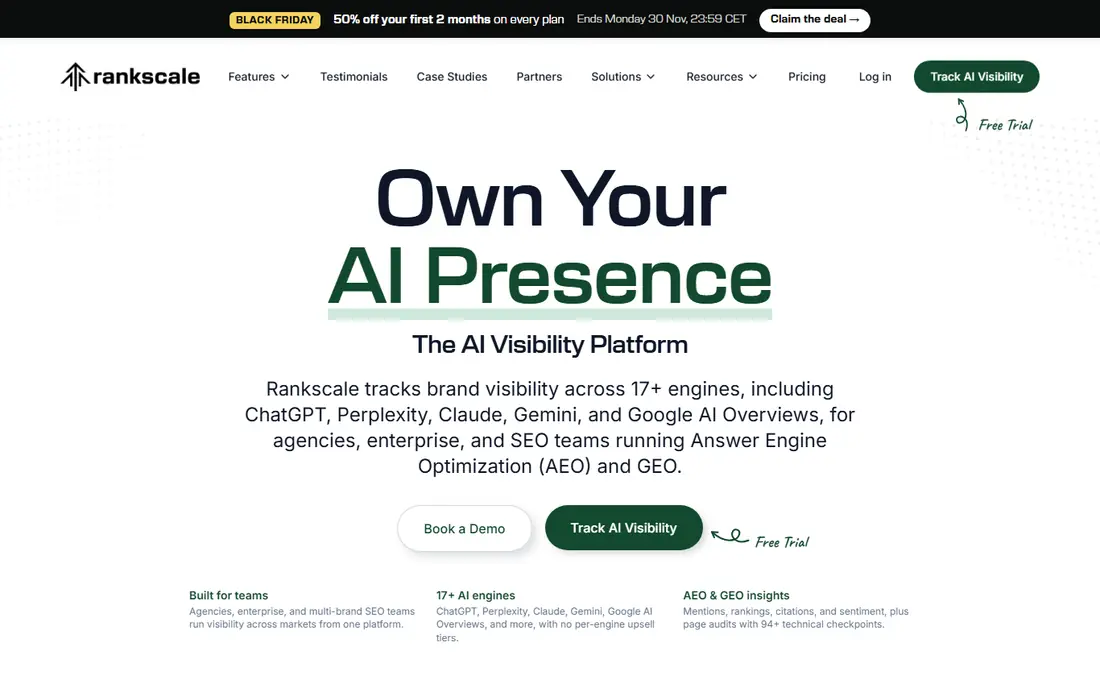
Rankscale appeals to beginners because the entry price is low and engine coverage is broad, including ChatGPT, Gemini, Perplexity, Claude, and others. That breadth helps you see whether an AI engine mentions your brand at all, rather than guessing from one engine alone. The credit model also suits teams that want to test in bursts.
The drawback is maturity. Rankscale is a newer name than Semrush or Ahrefs, so long-term support and reporting depth are less proven. It is a good trial tool, but check export options before you build a whole reporting workflow around it.
- Low entry price
- Wide engine coverage
- Pay-for-use credits on higher plans
- Newer vendor with less track record
- Interface is less polished than larger rivals
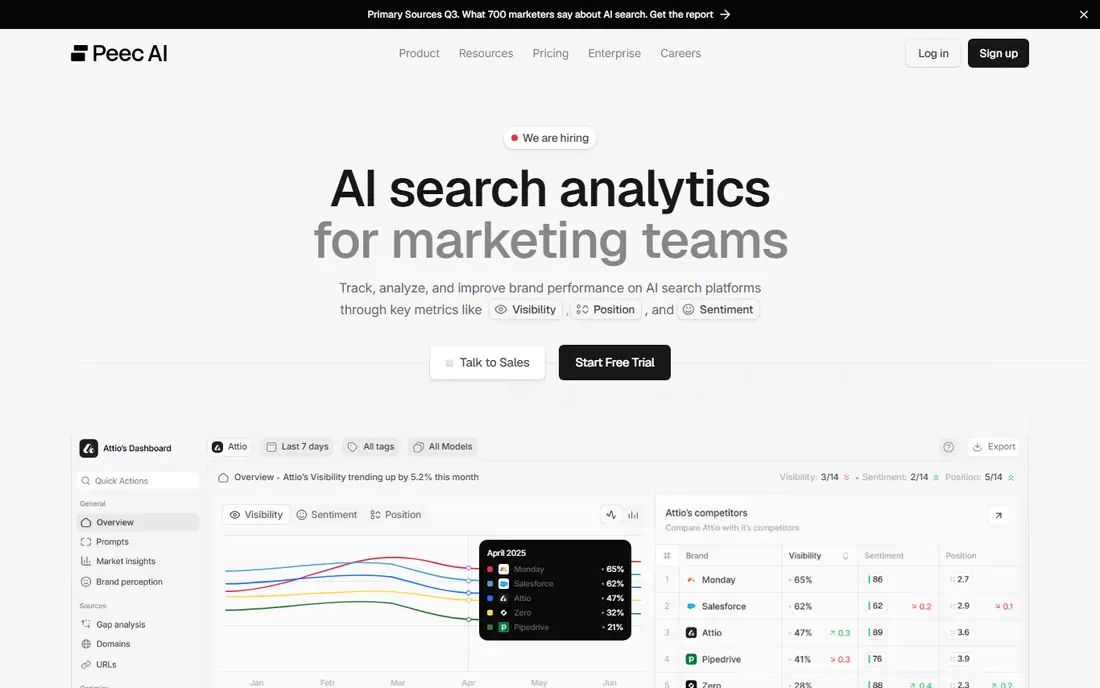
Peec AI gives beginners daily tracking without a steep learning curve. You pick prompts, choose engines, and watch how often your brand appears in AI answers over time. That daily view is useful for spotting sudden changes after a content update or a news story.
The entry price is higher than the cheapest tools, and prompt limits still matter. A team tracking many locations or languages should check country and language limits before signing up, because those can force an upgrade.
- Daily prompt tracking
- Choice of engines
- Straightforward dashboard
- Entry plan covers one country on some tiers
- Higher price than Otterly.AI
If you already pay for Semrush, its AI Visibility Toolkit is the simplest add-on to try. You keep keyword, backlink, and content tools in one account, and you can compare AI visibility with classic search rankings. That context helps beginners understand whether an AI drop is a real problem or a small shift.
The catch is that it is an add-on, not a standalone tool, so the total cost depends on your Semrush plan. Prompt counts on the entry tier are also modest, so large sites may need a higher tier to cover their key topics.
- Fits inside a familiar SEO suite
- Tracks major AI engines
- Content ideas included
- Priced per domain
- Prompt counts are modest on the entry plan
SE Ranking adds AI search tracking to a full SEO platform at a price that undercuts some rivals. Beginners who already track rankings will find the layout familiar, and the prompt allowance on paid plans is generous for the price. That makes it a good value pick for a small SEO team.
The AI side is newer than SE Ranking's classic rank tracking, so reports may feel less deep than a dedicated AI visibility tool. Beginners with no SEO background may also need time to learn the wider suite before the AI reports feel useful.
- AI Overviews and AI engine tracking
- Many prompts for the price
- Full SEO suite
- AI features are newer than core rank tracking
- Setup needs some SEO knowledge
AthenaHQ is unusual because it offers a free tier, which lowers the risk of trying AI search tracking for the first time. The paid plans add more credits and engines, and the recommendation engine tries to turn citation gaps into concrete content fixes. That guidance is valuable for beginners who know they need to act but are unsure what to change.
The paid Starter plan is priced well above the cheapest tools, so the free tier is the main draw for beginners. The credit system also needs a little learning, because one credit does not always mean one simple check across every engine.
- Free tier to start
- Automated recommendations
- Wide engine coverage
- Paid Starter plan is expensive
- Credit system takes time to learn
Scrunch AI goes further than simple prompt tracking by showing how AI crawlers and agents interact with your site. That extra layer helps teams that want to know whether AI systems can read, cite, and reach their pages at all. For a technical team, that diagnostic view is a real advantage.
The price and setup put it beyond most beginners. At $250 per month on annual billing, it is an investment, and the crawler data needs someone who can act on it. Beginners should start cheaper and move here when crawler issues become a known problem.
- AI crawler analytics
- Citation tracking
- Content and agent insights
- High entry price
- More setup than beginner tools
Profound offers some of the deepest AI search data in this list, with citation detail across many answer engines. Larger brands use it to track many products, regions, and competitors in one place. The trial lets you see that depth before a sales conversation.
The dashboard is dense and analyst-focused, which can overwhelm a beginner. Pricing is also sales-led for full plans, so small teams may find it hard to get a firm number without a demo. It is a strong enterprise tool, not the simplest first step.
- Deep multi-engine data
- Citation detail
- Enterprise reporting
- Sales-led pricing
- Heavier dashboard for beginners
How we picked these
We compared official pricing pages and public comparisons for AI search tools, and we favored tools that a beginner can set up without an agency, publish clear pricing or a free tier, and track the main AI engines. We left out agency-only services and tools that only report classic search rankings, because this list is for AI search visibility.
How to start with AI search optimization
Pick ten prompts that matter
Do not track hundreds of prompts on day one. Pick ten questions a real customer would ask, plus your brand name and your top product names. If your tool cannot cover those ten well, it is not the right tool, no matter how many extra features it lists.
Fix pages that AI systems cannot cite
AI answers cite pages that are clear, factual, and easy to quote. Add short answers near the top of key pages, use clear headings, and keep facts current. A tracking tool can show the gap, but the content fix is what changes the citation.
Check trends, not single days
AI answers change often, so one good or bad day means little. Watch weekly trends for each prompt, and note what changed on your site when a trend moves. That habit keeps beginners from chasing noise and helps you spot real wins.
FAQ
What is the best ai search optimization platform for beginners?
Otterly.AI is a strong first choice because it is cheap, simple, and covers the main AI engines. Rankscale is another low-cost start, while Semrush suits teams that already use that suite. The best ai search optimization platform for beginners is the one you will check weekly and act on.
What are the best ai search optimization tools for beginners?
The best ai search optimization tools for beginners combine prompt tracking, engine coverage, and clear next steps. Otterly.AI, Rankscale, Peec AI, and SE Ranking all fit that description at different price points. Start with one tool and a small prompt set before adding more.
How many prompts should a beginner track?
Start with 10 to 25 prompts covering your brand, top products, and the questions customers ask most. That range fits most entry plans and gives a clear picture without spreading your attention too thin. Add prompts only when you act on the first set.
Do AI search tools guarantee higher rankings in AI answers?
No tool can guarantee a citation or a ranking in an AI answer. These tools track visibility and suggest fixes, but AI engines decide what to cite based on their own models and sources. Treat scores as directional trends, not exact grades.
Should beginners buy a dedicated AI tool or use an SEO suite?
If you already pay for an SEO suite with AI tracking, start there and save money. If you do not, a dedicated low-cost tool such as Otterly.AI or Rankscale is simpler to learn. Move to a larger platform only when prompt count or reporting needs grow.