Best AI Overviews Analysis Software in 2026: 8 Tools Compared
Find the best AI overviews analysis software in 2026. We compared 8 tools that track Google AI Overview citations, presence, share, and competitors over time.
- Editor's choice
 Otterly.ai
Budget AI Overviews tracking
Starts at$29 per monthVisit otterly.aiFull review - Great alternative
 Semrush AI Visibility Toolkit
Teams already on Semrush
Starts at$99 per monthVisit semrush.comFull review - Also consider
 Ahrefs Brand Radar
Teams already on Ahrefs
Starts atSee websiteVisit ahrefs.comFull review
TL;DR:
- AI Overviews analysis is different from rank tracking, because the key question is whether Google showed a summary and whether your page was cited in it.
- Otterly.ai gives the cheapest dedicated start, while Semrush, Ahrefs, and SE Ranking suit teams that want AI Overviews data inside a full SEO suite.
- Profound, Peec AI, and Scrunch AI add multi engine context, which helps when the same question also appears in AI Mode, ChatGPT, or Perplexity.
- Google Search Console can show generative AI impressions in aggregate, but it does not separate AI Overviews from AI Mode or show the answer text.
- Citation share is a sample based trend metric, not a traffic guarantee, and it should be read alongside clicks, impressions, and conversions.
Quick comparison
| Tool | Best for | Starts at | Free plan? | |
|---|---|---|---|---|
| Otterly.ai | Budget AI Overviews tracking | $29 per month | Free trial | Visit |
| Semrush AI Visibility Toolkit | Teams already on Semrush | $99 per month | No | Visit |
| Ahrefs Brand Radar | Teams already on Ahrefs | See website | No | Visit |
 SE Ranking AI Tracker | High volume SEO teams | See website | Free trial | Visit |
 Peec AI | Prompt level competitor analysis | See website | Free trial | Visit |
 Profound | Enterprise citation analysis | See website | Free trial | Visit |
 Scrunch AI | Audits plus citation tracking | $250 per month | Free trial | Visit |
 Surfer AI Tracker | Content teams already on Surfer | See website | Free trial | Visit |
The best AI Overviews analysis software
We compared tools that check, keyword by keyword, whether an AI Overview appeared, which domains were cited, and how that picture changed over time. Tools that only report a general visibility score without citation detail ranked lower for this topic.

Otterly.ai is a strong first pick for AI Overviews work because it focuses on the right unit: the prompt, the overview, and the citation. A small team can load its most important keywords, see which ones trigger an overview, and learn whether its pages appear among the cited sources. That direct view beats a generic score when you need to decide which page to improve next. The limits are real. A Lite prompt set will not cover a large site, and teams that need deep competitor or content audit features may outgrow it. Still, for a first quarter of AI Overviews analysis, Otterly gives a clear, affordable picture, and the trial lets you test whether the data changes any content decision before you pay for more prompts.
- Low entry price
- Daily tracking
- Citation and inclusion views for AI Overviews
- Prompt limits are tight on Lite
- Some engines are add ons
- Reporting is simpler than enterprise suites

Semrush makes AI Overviews analysis part of normal SEO work. You can see, for tracked keywords, whether an overview appeared, whether your domain was cited, and how competitors fared, without exporting data to another tool. For a team that reports rankings and traffic in Semrush already, that integration saves time and keeps one source of truth. The catch is prompt volume. The entry add on covers a modest set, so a large site may need a higher tier or a narrower keyword list. Choose Semrush when AI Overviews are one part of a wider search program. If AI Overviews are your sole focus and you need deep citation analysis, a specialist tool may give more detail per prompt.
- AI Overviews data next to keyword and ranking data
- Competitor benchmarking
- Familiar reporting for SEO teams
- Entry prompt allowance is limited
- Total cost includes the base Semrush plan
- Specialist citation detail may be thinner
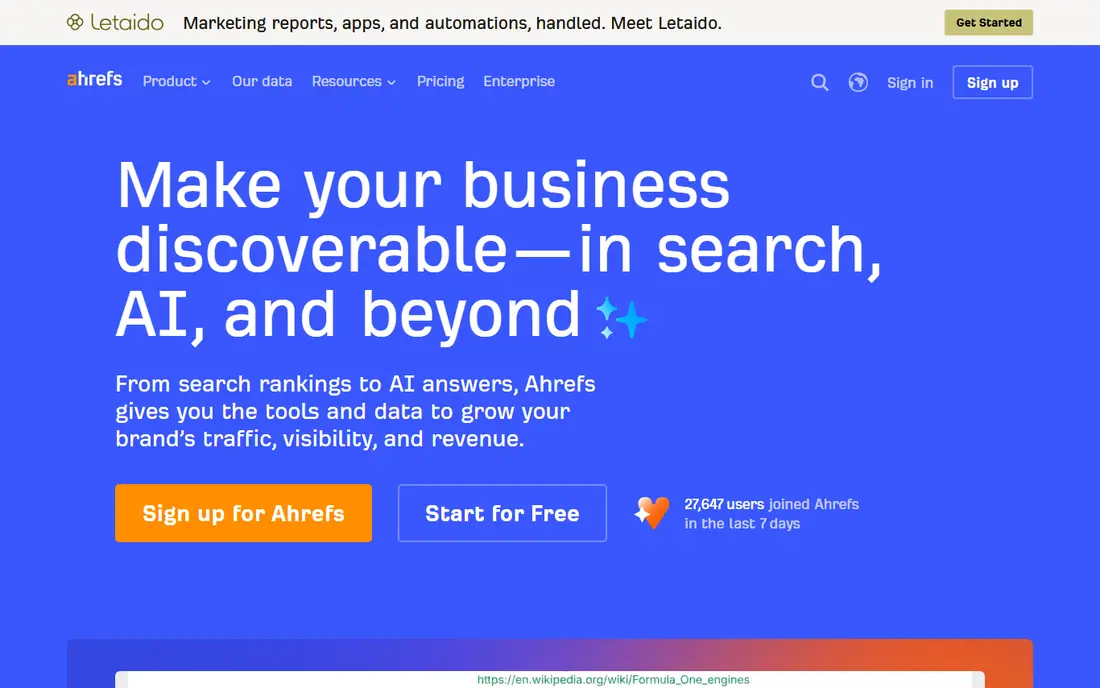
Ahrefs Brand Radar is useful when you want to research AI Overviews beyond your own keyword list. Its index can reveal which domains Google cites most often for a topic, which pages earn repeated citations, and where your brand is absent. That research angle helps content teams find gaps they would miss if they only tracked keywords they already rank for. Pricing needs care, since platform add ons add up. For Ahrefs users, though, the extra context is powerful: a citation gap can be checked against backlinks, content, and keyword difficulty in the same platform. If you do not already use Ahrefs, compare the total cost with a specialist tracker before committing.
- Large AI answer index
- Citation and mention research
- Strong keyword and backlink context
- Add on pricing can rise with platform coverage
- Not a low cost standalone tracker
- Depth varies by plan
SE Ranking suits agencies and in house teams that track hundreds or thousands of keywords. Its AI tracker can flag which keywords trigger overviews, whether your domain is cited, and how that share moves, while the wider suite handles rankings, audits, and reporting. That scale is hard to match in a small specialist plan. The trade off is focus. You get breadth and reporting, but you may not get the same prompt level sentiment or citation narrative as a dedicated AI tool. For most SEO teams, that breadth is the right priority, and a specialist can be added later for a flagship client or product line.
- Scales to larger keyword lists
- AI Overviews and AI Mode tracking in one suite
- Agency reporting is practical
- AI depth varies by plan
- Pricing depends on volume
- Specialist prompt sentiment may be lighter
Peec AI turns AI Overviews analysis into a competitor story. For each prompt, you can see your position, your sentiment, and which sources the model cited, then compare that with rivals on the same prompts. That comparison is often more actionable than a single citation count, because it shows whether a loss is a content gap, a source gap, or a topic where a competitor simply dominates. As with other tools here, engine math matters. The entry tier covers a limited set of models, so price the full list you need, including AI Mode if you want both Google surfaces. For marketing teams that review AI data weekly and share it across departments, Peec's unlimited seats and clean reports are a genuine advantage.
- Clear prompt level visibility and sentiment
- Competitor benchmarking
- Unlimited seats on many plans
- Entry plans cover only a few models
- Full engine coverage costs extra
- Pricing in euros can complicate dollar budgets
Profound treats AI Overviews as one signal inside a larger AI search program. Its citation analysis shows which pages and domains drive answers, its prompt volume data shows what people ask, and its agent analytics show how AI crawlers reach your site. For a large brand, that combination can explain a citation change that a simple tracker would only report. For a small site, the cost and sales process are hard to justify. Profound belongs on the shortlist when AI Overviews affect revenue, when several teams need the same data, and when you want to connect citation trends to content production. Otherwise, start with a cheaper tracker and use Profound's trial to judge whether the depth changes your decisions.
- Deep citation and conversation analysis
- Up to nine engines on enterprise plans
- Crawler analytics add context
- Custom enterprise pricing
- Trial is short
- Overkill for a small keyword set
Scrunch AI is for teams that want to know why a citation is missing, not only that it is missing. Its audits look at how a site presents content to AI systems, which can reveal crawl, structure, or clarity issues that block citations. When paired with tracking, that diagnosis shortens the gap between spotting a lost overview and fixing the page behind it. The price is above budget tools, and the audit only pays if someone owns the fixes. A team with a content owner who reviews findings weekly will get more from Scrunch than a team that only checks a dashboard monthly. If your main need is a citation log, a cheaper tool will do. If your main need is a fix list, Scrunch earns its place.
- Citation tracking plus site audits
- AI Overviews and AI Mode coverage
- Share of voice views
- Higher entry price
- Advanced features sit on higher tiers
- Value depends on acting on audit findings
Surfer AI Tracker fits content teams that already use Surfer to plan and optimize pages. AI Overviews data can be reviewed next to content scores, which helps a writer see whether a page that scores well for classic search also earns citations in an overview. That link between content quality and AI citation is the main reason to pick Surfer here. If you do not use Surfer for content, the case is weaker. A specialist tracker or a full SEO suite may offer broader citation research at a similar price. For Surfer users, though, keeping AI Overviews analysis in the same workflow reduces tool switching and keeps content decisions in one place.
- AI Overviews tracking linked to content optimization
- Prompt level views
- Fits teams that already score content in Surfer
- Best value is inside the Surfer workflow
- Standalone AI tracking may be thinner than specialists
- Pricing depends on plan and prompts
How we picked these
We compared official feature pages, pricing pages, and public comparisons, and we required explicit AI Overviews tracking, not only general AI visibility claims. We favored tools that report which domains were cited, not only whether an overview appeared, and we noted where AI Mode is an add on or a separate surface. We also considered Search Console as a free complement, since it reports generative AI impressions in aggregate even though it does not give prompt level citation detail. We did not run live overview tests for this article. Our method was desk research across vendor pages, pricing, documentation, and public reviews. AI Overviews change by keyword, location, and time, so treat any single snapshot as a sample and check the current vendor page before buying.
How to read AI Overviews data without overclaiming
Start with presence, then citations, then clicks
First, check whether an overview appeared for each keyword. Second, check whether your domain was cited. Third, check Search Console and analytics for clicks and conversions. A citation without clicks still has brand value, but it is not the same as traffic, and a drop in clicks after an overview appears does not prove the overview caused it.
Compare like with like
Compare the same prompt set, in the same location, over the same period. Changing prompts each week makes trends meaningless. Keep a stable core set, add new prompts as a separate group, and note when Google changes overview coverage for a topic, since that can move citation share without any change to your content.
Turn a lost citation into a page task
When a page loses a citation, check the cited competitors, the page structure, and whether the answer is clear in the first sections. Short, direct answers, clear headings, and factual detail that matches the question often help, but no format guarantees a citation. Test one change at a time, and give the overview time to refresh before judging the result.
FAQ
What is the best AI overview analysis software?
Otterly.ai is the lowest cost dedicated start, Semrush and Ahrefs suit teams inside those suites, and Profound or Scrunch suit larger programs that need deep citation analysis. The best choice depends on prompt volume, budget, and whether you need multi engine data.
How is AI Overviews analysis different from rank tracking?
Rank tracking reports a position in classic results. AI Overviews analysis reports whether Google generated a summary and which domains it cited as sources. A page can rank well in classic results and still miss an overview citation, or vice versa.
Can Google Search Console track AI Overviews?
Search Console can show generative AI impressions in aggregate, but it combines AI Overviews and AI Mode, and it does not show the answer text or prompt level citations. Use it as a complement to a dedicated tracker, not as a replacement.
How often should I check AI Overviews citations?
Weekly checks suit most teams, with a deeper monthly review of trends and lost citations. Daily checks can create noise, since overviews vary, while quarterly checks miss changes that could have been fixed sooner.
Can I guarantee an AI Overview citation?
No. Google decides when to show an overview and which sources to cite, and no tool or format can guarantee placement. Clear, accurate, well structured content improves your chances, but it does not promise a citation.
Should I track AI Overviews if my traffic is small?
Yes, if search drives leads or sales for you, even at low volume. A small prompt set in a budget tool can show whether overviews appear for your core questions, and that early signal helps you plan content before competitors dominate the topic.