6 Strong AI Medical Scribe Software Options in 2026
Searching for the best AI medical scribe software? Here are 6 options with prices and free plans. Weaknesses are named for every tool. Full profiles inside.

- Editor's choice
 Nabla
Multilingual clinical AI assistant
Starts atSee websiteVisit nabla.comFull review - Great alternative
 DeepScribe
Specialty practices and oncology
Starts atSee websiteVisit deepscribe.aiFull review - Also consider
 Dragon Copilot
Enterprise Epic-based systems
Starts atSee websiteVisit nuance.comFull review
TL;DR:
- Nabla takes the first slot, best suited to multilingual clinical AI assistant.
- What to know about Dragon Copilot first: enterprise pricing and procurement cycles.
- Freed fits teams comparing choices in this category.
- Nabla, Freed and the 4 others all sell by quote; expect sales conversations before you see a price.
Direct answer
If you need multilingual clinical AI assistant, Nabla is the first tool to look at here. Alternatives: DeepScribe for specialty practices and oncology, and Dragon Copilot for enterprise Epic-based systems. The full list of 6 tools follows, with prices and free plan facts.
Quick comparison
| Tool | Best for | Starts at | Free plan? | |
|---|---|---|---|---|
| Nabla | Multilingual clinical AI assistant | See website | No | Visit |
| DeepScribe | Specialty practices and oncology | See website | No | Visit |
| Dragon Copilot | Enterprise Epic-based systems | See website | No | Visit |
 Augmedix | Ambient plus human review | See website | No | Visit |
 Heidi Health | Free level plus global adoption | See website | Yes | Visit |
 Freed | Teams comparing choices in this category | See website | No | Visit |
The full AI medical scribe software list
This LinkVetted guide covers 6 options for AI medical scribe software. Each profile lists a starting price, free plan details, strengths and drawbacks, so you can drop poor fits quickly.
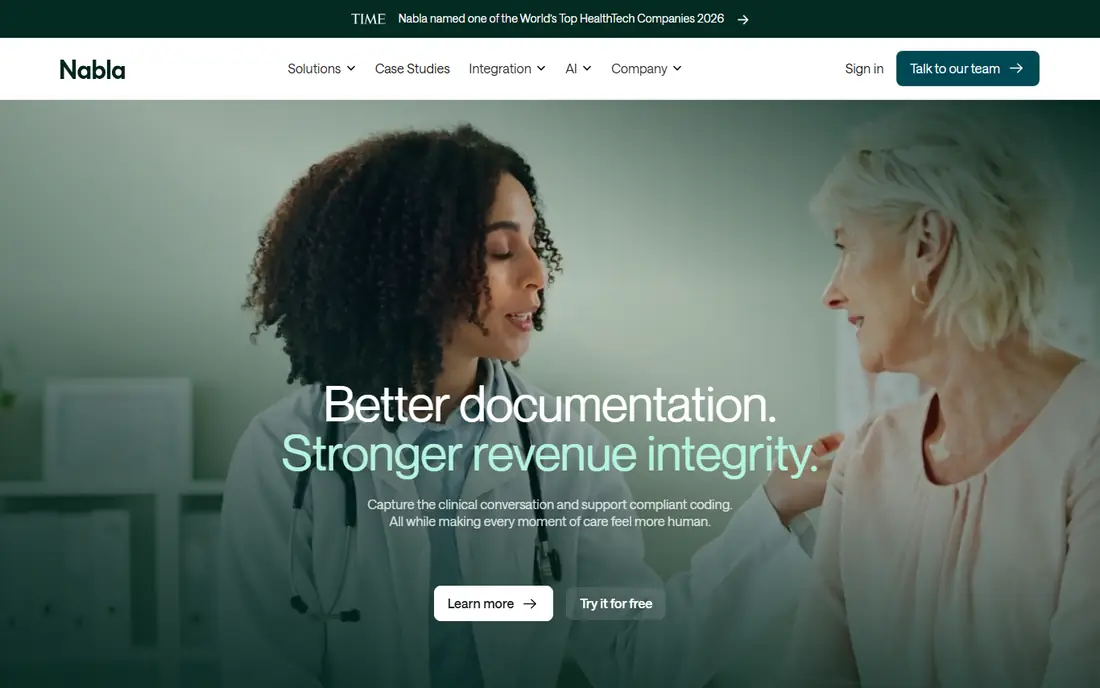
Nabla works best for multilingual clinical AI assistant. The 35-plus language support matters for diverse patient populations, and adoption spans over 100,000 clinicians.
Honest limits: The expanding feature set can dilute the scribe focus.
The system's breadth means evaluating which modules you actually need. From a buyer's view, Nabla positions as contextual clinical intelligence: ambient documentation plus dictation, coding suggestions and workflow automation, embedded in clinical workflows. Nabla shows no starting price here, so confirm the cost on the vendor site. No free plan comes with Nabla.
- Wide clinician adoption across health systems
- Merges documentation with coding support and workflow automation
- Enterprise pricing
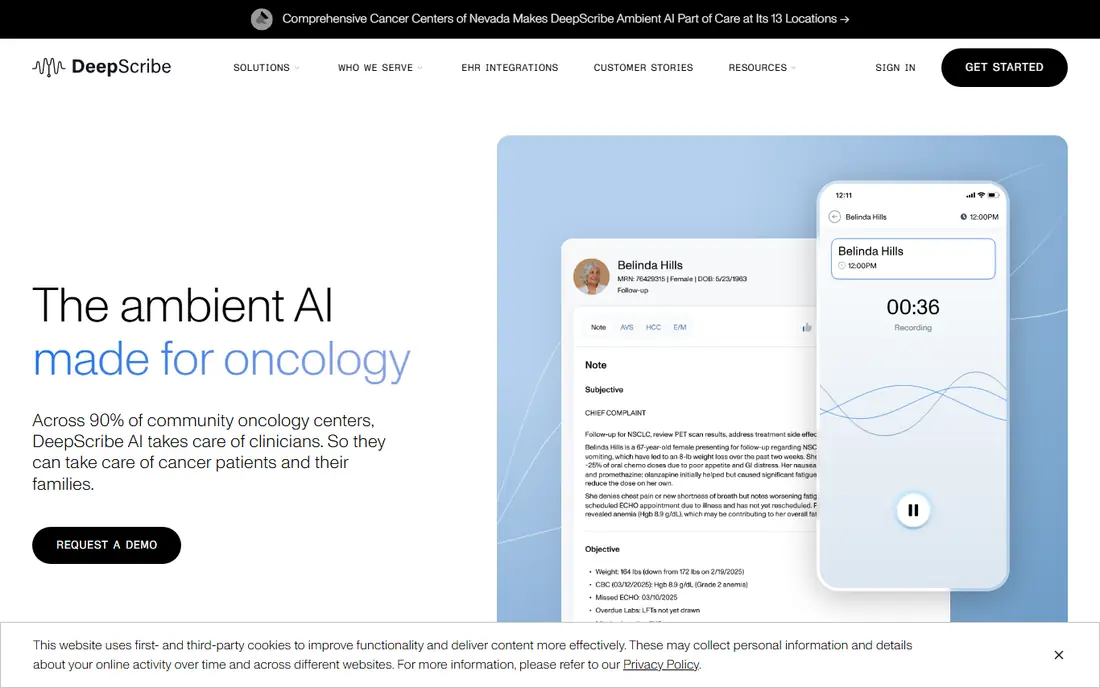
DeepScribe works best for specialty practices and oncology. Pre-visit summaries help clinicians prepare, not just document.
Where it falls short: Pricing information needs a sales conversation.
Beyond that, DeepScribe listens ambiently, drafts notes and recommends diagnostic codes, with particular traction in oncology and specialty practices. As for the details, practices on less typical EHRs should verify integration depth. Check the vendor site for DeepScribe pricing; none is listed in this comparison. There is no free plan with DeepScribe.
- Ambient scribe with pre-visit summaries
- Suggested diagnostic coding included
- Integration list is narrower than the enterprise leaders

Dragon Copilot serves enterprise Epic-based systems. The enterprise positioning is the trade-off: pricing, contracting and implementation assume health-system buyers.
For everyday use, Dragon Copilot suits large Epic-based organizations standardizing ambient documentation. No starting price is listed for Dragon Copilot here; confirm pricing on the vendor site. Dragon Copilot does not include a free plan.
Honest limits: Enterprise pricing and procurement cycles.
- Operating at massive scale across hundreds of organizations
- Microsoft-owned with deep Epic integration
- The DAX-to-Dragon-Copilot rebrand confuses buyers researching older reviews
Augmedix is a good fit for ambient plus human review. Augmedix pairs ambient AI with trained human specialists who review documentation, offering an accuracy backstop pure-AI tools lack. In practice, Augmedix suits practices and systems where note accuracy justifies human review, especially in high-risk specialties.
The hybrid model carries higher cost and different turnaround than instant AI drafts. For everyday use, the company predates the ambient AI wave, with years of documentation operations behind it. Check the vendor site for Augmedix pricing; none is listed in this comparison. Augmedix has no free plan.
The main drawbacks: Turnaround expectations differ from live scribes.
- Merges AI with human specialist review for accuracy
- Long track record in medical documentation
- Human-in-the-loop model costs more than pure AI
Heidi Health makes the most sense for free level plus global adoption. The configurable templates suit varied specialties, and global adoption across 50-plus countries is unusual in this category.
Watch-outs: Support expectations should match the freemium model.
Heidi Health shows no starting price here, so confirm the cost on the vendor site. A free plan is available with Heidi Health.
- Free entry-level scribe level lowers the trial barrier
- Adoption across 50-plus countries
- Premium levels needed for advanced features
Think of Freed for teams comparing choices in this category. Adoption among tens of thousands of clinicians presents the product-market fit.
In practice, enterprise features like deep EHR integration and admin controls are thinner. No starting price is listed for Freed here; confirm pricing on the vendor site. Freed has no permanent free option.
Where it is weaker: Restricted direct EHR integrations compared to enterprise tools.
- Scribe plus coding assistant and front-desk tools
- Quick to start
- Solo-practice focus means fewer enterprise controls
How these tools were picked
LinkVetted looked at what each vendor publishes: pricing, plan limits, feature coverage for AI medical scribe software and stated drawbacks. No hands-on testing is claimed. Figures are shown as the vendors publish them. Billing terms, seat minimums and add-ons can change the real cost. The ranking is editorial: typical fit first, then clear pricing, then free access. If your needs are unusual, read the profiles rather than relying on position.
Things to verify first
- Confirm the entry price with every vendor: no tool from Nabla to Freed shows a fixed starting price.
- Look at the free plan from Heidi Health closely: its caps decide whether it is usable for real work.
- Read the limits listed for Nabla first: enterprise pricing.
- Compare total cost, not headline price: for DeepScribe, add extra seats, add-ons and any usage-based charges.
- Ask Heidi Health whether prices are locked for the first term and what happens at renewal.
FAQ
Do patients have to consent to AI scribe recording?
In most cases yes, or at minimum they should be informed. Plenty of states need two-party consent for recording, and professional ethics favor transparency regardless.
Which options for AI medical scribe software have a free plan?
Heidi Health is the only tool in this list with a free plan. Free plans usually cap users, projects or features, so check the limits on the vendor page.
How much editing do AI scribe notes generally need?
It varies by specialty and product, but most clinicians report light to moderate editing: correcting names, adjusting phrasing, and verifying the plan section. The review burden drops as the system learns the clinician's style and templates get tuned.
Can I try these options before paying?
Often, yes. Heidi Health has a free plan. Use your own data and a real task during the test, and check what the free tier or trial limits before you rely on it.
How accurate are AI-generated notes?
Accuracy is high for routine visits and varies with specialty complexity, accents and background noise. Every note needs clinician review; these are drafting tools, not autonomous documentation.
Do these tools publish their prices?
No. None of the tools, from Nabla to Freed, shows a fixed starting price here, so budget time for quotes.