Alternatives to Wikipedia in 2026: 8 Reference Sites Compared
Looking for alternatives to wikipedia? We compare 8 trusted encyclopedias, from Britannica to Scholarpedia, so you can check facts fast and with confidence.

- Editor's choice
 Encyclopaedia Britannica
Professionally edited general reference
Starts atSee websiteVisit britannica.comFull review - Great alternative
 Scholarpedia
Expert-reviewed science topics
Starts atFreeVisit scholarpedia.orgFull review - Also consider
 Citizendium
Community-edited articles with real-name editors
Starts atFreeVisit en.citizendium.orgFull review
TL;DR:
- No single site matches Wikipedia for breadth, so the best choice depends on whether you need general facts, expert review, or school-safe material.
- Encyclopaedia Britannica is our pick for most people who want professionally edited general reference content.
- Scholarpedia and the Stanford Encyclopedia of Philosophy are the strongest options when an expert-reviewed article matters more than speed.
- Free sites such as Encyclopedia.com, Infoplease, and Citizendium cover everyday questions well, though their depth varies by topic.
- Always cross-check a surprising claim in a second source, and follow the citations at the bottom of any reference article.
Quick comparison
| Tool | Best for | Starts at | Free plan? | |
|---|---|---|---|---|
| Encyclopaedia Britannica | Professionally edited general reference | See website | No | Visit |
| Scholarpedia | Expert-reviewed science topics | Free | Yes | Visit |
| Citizendium | Community-edited articles with real-name editors | Free | Yes | Visit |
 Encyclopedia.com | Quick free lookups | Free | Yes | Visit |
 World History Encyclopedia | History topics and classroom use | Free | Yes | Visit |
 Stanford Encyclopedia of Philosophy | Philosophy and related subjects | Free | Yes | Visit |
 Infoplease | Fast facts and homework help | Free | Yes | Visit |
 New World Encyclopedia | General reference with an editorial board | Free | Yes | Visit |
The best alternatives to Wikipedia
Wikipedia is useful, but it is not the right tool for every question. Some readers want articles written by named experts, some want a site their school will accept, and some just want a quick, readable answer. The sites below each take a different approach to that problem.
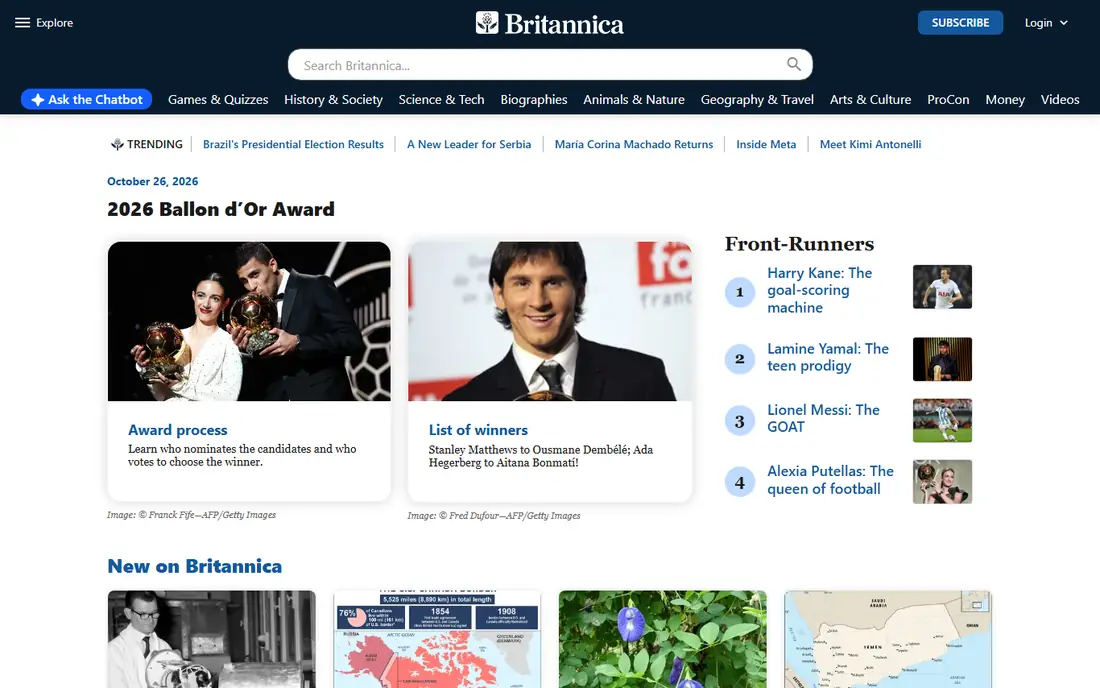
Britannica is the closest thing to a traditional encyclopedia on the web, and that is exactly its appeal. Articles are commissioned, written, and edited through a professional process rather than open community editing, which gives readers a clearer sense of who stands behind each entry. Coverage spans history, science, geography, the arts, and current affairs, with biographies and country profiles that work well as a starting point for research.
The trade-off is access. A good amount of content is free to browse, but full access sits behind a subscription, so casual readers may hit limits. Britannica also cannot match Wikipedia article-for-article on very recent or very niche topics. For a reliable first stop on a well-established topic, though, it remains our pick for most people.
- Articles written and edited by experts
- Long publishing history
- Clear, readable entries for students and general readers
- Full access requires a subscription
- Some articles are shorter than Wikipedia equivalents
Scholarpedia describes itself as a peer-reviewed, open-access encyclopedia, and the difference shows in the writing. Articles are authored by invited experts and reviewed before publication, so entries on topics such as dynamical systems or computational neuroscience carry real authority. Readers who need to understand a scientific concept properly, rather than skim a summary, will find the depth here rewarding.
The catch is scope. Scholarpedia focuses mainly on science and mathematics, so it will not help with a question about a film, a sports team, or a historical event. New articles also arrive slowly, because expert review takes time. Use it as a specialist companion to a general encyclopedia, not as a replacement for one.
- Articles written and reviewed by scholars
- Strong on physics, neuroscience, and mathematics
- Free to read
- Narrow subject range
- Slower to add new topics than Wikipedia
Citizendium was founded by Wikipedia co-founder Larry Sanger with a simple idea: keep the open wiki model, but add accountability by requiring real names and giving experts a defined role. The result is a smaller, calmer encyclopedia where articles tend to read carefully and cite their sources. For readers who like the wiki format but worry about anonymous editing, that structure is a genuine selling point.
Size is the honest limitation. Citizendium has far fewer articles than Wikipedia, and coverage is uneven, with some topics well developed and others thin or old. It works best as a second opinion on topics it covers well, rather than as a first stop for everything.
- Editors use real names
- Expert guidance alongside community editing
- Free to read
- Much smaller article count than Wikipedia
- Some entries are dated
Encyclopedia.com gathers entries from published reference works, including the Columbia Encyclopedia and other established titles, and presents them in one searchable site. For a fast answer to a question about a person, place, or event, it is often quicker than wading through a long Wikipedia page. The entries are concise, plainly written, and easy to quote for homework or general reading.
Depth is the compromise. Some entries are short overviews rather than full articles, and the site carries advertising that can distract from the content. It is a solid free lookup tool, but for a topic you need to study in depth, pair it with Britannica or a specialist source.
- Free to use
- Draws on established reference works
- Simple search
- Article depth varies
- Advertising can clutter pages
World History Encyclopedia, formerly Ancient History Encyclopedia, is a nonprofit reference site focused entirely on human history, from prehistory to the modern period. Articles are written by specialists and reviewed by an editorial team, and the site adds timelines, maps, and definitions that help readers place events in context. Teachers and students will find it especially useful, and its clear licensing makes classroom use straightforward.
The limitation is obvious from the name: this is a history site, full stop. If your question is about biology, economics, or a living celebrity, look elsewhere. Within its field, though, it is one of the strongest free alternatives to Wikipedia, and its focus is a strength rather than a flaw.
- Expert-reviewed history articles
- Maps, timelines, and images
- Free for readers
- History only
- Not useful for science, technology, or current affairs
Stanford Encyclopedia of Philosophy
Best for: Philosophy and related subjects
The Stanford Encyclopedia of Philosophy is the gold standard for its subject. Each entry is written by an expert, peer-reviewed, and updated as scholarship moves on, with a full bibliography pointing readers to primary texts and further reading. Topics range from ethics and logic to philosophy of science, mind, and language, and many entries touch on politics, law, and economics where those fields meet philosophy.
Beginners should expect a challenge. Entries are scholarly and can run long, so a reader looking for a one-paragraph summary may feel out of depth. That density is the point, though: if you want to understand an argument rather than just name it, this is the place to start.
- Written by leading philosophers
- Peer-reviewed
- Extensive bibliographies
- Academic tone can be demanding
- Philosophy and closely related fields only
Infoplease is an old-school fact site in the best sense: it collects almanac data, biographies, timelines, country profiles, and reference tables in one place. It is ideal for settling a quick question, such as a date, a population figure, or the order of events in a historical episode. Students doing homework and trivia fans will both find it handy, and the writing is plain and direct.
Do not expect long-form analysis. Infoplease gives you the facts and a short summary, then stops, so deeper research needs another source. Treat it as a fast reference shelf rather than a library, and it does that job well.
- Free
- Almanac-style facts, biographies, and timelines
- Easy to navigate
- Entries are brief
- Less depth than a full encyclopedia
New World Encyclopedia
Best for: General reference with an editorial board
New World Encyclopedia combines wiki-style contributions with an editorial board that reviews content, aiming for a middle path between open editing and professional publishing. Its coverage is general, spanning history, religion, science, and culture, and its articles often include a values-oriented framing that sets it apart from strictly neutral reference works. Readers who want a broad free encyclopedia with some editorial control will find it worth a look.
Scale remains the weakness. The article count is far below Wikipedia, and some entries have not been refreshed recently. Use it alongside a larger reference site, and check dates and citations on anything time-sensitive.
- Free
- Editorial oversight of community contributions
- Broad general coverage
- Smaller than Wikipedia
- Some articles rely on older source material
How we picked these
We compared official feature pages, access models, and editorial policies, along with public descriptions of each site's review process. We favored sites that are active in October 2026, free or clearly priced, and genuinely useful as reference works rather than simple Wikipedia mirrors. We also looked for a mix of general and specialist sources, so readers with different needs could find a fit.
What to check before you trust a reference site
A good reference site should tell you who wrote an article, when it was updated, and where its claims come from. If a site hides its authors, never dates its entries, and offers no citations, treat it as a starting point only, no matter how confident it sounds. The strongest sites on this list score well on all three tests, which is why they made the cut.
Matching the site to your question
For a school assignment, start with Britannica or World History Encyclopedia, then follow their citations to primary and scholarly sources. For a scientific concept, Scholarpedia or the Stanford Encyclopedia will usually give you a more careful explanation than a general article. For a fast fact, Encyclopedia.com or Infoplease will save time. The mistake is using one site for every kind of question, when each of these tools is built for a different job.
A note on citing encyclopedias
Most teachers and editors treat encyclopedias as background reading, not as a final citation. Use them to understand a topic, find the right terms, and locate stronger sources, then cite those stronger sources in your own work. That habit matters more than which encyclopedia you open first, and it protects you when any single site gets a detail wrong.
FAQ
Are alternatives to Wikipedia more accurate than Wikipedia?
Not automatically. Accuracy depends on the article, the author, and how recently it was reviewed. Expert-reviewed sites such as Scholarpedia and the Stanford Encyclopedia tend to be more reliable within their fields, while Wikipedia often wins on breadth and speed for current topics. Cross-checking two independent sources is the safest approach.
Is Encyclopaedia Britannica free?
Britannica offers some free content, but full access requires a subscription, with pricing listed on its own site. Many schools and public libraries provide free access through their subscriptions, so check with your library before paying.
What is Scholarpedia best for?
Scholarpedia is best for science and mathematics topics where an expert-written, peer-reviewed explanation matters. Its coverage is narrower than Wikipedia, but its articles in physics, neuroscience, and related fields are unusually careful and well referenced.
Can I use these sites for school homework?
Yes, for background research and fact-checking, and many teachers welcome Britannica, World History Encyclopedia, and the Stanford Encyclopedia. For final citations, your teacher will usually prefer primary sources, scholarly articles, or books that the encyclopedia points you toward.
Is Citizendium still active?
Citizendium remains available to read, though its article count is much smaller than Wikipedia and updates are slower. It is worth checking for topics it covers well, but it should not be your only reference source.
Which free alternative to Wikipedia is best for everyday questions?
Encyclopedia.com and Infoplease are the best free picks for quick everyday questions, thanks to their simple search and concise entries. For a deeper answer, move on to Britannica or a specialist site from this list.