Alternatives to R in 2026: 9 Statistical Tools Compared
Alternatives to R compared for 2026, with Python, Julia, SAS, Stata and SPSS options for statistics, data science, research and business analysis for 2026.
- Editor's choice
 Python
General data science
Starts atFreeVisit python.orgFull review - Great alternative
 Julia
High-performance computing
Starts atFreeVisit julialang.orgFull review - Also consider
 SAS
Regulated enterprise analytics
Starts atSee websiteVisit sas.comFull review
TL;DR:
- Python is the best general replacement, with the largest data science ecosystem and strong machine learning libraries.
- Julia suits high-performance numerical work, while SAS and Stata suit regulated and econometrics work respectively.
- Jamovi and JASP offer the easiest path for students who want point-and-click statistics without learning code first.
- SPSS and JMP suit teams that need a guided interface, reporting, and support, at a commercial price.
- KNIME suits analysts who prefer visual workflows over code, with a free platform for many data tasks.
Quick comparison
| Tool | Best for | Starts at | Free plan? | |
|---|---|---|---|---|
| Python | General data science | Free | Yes | Visit |
| Julia | High-performance computing | Free | Yes | Visit |
| SAS | Regulated enterprise analytics | See website | Free trial | Visit |
 MATLAB | Engineering and numerical work | See website | Free trial | Visit |
 Stata | Econometrics and panel data | See website | Free trial | Visit |
 SPSS Statistics | Guided social science stats | See website | Free trial | Visit |
 JMP | Interactive visual analysis | See website | Free trial | Visit |
 Jamovi | Free point-and-click stats | Free | Yes | Visit |
 KNIME | Visual data workflows | Free | Yes | Visit |
The best alternatives to R
R remains a powerful free language for statistics, with thousands of packages and strong graphics, but its learning curve and memory handling push many users to look elsewhere. The tools below cover the same statistical job in different ways, and we compared their official feature pages, licensing terms, learning curves, and typical use cases to build this list.

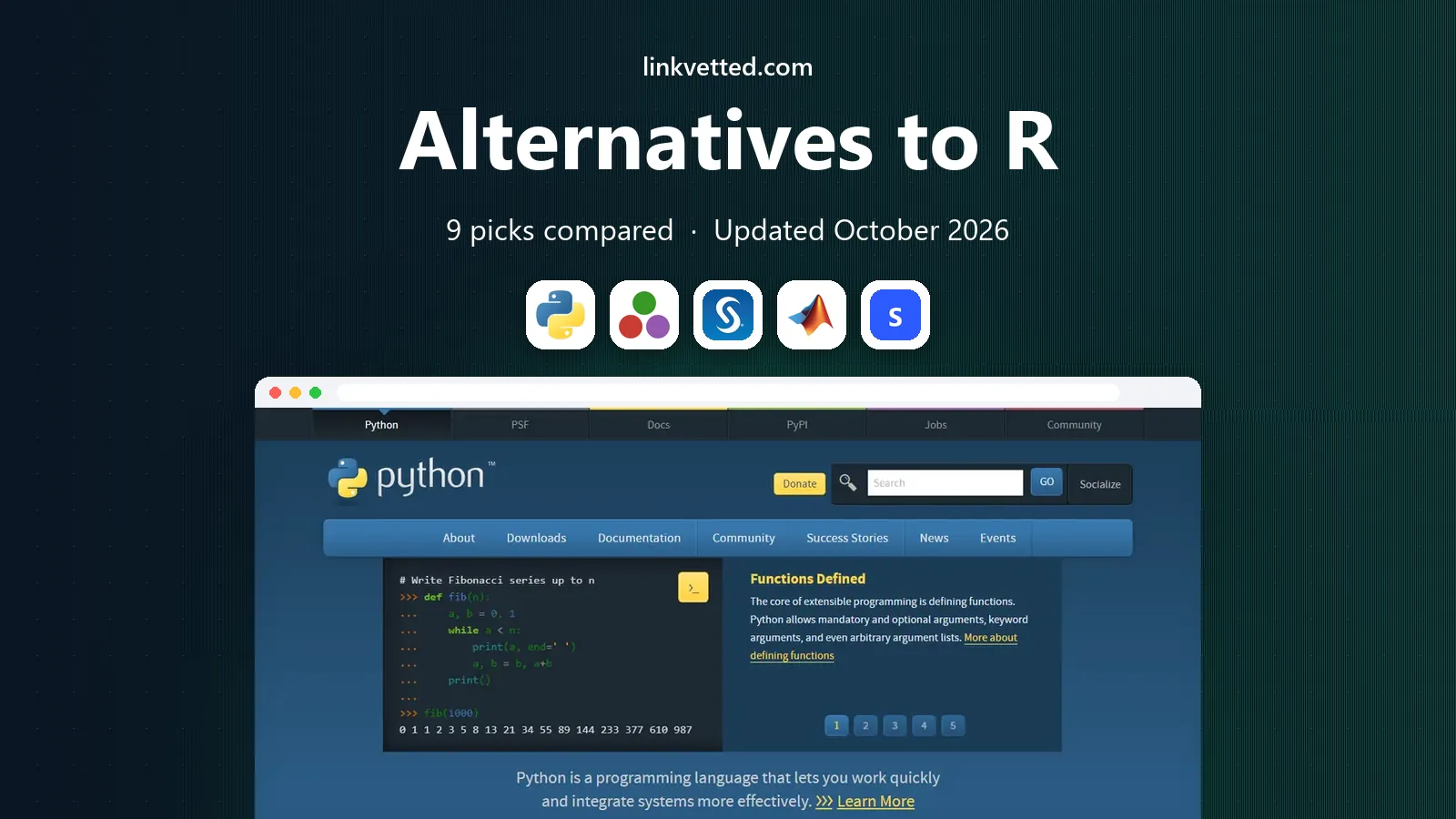
Python is the most practical general replacement for R, especially if your work is moving toward machine learning, automation, or production systems. Libraries such as pandas for data handling, NumPy for numerical work, statsmodels for statistics, and scikit-learn for machine learning cover most R workflows, while Jupyter notebooks support reproducible analysis. The Anaconda distribution bundles many of those libraries for easier setup.
The trade-off is polish for pure statistics. R still offers a more unified set of statistical packages and graphics in one ecosystem, while Python requires choosing and combining libraries. For a student or analyst who only needs t-tests, regression, and charts, Jamovi may be faster to learn. For a data scientist who wants one language for analysis and deployment, Python is the clear pick.
- Free and open source
- Huge libraries for data, statistics, and machine learning
- Strong community and job market
- Statistical packages are less unified than R
- Visualization needs extra libraries
- Beginners must learn programming

Julia was designed for high-performance numerical and scientific computing, and it delivers speed that Python and R often need compiled extensions to match. It reads like a high-level language, handles large numerical problems well, and supports parallel and distributed computing for simulation and modeling work. Researchers in physics, finance, and engineering use it where runtime matters.
The ecosystem is still growing. You will find fewer ready-made packages for niche statistics than in R, and finding help for an unusual method can take longer. If your main pain in R is speed on large numerical tasks, Julia is worth learning. If your main pain is finding a package for a specific statistical test, Python or Stata will usually have it sooner.
- Free and open source
- Fast numerical performance
- Combines high-level ease with low-level speed
- Good parallel computing
- Smaller package ecosystem than Python or R
- Fewer ready-made statistical routines
- Community is smaller
SAS is the enterprise standard where audit trails, validation, and regulatory acceptance matter more than price. Pharmaceutical, banking, and government teams use SAS for clinical reporting, risk modeling, and large dataset processing, with support and documentation that suit regulated workflows. Its data step and procedure model also handle massive files efficiently.
The cost and learning curve are the barriers. Licensing is commercial and often expensive, the language is proprietary, and exploratory graphics feel dated next to R or Python. A small research team should not choose SAS unless a regulator, client, or employer requires it. A regulated enterprise team that needs SAS-format output will find no free tool fully replaces it.
- Trusted in pharma, finance, and government
- Handles very large datasets
- Strong audit trails and support
- Expensive commercial licensing
- Proprietary language
- Less flexible for exploratory analysis and modern graphics
MATLAB suits engineers and scientists who already think in matrices and need reliable numerical tools. Its Statistics and Machine Learning Toolbox, signal processing tools, and app builder help teams move from analysis to a working prototype without switching languages. University licenses make it common in engineering courses, which helps hiring and collaboration.
For pure statistics, MATLAB is narrower than R, and commercial pricing puts it out of reach for many independent researchers. Python with NumPy and SciPy covers much of the same numerical ground for free, though with less integrated tooling. Choose MATLAB when engineering toolboxes and institutional support matter, and choose Python when cost and general data science matter more.
- Strong numerical computing and matrix math
- Extensive toolboxes for engineering
- Good visualization and app building
- Commercial licensing is expensive
- Statistical breadth trails R
- Less suited to general data science pipelines
Stata is a favorite in economics, epidemiology, and policy research, thanks to its consistent commands and excellent manuals. Panel data, time series, survival analysis, and causal inference tools are well documented, and results output is clean enough for academic papers. Many university courses teach Stata, so collaborators often share code easily.
The limits are flexibility and cost. Stata is commercial, its community package set is smaller than R, and custom methods can be harder to build than in Python or Julia. For an economist or biostatistician who needs reliable panel and survey tools with strong documentation, Stata is a dependable R alternative. For a general data scientist, Python offers broader machine learning coverage.
- Clear command syntax
- Excellent documentation
- Strong panel data, survival, and econometrics tools
- Commercial licensing
- Less flexible than R or Python for custom methods
- Smaller community package set
SPSS Statistics, from IBM, is the classic guided alternative for teams that do not want to learn a programming language first. Menus cover descriptives, t-tests, ANOVA, regression, factor analysis, and survey weighting, while syntax lets advanced users save and rerun analyses. That mix suits psychology, education, healthcare, and market research teams with mixed technical skills.
The price is the main drawback, with commercial licenses often running into thousands per year for full editions, and flexibility trails R for custom modeling. SPSS also adds new statistical methods more slowly than open-source ecosystems. If your team needs menus, training, and a familiar interface, SPSS is a safe pick. If your team can learn code, Jamovi or Python will save money and offer more methods.
- Point-and-click interface with syntax option
- Widely used in social sciences and market research
- Good support and training
- Commercial licensing is expensive
- Less flexible than R
- Newer methods arrive slower than in open-source tools
JMP, from SAS, focuses on interactive visual exploration. Clicking a point in a chart highlights the same rows in tables and other charts, which helps analysts spot patterns, outliers, and subgroup differences quickly. Design of experiments, quality control, and predictive modeling tools suit manufacturing, pharma, and engineering teams that explore data visually before modeling.
JMP is commercial, so pricing requires a quote or vendor page check, and its user base is smaller than SPSS or Stata, which can limit shared code and training. Its scripting language, JSL, is also specific to JMP. For a team that values visual exploration and design of experiments, JMP is a distinctive R alternative. For a team that needs broad statistical coverage at low cost, Python or Jamovi will fit better.
- Interactive graphics linked to data
- Strong design of experiments and quality tools
- Good for exploratory analysis
- Commercial pricing
- Smaller user base than SPSS or Stata
- Scripting uses its own JSL language
Jamovi is the best free point-and-click replacement for students and researchers who find R syntax daunting. It offers menus for descriptives, t-tests, ANOVA, regression, and Bayesian analyses, with results that update live as options change. Because Jamovi is built on R, its output and methods feel familiar to R users, and the R syntax view helps students transition to code later.
Advanced methods are thinner than in full R, and very large datasets can feel slower in a graphical tool. Module quality also varies, since community modules add features beyond the core. For teaching, undergraduate research, and standard analyses, Jamovi removes the cost and coding barrier. For custom modeling or large-scale data work, Python or R itself remains stronger.
- Free and open source
- SPSS-like interface
- Built on R, so results are familiar
- Bayesian modules available
- Fewer advanced methods than full R
- Large datasets can be slower
- Module quality varies
KNIME Analytics Platform lets analysts build data workflows by connecting nodes for reading, cleaning, modeling, and reporting, without writing code for every step. That visual approach suits business analysts, operations teams, and researchers who need repeatable pipelines but do not want to maintain R scripts. Extensions add Python, R, and machine learning nodes, so code users can mix visual and scripted steps.
Large, complex workflows can become hard to read, and some advanced statistical methods require extensions or custom nodes. Enterprise deployment, scheduling, and collaboration features sit on paid KNIME Business Hub plans. For a team that wants visual, shareable data pipelines for free, KNIME is a practical R alternative. For a team that prefers pure code, Python or Julia will stay cleaner at scale.
- Free Analytics Platform
- Visual drag-and-drop workflows
- Good data blending, machine learning, and reporting nodes
- Visual workflows can get messy at scale
- Advanced statistics need extensions
- Enterprise server features cost extra
How we picked these
We compared official feature pages, licensing terms, learning curves, and typical use cases for statistical languages and platforms available in October 2026. We favored tools with a working statistics product, clear free or commercial terms, and a distinct fit, such as general data science, econometrics, guided analysis, or visual workflows. We did not claim hands-on testing, and commercial prices should be confirmed on the vendor site, since academic, student, and enterprise pricing differ sharply.
What to check before you switch
Start with the analyses you actually run, not the full method list. List your top ten procedures, from descriptives and regression to survival analysis or Bayesian models, and check each tool for those exact methods. A tool that covers 90 percent of methods but misses your core procedure is not a replacement, no matter how low its price.
Code, reproducibility, and collaboration
If your work must be reproducible, favor code-based tools such as Python, Julia, or Stata syntax, or a visual tool that saves a runnable workflow like KNIME. If your collaborators use a specific tool, that compatibility often outweighs small feature differences, since shared code and training matter. For teaching, Jamovi and SPSS lower the entry barrier, but they should still save syntax or workflow files so results can be checked and rerun.
FAQ
What is the best free alternative to R?
Python is the best free general alternative, with the largest data science ecosystem and strong machine learning support. Jamovi is the best free point-and-click alternative for standard statistics. Julia is the best free alternative when numerical speed matters most. Choose Python for general work, Jamovi for teaching, and Julia for performance.
Is Python better than R for statistics?
Python is better for general data science, machine learning, and production work, while R remains stronger for pure statistical packages and publication graphics. Many analysts use both, with Python for pipelines and R for specialized methods. If you must pick one language for a data science job market, Python currently offers broader opportunities.
Can I do statistics without learning to code?
Yes, Jamovi, SPSS Statistics, and JMP offer point-and-click statistics without required coding, and KNIME offers visual workflows. These tools cover standard tests, regression, and many advanced methods, though custom methods still benefit from code. Start with Jamovi for free, and move to SPSS or JMP if you need commercial support and training.
Which alternative is best for econometrics?
Stata is the best econometrics pick, with strong panel data, time series, and causal inference tools plus excellent documentation. Python with statsmodels and linearmodels is a strong free alternative for many econometric tasks. R also remains strong here, so switch to Stata mainly for its documentation, teaching base, and consistent commands.
Should I switch from R if I already know it?
Switch only if R creates a specific problem, such as speed, deployment, collaboration, or a required employer tool. R remains free, powerful, and well supported for statistics, and many teams use R beside Python. Learn Python as a second language rather than replacing R entirely, unless a job or regulator requires a different tool.