8 Alternatives to PyTorch in 2026: Frameworks for Production and Research
Searching for alternatives to pytorch for production, tabular data, or TPU work? We compare 8 free frameworks with different strengths in 2026 for everyday use.
- Editor's choice
 TensorFlow
Production deep learning
Starts atFreeVisit tensorflow.orgFull review - Great alternative
 Keras
Beginner friendly deep learning
Starts atFreeVisit keras.ioFull review - Also consider
 JAX
High performance research
Starts atFreeVisit jax.readthedocs.ioFull review
TL;DR:
- PyTorch dominates research, but production, mobile, tabular, and TPU work each have a stronger alternative.
- TensorFlow and Keras suit production pipelines, mobile deployment, and teams that need a mature serving stack.
- JAX suits high performance research and TPU scale, with a functional style that takes learning.
- scikit-learn, XGBoost, and LightGBM remain the best choices for tabular data, often beating deep learning on small data.
- Hugging Face Transformers and MXNet cover pretrained models and distributed training, with different ecosystem trade offs.
Quick comparison
| Tool | Best for | Starts at | Free plan? | |
|---|---|---|---|---|
| TensorFlow | Production deep learning | Free | Yes | Visit |
| Keras | Beginner friendly deep learning | Free | Yes | Visit |
| JAX | High performance research | Free | Yes | Visit |
 scikit-learn | Traditional machine learning | Free | Yes | Visit |
 XGBoost | Tabular gradient boosting | Free | Yes | Visit |
 LightGBM | Fast tabular boosting | Free | Yes | Visit |
 Hugging Face Transformers | Pretrained models | Free | Yes | Visit |
 MXNet | Distributed deep learning | Free | Yes | Visit |
The best alternatives to pytorch
PyTorch is a flexible, Python friendly framework for research and prototyping, but no single framework fits every deployment, data type, or hardware target. These eight alternatives are all free and open source, and each one earns its place for a specific kind of work.
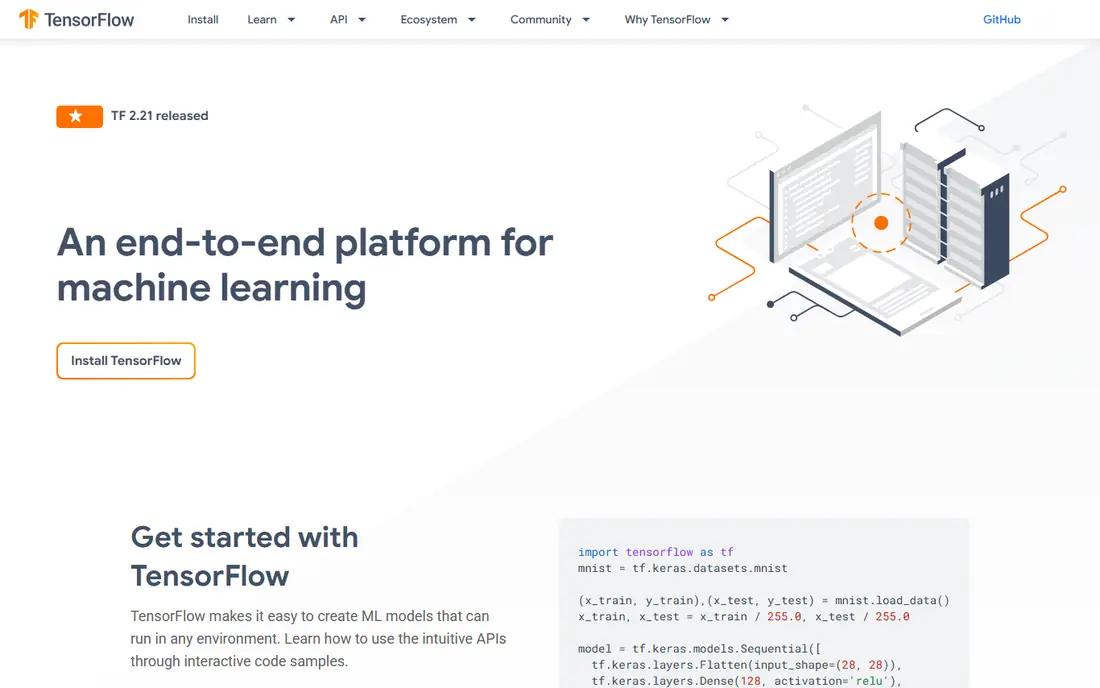
TensorFlow, developed by Google, is the production focused alternative to PyTorch. It covers data pipelines, training, evaluation, serving, and monitoring in one ecosystem, with TensorFlow Serving for server deployment and mobile and edge paths for on device models. Teams that need a stable, auditable production pipeline, especially in regulated or enterprise settings, often prefer that completeness over PyTorch flexibility.
The trade is research speed. PyTorch dynamic graphs feel more natural for experimenting with new architectures, and some recent model code is published PyTorch first. TensorFlow still supports eager execution and Keras as a high level interface, so the gap is smaller than in early years. If your model must run reliably in production, on mobile, or inside a Google Cloud pipeline, TensorFlow is the natural alternative.
- Mature production and serving ecosystem
- Mobile and edge deployment through LiteRT and TensorFlow Lite paths
- Strong enterprise support
- API feels heavier than PyTorch for quick research
- Some research code is now PyTorch first
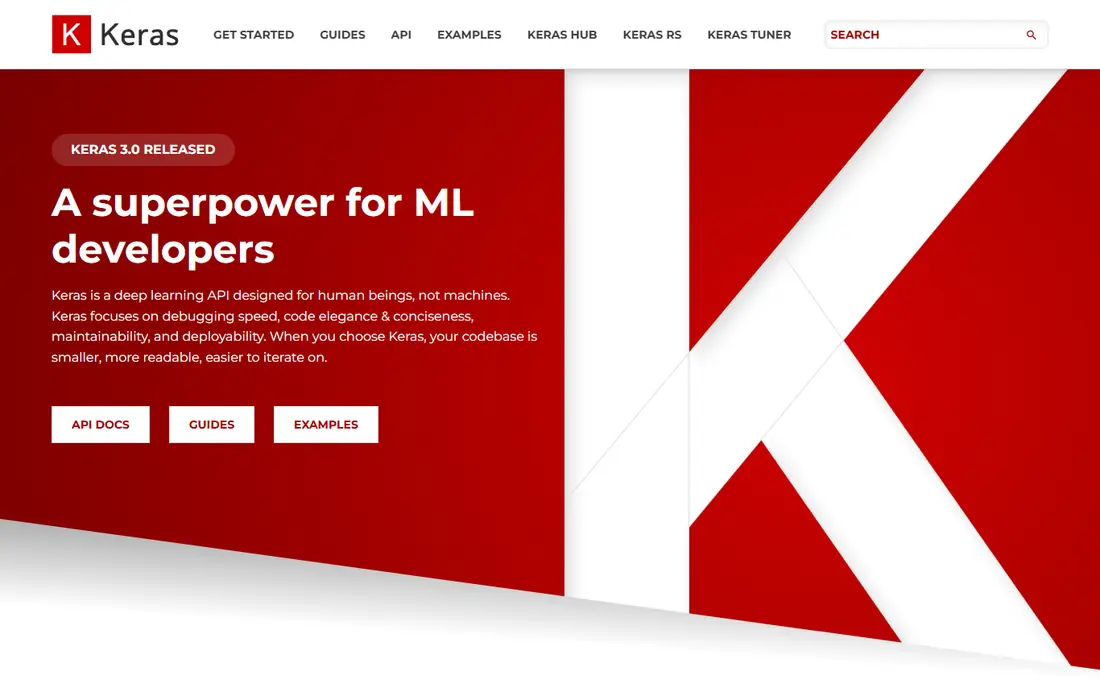
Keras 3 is a high level deep learning interface that runs on multiple backends, including TensorFlow, JAX, and PyTorch itself. That portability is useful: a model written in Keras can move between backends without a full rewrite, which reduces lock in and lets a team test performance on different hardware. For beginners and for teams that want a stable API, Keras removes much of the boilerplate that slows early work.
The limit is control. Researchers building novel training loops or custom operators may need to drop below the Keras API, and backend quirks can still appear in advanced cases. For standard image, text, and tabular deep learning, and for teaching, Keras is one of the fastest ways to a working model. It is also a useful bridge for teams migrating away from PyTorch without rewriting every model at once.
- Simple Sequential and Functional APIs
- Portable across backends including TensorFlow, JAX, and PyTorch
- Fast prototyping
- High level abstraction hides some low level control
- Backend differences can still surface in edge cases
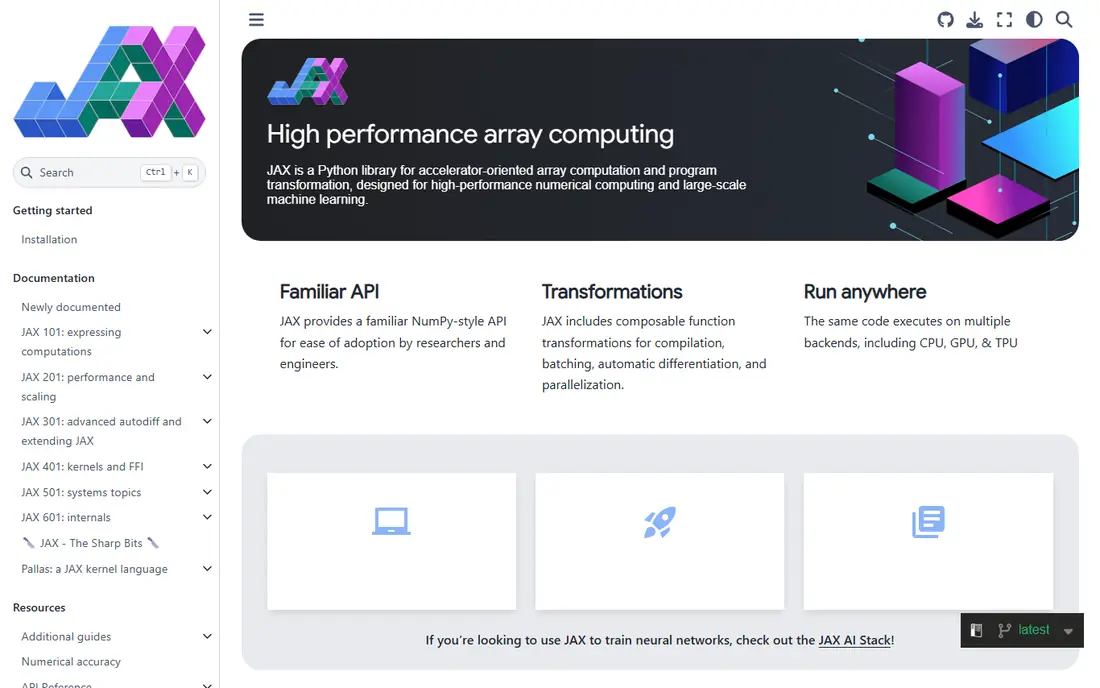
JAX, also from Google, is a numerical computing library with automatic differentiation, just in time compilation through XLA, and transformations for vectorization and parallel execution. Its NumPy like API feels familiar, while grad, jit, vmap, and pmap let researchers compose performance features that are harder to express in other frameworks. On TPUs and for scientific computing, JAX performance is a genuine reason to switch.
The cost is a paradigm shift. JAX favors pure functions and immutable arrays, which differs from PyTorch imperative style, and the surrounding ecosystem is smaller. Teams should budget time for that learning curve and for tooling gaps. For high performance research, novel algorithms, and TPU scale work, JAX is the most distinctive PyTorch alternative on this list.
- Composable transformations for gradients, vectorization, and parallelization
- Strong TPU performance
- NumPy like API
- Functional style takes learning
- Ecosystem is smaller than PyTorch
- Debugging can be harder for newcomers
scikit-learn is the standard library for traditional machine learning in Python, covering regression, classification, clustering, dimensionality reduction, and model selection with a consistent fit and predict API. Pipelines combine preprocessing, feature selection, and a model in one object, which makes experiments reproducible and code easy to review. For tabular data, text classification with classical methods, and baseline models, it remains the first tool many teams reach for.
It is not a deep learning framework. Large neural networks, image models, and language models need TensorFlow, Keras, JAX, or PyTorch, and scikit-learn does not offer GPU training at that scale. Use it as the baseline and the production choice for classical models, then move to deep learning only when the data and problem justify the extra complexity.
- Consistent API across many classical models
- Strong preprocessing and evaluation tools
- Excellent documentation
- Not built for deep learning or GPU training at scale
- Large neural models need another framework
XGBoost is a gradient boosting library that has won many tabular data competitions and remains a production staple for structured data. It builds ensembles of decision trees, handles missing values, and includes regularisation to control overfitting, with fast training on CPUs and GPUs. For credit scoring, churn prediction, fraud detection, and other tabular problems, it often beats a neural network, especially on smaller data sets.
The limit is data type. Images, audio, and raw text usually need deep learning or a separate feature step before XGBoost makes sense, and tuning depth, learning rate, and regularisation takes care. For tabular work, start with XGBoost as a strong baseline, compare it with LightGBM and scikit-learn models, and only move to deep learning if the gap is real.
- Very strong tabular performance
- Handles missing values and regularisation well
- Broad language and platform support
- Less suited to images, audio, or raw text
- Tuning takes care on small or noisy data
LightGBM, developed by Microsoft, is another gradient boosting framework, optimized for speed and memory efficiency on large tabular data. Its histogram based algorithm and leaf wise tree growth train faster than many rivals on wide data sets, which matters when a team retrains models daily or works with millions of rows. Accuracy is comparable to XGBoost in many tabular tasks, with different tuning trade offs.
Small data is the caution. Leaf wise growth can overfit when rows are few, so regularisation and early stopping matter. Like XGBoost, LightGBM is a tabular tool, not an image or language model framework. Choose it when training speed and large tabular scale matter, and compare it directly with XGBoost on your own data rather than assuming one always wins.
- Fast training on large tabular data
- Low memory use
- Strong accuracy with sensible defaults
- Can overfit on small data without tuning
- Less suited to unstructured data than deep learning
Hugging Face Transformers is a library and model hub for pretrained language, vision, audio, and multimodal models. Instead of training from scratch, teams download a pretrained model, fine tune it on their own data, and deploy it with a consistent API. That workflow has become the standard for many language and vision tasks, and the hub makes it easy to compare architectures, licenses, and model cards.
It is not a standalone training framework in the same sense as PyTorch. Transformers runs on PyTorch, TensorFlow, JAX, and other backends, so it complements a framework choice rather than replacing the underlying engine entirely. Note also that recent Transformers releases have focused on PyTorch, so teams moving away from PyTorch should check backend support for the specific model they need. For pretrained model work, it is still the most practical starting point.
- Huge hub of pretrained models and data sets
- Consistent API across model architectures
- Strong community and documentation
- Built on top of frameworks such as PyTorch, so it is not a full replacement alone
- Large models need significant compute
MXNet, an Apache Software Foundation project, is a deep learning framework built for efficiency and distributed training across multiple machines and GPUs. It offers both imperative and symbolic programming, supports several languages, and has long been used for scalable cloud training. Teams that need distributed deep learning with a stable Apache governed project may find it a sound alternative.
The ecosystem is the limit. PyTorch and TensorFlow have larger communities, more tutorials, and more pretrained model code, so MXNet users may need to port models or build more tooling themselves. For a new project in 2026, TensorFlow, Keras, or JAX will usually be easier to staff. MXNet remains on this list for teams with existing MXNet investments or specific distributed training needs.
- Efficient distributed training
- Flexible imperative and symbolic APIs
- Apache open source governance
- Community and ecosystem are smaller than PyTorch and TensorFlow
- Some newer model code is not MXNet first
How we picked these
We compared official documentation, project pages, and public framework comparisons, and kept only frameworks that still work in October 2026 and truly build, train, or run models. PyTorch itself is not listed, because this is an alternatives guide, though we use its research flexibility as the baseline. All eight options here are free and open source, so cost is compute and staff time, not a license fee, and readers should check hardware support and model availability for their specific task.
Choosing a framework by problem type
Tabular data calls for scikit-learn, XGBoost, or LightGBM first, with deep learning only if those baselines fall short. Production serving and mobile deployment point to TensorFlow and Keras. High performance research and TPU work point to JAX. Pretrained language and vision work point to Hugging Face Transformers on top of a supported backend. Distributed training with an Apache governed stack points to MXNet. Matching the framework to the data type and deployment target saves more time than chasing benchmark speed alone.
Test on your data before you migrate
Port a small but real model, not just a tutorial example, and compare training time, accuracy, serving latency, and code size. Check that your hardware, data pipeline, and deployment target are supported, and that your team can debug the new stack without outside help. A framework that wins a benchmark but slows your team down is not a win in production.
FAQ
What are the best pytorch alternatives?
The best pytorch alternatives are TensorFlow for production, Keras for simple deep learning, JAX for high performance research, and scikit-learn, XGBoost, and LightGBM for tabular data. Hugging Face Transformers suits pretrained models, while MXNet suits distributed training. The best choice depends on data type, deployment target, and team experience, not on a single ranking.
Is TensorFlow better than PyTorch?
TensorFlow is better than PyTorch for many production, mobile, and enterprise pipelines, thanks to its serving ecosystem and deployment paths. PyTorch is often better for research and rapid prototyping, thanks to its dynamic, Python friendly style. Many teams use both: PyTorch for experiments, TensorFlow or Keras for the production model, with ONNX or a shared format in between where it fits.
Can I use Keras without TensorFlow?
Yes, in Keras 3 you can use TensorFlow, JAX, or PyTorch as the backend, and you can switch backends without rewriting the Keras model in most cases. That portability makes Keras a useful bridge for teams moving away from PyTorch, because the model code stays stable while the backend changes. Check backend support for any custom layers or training loops you rely on.
Which framework is best for tabular data?
scikit-learn, XGBoost, and LightGBM are the best frameworks for tabular data in most cases. They train fast, need less data than deep learning, and are easier to explain and maintain. Deep learning can win on very large tabular data with complex interactions, but it should be tested against a strong gradient boosting baseline first, not assumed to be better.
Is JAX hard to learn for PyTorch users?
JAX takes adjustment, because it favors pure functions and composable transformations rather than PyTorch imperative style. The NumPy like API helps at first, but jit, grad, vmap, and pmap need study, and debugging differs from PyTorch. Teams with TPU or high performance goals usually find the learning curve worth it, while teams without those goals may prefer Keras or TensorFlow.
Are these frameworks really free?
Yes. TensorFlow, Keras, JAX, scikit-learn, XGBoost, LightGBM, Hugging Face Transformers, and MXNet are free and open source. Costs come from compute, storage, and staff time, not license fees, though cloud GPU and TPU time can be significant at scale. Check each project license and model license separately, because a pretrained model can carry terms that differ from the framework license.