9 Best Whova Alternatives in 2026
Compare the best whova alternatives for conferences, trade shows and community events, with event apps, networking, ticketing and pricing for organisers.
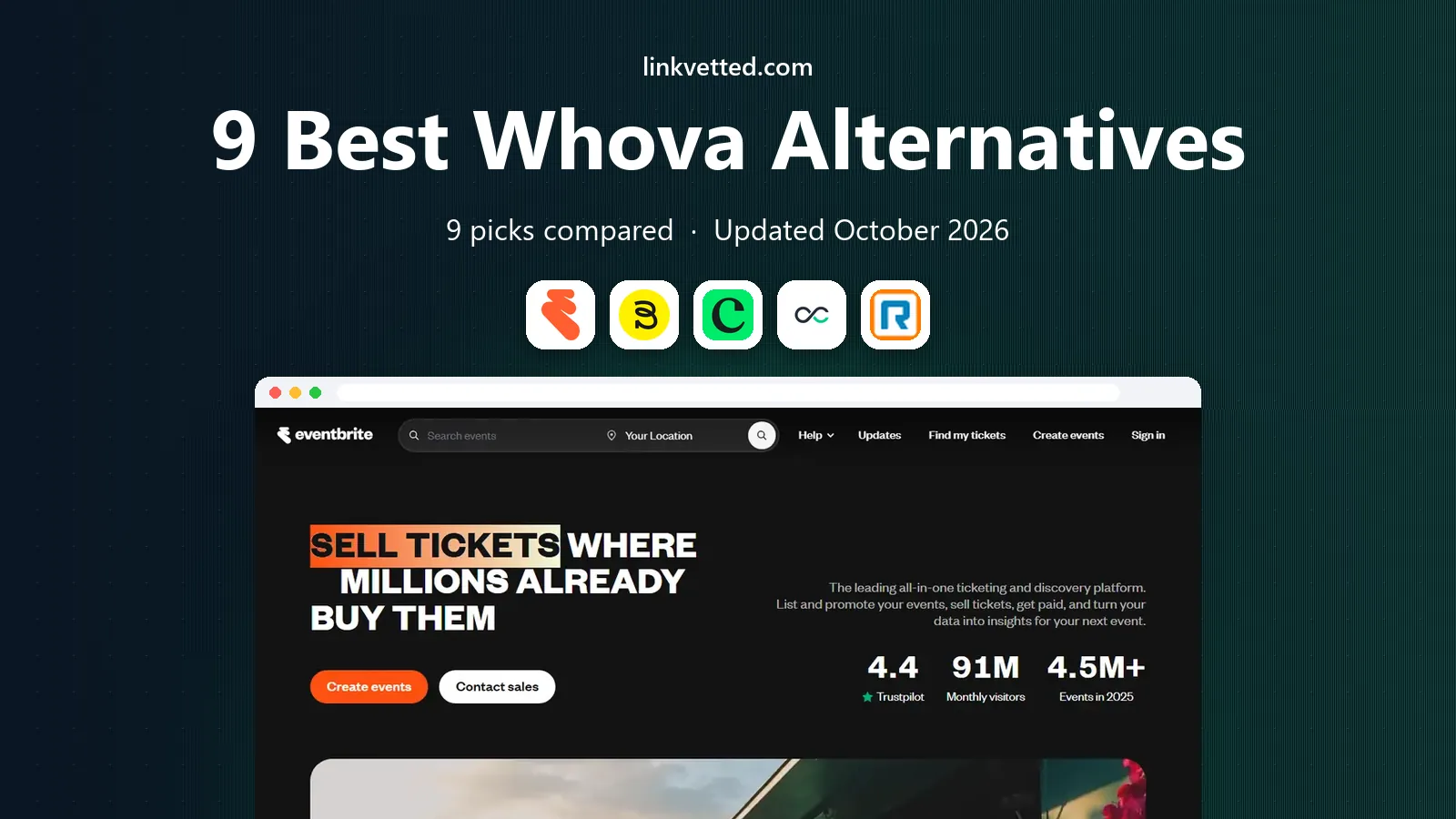
- Editor's choice
 Eventbrite
Simple public ticketed events
Starts atFree for free eventsVisit eventbrite.comFull review - Great alternative
 Bizzabo
Corporate event marketing teams
Starts at$17,999 per yearVisit bizzabo.comFull review - Also consider
 Cvent
Enterprise programmes with venue sourcing
Starts atSee websiteVisit cvent.comFull review
TL;DR:
- Eventbrite is the simplest replacement for public ticketed events, with free setup for free events and a built-in discovery marketplace.
- Bizzabo and Cvent suit large corporate and enterprise programmes, but both price at enterprise levels and usually require a sales conversation.
- Swapcard is the strongest pick for B2B trade shows where AI matchmaking and exhibitor lead capture matter most.
- Sched is the budget pick for straightforward conference agendas and attendee apps, with published pricing from around $50 per month.
- Accelevents and RingCentral Events are the better choices when an event mixes in-person and virtual audiences.
Quick comparison
| Tool | Best for | Starts at | Free plan? | |
|---|---|---|---|---|
| Eventbrite | Simple public ticketed events | Free for free events | Yes | Visit |
| Bizzabo | Corporate event marketing teams | $17,999 per year | No | Visit |
| Cvent | Enterprise programmes with venue sourcing | See website | No | Visit |
 Swapcard | B2B trade shows and AI networking | $610 per event | No | Visit |
 RingCentral Events | Virtual-first and hybrid conferences | See website | Free trial | Visit |
 Accelevents | Hybrid events with strong registration | $7,500 per event | No | Visit |
 EventMobi | Customisable association and conference events | See website | No | Visit |
 Sched | Simple conference agendas on a budget | $50 per month | No | Visit |
 vFairs | Virtual trade shows and immersive expos | See website | No | Visit |
The best Whova alternatives
We compared official feature pages, pricing pages and public reviews to find platforms that cover Whova's core work: event apps, agendas, attendee networking, registration and exhibitor tools.

Eventbrite is the easiest switch for organisers whose main need is selling tickets and getting people through the door. Publishing a free event costs nothing, and paid events carry per-ticket fees rather than a large annual subscription. Attendees already know the platform, which helps discovery, and the organiser app handles check-in without extra hardware.
The limit is depth. Networking, community boards and exhibitor tools are thinner than Whova's, and complex multi-track agendas with abstract management need another tool. For public workshops, meetups, festivals and classes, Eventbrite's simplicity is the point.
- Free to publish free events
- Built-in discovery marketplace
- Simple ticketing and check-in tools
- Limited attendee networking next to Whova
- Paid-event fees apply
- Less suited to complex multi-track conferences

Bizzabo targets corporate marketing teams running product launches, user conferences and field events. Its attendee app, registration and networking tools are polished, and integrations with CRMs help marketing teams track pipeline from event activity. Features like smart badges on higher tiers suit larger productions.
The price is the barrier: published comparisons put the starting point at $17,999 per year with a three-user minimum. Small associations and community conferences will find that hard to justify. For corporate teams where event marketing ROI is tracked closely, the tooling matches the price.
- Polished attendee experience
- Strong CRM integrations including HubSpot
- Event marketing and analytics tools
- High starting price with a three-user minimum
- Annual subscription only
- Overkill for small events
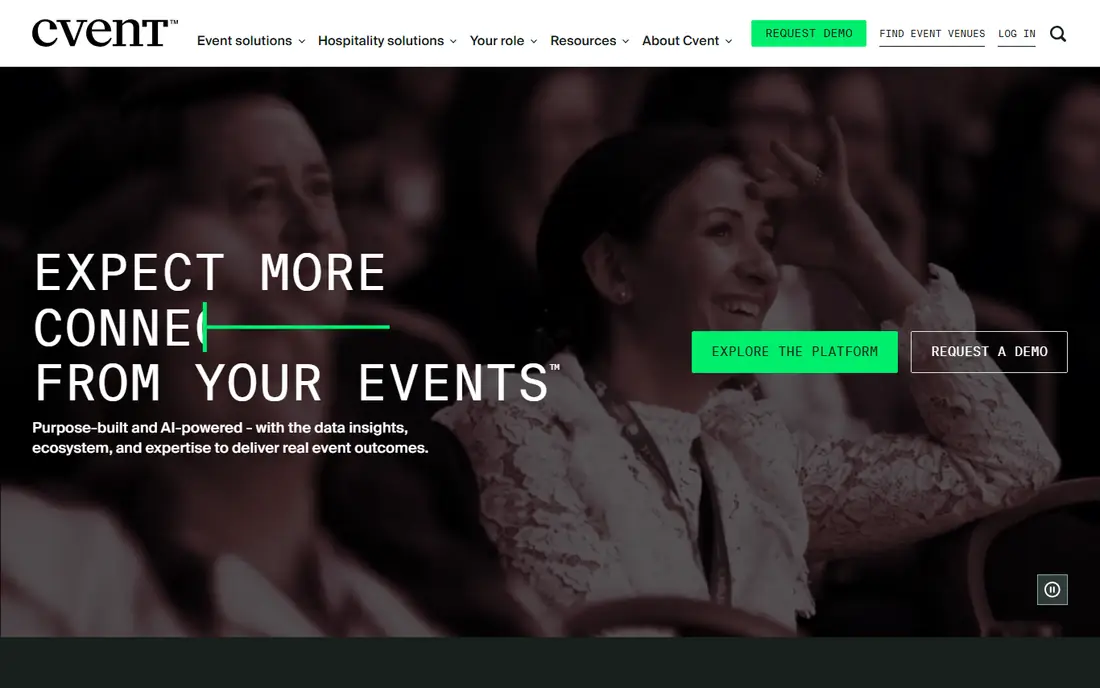
Cvent is the enterprise workhorse of this list, covering venue sourcing, registration, attendee management, mobile apps and reporting in one suite. Large organisations running dozens of events a year benefit from centralised templates, approvals and data, and the venue marketplace is a genuine differentiator for planners sourcing hotels and conference space.
That breadth brings complexity and quote-based pricing, with published comparisons placing typical annual costs well into five figures. Small teams will find setup heavy for a single conference. For enterprise programmes, Cvent remains the benchmark Whova alternatives are measured against.
- Huge venue-sourcing marketplace
- Deep registration and attendee management
- 200 plus integrations
- Quote-based pricing
- Enterprise complexity
- Long implementation for smaller teams
Swapcard shines where the event's value is meetings between attendees and exhibitors. Its AI matchmaking suggests relevant contacts, supports structured one-to-one meetings, and gives exhibitors lead capture and follow-up tools. Trade shows and B2B expos use it to prove exhibitor ROI, which keeps sponsors returning.
For a small community conference, that machinery may be more than needed, and the self-service starting price of around $610 per event rises as features are added. When networking and exhibitor value drive the event, Swapcard is the strongest Whova alternative here.
- AI matchmaking for meetings
- Exhibitor lead capture
- Strong trade show and expo tooling
- Less suited to simple community events
- Pricing rises with features
- Virtual-first design in some areas
RingCentral Events, formerly Hopin, is built for virtual and hybrid conferences with live stages, breakout rooms, networking areas and expo booths. Organisers get registration, streaming and attendee engagement in one platform, and it scales to large global audiences without a separate streaming stack. A free trial lets teams test the experience before committing.
For a purely in-person conference, some of that virtual machinery goes unused, and Whova's community feel may suit better. Pricing is tiered and best confirmed with the vendor. If your audience is partly or fully online, RingCentral Events is a natural fit.
- Built for large virtual audiences with breakout rooms
- Registration and streaming in one platform
- Scales to very large events
- Virtual-first strengths matter less for purely in-person events
- Pricing tiers need a sales check
- Branding options vary by plan
Accelevents covers the full hybrid event: registration and ticketing, a mobile app for in-person attendees, and a virtual venue for remote ones. That single-platform approach avoids stitching together separate tools for each audience, and its exhibitor and sponsor features suit conferences with a trade show element.
Pricing starts around $7,500 per event, with business plans higher for unlimited events, so it fits mid-size and large conferences rather than small meetups. Teams running one flagship hybrid event a year will find the pricing clearer than an annual enterprise subscription.
- In-person plus virtual in one platform
- Registration, ticketing and mobile app included
- Good exhibitor tools
- High per-event starting price
- Annual plans cost more
- Smaller events may not need the full suite
EventMobi suits associations and conference teams that want an event app shaped to their brand and workflow. Hundreds of customisation templates, registration options and a native app with strong offline performance make it reliable on patchy venue Wi-Fi. Published comparisons put per-event pricing from around $3,500, with annual options higher.
The downside is that pricing is not fully published and add-ons are priced separately, so budgeting needs a quote. Setup time also grows with customisation. For teams that run recurring branded conferences, the flexibility is worth it.
- Highly customisable apps and registration
- Strong offline app performance
- Wide template library
- Pricing is not published
- Customisation takes setup time
- Add-ons priced separately
Sched is the budget pick for conferences that mainly need a good agenda, speaker profiles and a simple attendee app. Published pricing starts from around $50 per month, a fraction of enterprise platforms, and setup is fast enough for volunteer-run events. It handles schedules, session feedback and basic attendee profiles well.
Networking and community boards are lighter than Whova's, and exhibitor features are limited, so trade shows should look elsewhere. For academic, community and professional conferences where the schedule is the star, Sched gives the best value here.
- Low published starting price
- Clean agenda, speaker and attendee tools
- Quick setup
- Networking features are lighter than Whova
- Limited exhibitor tooling
- Best for agenda-first events
vFairs builds immersive virtual events, with 3D exhibitor booths, expo halls and networking lounges that suit virtual trade shows and career fairs. Exhibitors get branded booths, live chat and lead capture, while attendees browse a visual show floor rather than a list of links. It also supports hybrid elements for mixed audiences.
Pricing is quote-based per event, and building polished 3D spaces takes production effort. For in-person-only conferences, a simpler app will serve better. When the event is virtual and the expo floor matters, vFairs stands out.
- 3D virtual booths and expo halls
- Virtual career fairs and expos
- AI matchmaking options
- Quote-based pricing
- Virtual-first, not ideal for in-person-only events
- Production setup for 3D spaces
How we picked these
We compared official feature pages, pricing pages and public reviews, focusing on platforms that cover event apps, agendas, registration, networking and exhibitor tools. We included options across price points, from free ticketing to enterprise suites, and we marked quote-based pricing honestly rather than repeating estimates as facts. Platforms that only handle webinars or only handle ticketing without an event app were left out.
Running a smooth switch from Whova
Shortlist by event type, not feature count
A trade show, an academic conference and a corporate launch need different tools, even though all three are called events. Write down your event's top three jobs, such as ticketing, networking or exhibitor ROI, and score finalists only on those. Feature count alone leads to paying for tools nobody uses.
Test the attendee app on real phones
Ask a small group of past attendees to try the finalist app on their own phones, including older devices and patchy connections. Check agenda browsing, networking messages and check-in speed under real conditions. Attendee experience on event day matters more than a polished sales demo.
Confirm total event cost early
Per-event, per-attendee and annual pricing behave very differently across a season of events. Add registration fees, payment processing, add-ons and support to each quote before comparing. A cheap platform with per-attendee fees can cost more than an annual plan once attendance grows.
FAQ
What is the best Whova alternative for small conferences?
Sched is the best value pick for small conferences, with published pricing from around $50 per month and solid agenda and speaker tools. Eventbrite suits small public events where ticketing matters more than networking. Both are far cheaper than enterprise platforms.
Which Whova alternative is best for trade shows?
Swapcard is the strongest trade show pick, thanks to AI matchmaking and exhibitor lead capture. vFairs suits virtual trade shows with 3D booths, while Accelevents covers hybrid shows with both in-person and virtual audiences.
Is there a free Whova alternative?
Eventbrite is free for free events, with fees only on paid tickets. Fully free event apps with Whova-level networking are rare, since most platforms charge organisers per event or per year. Sched's low monthly price is the closest budget option for paid conferences.
Can I migrate my Whova event data to another platform?
Most platforms support importing attendee lists, session schedules and speaker data from spreadsheets, but community posts and networking history rarely transfer cleanly. Export your attendee and session data from Whova early, and plan to rebuild community spaces in the new tool.
Do these platforms support hybrid events?
Yes. RingCentral Events, Accelevents and vFairs are built for hybrid and virtual audiences, while Bizzabo, Cvent and EventMobi support hybrid elements alongside in-person apps. Confirm streaming, virtual booth and remote networking features on your plan before buying.