Best Triple Whale Alternatives in 2026: 8 Analytics Tools Compared
Looking for Triple Whale alternatives in 2026? We compare 8 ecommerce analytics tools on attribution, profit tracking, pricing, and fit. for your Shopify store
- Editor's choice
 Northbeam
Paid-media attribution at scale
Starts at$1,500 per monthVisit northbeam.ioFull review - Great alternative
 Polar Analytics
Warehouse-style DTC dashboards
Starts at$750 per monthVisit polaranalytics.comFull review - Also consider
 Lifetimely
Profit and lifetime value tracking
Starts at$79 per monthVisit lifetimely.ioFull review
TL;DR:
- Northbeam is our pick for brands scaling paid ads that need stronger attribution and media mix modeling, though entry pricing is high for small stores.
- Polar Analytics suits mid-market teams that want warehouse-style dashboards and custom reporting, while Lifetimely suits profit and lifetime value tracking at a lower price.
- ThoughtMetric suits budget-friendly multi-touch attribution, and TrueProfit suits small stores that mainly need clear profit and loss reports.
- Wicked Reports suits email-heavy brands with long purchase windows, while Littledata suits accurate server-side tracking for Shopify and Google Analytics.
- Google Analytics 4 suits free baseline traffic reporting, but it does not replace profit, margin, or lifetime value reporting for a commerce brand.
Quick comparison
| Tool | Best for | Starts at | Free plan? | |
|---|---|---|---|---|
| Northbeam | Paid-media attribution at scale | $1,500 per month | No | Visit |
| Polar Analytics | Warehouse-style DTC dashboards | $750 per month | No | Visit |
| Lifetimely | Profit and lifetime value tracking | $79 per month | Yes | Visit |
 ThoughtMetric | Budget multi-touch attribution | $99 per month | No | Visit |
 Wicked Reports | Email-heavy long-window attribution | $499 per month | No | Visit |
 TrueProfit | Small-store profit and loss | $35 per month | Yes | Visit |
 Littledata | Accurate Shopify tracking | See website | Free trial | Visit |
 Google Analytics 4 | Free baseline traffic analytics | Free | Yes | Visit |
The best Triple Whale alternatives
Triple Whale, also searched as Triplewhale, is an all-in-one analytics tool for Shopify brands, combining profit tracking, attribution, and AI summaries. Brands leave it for clearer attribution, lower costs, a warehouse they control, or a simpler profit report. We compared official pricing pages, attribution models, profit and lifetime value features, and Shopify integration notes for the tools below. Attribution models differ, so no tool should be treated as exact truth for financial reporting without checking it against real orders and ad platform data.

Northbeam is a paid-media attribution platform for direct-to-consumer brands spending heavily on ads. It blends clicks, views, and modeled data to show how channels contribute to orders, and higher plans add media mix modeling for budget planning. Brands that spend across Meta, Google, TikTok, and other channels use it to compare blended results rather than trusting each ad platform's own reported conversions alone.
The entry price is high, and modeling takes time to understand, so small stores will find Northbeam heavy and costly. Results also depend on tracking setup and data quality, so a poor pixel or server setup will weaken any model. Pick Northbeam when ad spend is large enough that better budget decisions pay for the tool, and when your team can act on attribution reports weekly.
- Strong cross-channel attribution
- Media mix modeling on higher plans
- Good for large ad budgets
- High entry price
- Learning curve for modeling
- Smaller stores will find it heavy
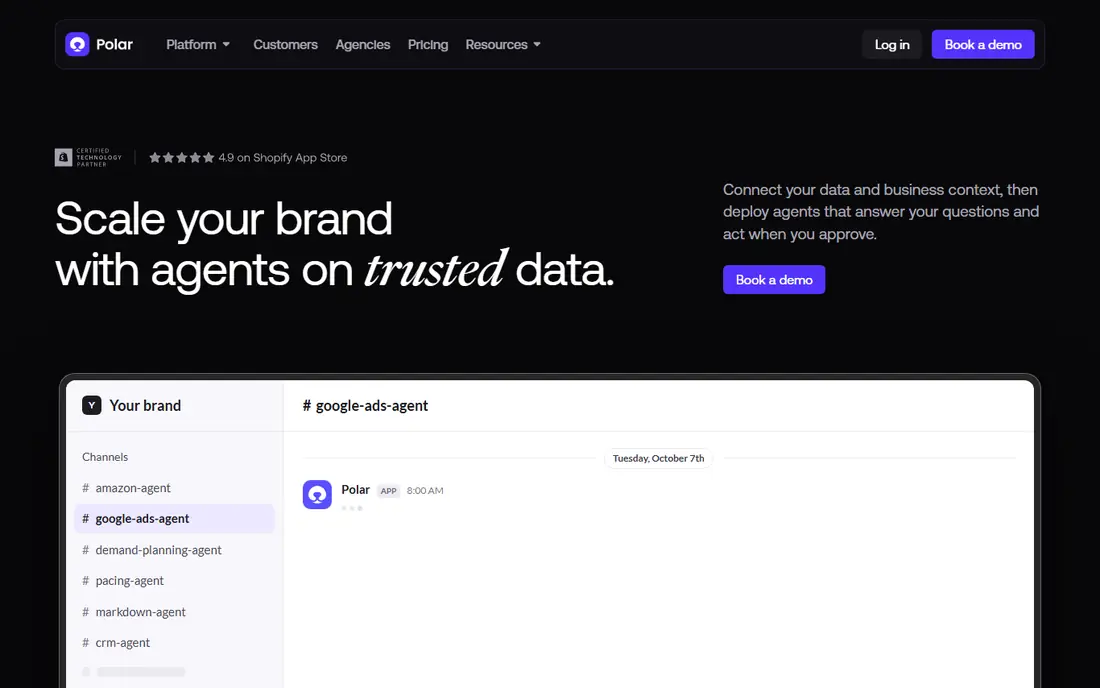
Polar Analytics gives mid-market Shopify brands a business intelligence layer with custom dashboards, a data warehouse, and SQL access for analysts who want to ask their own questions. Profit, attribution, customer retention, and product views sit in one system, which suits teams that have outgrown a single fixed dashboard. Analysts can join store, ad, and customer data for reports that match how the business actually runs.
Entry pricing is high, and building useful dashboards takes time and analytical skill. Smaller stores may find a simpler profit tool enough, and non-Shopify stores should check integration coverage first. Pick Polar Analytics when your team wants to own its data model and build custom reports, rather than accepting one vendor's default attribution view.
- Custom dashboards and data warehouse access
- Profit, attribution, and retention views
- SQL options for analysts
- High entry price
- Setup and dashboard building take time
- Shopify-focused

Lifetimely, by AMP, focuses on profit and customer lifetime value for Shopify stores, with clear reports on revenue, costs, margins, cohorts, and repeat purchase behavior. For a brand that mainly needs to know which products and cohorts actually make money, that focus is more useful than a complex attribution model. The price is also lower than Northbeam or Polar Analytics, which suits growing stores that need profit clarity before they need modeling.
Attribution in core reports is limited to first and last touch, so brands that need multi-touch modeling for large ad budgets will need another tool. Ad optimization features are also thinner than in a dedicated attribution platform. Pick Lifetimely when profit, margin, and lifetime value are the main questions, and use an attribution tool alongside it only if ad spend grows large enough to justify the extra cost.
- Clear profit, margin, and lifetime value reports
- Cohort and retention views
- Lower price than attribution suites
- Attribution is first and last touch only on core reports
- Fewer ad optimization tools
ThoughtMetric offers multi-touch attribution for Shopify brands at a lower entry price than Northbeam or Polar Analytics, with a first-party tracking focus that suits privacy-conscious stores. It shows how channels work together across the customer journey, rather than giving all credit to the last click, and its reports are clear enough for a small marketing team to use weekly. For a growing brand that needs better attribution without enterprise pricing, that balance is appealing.
Incrementality testing and full media mix modeling are not core strengths at this price, so brands that need causal proof for large budget shifts will need a higher-tier tool. Data quality also matters, since first-party tracking still needs correct setup on the store and ad platforms. Pick ThoughtMetric when you want multi-touch insight on a budget, and you are willing to treat attribution as a guide for decisions, not as exact financial truth.
- Multi-touch attribution at a lower price
- First-party tracking focus
- Clear channel reports
- No full incrementality testing on core plans
- Modeling depth is thinner than Northbeam
Wicked Reports is known for contact-based attribution with a long lookback, which suits brands where customers buy again over months, often after email, content, or repeat ads. It tracks lifetime value by contact and channel, so a brand can see which first touch led to a valuable long-term customer, not just a first order. Email-heavy and subscription brands benefit most, because email often drives repeat revenue that last-click tools miss.
Pricing is higher than budget tools, and setup can be manual in places, with no simple public app listing to rely on for reviews in some cases. Smaller stores with short purchase cycles may not need the long-window depth. Pick Wicked Reports when repeat purchases and email drive a large share of revenue, and when lifetime value, not just first-order return, guides your budget.
- Long lookback for repeat purchases
- Strong email and contact-based lifetime value views
- Good for subscription and repeat brands
- Higher price than budget attribution tools
- Setup is manual in places
- Shopify app presence is limited
TrueProfit gives small Shopify stores a clear, real-time profit and loss view, pulling in orders, product costs, shipping, fees, and ad spend to show net profit without a spreadsheet. For a new brand that mainly needs to answer one question, which is whether the store actually made money today, TrueProfit is fast to set up and easy to read. The low price also suits stores that cannot justify an attribution suite yet.
Attribution depth is limited, and custom dashboards are thinner than in Polar Analytics or Northbeam. As ad spend and channels grow, a brand may need to add an attribution tool alongside TrueProfit. Pick TrueProfit when profit clarity is the priority and your budget is tight, and revisit attribution tools only when ad decisions become complex enough to need them.
- Low price
- Clear real-time profit and loss
- Simple Shopify setup
- Attribution depth is limited
- Fewer custom dashboards than Polar Analytics
Littledata fixes a different problem from the other tools here, which is tracking accuracy. It sends server-side order and customer data from Shopify to Google Analytics, Meta, and other platforms, so reports match real orders more closely than browser-only tracking. Brands that see large gaps between Shopify orders and ad platform conversions often find that cleaner data improves every other report they use.
Littledata is not a full profit or attribution suite on its own, so you will still need a dashboard or profit tool for daily decisions. It works best paired with Google Analytics 4, a profit tool, or an attribution platform, where accurate input data makes the output more trustworthy. Pick Littledata when tracking gaps are your main problem, and treat it as a data layer rather than a replacement dashboard.
- Server-side tracking for Shopify
- Cleaner Google Analytics and ad platform data
- Good for data accuracy problems
- Not a full profit or attribution suite on its own
- Needs a reporting tool for dashboards
Google Analytics 4 is the free baseline every store should have, with traffic, source, page, and conversion reports that help you understand where visitors come from and what they do on site. It integrates widely, and its data can feed other tools, including Littledata for cleaner Shopify tracking. For a new store, GA4 answers the basic questions about traffic and conversion without cost.
It does not replace a commerce analytics tool. Profit, product margin, shipping costs, and customer lifetime value are not core GA4 reports, and attribution is basic compared with Northbeam or ThoughtMetric. Setup also matters, since a poorly configured GA4 property can mislead. Pick GA4 as your free baseline, and add a profit or attribution tool when commerce questions, not just traffic questions, drive your decisions.
- Free traffic and conversion reporting
- Wide integration range
- Useful baseline for any store
- No profit, margin, or lifetime value reporting
- Sampling and setup limits
- Attribution is basic for commerce
How we picked these
We compared official pricing pages, attribution models, profit and lifetime value features, and Shopify integration notes, plus public brand reviews about setup and data accuracy. We favored tools that are actively sold in 2026, that publish clear starting prices or trial options, and that cover a distinct need, from enterprise attribution to simple profit reporting to tracking accuracy. We did not claim hands-on testing, and attribution results vary by setup, so treat any model as a decision guide, not as exact financial truth.
Choosing the right analytics tool for your store
Start with the decision you need to make each week. If the decision is which ad channel to fund, pick an attribution tool. If the decision is which product or cohort makes money, pick a profit and lifetime value tool. If the decision is whether tracking data can be trusted, pick a data accuracy tool first. Buying an enterprise attribution suite to answer a profit question wastes money, and buying a profit tool to answer an attribution question wastes time.
Compare tools on the same orders
Run two tools in parallel for a month, and compare their attributed revenue against real Shopify orders and ad spend. Look for large gaps, missing channels, and double counting, since attribution models often sum to more than real revenue. A tool that matches orders closely and explains its model clearly is more useful than a tool with a flashy dashboard and opaque math.
Budget by store size and ad spend
Revenue-priced and order-priced tools climb as a store grows, while flat tools stay steadier until a tier jump. Model the price at your current orders and ad spend, and at double that size, before you commit to a long contract. A tool that is cheap at $50,000 in monthly revenue can become costly at $500,000, so check the pricing bands, not just the entry price.
FAQ
What are the best Triple Whale alternatives?
Northbeam suits large ad budgets, Polar Analytics suits custom dashboards and warehouse reporting, and Lifetimely suits profit and lifetime value tracking. ThoughtMetric suits budget multi-touch attribution, TrueProfit suits small-store profit reports, Wicked Reports suits email-heavy repeat brands, and Littledata suits tracking accuracy. Google Analytics 4 suits free baseline reporting for any store.
Is there a free alternative to Triple Whale?
Google Analytics 4 is free for baseline traffic and conversion reporting, and TrueProfit and Lifetimely offer free tiers with limits. For profit, attribution, and lifetime value reporting at scale, most tools in this list are paid, with prices rising by revenue, orders, or ad spend. Start with GA4 plus a free profit tier, then upgrade when commerce decisions need deeper data.
Which Triple Whale alternative is best for attribution?
Northbeam is best for large ad budgets that need strong attribution and modeling, while ThoughtMetric is best for budget multi-touch attribution. Polar Analytics suits teams that want custom attribution dashboards with warehouse access. No attribution tool is exact, so compare its results against real orders and ad platform data, and use it as a guide for budget decisions.
Can I use Triple Whale alternatives without Shopify?
Most tools in this list are Shopify-focused, especially Triple Whale rivals such as Polar Analytics, Lifetimely, and TrueProfit. Northbeam, Wicked Reports, and Google Analytics 4 work more broadly, though setup varies by platform. If you sell on another platform, check integration coverage and tracking setup before you buy, since a Shopify-only tool will not help a non-Shopify store.
How do I know if attribution data is trustworthy?
Compare attributed revenue to real orders, check for double counting across channels, and test whether the tool's model is explained clearly. Run a holdout or a simple geo test for large budget shifts when possible, since observational attribution can overstate true lift. Treat attribution as a decision guide, and keep finance reports tied to real orders, costs, and bank data.
What is the difference between profit tracking and attribution?
Profit tracking shows whether a store made money after product costs, shipping, fees, and ad spend, while attribution shows which channels and campaigns get credit for orders. A store can have good attribution and poor profit, or good profit and unclear attribution. Most growing brands need both, but start with profit tracking, since a profitable store with rough attribution beats an unprofitable store with precise attribution.