Top Influencer Marketing Software for UGC in 2026: 8 Tools Compared
We compared the top influencer marketing software for ugc for brands sourcing creator videos, checking discovery, briefs, rights, payments, and real prices.
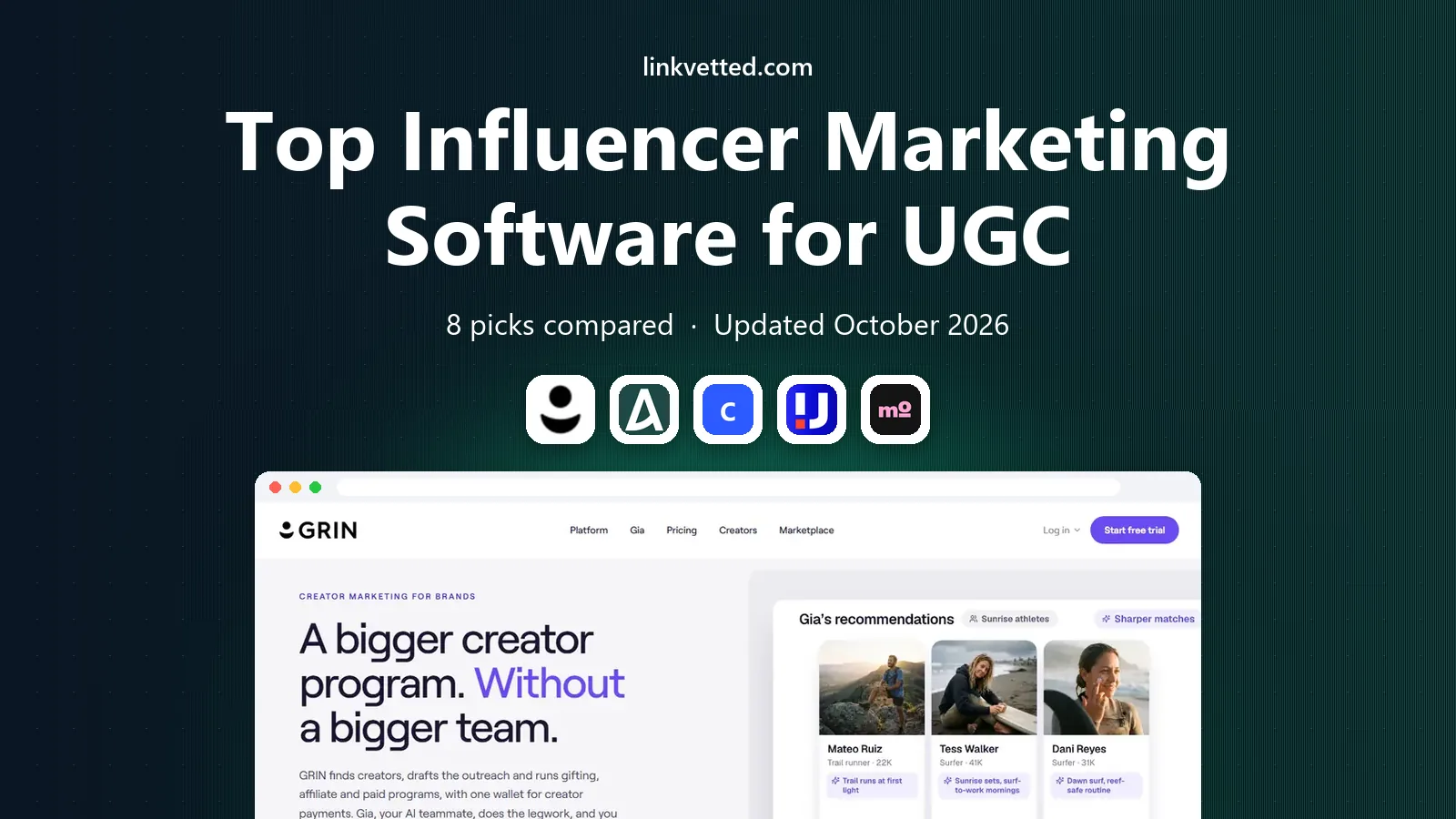
- Editor's choice
 GRIN
Gifting and affiliate creator programs
Starts atFreeVisit grin.coFull review - Great alternative
 Aspire
Large creator programs
Starts atSee websiteVisit aspire.ioFull review - Also consider
 CreatorIQ
Enterprise global programs
Starts atSee websiteVisit creatoriq.comFull review
TL;DR:
- GRIN is the easiest to price, with a free plan and published monthly tiers, plus a management fee on wallet deposits.
- Aspire, CreatorIQ, and Upfluence suit larger programs, but most pricing is quote based, so budget for a sales process.
- Insense and Collabstr suit paid social and one off creator videos, while Modash suits teams that start with discovery and vetting.
- Usage rights, creator pay, and content approval matter more than the software fee, because those costs usually dwarf the subscription.
Quick comparison
| Tool | Best for | Starts at | Free plan? | |
|---|---|---|---|---|
| GRIN | Gifting and affiliate creator programs | Free | Yes | Visit |
| Aspire | Large creator programs | See website | No | Visit |
| CreatorIQ | Enterprise global programs | See website | No | Visit |
 Upfluence | Shopify creator and affiliate programs | See website | No | Visit |
 Modash | Creator discovery and vetting | $199 per month | Free trial | Visit |
 Insense | UGC for paid social ads | $400 per month | No | Visit |
 Collabstr | One off creator bookings | See website | Yes | Visit |
 Creator.co | Community driven creator campaigns | See website | Yes | Visit |
The best influencer marketing software for ugc
User generated content, or UGC, is not the same as a polished brand ad. It is a short, creator made video or photo that looks native to TikTok, Instagram, or YouTube, and it is often used in paid social campaigns. Software for UGC should help you find creators, brief them clearly, approve content, secure usage rights, and pay on time. We compared official feature pages, pricing pages, and public documentation to separate full program platforms from discovery tools and marketplaces.

GRIN is our pick for ecommerce brands that want a real creator program without a long sales cycle. Its public pricing lists Free at $0, Starter at $200, Growth at $500, and Scale at $1,500 per month, with a management fee added when you fund your wallet for creators. That transparency is rare in this category, and it makes budgeting far easier than a quote only tool.
For UGC, GRIN covers the full loop: find creators, send products, manage briefs and approvals, track posts, and pay through one wallet. Creators are not charged a commission on what they earn, which helps with recruitment and retention. The catch is the wallet fee, which drops as the plan rises, so model the total cost on your expected creator spend, not just the monthly plan price.
- Published pricing from $0 to $1,500 per month
- Creator CRM with gifting, affiliate, and paid workflows
- Escrow style wallet payments
- Management fee applies to wallet deposits
- Enterprise features still need a sales conversation

Aspire suits mid sized and larger brands that run creator programs as an ongoing channel, not a one off campaign. Its marketplace brings in creator applications, while campaign tools help a team manage briefs, content, payments, and reporting in one place. That structure matters when you work with dozens or hundreds of creators at once.
The main drawback is access. Aspire sells through demos and custom quotes, and public guides put typical plans well above $1,000 per month. Smaller brands may find the commitment heavy for a first UGC test. If you already have a creator program and you need scale, process, and a large pool of applicants, Aspire is a strong contender for a demo.
- Large creator marketplace with inbound applications
- Strong campaign and relationship tools
- Good for long term programs
- Pricing is quote based and usually annual
- Better suited to teams with a dedicated creator manager

CreatorIQ is built for global enterprises with many markets, stakeholders, and compliance needs. It offers broad creator discovery, vetting, campaign management, and reporting, with controls that help large teams stay consistent across regions. For a brand running UGC in several countries with legal review, that structure is valuable.
For most small and mid sized brands, CreatorIQ will be too much. Pricing is quote based and typically runs to tens of thousands per year, and implementation takes time and internal ownership. Choose it when scale, compliance, and cross market reporting justify the cost. For a first UGC program, start with a smaller platform and move up when volume demands it.
- Deep creator data and compliance tools
- Strong reporting for global teams
- API partnerships with major platforms
- Enterprise pricing and contracts
- Overkill for a small UGC test
Upfluence stands out for brands that want to turn customers into creators. Its live capture feature surfaces people who already buy and post about your products, which often produces more authentic UGC than cold outreach. Shopify and WooCommerce integrations help tie creator content and affiliate sales back to orders.
Pricing is not published as a simple monthly figure, so you will need a demo and a quote. That makes it harder to compare on cost alone, and teams should ask about contract length, seat limits, and affiliate tracking scope before signing. If your store runs on Shopify and customer creators are central to your plan, Upfluence deserves a demo.
- Live capture finds creators among your own customers
- Strong Shopify and WooCommerce links
- Affiliate tracking included
- Pricing is quote based
- Interface and setup take time to learn
Modash is the discovery first pick. It helps teams search across Instagram, TikTok, and YouTube, check audience quality, and build shortlists before outreach. That vetting step matters for UGC, because a creator with a large follower count but a poor audience fit will waste both product and ad spend.
Modash does not try to run your whole program in the same depth as GRIN or Aspire. You may still need separate tools for briefs, approvals, contracts, and payments, or you may pair it with a marketplace for fulfillment. Its published starting price and trial make it easy to test, and it is a smart first buy for teams whose main problem is finding the right creators.
- Large public creator database with AI search
- Audience and fraud checks
- Useful affiliate tracking
- Focus is discovery, not full campaign management
- Creator payments and content workflows need other tools or add ons
Insense is built around a clear job: get creator videos that work as paid social ads. Brands post briefs, creators apply, content is delivered for review, and approved videos can move into ad accounts. That focus on ad ready UGC, rather than general influencer posting, makes it useful for performance marketing teams.
The price needs careful reading. The platform fee starts at $400 per month on an annual plan in recent guides, and creator fees sit on top. That total can still beat agency fees for steady ad creative, but it is a lot for one small test. Use Insense when you need a regular flow of ad creative and you already have a paid social budget to put the content to work.
- Briefs built for TikTok and Meta ad campaigns
- Creator sourcing plus content delivery
- Usage rights handling for ads
- Creator payments are separate from the platform fee
- Entry price is high for a single test campaign
Collabstr suits brands that need a few creator videos now, without committing to a platform subscription. You browse creators, agree a brief and price, and pay through the marketplace, which holds funds until delivery terms are met. That simplicity works for product launches, seasonal pushes, and testing a new creator style.
The trade off is program depth. Collabstr is not a full CRM for long term relationships, gifting at scale, or affiliate management. You also need to vet creators yourself, checking past work, audience fit, and usage terms before you book. For occasional UGC, it is a low friction starting point, and for ongoing programs, it works best beside a CRM style platform.
- Open marketplace for booking individual creators
- Escrow style payment protection
- Simple for one off campaigns
- Less program management than GRIN or Aspire
- Quality varies by creator, so vetting still matters
Creator.co blends a creator community with campaign tools, which suits brands that want micro creators and steady UGC rather than a few large influencers. Creators can join for free, discover campaigns, and submit content, while brands manage briefs and approvals in one place. That community feel can help smaller brands attract creators who genuinely like the product.
Brand pricing is quote based, so ask for the full fee structure, including any campaign or service charges, before you plan a budget. Also confirm how usage rights, revisions, and payment timing work in the contract, since those terms vary by campaign. For community led UGC with micro creators, Creator.co is a useful option to compare with Collabstr and GRIN.
- Community and marketplace mix for micro creators
- Campaign tools for briefs and content
- Free for creators to join
- Pricing for brands is not published simply
- Larger enterprise controls are weaker than CreatorIQ
How we picked these
We compared official feature pages, pricing pages, and public documentation for tools live in October 2026, and we kept only platforms that truly support UGC workflows: discovery, briefs, content approval, rights, or payments. A tool made the list when it had a working official homepage and a clear UGC use case for brands. We weighted published pricing, creator vetting, rights handling, and payment clarity over marketplace size alone.
We did not claim hands-on testing of campaigns. Where a vendor does not publish pricing, we wrote See website rather than repeating a third party estimate as fact. Creator fees, product gifting, and platform management fees usually exceed the software subscription, so we flagged those separate costs in each write-up. Ask each vendor for a written quote that covers the plan, fees, contract length, and rights terms.
How to run UGC without legal trouble
Write the brief, rights, and pay terms first
A good brief states the product, the message, the format, the deadline, the number of revisions, and where the content will run. Rights should state the platforms, the time period, and whether paid ads are included, because ad use usually costs more than organic posting. Put payment timing in writing, and confirm who owns the raw files. Clear terms protect both the brand and the creator, and they prevent most disputes.
Vet creators like you vet ad creative
Check past UGC work, not just follower counts. Look for natural delivery, clear product shots, and captions that fit your brand voice. Check audience geography and engagement quality, and watch for fake followers or sudden spikes. For regulated products, add compliance checks for claims, disclosures, and age gates. Creators must disclose paid partnerships clearly, and brands should review that disclosure before a post goes live.
Measure the content, not just the creator
Track cost per usable video, hook rate on paid social, and downstream sales or signups where you can attribute them. A creator who delivers three usable ad variants at a fair price is often worth more than a larger creator with one polished post. Keep a library of top performers, note what made them work, and reuse those patterns in future briefs. That habit turns UGC from a one off purchase into a repeatable creative system.
FAQ
What is the best influencer marketing tool for ugc for a small brand?
GRIN is the easiest to budget, thanks to published pricing and a free plan, while Collabstr suits one off bookings with no long contract. Start with a small brief, test two or three creators, and only move to a larger platform when you need steady volume. Keep creator fees and rights costs in the budget from day one.
How much does UGC software cost on top of creator fees?
Software fees range from free to several thousand per month, while creator fees, product costs, and management fees are usually larger. GRIN adds a wallet management fee, Insense charges a platform fee plus creator pay, and quote based tools add contract costs. Ask for a total cost model based on your expected creator spend before signing.
Do I own UGC content forever once I pay a creator?
Not automatically. Ownership and usage rights depend on the contract for each campaign. Some deals cover organic use for a set period, while paid ad use, whitelisting, and perpetual use cost extra. Get rights in writing for each piece of content, including platforms, duration, and ad use, before you publish.
How do I find creators for UGC?
Use discovery tools such as Modash to build a shortlist, marketplace tools such as Collabstr to book individuals, or program platforms such as GRIN and Aspire to manage ongoing relationships. Customer creators can also be found through Upfluence live capture. Vet past work and audience fit before you send product.
Should creators disclose UGC partnerships?
Yes. Paid partnerships, gifted products with posting obligations, and affiliate links should be disclosed clearly under FTC guidance in the United States and similar rules elsewhere. Review disclosure in the draft before approval, and keep a record of the final post. Clear disclosure protects the brand and respects the audience.