Top ELT Software for Data Pipelines in 2026: 8 Tools Compared
This guide to top elt software for data pipelines compares 8 tools that move data into your warehouse reliably, with pricing models, free plans and trade-offs.
- Editor's choice
 Fivetran
Managed ELT at scale
Starts atSee websiteVisit fivetran.comFull review - Great alternative
 Airbyte
Open source ELT
Starts at$20 per monthVisit airbyte.comFull review - Also consider
 Matillion
Warehouse-native ELT
Starts atSee websiteVisit matillion.comFull review
TL;DR:
- ELT loads raw data into the warehouse first and transforms it there, which suits cloud warehouses better than the older extract, transform, load order for many teams.
- Fivetran is the managed default for teams that want a large connector catalog with little pipeline maintenance, while Airbyte suits teams that want open source control.
- Hevo and Stitch cover smaller teams well, and Estuary suits teams that need fresh data in minutes rather than hours.
- Watch the billing unit closely, since monthly active rows, events, credits, and volume can produce very different bills for the same data.
Quick comparison
| Tool | Best for | Starts at | Free plan? | |
|---|---|---|---|---|
| Fivetran | Managed ELT at scale | See website | Yes | Visit |
| Airbyte | Open source ELT | $20 per month | Yes | Visit |
| Matillion | Warehouse-native ELT | See website | Free trial | Visit |
 Hevo Data | No-code ELT for smaller teams | $265 per month | Yes | Visit |
 Stitch | Simple extract and load | $100 per month | Free trial | Visit |
 Integrate.io | Flat-fee ELT and reverse ETL | $1,999 per month | No | Visit |
 Estuary Flow | Streaming ELT | See website | Yes | Visit |
 Rivery | ELT with orchestration | See website | Free trial | Visit |
The best ELT software for data pipelines
We compared official pricing pages, connector documentation, and public comparisons for ELT tools that move data from apps and databases into a cloud warehouse. The list below balances managed services, open source, and streaming options.
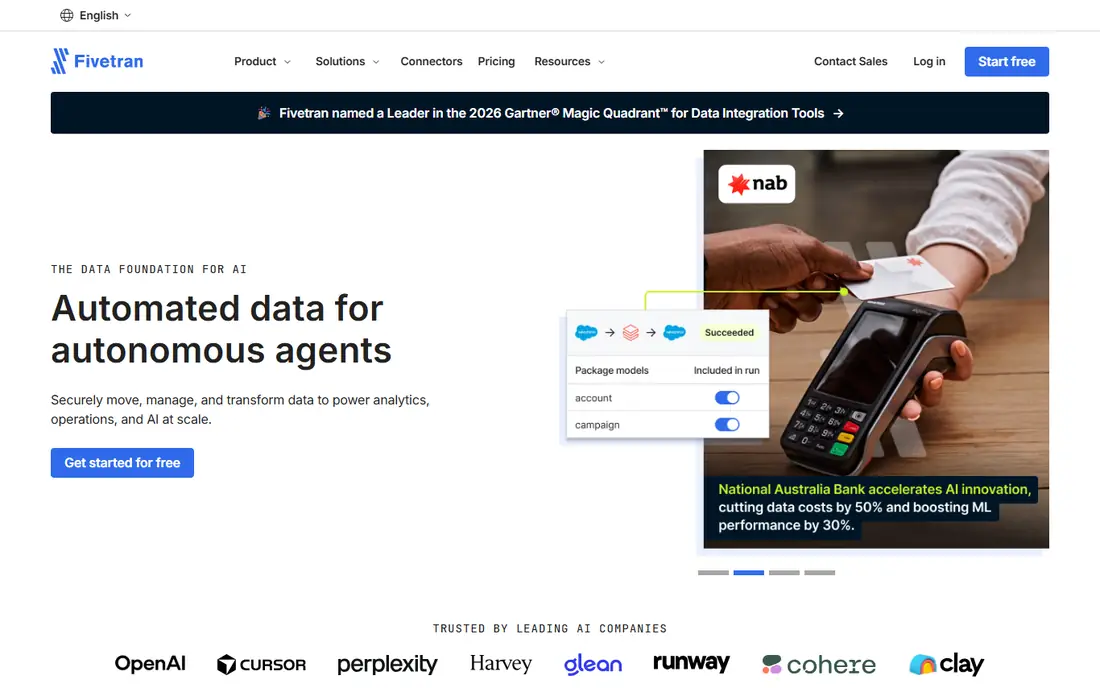
Fivetran is the tool many data teams reach for when they want pipelines that mostly run themselves. It connects SaaS apps, databases, and files to warehouses such as Snowflake, BigQuery, and Databricks, handles schema changes, and captures database changes so dashboards stay current. Its connector catalog is broad, and its managed approach means a small data team can support many sources without building each pipeline by hand.
The main watch-out is cost control. Fivetran bills by monthly active rows per connection, with a per-connection base charge, so a new source or a history-mode change can move the bill. The free plan helps small teams test it, but larger teams should model costs on their actual row counts and set alerts. For teams that value reliability over the lowest price, Fivetran remains the default managed pick.
- Large managed connector catalog
- Automated schema handling and change data capture
- Free plan up to 500,000 monthly active rows
- Usage-based billing can be hard to predict
- Annual contract minimums apply on paid plans in public comparisons

Airbyte gives teams a choice that Fivetran does not: run the open source Core edition yourself, or use managed Airbyte Cloud. The catalog covers databases, SaaS APIs, files, and unstructured sources, and its no-code Connector Builder helps teams add a custom source without writing a full integration from scratch. Transformations work through dbt and SQL in the warehouse, which keeps modeling in familiar tools.
Self-hosting is not free in practice. Someone must run upgrades, monitor sync failures, and manage infrastructure, and that time adds up for a small team. Airbyte Cloud removes that burden for a volume-based fee, starting at $20 per month for Standard in public comparisons from October 2026. For teams that want control, a large catalog, and a genuine free starting point, Airbyte is the strongest open option.
- Open source Core edition with no licence fee
- Large connector catalog including community connectors
- Cloud Standard plan starts at $20 per month in public comparisons
- Self-hosting adds operational work
- Cloud pricing is volume-based and needs monitoring

Matillion builds pipelines that push work down into the warehouse, so transformations run where the data already lives instead of on a separate server. Its visual designer suits data engineers who want to see pipeline logic clearly, while SQL and Python steps cover custom work. Newer agentic pipeline building features aim to speed up pipeline creation, though teams should still review generated logic before it reaches production.
Pricing is the main friction. Matillion lists no entry price and bills by credits tied to pipeline execution, so buyers need a trial and a workload estimate to budget. That makes it a harder first pick for a small team, but a strong one for a warehouse-centered team that already runs Snowflake, BigQuery, or Databricks and wants ELT that feels native to that platform.
- Push-down ELT that runs work inside the warehouse
- Visual pipeline building with SQL and Python
- Streaming change data capture on higher tiers
- No published entry price
- Credit-based billing needs careful forecasting
Hevo Data targets small and mid-size teams that need ELT without a data engineering team. Sources are connected through a no-code interface, pipelines can be scheduled and monitored from one dashboard, and transformations use Python, drag-and-drop steps, or dbt on paid plans. The free plan, covering 1 million events a month, is genuinely useful for a startup testing its first warehouse dashboards.
Growth brings cost questions. Starter is listed at $265 per month on annual billing in public comparisons, and event tiers mean a jump in data volume can push a team into a higher tier. Teams with steady, moderate volume will find Hevo easy to live with. Teams with spiky or very large volumes should model costs against Fivetran and Airbyte before committing.
- No-code setup for non-engineers
- Free plan covers 1 million events a month
- Change data capture and dbt support on paid plans
- Event-based pricing can rise with volume
- Fewer enterprise governance features than Fivetran or Matillion
Stitch, now part of Talend, keeps ELT deliberately simple. Standard starts at $100 per month for 5 million rows in public comparisons, with a set number of standard sources and one destination, after a 14-day trial. For a team that needs to move data from a handful of apps into a warehouse and do its modeling in dbt or SQL afterward, that simplicity is a feature, not a gap.
The limits show up when pipelines need more than extract and load. Transformations are not a Stitch strength, and change data capture is limited, so teams with heavy transformation or near-real-time needs should look at Matillion, Fivetran, or Estuary. For a straightforward, low-maintenance pipeline, Stitch remains a dependable, low-cost choice.
- Simple row-based pricing that is easy to forecast
- Quick setup for standard sources
- Long track record as a Talend product
- Limited transformation support
- Change data capture is limited compared with Fivetran and Estuary
Integrate.io appeals to operations teams that hate usage surprises. Its published model is a flat fee, listed at $1,999 per month in public comparisons, with unlimited volume, plus ETL, ELT, change data capture, and reverse ETL in one platform. Visual steps with SQL and Python cover transformations, and reverse ETL can send warehouse data back to business tools such as a CRM.
The entry price rules it out for most startups, and the lack of a free plan means evaluation runs through a trial or demo rather than self-serve signup. For a mid-size company with large or unpredictable volumes, however, flat pricing can beat a row-based bill that grows every month. Compare it with Fivetran on your actual volumes before deciding.
- Flat fee with unlimited volume in its published model
- ETL, ELT, change data capture, and reverse ETL in one platform
- Visual transformation steps
- High entry price for small teams
- No free plan, so testing needs a sales conversation
Estuary Flow is built for teams that cannot wait hours for data. It streams database changes into the warehouse with sub-minute latency in many setups, and its derivations let teams shape data with SQL or TypeScript as it flows. The free tier, covering 10 GB a month in public comparisons, lets a team test a real streaming pipeline before paying.
Pricing mixes volume and connectors, listed in public comparisons at $0.50 per gigabyte plus $100 per connector beyond the free tier, so a team with many sources should model the total, not just the volume rate. Connector breadth is also narrower than the largest managed catalogs. For real-time dashboards, fraud checks, or operational analytics that need fresh data, Estuary is the strongest streaming pick here.
- Streaming change data capture with low latency
- Free tier up to 10 GB a month in public comparisons
- SQL and TypeScript derivations
- Per-gigabyte and per-connector pricing needs modeling
- Smaller connector catalog than Fivetran or Airbyte
Rivery, now part of Boomi, combines ELT with orchestration and reverse ETL, so a team can move data in, transform it, and send results back to business systems from one platform. Logic steps in SQL and Python cover custom work, and log-based change data capture keeps database sources current without full reloads. That breadth suits data teams that also own reporting automation and reverse ETL.
The main drawback is pricing clarity. Rivery bills by credits, listed at $0.90 per credit for a Base tier in public comparisons, so buyers need a trial workload to forecast cost. Teams that only need simple extract and load may find Stitch or Hevo simpler. Teams that want orchestration plus reverse ETL in one tool should put Rivery on the shortlist.
- Credit-based ELT with orchestration and reverse ETL
- SQL and Python logic steps
- Log-based change data capture
- Pricing is credit-based and needs a workload estimate
- Smaller public community than Airbyte
How we picked these
We compared official pricing pages, connector documentation, and public comparisons from October 2026 for ELT tools that load data into cloud warehouses. We kept only tools that exist and work today, and we balanced managed services, open source, and streaming options across team sizes. We did not claim hands-on testing we did not do; our comparisons rest on vendor documentation, published pricing models, and public reviews.
How to avoid a surprise ELT bill
Start with your billing unit, not your connector count. Fivetran bills monthly active rows per connection, Hevo bills events, Airbyte Cloud bills volume or capacity, Matillion and Rivery bill credits, and Estuary bills volume plus connectors. Two tools can look similar on a feature page and differ by thousands of dollars a month on the same data, so model the bill on last month's actual source volumes.
Test with your messiest source
Every vendor demo uses clean sample data. Connect your hardest source first, the one with schema changes, deleted rows, or large history, and watch how the tool handles it for two weeks. Check row counts in the warehouse against the source, test a schema change, and confirm that a failed sync alerts someone. A tool that passes that test will handle your easier sources without drama.
Decide where transformation lives
ELT works best when transformation lives in the warehouse, usually in dbt or SQL, rather than in a separate transformation server. That keeps logic version-controlled, testable, and visible to analysts. If your team already uses dbt, favor tools with native dbt support. If it does not, favor a tool with visual or Python steps that your current team can maintain.
FAQ
What is the difference between ETL and ELT?
In ETL, data is transformed before it is loaded into the warehouse. In ELT, raw data is loaded first and transformed inside the warehouse, which suits cloud warehouses that can scale compute for transformation work. Most tools here follow the ELT pattern, though some also support older ETL flows.
Which ELT tool is best for a small team?
Hevo Data and Stitch suit small teams best, since both offer simple setup and clear entry pricing, with Hevo offering a free plan up to 1 million events a month. Airbyte Core is the best free option for a team willing to self-host, while Fivetran is the better managed pick once volume and reliability needs grow.
Is Airbyte really free?
Airbyte Core, the open source edition, carries no licence fee, but you pay for the infrastructure to run it and the staff time to maintain it. Airbyte Cloud is a paid managed service, starting at $20 per month for Standard in public comparisons, with volume-based pricing above that tier.
How does Fivetran pricing work?
Fivetran bills by monthly active rows per connection, with a per-connection base charge, and it offers a free plan up to 500,000 monthly active rows. Because inserts, updates, deletes, and history-mode changes can all count, teams should model costs on real row counts and monitor usage monthly.
Do I need streaming ELT?
Most reporting works fine on hourly or daily batch syncs, so streaming is not required for weekly dashboards. Streaming tools such as Estuary Flow matter when decisions depend on fresh data, such as fraud checks, inventory alerts, or operational dashboards that must reflect changes within minutes.