Top EHS Management Software in 2026: 9 Tools Compared
We compared the top EHS management software for 2026, from VelocityEHS and Cority to SafetyCulture, on price, usability and who each platform suits best.
- Editor's choice
 VelocityEHS
Mid-size companies wanting usability
Starts atSee websiteVisit ehs.comFull review - Great alternative
 Cority
Large enterprises needing EHSQ depth
Starts atSee websiteVisit cority.comFull review - Also consider
 Intelex
Complex programs needing configuration
Starts atSee websiteVisit intelex.comFull review
TL;DR:
- VelocityEHS is the best EHS management software for mid-size companies that want usability, while Cority and Intelex suit large enterprises with complex programs.
- Small teams can start free with SafetyCulture, while EHS Insight publishes pricing from $5,000 per year for mid-market buyers.
- Most enterprise EHS platforms are quote-based, with reported annual costs from about $9,000 to more than $100,000 depending on modules and scale.
- The best EHS software is the one your frontline staff will actually use, so mobile inspections and offline access matter more than feature counts.
Quick comparison
| Tool | Best for | Starts at | Free plan? | |
|---|---|---|---|---|
| VelocityEHS | Mid-size companies wanting usability | See website | No | Visit |
| Cority | Large enterprises needing EHSQ depth | See website | No | Visit |
| Intelex | Complex programs needing configuration | See website | No | Visit |
 Benchmark Gensuite | Enterprise risk and compliance | See website | No | Visit |
 SafetyCulture | Frontline teams and small businesses | Free | Yes | Visit |
 EHS Insight | Mid-market value with published pricing | $5,000 per year | No | Visit |
 EcoOnline | Chemical safety and connected EHS | See website | No | Visit |
 Enablon | Global EHSQ governance | See website | No | Visit |
 HSI | Chemical safety plus training | $4,000 per year | No | Visit |
The best EHS management software
EHS stands for environment, health and safety, and EHS software covers incident reporting, inspections, audits, training, chemical management and regulatory compliance in one place. The tools below range from free frontline apps to enterprise suites, so match the platform to your headcount, site count and regulatory exposure.
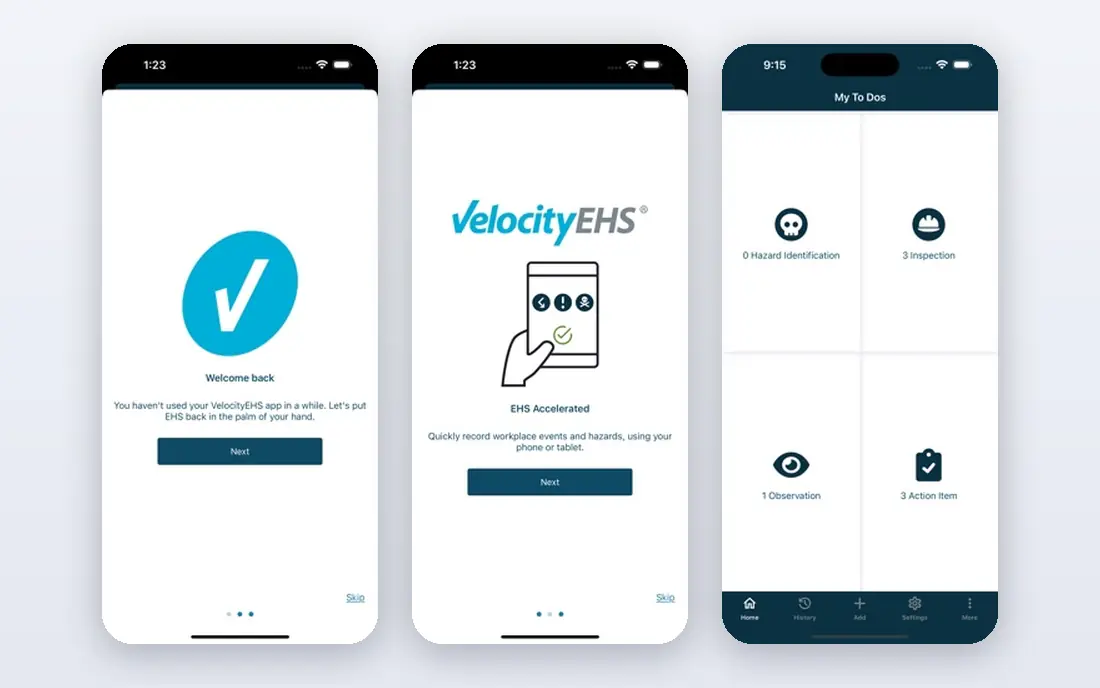
VelocityEHS grew out of chemical management, through its MSDSonline roots, into a full EHS platform covering safety, ergonomics, industrial hygiene, training and sustainability. Its chemical module covers SDS libraries, chemical inventory by site and location, GHS labeling and mobile access, while the wider platform handles incidents, audits and corrective actions. Reviewers consistently rate it highly for ease of use, with a 4.4 out of 5 score on G2 in October 2026.
The trade-off is depth at the very top end. VelocityEHS will not match Intelex or Cority on configurability for the most complex global programs, and pricing is quote-based, with the vendor stating there are no per-user fees. For a company with a few sites and a small safety team, it gets you running faster than the enterprise alternatives, and it is our pick for most mid-size buyers.
- Strong chemical management heritage
- Good usability
- No per-user fees according to the vendor
- Quote-based pricing
- Less configurability than Intelex or Cority for sprawling programs
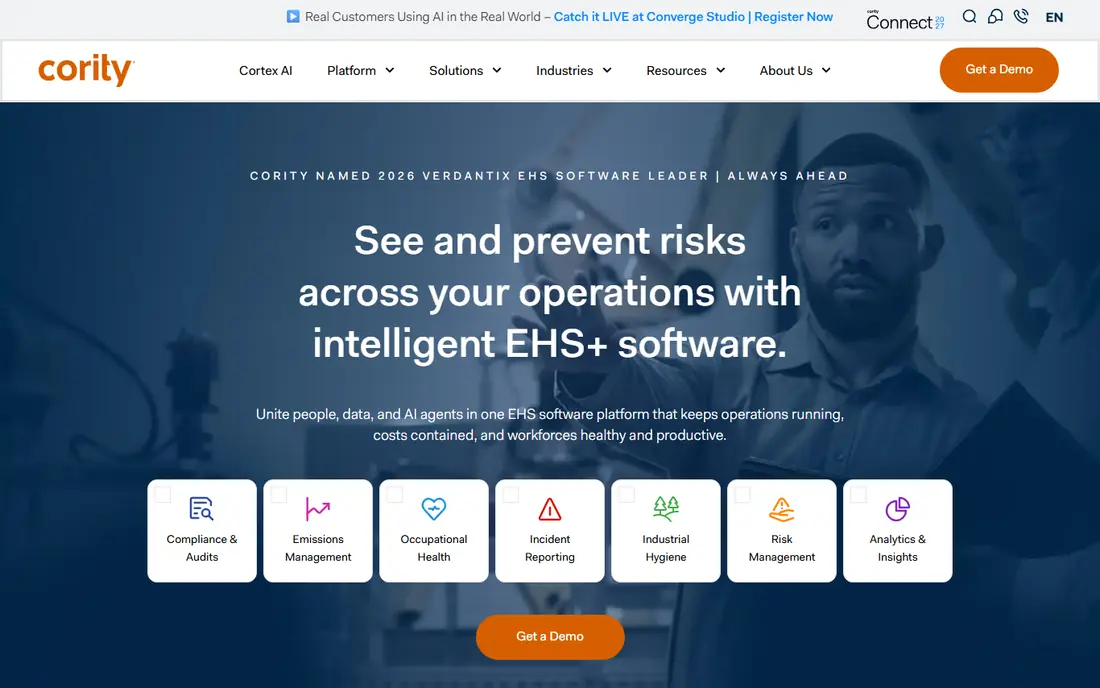
Cority, now sold as CorityOne, is an enterprise EHSQ platform, meaning it adds quality management to environment, health and safety. It covers safety, occupational health, industrial hygiene, environmental compliance, sustainability and quality workflows in one suite, with chemical management supported through regulatory content integrations. Large enterprises use it to standardize programs across many sites and countries.
The honest catch is cost and effort. Cority is quote-based, reviewers note that cost can limit access to added features, and a full rollout needs dedicated administrators. Buy Cority when your program spans occupational health, hygiene and quality alongside safety, not when a simpler incident and inspection tool would do. For that enterprise brief, it is the most comprehensive pick here.
- Broadest EHSQ coverage including occupational health
- Strong analytics
- Global enterprise scale
- Quote-based pricing
- Implementation needs real planning and resources
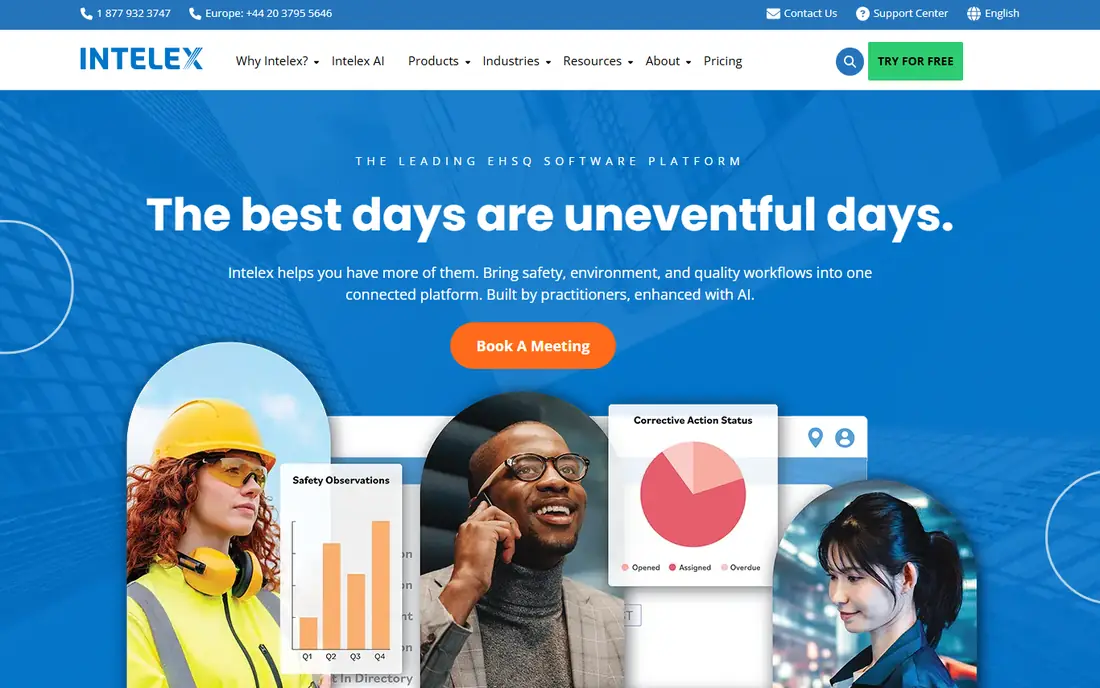
Intelex, part of Fortive, is the configurability pick among enterprise EHSQ platforms. Its applications cover safety, environment, quality and supplier management, and they adapt to how your organization actually works rather than forcing a single template. Multinationals with complex, multi-site programs use it to standardize without oversimplifying local requirements, and it holds a 4.1 out of 5 rating on G2.
Flexibility is also the cost. Implementations are measured in months, pricing is quote-based, and the platform expects dedicated administrators to keep it tuned. If your EHS program is too complex for a simpler tool, Intelex is the right call. If it is not, you will pay enterprise prices for power you never use.
- Deep configurability
- Broad EHSQ application library
- Strong for multi-site standardization
- Enterprise pricing
- Implementations measured in months
- Needs dedicated administrators
Benchmark Gensuite is an enterprise EHS platform used by large organizations for incident management, audits, risk assessment, compliance tracking and sustainability reporting. It suits companies that need consistent processes across many sites, with dashboards that roll up risk and compliance status for leadership. Its workflow engine lets safety teams route findings and corrective actions without chasing people by email.
The weakness is the same as other enterprise suites: quote-based pricing and a configuration project before the system matches your processes. Smaller teams will find SafetyCulture or EHS Insight faster to adopt. For a large enterprise that needs audit-ready compliance across sites, Benchmark Gensuite belongs on the shortlist next to Cority and Intelex.
- Strong risk, audit and compliance workflows
- Good for multi-site enterprises
- Solid reporting
- Quote-based pricing
- Breadth needs configuration to fit your processes
SafetyCulture, formerly known as iAuditor and now associated with the Mitti brand in some listings, is the frontline pick in EHS software. It lets workers complete inspections, report incidents and hazards, and close corrective actions from a phone, even offline, with templates for common checklists. Paid plans start at $24 per user per month billed annually, and a free tier covers small teams getting started.
The limit is depth. SafetyCulture will not replace Cority for occupational health or complex environmental permitting, and its analytics are simpler than enterprise suites. But adoption is where EHS programs live or die, and a tool your crews actually open every day beats a powerful system they avoid. For small businesses and frontline teams, it is our pick, and the free tier makes it risk-free to try.
- Free tier for small teams
- Excellent mobile inspections
- Fast setup in days
- Less depth than enterprise suites for complex EHSQ
- Paid tiers from $24 per user per month
EHS Insight is the rare EHS vendor that publishes a starting price: from $5,000 per year, according to its pricing page. It offers modular EHS software covering incidents, audits, inspections, training and compliance, so mid-market buyers can start with the modules they need rather than buying a full enterprise suite. That pricing transparency makes budgeting far easier than with quote-only rivals.
The trade-off is scale and ecosystem. EHS Insight is a smaller vendor than Cority or VelocityEHS, and its integration catalog is narrower. For a mid-size company that wants real EHS capability at a known price, though, it is the best value pick here, and the modular approach keeps the first-year cost under control.
- Published starting price
- Modular design
- Good fit for mid-market budgets
- Smaller vendor than the enterprise leaders
- Fewer native integrations
EcoOnline is a connected EHS and ESG platform with particular strength in chemical safety, including SDS management, risk assessment and chemical inventory, alongside incident, audit and contractor safety tools. It also offers lone worker protection, which matters for utilities, field services and remote sites. Reviewers rate it around 4.3 out of 5 on G2, and it scores highly for safety management in analyst rankings.
The catch is pricing transparency: EcoOnline is quote-based, and its breadth needs configuration to fit your workflows. For organizations where chemical exposure and lone working are central risks, it is a strong specialist pick. For general incident and inspection needs, SafetyCulture or EHS Insight will be simpler and cheaper.
- Strong chemical safety and SDS tools
- Connected EHS and ESG reporting
- Lone worker protection
- Quote-only pricing
- Breadth needs configuration
Enablon, part of Wolters Kluwer, is a global EHSQ and ESG platform used by large enterprises for safety, environmental compliance, risk management and sustainability reporting. It suits organizations that need governance across many countries, with audit trails and controls that satisfy regulators and boards. Its ESG capabilities also appeal to companies reporting sustainability metrics alongside safety data.
The honest weakness is accessibility. Enablon is quote-based, implementations are enterprise projects, and smaller companies will find it heavy. But for a global enterprise that needs one governance system for EHS, risk and ESG, Enablon is among the most complete options available, and it belongs on any enterprise shortlist.
- Broad EHSQ and ESG governance
- Strong for global enterprises
- Deep compliance content
- Quote-based pricing
- Enterprise implementation effort
HSI pairs chemical safety software with an EHS learning platform, which is a useful combination: SDS management and chemical inventory sit alongside the training records that prove workers know how to handle those chemicals. Pricing is listed from $4,000 per year, and reviewers rate HSI around 4.7 out of 5 on G2, the highest score among the chemical-focused tools here.
The limit is breadth. HSI is strongest where chemical safety and training overlap, and it is less of a general EHSQ suite than Cority or Intelex. For a company whose main risks are chemical exposure and workforce training, though, that combination is exactly right, and the published starting price makes it easy to budget.
- SDS management paired with a learning platform
- Pricing from $4,000 per year
- Strong field access
- Less known for broad EHSQ than Cority
- Training focus may exceed what some buyers need
How we picked these
We compared official product pages, pricing pages and reviewer ratings for the leading EHS platforms in October 2026, and favored tools that cover incidents, inspections, audits and corrective actions, with mobile access for frontline staff. We mixed enterprise suites, mid-market tools and free frontline apps, because the best EHS management software depends on company size and risk profile. Prices shown are starting figures from vendor or reputable listings, and we wrote See website where a vendor does not publish pricing.
How to choose the right EHS platform
Start with your user, not your feature list. If frontline workers will log observations, test the mobile app in the field, with gloves on and signal off, before you buy. If your safety team lives in an office, prioritize reporting and audit workflows instead. Then map your regulatory duties: OSHA 300 logs, chemical inventories, training records, permits and audits, and confirm each one is a native workflow, not a spreadsheet export.
Next, be honest about implementation capacity. A tool like SafetyCulture can run in days, mid-market platforms typically take four to twelve weeks, and enterprise suites can take three to nine months. Ask every vendor for a written timeline, a named owner on your side, and a data export plan. Finally, measure leading indicators after launch, such as inspections completed and hazards closed, not just incident rates, because those numbers show whether the system is actually being used.
A note on compliance
EHS software helps a great deal with compliance, but it does not guarantee it. Good software gives you OSHA logs, incident tracking, audit trails and training records in one place, which covers most of what an inspection asks for. You still need correct procedures, trained people and timely reporting. Treat the software as the filing cabinet and the reminder system, not as the safety program itself.
FAQ
Which EHS management software is the best?
For mid-size companies, VelocityEHS is our pick for usability and chemical strength. For large enterprises needing full EHSQ, Cority is the most comprehensive, and for complex configurable programs, Intelex leads. For small teams, SafetyCulture is the best free starting point.
How much does EHS software cost?
Enterprise platforms are quote-based, with reviewers reporting roughly $9,000 to more than $100,000 per year depending on modules and scale. EHS Insight publishes pricing from $5,000 per year, HSI from $4,000 per year, and SafetyCulture offers a free tier with paid plans from $24 per user per month.
What is the difference between EHS and EHSQ software?
EHS covers environment, health and safety. EHSQ adds quality management, so platforms like Cority and Intelex include quality workflows alongside safety. If your organization manages quality systems such as ISO 9001 alongside safety, an EHSQ platform avoids a separate quality system.
Should a small business use EHS software?
Yes. SafetyCulture offers a capable free tier that handles inspections, incidents and compliance for small teams, and the cost of a serious incident far exceeds the software price. Start free, then add paid features as your safety program matures.
How long does EHS software take to implement?
Simple tools like SafetyCulture can run in days. Mid-market platforms typically take four to twelve weeks including configuration, data migration and training. Enterprise suites can take three to nine months for a full multi-module rollout, so ask for a written timeline before signing.
Will EHS software keep us OSHA compliant?
It helps a great deal but does not guarantee compliance. It organizes OSHA 300 logs, incident tracking, audit trails and training records, which is most of what an inspection asks for. Correct procedures, trained people and timely reporting are still your responsibility.