Top Call Center Software Vendors in 2026: 8 Vendors Compared
Compare the top call center software vendors for voice, chat, and email routing, AI assistance, workforce tools, and per-agent pricing compared in full.
- Editor's choice
 Genesys Cloud CX
Large global centers
Starts at$75 per user per monthVisit genesys.comFull review - Great alternative
 NICE CXone
Regulated enterprises
Starts at$110 per agent per monthVisit nice.comFull review - Also consider
 Five9
High-volume voice, outbound
Starts at$119 per seat per monthVisit five9.comFull review
TL;DR:
- Genesys Cloud CX and NICE CXone suit large, regulated contact centers, while RingCentral RingCX and Aircall suit smaller teams with lower seat prices.
- Five9's strength is high-volume voice and outbound dialing, but its 50-seat minimum rules it out for very small teams.
- Published seat prices rarely include telephony, compliance fees, or AI add-ons, so treat them as a floor and ask for a full monthly estimate.
- Check workforce management, quality tools, and CRM links in a trial with real call flows, not just a vendor demo script.
Quick comparison
| Tool | Best for | Starts at | Free plan? | |
|---|---|---|---|---|
| Genesys Cloud CX | Large global centers | $75 per user per month | No | Visit |
| NICE CXone | Regulated enterprises | $110 per agent per month | No | Visit |
| Five9 | High-volume voice, outbound | $119 per seat per month | No | Visit |
 Talkdesk | Industry-specific centers | $85 per user per month | No | Visit |
 RingCentral RingCX | Lowest published seat price | $65 per user per month | No | Visit |
 Dialpad Support | AI coaching built in | $80 per user per month | No | Visit |
 Aircall | Small teams, CRM links | $30 per license per month | No | Visit |
 Zendesk | Ticket-first support teams | $55 per agent per month | No | Visit |
The best call center software vendors
Call center software, now usually called contact center software, routes voice, chat, email, and social messages to the right agent, records quality, and helps managers forecast staffing. The vendors below differ in scale, price, and how much AI and workforce tooling is included in the base plan.

Genesys Cloud CX is the default shortlist pick for large contact centers that handle voice and digital channels across countries and time zones. Its routing, journey tools, and AI assistance help large teams manage complex flows, and its workforce management and quality tools, available at higher tiers, help managers forecast, schedule, and review agent work. The platform is built for scale, with deep CRM and enterprise integrations.
The cost rises quickly as you move from CX 1 at $75 per user per month to CX 3 and CX 4, and a large deployment needs planning, integration work, and training. Small teams will find Genesys more than they need. For a center with hundreds of agents, complex routing, or global coverage, Genesys is a strong and proven choice.
- Broad omnichannel routing
- Strong workforce and quality tools at higher tiers
- Global scale
- Higher tiers get expensive
- Implementation can take weeks for large centers
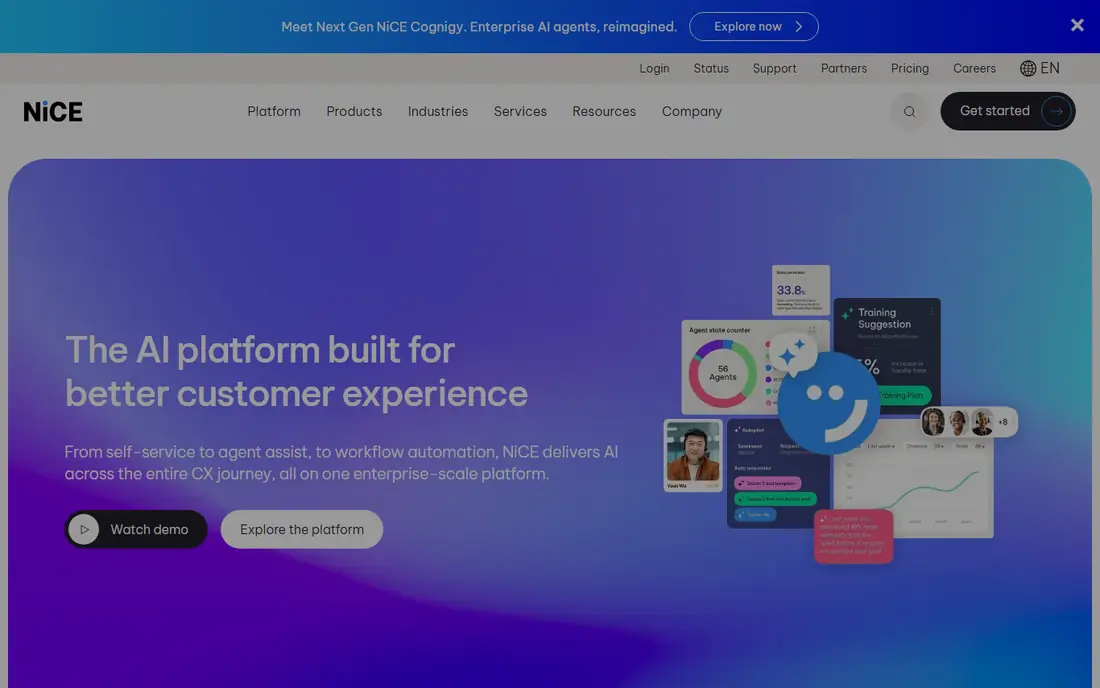
NICE CXone combines voice and digital channels with AI agents, analytics, and workforce tools in one enterprise platform. Its Enlighten AI features help with agent assistance, quality scoring, and customer insight, and its workforce tools help large centers forecast demand and schedule staff. Regulated industries value its compliance, recording, and reporting depth, which is why banks, insurers, and healthcare providers often shortlist it.
CXone starts at $110 per agent per month for omnichannel, with higher tiers up to $249, so it is not a budget pick. Many AI features sit in higher plans, so check the tier comparison carefully. For a large, regulated center that wants AI, quality, and workforce tools in one vendor, CXone is a leading option.
- Strong AI and analytics
- Workforce and quality management
- Suited to regulated industries
- Higher starting price
- AI features are gated by tier
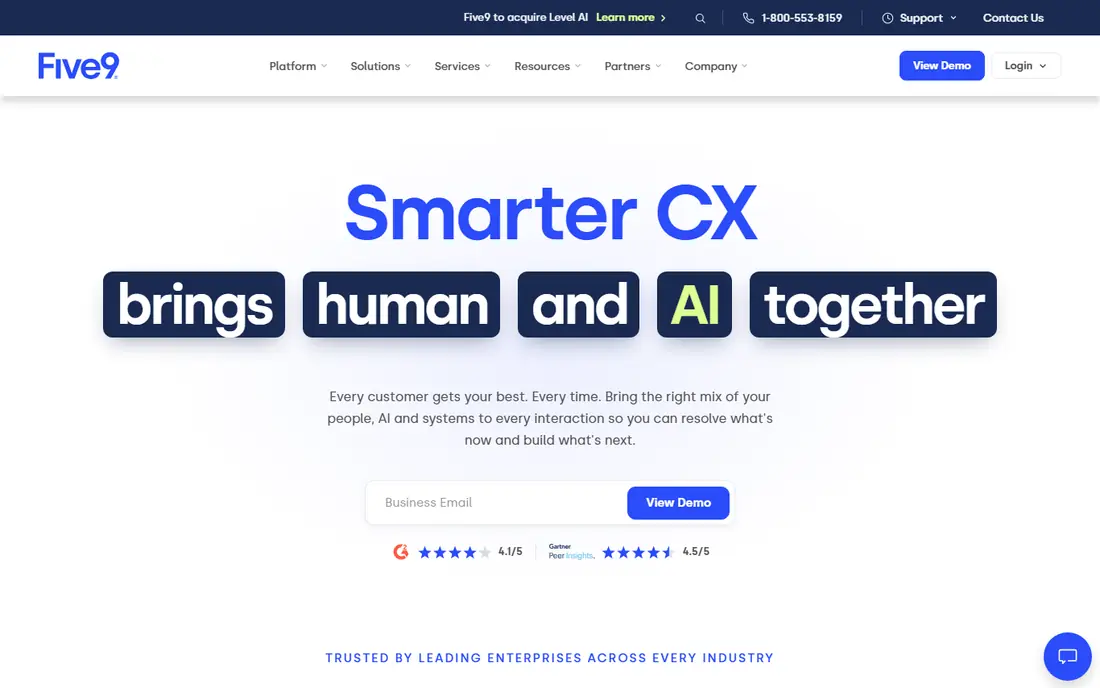
Five9 is built for voice-heavy centers, especially those that run outbound campaigns alongside inbound support. Its predictive, progressive, and preview dialers, blended queues, and CRM links help large sales and service floors work efficiently, and its AI tools assist agents during calls. Centers that live on phone volume often choose Five9 for dialer depth rather than for chat-first design.
The main limit is the minimum: key plans require 50 seats, so a five-agent team would pay for 50 seats, which rules Five9 out for small teams. Digital starts at $119 per seat per month, while Core voice starts at $159, so price the exact plan you need. For a 50-plus agent voice center, Five9 is a serious contender.
- Strong dialers and blended inbound and outbound
- Proven at scale
- Broad CRM links
- 50-seat minimum on key plans
- Core voice plan starts at $159 per seat
Talkdesk offers a modern contact center with industry editions tuned for healthcare, financial services, retail, travel, and utilities. Those editions include workflows, integrations, and compliance settings that fit each sector, which saves setup time compared with a generic platform. Its AI tools help with routing, agent assistance, and self-service, and its interface is easier to learn than some enterprise rivals.
Digital Essentials starts at $85 per user per month, Voice Essentials at $105, and higher tiers reach $225 for industry clouds, so the plan you need matters more than the headline price. Talkdesk suits mid-market and enterprise centers that want industry fit without a long custom build. For a small team that only needs basic calling, Aircall or RingCentral may be cheaper.
- Industry editions for healthcare, retail, and finance
- Modern interface
- AI built in
- Voice plans start higher than digital
- Industry clouds cost more
RingCentral RingCX is the value pick among enterprise contact centers, with Standard starting at $65 per user per month billed annually. It covers voice and digital channels, routing, analytics, and AI assistance, and it pairs naturally with RingCentral's phone system, so a business can consolidate vendors. For a mid-size center that wants omnichannel routing without Genesys or NICE pricing, RingCX is attractive.
Higher tiers at $95 and $145 add more AI, quality, and workforce features, so a large center should price the tier it actually needs. RingCX is less deep than Genesys or CXone for very large, complex centers, but for most mid-size teams it covers the core well. If you already use RingCentral for phones, RingCX is an easy shortlist pick.
- Lowest published omnichannel seat price
- Combines phone system and contact center
- Fast setup for RingCentral users
- Advanced workforce tools sit in higher tiers
- AI depth varies by plan
Dialpad Support, formerly Dialpad Ai Contact Center, brings voice intelligence into the contact center from the start. Calls are transcribed, summarized, and analyzed, and managers get coaching insights without buying a separate analytics tool. That helps mid-market teams improve quality and train new agents faster, and deployment is usually quicker than enterprise platforms.
Essentials starts at $80 per user per month billed annually, with Advanced at $115 and Premium at $150, and the support product is separate from Dialpad's phone system price. Workforce management sits in the higher tier. For a support team that wants AI transcripts and coaching without a heavy enterprise project, Dialpad is a strong modern choice.
- Native AI transcripts, recaps, and coaching
- Clean interface
- Fast deployment
- Support plans are separate from the phone system
- Coaching and workforce tools cost more
Aircall is the best entry point for a small team that needs business calling, routing, and CRM links without enterprise cost. Essentials starts at $30 per license per month with a three-license minimum, and its integrations with HubSpot, Salesforce, Zendesk, and other tools log calls automatically. Setup is fast, and the interface is friendly for teams without a telecom specialist.
Advanced routing, queue callback, and monitoring features sit in higher plans, so a growing center should price Professional rather than Essentials. Aircall is not a full workforce management platform for hundreds of agents. For a team of three to 50 agents that wants simple, well-connected calling, Aircall is excellent value.
- Low starting price and small minimum
- Large integration marketplace
- Simple setup
- Advanced routing needs higher plans
- Not a full enterprise workforce platform
Zendesk suits support teams that think in tickets first and calls second. Its Suite plans, starting at $55 per agent per month, cover email, chat, and help center, with voice added as a usage-based channel. Agents see customer history, tickets, and knowledge articles in one workspace, and managers get reporting across channels. For a team already using Zendesk for support, adding voice keeps everything in one place.
Zendesk is not as deep as Genesys or NICE for large voice centers, workforce forecasting, or complex routing, and voice usage costs add to the seat price. A voice-heavy center should compare it carefully with RingCX or Talkdesk. For a ticket-first team that wants a single support workspace, Zendesk remains a solid pick.
- Strong ticketing and help center
- Broad app marketplace
- Familiar for support teams
- Voice is usage based on top of seat price
- Contact center depth is less than Genesys
How we picked these
We compared official pricing pages and product documentation for contact center vendors, focusing on channels, routing, AI assistance, workforce tools, and published seat prices. We favored vendors that are actively sold in 2026 and that cover different team sizes, from three-agent teams to global centers. Where pricing varies by billing term, we note the annual figure, and we flag seat minimums that change the real cost.
How to price a contact center honestly
Ask each vendor for a monthly estimate that includes seats, telephony minutes, SMS and chat usage, AI add-ons, compliance fees, and implementation. Run a trial with your real call flows, including after-hours routing, overflow queues, and CRM screen pops, and measure handle time and first-contact resolution, not just agent satisfaction. Check contract length, seat minimums, and what happens when headcount falls, because contact center headcount changes with seasons. A cheap seat price with high usage fees can cost more than a higher seat price with usage included.
FAQ
What is the best call center software for a small team?
Aircall is best for very small teams because of its $30 starting price and three-license minimum, while RingCentral RingCX suits growing teams that want omnichannel routing at $65 per user per month. Five9 is not suited to small teams because of its 50-seat minimum.
How much does call center software cost per agent?
Published prices in this list range from $30 to $159 per agent per month, depending on plan and channels, and telephony and AI add-ons sit on top. Always ask for a full monthly estimate for your agent count and call volume before comparing vendors.
What is the difference between a call center and a contact center?
A call center handles phone calls, while a contact center handles voice plus chat, email, SMS, and social messages in one system. Most vendors in this list are contact center platforms, even if buyers still search for call center software.
Do I need workforce management software?
Large centers need forecasting, scheduling, and quality tools to staff peaks and review calls, while small teams can often manage with basic reporting and manual schedules. Genesys and NICE include deeper workforce tools at higher tiers, while Aircall and Zendesk suit teams that do not need that depth yet.
Can call center software integrate with my CRM?
Yes, all vendors in this list offer CRM integrations, with Aircall, Genesys, Talkdesk, and Five9 offering broad marketplaces for Salesforce, HubSpot, and Zendesk. Check whether your CRM version is supported and whether screen pops, call logging, and click-to-dial are included in your plan or sold as add-ons.