Top 10 Logistics Software in 2026: 8 Tools Compared
Compare the top 10 logistics software options for 2026, with shipping, warehouse, freight and tracking tools for ecommerce and supply chain teams today.
- Editor's choice
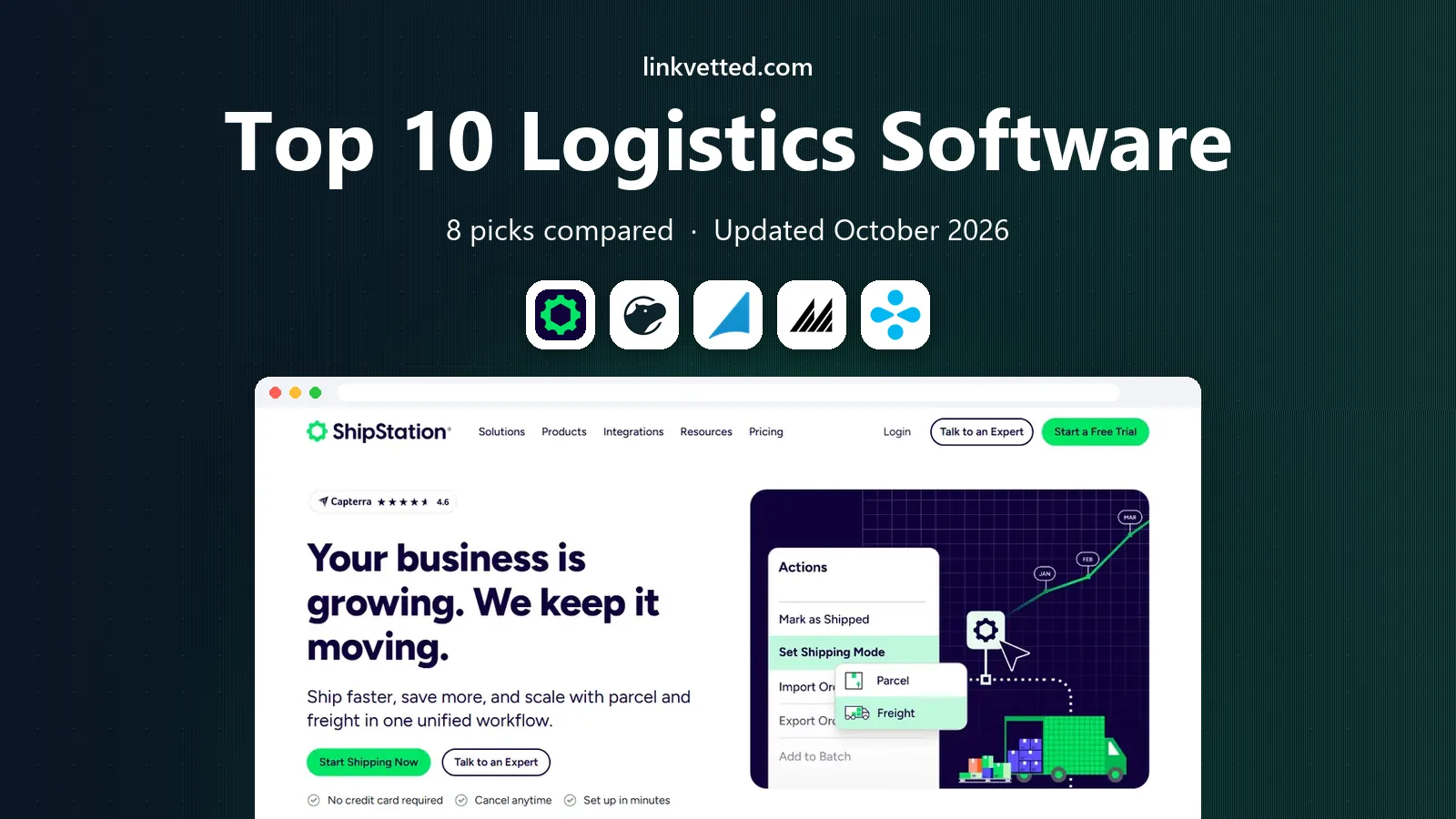
 ShipStation
Multichannel ecommerce shipping
Starts at$14.99 per monthVisit shipstation.comFull review - Great alternative
 Shippo
Simple labels and developer API
Starts atFreeVisit goshippo.comFull review - Also consider
 Descartes
Global logistics and compliance
Starts atSee websiteVisit descartes.comFull review
TL;DR:
- ShipStation and Shippo suit ecommerce sellers that need labels, automation and carrier choice.
- Descartes, Manhattan Associates and Blue Yonder suit larger supply chains with warehouse and transport complexity.
- MercuryGate and project44 suit teams focused on freight management and shipment visibility.
- Easyship suits sellers shipping internationally who need customs and cross border rates.
- Total cost depends on shipment volume, carrier mix and warehouse needs, not just the subscription price.
Quick comparison
| Tool | Best for | Starts at | Free plan? | |
|---|---|---|---|---|
| ShipStation | Multichannel ecommerce shipping | $14.99 per month | Free trial | Visit |
| Shippo | Simple labels and developer API | Free | Yes | Visit |
| Descartes | Global logistics and compliance | See website | No | Visit |
 Manhattan Associates | Warehouse and omnichannel fulfillment | See website | No | Visit |
 Blue Yonder | Supply chain planning and execution | See website | No | Visit |
 MercuryGate | Transportation management | See website | No | Visit |
 project44 | Real time shipment visibility | See website | No | Visit |
 Easyship | Cross border ecommerce shipping | Free | Yes | Visit |
The best logistics software
Logistics software covers shipping, warehousing, freight, tracking and returns. We compared carrier coverage, automation, warehouse tools, visibility and pricing, with a mix of ecommerce tools and enterprise supply chain platforms.

ShipStation pulls orders from stores and marketplaces into one place, compares carrier rates, prints labels in batches and tracks shipments. Automation rules can assign carriers, add packing slips and send branded tracking updates without manual work for each order. Higher plans add inventory and warehouse picking tools, which help as order volume grows.
The subscription price depends on monthly shipments, so a growing store should model cost at its peak volume, not its current average. Support and features also vary by plan. For sellers shipping from several channels each day, ShipStation remains one of the most practical all round shipping tools.
- Wide carrier and store integrations
- Automation rules
- Warehouse tools on higher plans
- Price rises with shipment volume
- No built in helpdesk

Shippo combines a simple web app for printing labels with an API that developers can use to add shipping to their own platform. It offers discounted rates with major US carriers, rate comparison and batch labels, and its free starter plan covers a limited number of labels each month. That makes it easy to test without a subscription.
The trade off is depth. Shippo does not offer a full customer returns portal or deep warehouse management, and some features sit on paid tiers. For small stores and teams building shipping into an app, its simplicity and low entry cost are strong advantages.
- Free starter plan
- Clean interface
- Well documented shipping API
- Returns are label only
- Fewer warehouse features than rivals
Descartes operates a large logistics network covering transportation, customs, routing and shipment management across many countries. Its tools help companies manage freight, comply with trade rules and keep partners connected through a shared network. That breadth suits manufacturers, distributors and logistics providers with international operations.
Pricing is quote based and implementation can be involved, so it is not a quick pick for a small ecommerce store. For companies with cross border freight, customs complexity and many trading partners, Descartes offers a depth that shipping label tools do not.
- Broad global network
- Customs and compliance tools
- Freight and routing options
- Quote based pricing
- Complex for small shippers
Manhattan Associates is known for warehouse management and supply chain software used by retailers and distributors with complex fulfillment. Its tools manage inventory, picking, packing and order routing across warehouses and stores, and connect to transport and planning systems. That control matters when orders must be fulfilled from the best location to meet delivery promises.
This is enterprise software with enterprise pricing and implementation timelines. Small sellers will find it far more than they need. For larger operations where warehouse accuracy and fulfillment speed drive customer satisfaction, Manhattan is a leading option.
- Strong warehouse management
- Order management
- Supply chain planning
- Enterprise pricing
- Implementation needs planning
Blue Yonder covers demand planning, supply planning, warehouse management and transportation in one supply chain suite. Companies use it to forecast demand, plan inventory and execute fulfillment with fewer stockouts and less excess stock. Its scale suits retailers, manufacturers and logistics providers with complex networks.
The breadth that helps large companies can overwhelm smaller ones, and pricing is quote based. Deployment often needs careful planning and change management. For organizations that need planning and execution together, rather than shipping labels alone, Blue Yonder is a serious contender.
- Planning and forecasting tools
- Warehouse and transport modules
- Large customer base
- Quote based pricing
- Broad suite can be complex to deploy
MercuryGate is a transportation management system for companies that move freight by truck, rail, ocean or air. It helps plan loads, compare carrier rates, tender shipments, track freight and audit invoices. That focus makes it useful for shippers and logistics providers that manage large freight spend and many carrier contracts.
It is not designed as a simple ecommerce label tool, so small parcel sellers should look elsewhere. For freight heavy operations, its optimization and visibility tools can reduce cost and improve delivery reliability. Buyers should ask for a quote based on shipment volume, modes and carrier count.
- Freight rating and optimization
- Carrier management
- Shipment tracking
- Quote based pricing
- Focused on freight rather than ecommerce labels
project44 provides supply chain visibility by tracking shipments across carriers and modes in real time. Teams can see where freight is, spot delays early and share status with customers and partners. Exception alerts help operations teams act before a delay becomes a missed delivery promise.
Pricing is quote based and value depends on how well its network covers your specific carriers and lanes, so a coverage check is essential before buying. For companies where customers ask where their order is and delays are costly, project44 can improve both operations and customer communication.
- Wide carrier network
- Real time tracking
- Exception alerts
- Quote based pricing
- Value depends on carrier coverage for your lanes
Easyship helps ecommerce sellers ship internationally by comparing courier rates, generating customs documents and providing tracking across borders. Its free plan lets small sellers test international shipping without a subscription, and paid plans add automation and higher limits. That focus suits stores selling to customers in several countries.
Rates and delivery times vary by destination and courier, so sellers should test their main lanes before promising delivery dates. Easyship is less of a warehouse system than Manhattan or Blue Yonder, but for cross border parcel shipping it is a practical and accessible choice.
- Many international couriers
- Customs paperwork help
- Free entry plan
- Paid plans needed for higher volume features
- Rates vary by lane
How we picked these
We compared official product pages, pricing pages where published and public documentation for shipping, warehouse, freight and visibility features. We included both ecommerce shipping tools and enterprise supply chain platforms, because logistics buyers range from small online sellers to global distributors. We did not claim hands-on testing. We checked that each product is actively sold in October 2026 and that it truly fits logistics work.
How to choose logistics software
Start with your shipment profile. Count monthly orders, average weight, destinations and carrier mix, and note whether you ship parcels, freight or both. A parcel seller needs label automation and carrier rates, while a freight shipper needs rating, tendering and invoice audit. A warehouse heavy operation needs picking and inventory accuracy above all.
Next, test integration and total cost. Connect your store or order system, print a batch of real labels, and check how returns and tracking are handled. Add label costs, subscription fees and any per shipment charges together, because a cheap subscription can still be costly at volume. Check carrier coverage for your main lanes, support hours and how the vendor handles carrier outages.
Warehouse, freight and visibility
If you run your own warehouse, prioritize inventory accuracy, picking workflows and order routing. If you outsource fulfillment, prioritize order sync and tracking. If freight is a large cost, prioritize rate optimization and audit tools. Visibility tools pay off when delays are frequent or customers need accurate status, but they add most value when paired with a clear plan for acting on alerts.
FAQ
What is the best software for logistics?
The best software depends on what you ship and how much. ShipStation and Shippo suit ecommerce parcel sellers, while Manhattan, Blue Yonder and Descartes suit larger supply chains. Freight focused teams should shortlist MercuryGate, and visibility focused teams should check project44.
What is the top logistics software for small businesses?
Small businesses usually do best with Shippo for a free start, ShipStation for multichannel automation, or Easyship for international orders. All three are faster to set up than enterprise platforms and cost less at low volume. Test with real orders before committing to a paid tier.
What are the best logistics platforms for ecommerce?
For ecommerce, the best platforms combine store integrations, carrier rate comparison, batch labels and tracking. ShipStation leads for multichannel sellers, Shippo leads for API users and small stores, and Easyship leads for cross border sellers. Warehouse features matter more as volume grows.
What is the best logistics software solution for freight?
Freight shippers should look at transportation management systems such as MercuryGate and Descartes, which handle rating, tendering, tracking and invoice audit across modes. Parcel label tools do not cover freight complexity well. A lane and carrier coverage check should come before any purchase.
How much does logistics software cost?
Cost ranges from free starter plans for label tools to quote based enterprise contracts for warehouse and supply chain suites. Parcel tools often start under $20 per month, while enterprise platforms can cost far more once implementation is included. Model total cost at peak volume, including carrier and label charges.