Best Surfer SEO Alternatives in 2026: 8 Tools Compared
We compared surfer seo alternatives for writers and SEO teams in 2026, covering scoring, briefs, pricing and limits, to help you pick the right fit now.

- Editor's choice
 Frase
AI-assisted briefs and scoring
Starts atSee websiteVisit frase.ioFull review - Great alternative
 Clearscope
Clear content grading
Starts atSee websiteVisit clearscope.ioFull review - Also consider
 MarketMuse
Topic authority planning
Starts atSee websiteVisit marketmuse.comFull review
TL;DR:
- Frase and Clearscope are the closest matches for teams that want briefs, scoring and content grading in one place.
- NeuronWriter and WriterZen give smaller teams a lower cost way to work with topic research and on-page checks.
- MarketMuse suits larger sites that need topic authority planning, while PageOptimizer Pro suits technical on-page work.
- No tool on this list replaces keyword research, editing judgement or a clear publishing plan on its own.
- Check limits on documents, users and credits before you buy, since those limits shape the real monthly cost.
Quick comparison
| Tool | Best for | Starts at | Free plan? | |
|---|---|---|---|---|
| Frase | AI-assisted briefs and scoring | See website | Free trial | Visit |
| Clearscope | Clear content grading | See website | Free trial | Visit |
| MarketMuse | Topic authority planning | See website | Free trial | Visit |
 NeuronWriter | Affordable on-page optimisation | See website | Free trial | Visit |
 PageOptimizer Pro | Detailed on-page audits | See website | Free trial | Visit |
 SEOwind | Briefs for writers | See website | Free trial | Visit |
 WriterZen | Keyword and topic research | See website | Free trial | Visit |
 Scalenut | AI drafting with SEO checks | See website | Free trial | Visit |
The best surfer seo alternatives
We compared official feature pages, pricing pages, public reviews and app store listings to find tools that cover the same core job as Surfer SEO, which is helping a page match what searchers and top results cover.
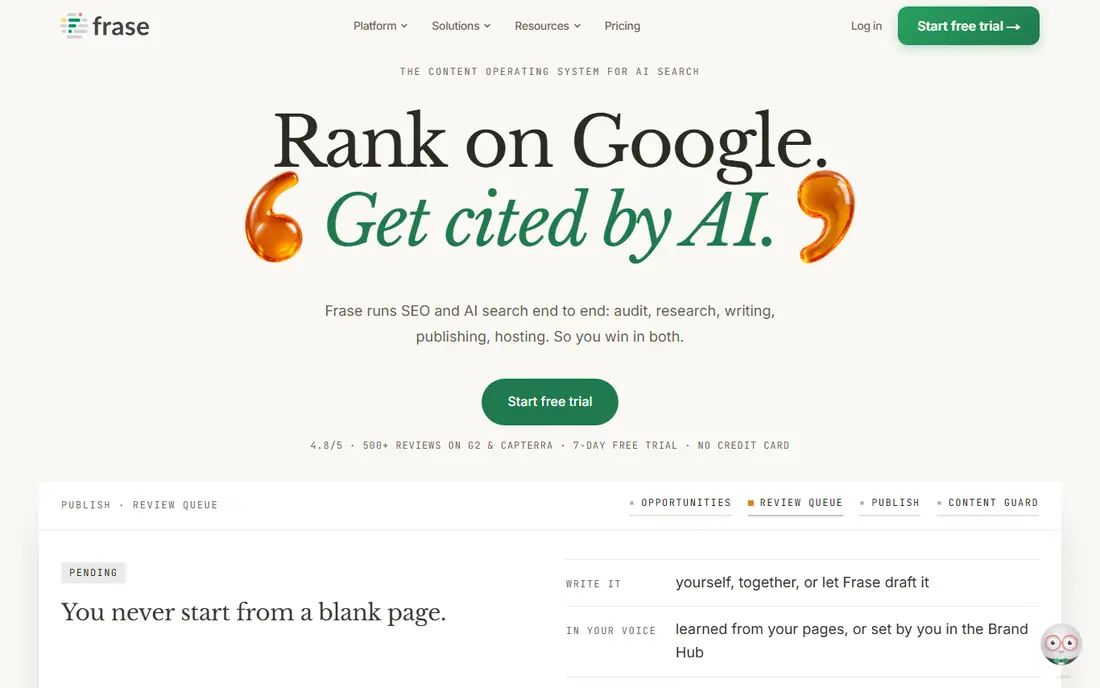
Frase works well when a small team needs to move from a keyword to a finished brief without opening five separate tools. It pulls headings, questions and related topics from top results, then lets writers draft inside the same editor while a score tracks coverage. That flow cuts down on copy and paste work, and it keeps the brief and the draft in one place.
The catch is that a good score does not guarantee a good article. We found Frase strongest when an editor still checks facts, tone and structure, and uses the score as a guide rather than a target. Teams that publish a high volume of posts should also check how many documents and AI words each plan allows, since those caps matter more than the headline price.
- Fast brief creation
- Helpful content scoring
- Useful AI drafting and editing tools
- Credit limits can feel tight on larger plans
- Some scores need human review before publishing

Clearscope takes a different approach from tools that try to do everything. It focuses on grading a draft against competing pages, with clear term suggestions and a letter grade that writers can understand at a glance. For agencies and in-house teams that hand work to freelance writers, that clarity is a real benefit, since a writer can see exactly what is missing.
The trade-off is price and scope. Clearscope costs more than several options here, and teams that also want AI drafting will need another tool alongside it. It fits best when content quality and clear feedback matter more than having one tool for every task.
- Simple A to F grading
- Strong keyword and heading suggestions
- Clean reports for clients
- Higher starting cost than many rivals
- No full AI writing suite built in

MarketMuse is less about polishing one page and more about deciding what to publish next. It maps topics, shows gaps across a whole site, and helps teams build clusters of related articles rather than one-off posts. That site-wide view is useful for publishers with hundreds of pages, where a single article score tells only part of the story.
New users should expect time to learn the interface and the reports. Solo bloggers may find it more than they need, and the cost reflects its focus on larger content operations. For a team planning a full content program, though, that planning depth is the point.
- Strong topic modelling
- Useful site-wide content planning
- Detailed inventory views
- Steeper learning curve
- Pricing suits larger teams better than solo writers
NeuronWriter has earned attention because it offers much of the Surfer-style workflow at a lower price. Writers get a content editor, term suggestions and a score, plus tools for planning and internal links. For freelancers and small blogs, that balance of price and features is hard to ignore.
The editor can feel crowded when many panels are open at once, so new users may need a short session to settle in. AI writing credits also differ by plan, so check what is included before you rely on drafting features. Used mainly as an optimiser and brief tool, it holds up well against pricier rivals.
- Lower cost entry point
- Solid content editor and scoring
- Useful internal linking suggestions
- Interface feels busy at first
- AI features vary by plan
PageOptimizer Pro appeals to SEOs who like detail. It breaks down on-page factors, compares a page with competitors, and gives specific tasks for a refresh or a new article. That detail helps when a page is close to ranking and needs precise fixes rather than a broad rewrite.
It is not the best pick for teams that want a simple writing tool. The reports assume some SEO knowledge, and writers may need an editor to translate tasks into plain steps. For audits, site refreshes and technical on-page work, that depth is a strength rather than a drawback.
- Deep on-page analysis
- Clear competitor comparisons
- Useful for audits and refreshes
- Less focused on AI drafting
- Interface is more technical than some rivals
SEOwind focuses on the brief, which is often the weakest link in a content workflow. It builds outlines from top results, suggests headings and questions, and gives writers a clear starting point. Teams that brief many writers each week can save real time here, since a consistent brief reduces rewrites.
The limit is scope. SEOwind does not try to replace a full editor, rank tracker or AI writer, so teams will still need other tools for parts of the job. If your main pain is slow or vague briefs, that narrow focus is exactly why it may fit.
- Clear brief outlines
- Helpful AI outline generation
- Good for scaling brief production
- Smaller feature set than all-in-one tools
- Limited drafting depth
WriterZen started as a keyword research tool and still shines there. It helps writers find related keywords, group them into topics, and plan articles around real search demand. That research strength makes it a good companion for teams that already have an editor they like, but need better topic ideas.
Content optimisation is present, yet it is not the centre of the product in the same way as Frase or Clearscope. Teams that want a single score to guide every draft may prefer another option here. Teams that want research first, with optimisation as a second step, will get more from WriterZen.
- Good keyword discovery
- Topic clustering tools
- Useful plagiarism and content checks
- Scoring is less central than in Surfer
- Some features feel spread across modules
Scalenut bundles research, AI drafting and SEO scoring into one workflow. A writer can move from a keyword report to a draft, then check optimisation before publishing, without switching tools. For teams that publish often and want AI help with first drafts, that combined flow saves time.
As with any AI drafting tool, the first draft is a starting point, not a finished article. Facts, examples and brand voice still need a human pass, and AI credits can run out on busy months. When used that way, Scalenut is a practical alternative for teams that want drafting and scoring together.
- Combined research, drafting and optimisation
- Useful cruise mode for long articles
- Clear SEO reports
- AI output still needs editing
- Credit limits apply to AI features
How we picked these
We compared official feature pages, pricing pages, app store listings, privacy policies and public reviews for tools that do the core Surfer SEO job of briefs, content scoring and on-page guidance. We favoured tools with a clear editor or report, real competitor analysis, and a pricing page a buyer can check before signing up. We left out tools that only track rankings or only write generic AI text without SEO scoring.
What to check before you switch
A tool switch goes wrong most often when a team buys for the headline price and misses the limits that shape daily use. Start with your real workflow, then match the tool to it, rather than the other way around.
Briefs, scoring and drafting
Decide which of these three jobs matters most. If writers struggle with vague briefs, prioritise outline quality and heading suggestions. If editors spend time fixing thin drafts, prioritise a clear score and term guidance. If speed matters most, look at AI drafting, but budget time for editing, since no tool on this list removes that step.
Limits, users and credits
Check how many documents, content editor uses, AI words and users each plan allows. A plan that looks cheap can turn costly when a team hits document caps mid-month. Also check whether scores update in real time and whether reports can be shared with writers or clients without an extra seat.
Fit with your other tools
Most teams already use a rank tracker, a docs tool or a content management system. Pick a tool that exports cleanly or integrates with the tools you already use, and test the editor with a real article before you commit. A short trial on two or three live posts tells you more than a feature list ever will.
FAQ
What are the best surfer seo alternatives?
Frase and Clearscope are the closest all-round matches for briefs and scoring, while NeuronWriter and WriterZen offer lower cost routes for smaller teams. MarketMuse suits site-wide planning, and PageOptimizer Pro suits detailed audits. The best choice depends on whether you need briefs, scoring, drafting or planning most.
What are the best alternatives to surfer seo for small teams?
NeuronWriter, SEOwind and WriterZen tend to fit small teams well, since they keep costs lower while still covering briefs, research or scoring. Frase can also work for a small team that wants briefs and drafting in one place. Check document and credit limits, since small teams often publish in bursts.
Are there free surfer seo alternatives?
Most tools on this list offer a trial rather than a lasting free plan, and free tiers tend to limit documents or features. WriterZen and NeuronWriter have offered lower cost entry plans in the past, but terms change, so check the current pricing page. A trial is usually enough to test the editor on a real article.
Do these tools replace an SEO editor?
No. These tools highlight terms, headings and gaps, but they do not judge accuracy, originality or brand voice. An editor still needs to check facts, cut filler and shape the argument. Teams that treat a high score as proof of quality often publish thin articles that read well to a tool and poorly to a reader.
How do content scores work in these tools?
Most tools compare your draft with top-ranking pages for a keyword, then suggest related terms, headings and length ranges. A higher score usually means broader coverage of those terms. Scores differ between tools, so a score in one tool should not be compared directly with a score in another.