Best Sage Accounting Alternatives in 2026: 8 Tools Compared
Looking for Sage accounting alternatives? We compare 8 bookkeeping tools on price, invoicing, payroll, and accountant support for US small businesses.
- Editor's choice
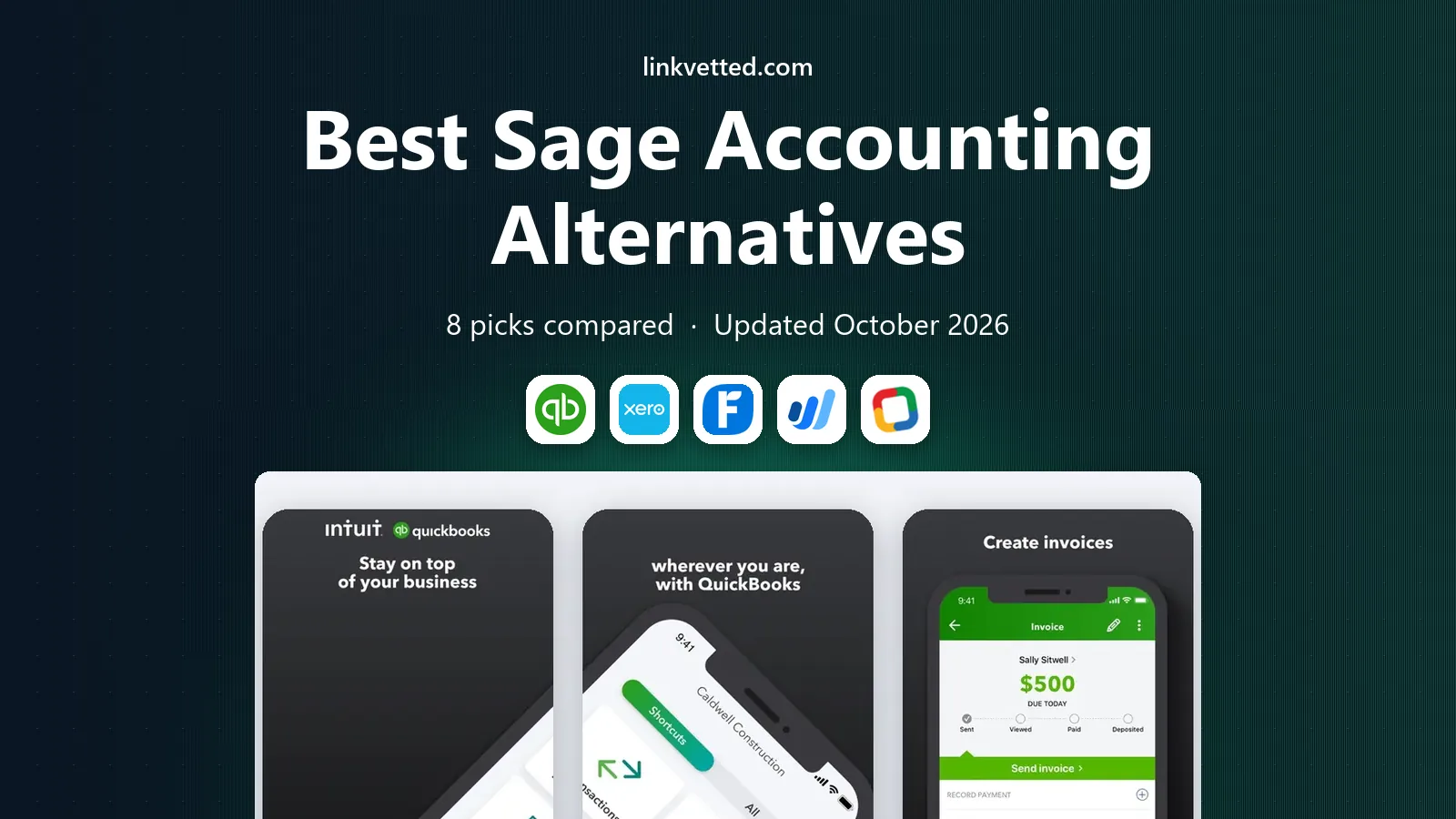
 QuickBooks Online
Most US small businesses
Starts at$38 per monthVisit quickbooks.intuit.comFull review - Great alternative
 Xero
Teams needing unlimited users
Starts at$25 per monthVisit xero.comFull review - Also consider
 FreshBooks
Service businesses billing by time
Starts at$23 per monthVisit freshbooks.comFull review
TL;DR:
- QuickBooks Online is our pick for most US small businesses, with the largest accountant network and the widest integration range, from $38 per month.
- Xero is the best pick if several people need access, since all plans include unlimited users, starting at $25 per month.
- Wave and Zoho Books are the cheapest routes in, with free core accounting options, though Wave now charges for bank feeds on Pro.
- FreshBooks suits service businesses that bill by the hour, while Patriot Accounting suits owners who want simple books and US-based support at $20 per month.
Quick comparison
| Tool | Best for | Starts at | Free plan? | |
|---|---|---|---|---|
| QuickBooks Online | Most US small businesses | $38 per month | Free trial | Visit |
| Xero | Teams needing unlimited users | $25 per month | Free trial | Visit |
| FreshBooks | Service businesses billing by time | $23 per month | Free trial | Visit |
 Wave | Solopreneurs wanting free core accounting | Free | Yes | Visit |
 Zoho Books | Budget-conscious businesses in the Zoho ecosystem | $15 per month | Yes | Visit |
 FreeAgent | Freelancers and very small businesses | See website | Free trial | Visit |
 Kashoo | Owners with no bookkeeping background | $20 per month | Free trial | Visit |
 Patriot Accounting | Simple US accounting with payroll add-ons | $20 per month | Free trial | Visit |
The best Sage accounting alternatives
Sage Accounting serves many small businesses well, especially those with inventory or UK accounting needs, but US owners often switch for a larger local accountant network, simpler pricing, or better payroll options. The tools below cover full double-entry bookkeeping, invoicing, and reporting. We compared vendor pricing pages, feature lists, and public user reviews for products actively sold in October 2026. This article is general information, not tax or accounting advice, so check with your accountant before changing systems.

QuickBooks Online is the default answer for a reason, and that reason is rarely the software alone. Most US accountants already know it, most banks connect to it, and most add-on tools integrate with it first. Simple Start at $38 per month covers invoicing, expense tracking, and basic reports for a single user, while Plus adds inventory and project tracking as a business grows.
The cost curve deserves a close look. Promotional first-year rates expire, payroll is a paid add-on, and adding users pushes you up the plan ladder. If you already work with a QuickBooks accountant, those costs are usually worth it. If you do not, Xero or Zoho Books may give you similar books for less.
- Largest US accountant network
- Wide bank, payroll, and app integrations
- Scales from solo to mid-market
- Simple Start allows only one user
- Promotional pricing expires and the regular rate is higher

Xero wins the team argument outright. Every plan includes unlimited users, so an owner, a bookkeeper, and an accountant can all work in the same books without seat fees. Bank reconciliation is fast and clear, and multi-currency support suits businesses that buy or sell abroad. Early at $25 per month is a fair entry point for a small operation.
The caps are the catch. Early allows only 20 invoices and 5 bills a month, so a growing business will move to Growing at $55 per month sooner than the headline suggests. US payroll also needs a closer look, since Xero payroll coverage is thinner than QuickBooks or Patriot. For multi-user teams without heavy US payroll needs, Xero is our second pick overall.
- Unlimited users on every plan
- Clean bank reconciliation
- Strong multi-currency support
- Early plan caps invoices at 20 and bills at 5 per month
- US payroll is limited compared with QuickBooks

FreshBooks is built around getting paid for services, and it shows in every invoice. Time tracked on a project flows straight into an invoice, clients can pay online, and late-payment reminders run without manual chasing. Lite at $23 per month suits a freelancer with a handful of regular clients, and Plus expands the client count for a small agency.
The limit is accounting depth. FreshBooks handles invoicing and expenses beautifully, but businesses with inventory, complex job costing, or strict double-entry needs will find QuickBooks or Xero stronger. If your business sells hours and expertise rather than stock, FreshBooks is the most pleasant tool on this list to use daily.
- Excellent invoicing and time tracking
- Client-friendly payment pages
- Simple expense and mileage capture
- Lite covers only 5 clients
- Not built for complex inventory or double-entry depth
Wave remains the best free starting point for a one-person business. Starter covers unlimited invoices, estimates, bills, and bookkeeping records at no monthly cost, with no revenue cap forcing an upgrade. That makes it ideal for a new freelancer testing whether a business will take off before paying for software.
The trade-off arrived with bank feeds. Automatic bank import now sits on Pro at $19 per month, so free-plan users enter transactions manually or pay for the convenience. Payroll is also a paid add-on where available. If you reconcile weekly and value a zero monthly bill, Wave still wins. If bank feeds save you hours, price Pro into the comparison.
- Free Starter plan with unlimited invoices and bookkeeping records
- No revenue cap on the free plan
- Simple interface
- Automatic bank import now needs paid Pro at $19 per month
- Payroll is a separate paid add-on
Zoho Books gives you the most accounting per dollar on this list, especially if you already use Zoho CRM, Inventory, or other Zoho apps. Standard at $15 per month on annual billing includes three users, and the free plan covers businesses with under $50,000 in annual revenue. Invoicing, expenses, bank reconciliation, and tax reports are all solid for a small business.
The ecosystem cut works both ways. Inside Zoho, everything connects cleanly. Outside Zoho, the third-party integration range is narrower than QuickBooks, so a business built on niche US tools should check each connection before switching. For a bootstrapped founder already in Zoho, the value is hard to argue with.
- Free plan for businesses under $50,000 in annual revenue
- Full double-entry accounting
- Deep Zoho app integration
- Fewer third-party integrations than QuickBooks
- Free plan caps invoices at 1,000 per year
FreeAgent started for UK freelancers, and its clarity still reflects that origin. The dashboard shows cash flow, upcoming tax, and overdue invoices at a glance, which helps an owner who checks the books once a week rather than daily. Invoicing, expenses, and bank reconciliation are simple without feeling thin.
US buyers should test it first. Bank feed coverage and tax handling are stronger in the UK than in the US, and pricing is often quoted in pounds on some pages, so confirm the US rate at checkout. For a US freelancer who wants a calm, simple ledger and does not need deep US payroll or inventory, FreeAgent remains a worthy shortlist option.
- Clear dashboard for cash flow and tax
- Simple invoicing and bank reconciliation
- Built-in time tracking
- US pricing and bank coverage are less established than UK coverage
- Reporting is less customizable than QuickBooks
Kashoo is the tool to hand to an owner who has never kept books and does not want to learn accounting jargon. Setup takes minutes, bank transactions import automatically, and income, expenses, and invoices sit in plain language. At around $20 per month, it undercuts most full suites while covering the basics a small business actually uses.
The simplicity has a ceiling. Reporting options are limited, integrations are fewer than QuickBooks or Xero, and businesses with inventory, multi-entity books, or complex reporting will outgrow it. If your books are straightforward and your priority is actually keeping them up to date, Kashoo's ease may matter more than feature depth.
- Very simple setup and interface
- Automatic bank imports
- Clear income and expense tracking
- Limited reporting and integrations
- No double-entry depth for complex businesses
Patriot Accounting is built for American Main Street businesses, and its support and payroll options reflect that focus. Accounting Basic at $20 per month covers unlimited customers, invoices, vendors, and bank imports, while Premium at $30 per month adds estimates, recurring invoices, and user permissions. Payroll starts at $17 per month plus a per-worker fee, so books and pay can stay with one vendor.
The integration range is the main limit. Businesses that rely on a wide app ecosystem will find fewer native connections than with QuickBooks or Xero. For an owner who wants a simple ledger, a US support team, and payroll without a second vendor, Patriot is the most straightforward Sage alternative on price and clarity.
- US-based support
- Cash-to-accrual toggle
- Payroll add-on from the same vendor
- Fewer integrations than QuickBooks and Xero
- Reporting is less deep than larger suites
How we picked these
We compared vendor pricing pages, feature documentation, and public user reviews for accounting tools that serve US small businesses and freelancers. We kept only products actively sold in October 2026, and we mixed full double-entry suites with simpler ledgers so owners at different stages have real choices. Prices are regular list prices where available, not short-term promotions, and we note where a free plan has a revenue or invoice cap.
What to check before you switch
Start with your accountant, not the software. If your accountant works in QuickBooks, switching to a tool they do not use can cost more in billable hours than the subscription saves. Ask which tools they support, what file format they need at year end, and whether they charge extra for an unfamiliar system.
Map payroll, inventory, and bank feeds first
Those three features decide most switches. Check whether payroll is native, an add-on, or a separate vendor, and whether it covers your states. Check inventory depth if you hold stock, since FreshBooks and Kashoo are thin there. Check bank feed coverage for your actual banks, and whether feeds are free or paid, since Wave Pro and similar tiers change the math.
Migrate at a clean boundary
Move books at a month end or year end, not mid-month, and run the old and new systems in parallel for one cycle. Reconcile bank accounts in both, compare profit and loss reports line by line, and keep the old system readable for at least a year. A clean cutover avoids the most common switching cost: months of reconciling data that never quite matches.
FAQ
What is the best Sage alternative for a US small business?
QuickBooks Online is the best overall pick for most US small businesses, thanks to its accountant network, bank coverage, and integration range, from $38 per month. Xero is the better pick if unlimited users matter more than the accountant network, and Zoho Books is the better pick if price matters most. Your accountant's preference should break any tie.
Is there a free Sage alternative?
Yes. Wave Starter is free with unlimited invoices and bookkeeping records and no revenue cap, though automatic bank import needs paid Pro. Zoho Books is free for businesses under $50,000 in annual revenue, with a 1,000-invoice annual cap. Both are real free options, not trials, but check the caps against your volume before relying on them.
Can I move my Sage data to a new accounting tool?
Most tools offer import for customers, vendors, invoices, and chart of accounts, but a full history migration rarely transfers cleanly. Plan to import opening balances and recent transactions, and keep Sage readable for historical records. Your accountant can advise on what must transfer for tax purposes and what can stay in the old system as an archive.
Do these tools handle sales tax and payroll?
All eight handle invoicing and tax reporting in some form, but sales tax depth and payroll coverage vary by state and plan. QuickBooks and Patriot offer the most complete US payroll paths, while Xero and FreeAgent need closer checking for US payroll. Confirm sales tax automation and payroll coverage for your states during a trial, and do not assume a feature listed for one country applies in the US.
Which Sage alternative is easiest for a non-accountant?
Kashoo and Wave are the easiest to learn, with plain-language interfaces and fast setup. FreshBooks is also easy if your work is mainly invoicing and time tracking. QuickBooks and Xero offer more depth, but they assume more bookkeeping knowledge or an accountant's help. Pick ease over depth if it means your books actually stay current.