8 Best Folloze Alternatives for Personalized B2B Content in 2026
Searching for folloze alternatives? We compare 8 B2B personalization and ABM tools for content hubs, buyer journeys, sales outreach, and account targeting.
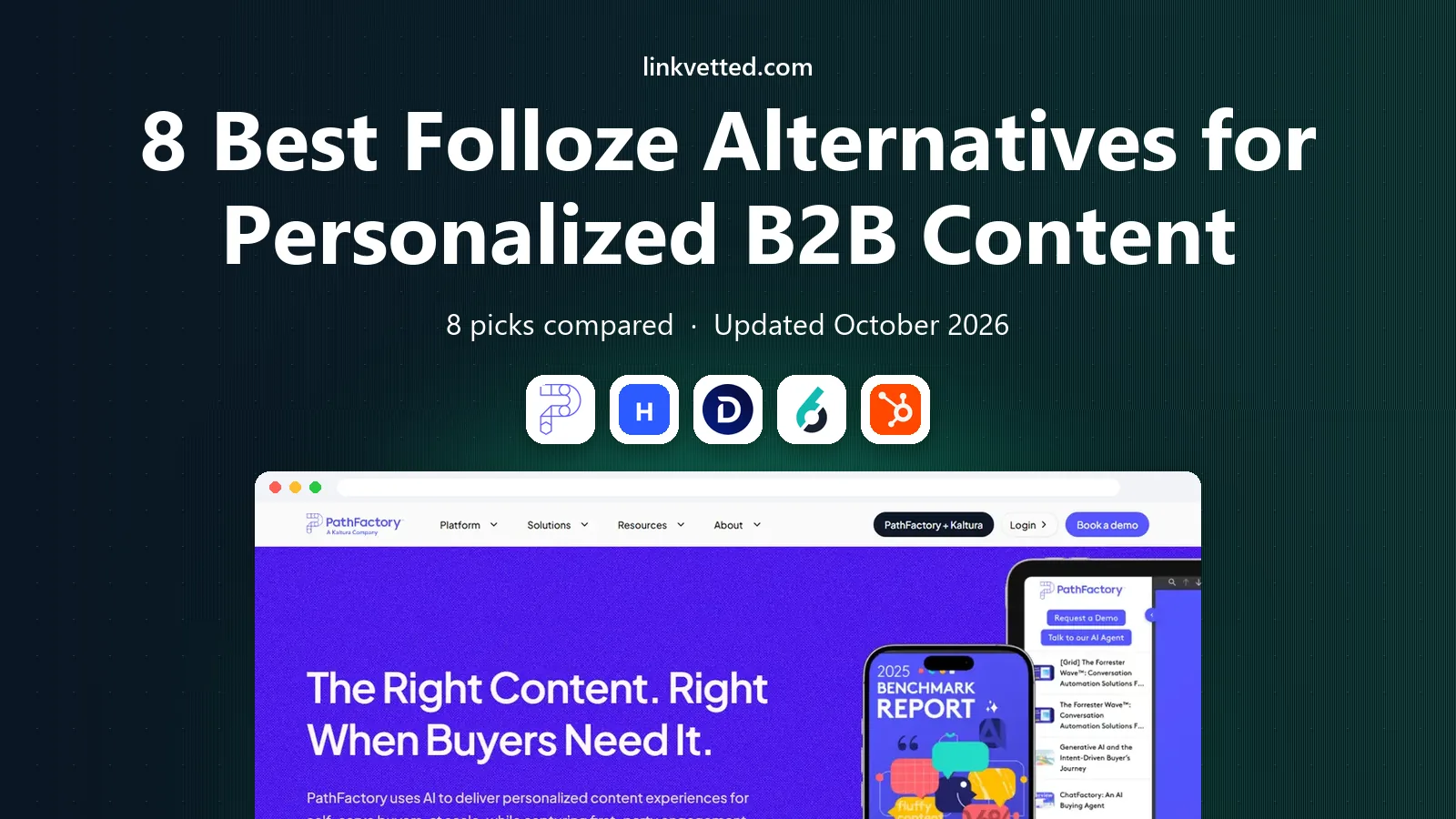
- Editor's choice
 PathFactory
Guided content journeys and binge-style consumption
Starts atSee websiteVisit pathfactory.comFull review - Great alternative
 Hushly
Personalized content and faster lead capture
Starts atSee websiteVisit hushly.comFull review - Also consider
 Demandbase One
Account identification, advertising, and sales alignment
Starts atSee websiteVisit demandbase.comFull review
TL;DR:
- PathFactory and Uberflip are closest to Folloze for content hubs and guided buyer journeys.
- Demandbase and 6sense add account targeting and intent data when you need to choose which accounts to pursue first.
- HubSpot and Marketo suit teams that want personalization inside a wider marketing automation system.
- Hushly and Mutiny are strong when the goal is a faster lift in form fills and on-site conversion from existing traffic.
- Folloze alternatives vary widely in price, so ask for a quote based on your account count, users, and content volume before shortlisting.
Quick comparison
| Tool | Best for | Starts at | Free plan? | |
|---|---|---|---|---|
| PathFactory | Guided content journeys and binge-style consumption | See website | No | Visit |
| Hushly | Personalized content and faster lead capture | See website | No | Visit |
| Demandbase One | Account identification, advertising, and sales alignment | See website | No | Visit |
 6sense | Predictive account prioritization and intent data | See website | No | Visit |
 HubSpot Marketing Hub | Small and midsize teams that want personalization inside HubSpot | Free | Yes | Visit |
 Adobe Marketo Engage | Enterprise teams with complex nurture and scoring needs | See website | No | Visit |
 Mutiny | Personalizing your website for target accounts | See website | No | Visit |
 Uberflip | Branded content hubs for marketing and sales | See website | No | Visit |
The best folloze alternatives for account-based content experiences
Folloze helps B2B teams build personalized boards and content experiences for target accounts. The tools below cover the same ground from different angles. Some focus on content journeys, some on account data, and some on website changes for known visitors. We compared official feature pages, pricing pages, and public reviews to match each tool to a clear job.

PathFactory turns scattered assets into a path a buyer can follow. You can group ebooks, videos, and case studies into tracks, recommend the next piece based on what was viewed, and see how long each account spent with each asset. That view helps marketers learn which topics actually hold attention, rather than just counting clicks. The trade-off is scope and cost. Pricing is quoted, and the platform rewards teams that already have a library worth organizing. If you only send a few PDFs each quarter, it may be more than you need. For teams running regular campaigns to named accounts, the journey view and account-level reporting are a real step up from static links.
- Content tracks and recommendations, detailed engagement analytics, marketing automation integrations
- Quote-based pricing, setup takes planning, best value for content-heavy teams
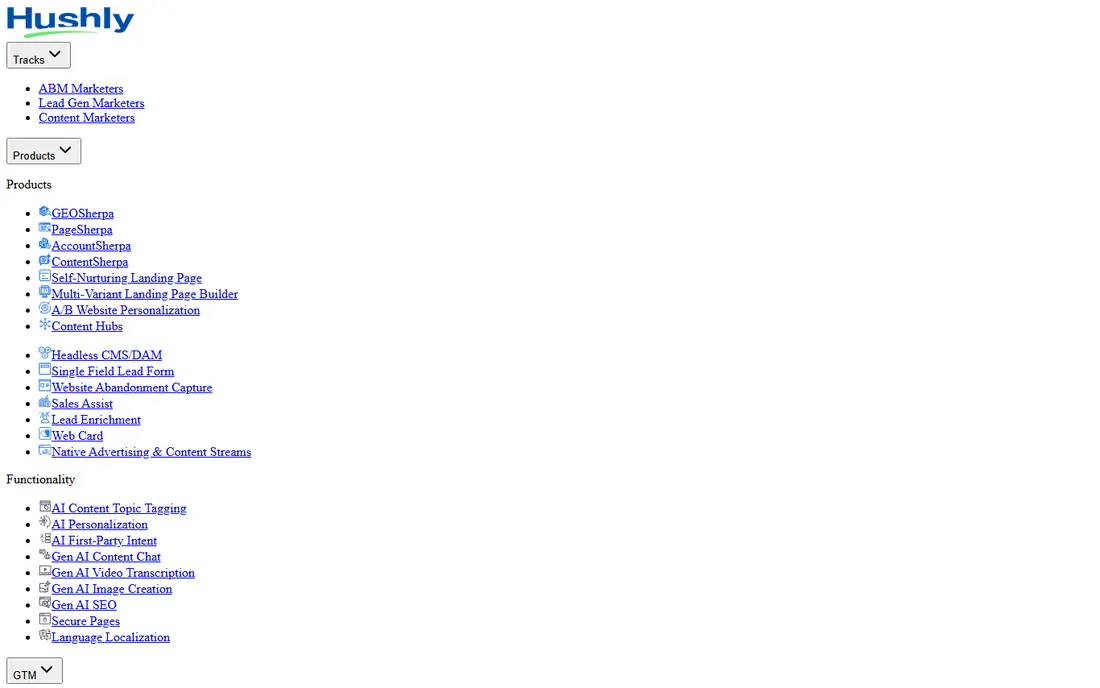
Hushly focuses on the moment a visitor arrives. It can personalize the content shown, shorten the path to a form, and track how that visitor moves through assets. For teams frustrated by low conversion on generic landing pages, that focus is practical. You do not need to rebuild your whole stack to test it. It is not a full account orchestration suite on its own. Teams that also need advertising, sales intelligence, and multi-channel sequencing will likely pair it with a CRM or an ABM platform. Start with one campaign, compare form completion against your current pages, and expand only if the lift holds across more than one audience.
- Personalized landing pages, lead capture forms, content engagement tracking
- Quote-based pricing, narrower ABM orchestration than full platforms, needs good content to work well
Demandbase One
Best for: Account identification, advertising, and sales alignment

Demandbase One is the broader platform in this list. It helps teams define target accounts, see buying signals, run account-based advertising, and give sales a shared view of engagement. If Folloze felt like only the content layer, Demandbase adds the layer above it that decides which accounts deserve attention first. That breadth brings cost and complexity. Smaller teams may find the setup heavy and the quote higher than a content-only tool. It fits best when marketing and sales already agree on a target list, and when you need one system to track an account from first signal to meeting. Ask about data coverage for your industry before committing.
- Account intelligence, intent signals, advertising and sales tools in one platform
- Enterprise pricing, implementation takes time, can be complex for very small teams
6sense is built around a simple question: which accounts are most likely to buy now. It pulls intent signals, company data, and engagement history into account scores and stages, then helps teams route the right accounts to sales or advertising. For teams with long lists and limited reps, that ranking can save a lot of wasted outreach. The catch is data quality. If your CRM has duplicates, stale accounts, or missing contacts, scores will reflect that mess. Clean your target list first, agree on what counts as a qualified account, and test predictions against real pipeline for a quarter. Used that way, 6sense can sharpen focus. Used without that discipline, it can just add another dashboard.
- Strong intent and predictive signals, account prioritization, CRM and ad integrations
- Quote-based pricing, needs clean CRM data to shine, learning curve for new users
HubSpot Marketing Hub
Best for: Small and midsize teams that want personalization inside HubSpot
HubSpot Marketing Hub appeals to teams that already live in HubSpot. Smart content can change text, images, and calls to action based on list membership or lifecycle stage, and account-based tools in higher tiers help target companies rather than just contacts. Because the CRM sits underneath, sales can see the same engagement history marketing sees. It is not as specialized as Folloze for curated boards, and the most useful ABM features sit in paid editions. Contact-based pricing also means costs grow as your database grows. Even so, for a small business that wants one system for email, landing pages, forms, and basic personalization, HubSpot is often the most practical starting point.
- Free starter tools, smart content and lists, strong CRM connection, wide integrations
- Advanced personalization needs paid tiers, costs rise with contacts, ABM tools are lighter than dedicated platforms
Adobe Marketo Engage
Best for: Enterprise teams with complex nurture and scoring needs
Marketo Engage suits larger teams with long, multi-touch buying cycles. It handles lead scoring, nurture streams, account-based campaigns, and detailed reporting at a scale that smaller tools struggle to match. If your team already uses Adobe tools or Salesforce heavily, the integration story is a plus. That power has a cost in time. Marketo rewards teams with a trained admin and clear processes. Without that, campaigns can become tangled and reporting can lose trust. Budget for setup and training, not just the license, and confirm pricing with Adobe or a partner since it is quoted rather than listed.
- Deep automation and scoring, account-based marketing features, large integration ecosystem
- Quote-based pricing, steep learning curve, needs dedicated admin time
Mutiny changes what visitors see on your own website, without a full rebuild. You can show different headlines, proof points, or calls to action to visitors from target accounts, industries, or campaign sources, then test which version converts better. For teams whose website is the main destination, that is a direct way to make traffic work harder. It does not replace a content hub or an email system. It works best when paired with a CRM, an ad platform, or a content tool that drives the right visitors in the first place. It also needs enough traffic to run fair tests. If your site gets only a handful of target visits per week, start with one high-traffic page and a simple change.
- No-code website personalization, account-based targeting, experiment testing
- Quote-based pricing, focused on website only, needs traffic volume to test well
Uberflip gives teams a branded home for content that sales can share and marketing can measure. You can build hubs by topic, persona, or account, create streams for individual deals, and see which assets get opened and shared. That shared library helps sales stop hunting for the latest deck in email threads. The hub needs care to stay useful. Old assets, duplicate versions, and unclear ownership will blunt the benefit. Assign someone to review content each quarter, retire what is outdated, and tag new pieces clearly. When the library is current, Uberflip is a clean Folloze-style option for teams that value presentation and sales use as much as marketing analytics.
- Central content hubs, sales streams, engagement analytics, integrations
- Quote-based pricing, content organization takes upkeep, less intent data than ABM platforms
How we picked these
We compared official feature pages, pricing pages, and public reviews for tools that deliver personalized B2B content experiences, account targeting, or website personalization. We kept tools that are actively sold in October 2026 and that a B2B team could realistically use in place of, or alongside, Folloze. Prices marked See website reflect quoted pricing, so we did not invent figures where vendors do not publish them.
How to choose the right folloze alternative
Decide whether you need content, data, or both
Content tools such as PathFactory and Uberflip organize and present what you already have. Data tools such as Demandbase and 6sense help you choose which accounts to target. Many teams need both, but buying both at once can be wasteful. Start with the gap that hurts most: low engagement with content, or poor targeting of accounts.
Check your content library first
Personalization only works if you have relevant pieces to show. Audit your library by persona, industry, and buying stage before buying a platform. If you find large gaps, plan new content alongside the tool purchase. A polished hub with three generic assets will not impress a target account.
Test with one campaign and one sales team
Run a pilot with a single campaign, a defined account list, and one sales team that will actually use the links. Measure form fills, time spent, meetings booked, and sales feedback. A pilot gives you real numbers for a business case and reveals integration gaps before you roll out company-wide.
Watch total cost, not just the license
Quoted platforms often add implementation, training, data, and integration costs. Ask what is included, how many users and accounts are covered, and what happens when you exceed those limits. For contact-based tools, model cost at your database size in twelve months, not just today.
FAQ
What is the closest alternative to Folloze?
PathFactory and Uberflip are closest for content hubs and guided experiences, since both organize assets into tracks or hubs and report engagement by account. Hushly is also close for personalized landing pages and lead capture. The best match depends on whether you value journey analytics, sales sharing, or conversion most.
Do folloze alternatives work without an ABM platform?
Yes, for content personalization alone. Tools such as PathFactory, Uberflip, and Hushly can run campaigns to a list you already have. An ABM platform such as Demandbase or 6sense becomes useful when you need intent data, account scoring, and advertising in the same workflow.
Can small businesses use these tools?
HubSpot offers a free starting point and is the most accessible for small teams. Most other tools here use quoted pricing aimed at midsize and enterprise teams. Small teams should pilot one tool, keep the account list tight, and avoid paying for orchestration features they will not use in the first year.
How do these tools measure success?
Common measures include content engagement time, asset views by account, form completion, meetings booked, and pipeline influenced. Agree on two or three measures before launch, and compare them with your previous approach. Vanity clicks alone will not show whether target accounts moved closer to a deal.
Do I need to replace my CRM to use a Folloze alternative?
No. Most tools here integrate with common CRMs such as Salesforce and HubSpot. Check the integration list for your CRM, confirm whether sync is one-way or two-way, and test how engagement data appears in the sales view before you sign.
Is personalization risky for privacy?
It can be if done carelessly. Use first-party data you have permission to use, follow your privacy policy and local rules, and avoid showing personal details in shared content. Prefer account-level personalization over individual tracking when you can, and give visitors a clear way to opt out.
Sources
https://www.pathfactory.com https://www.hushly.com https://www.demandbase.com https://www.6sense.com https://www.hubspot.com/products/marketing https://business.adobe.com/products/marketo/marketo-engage.html https://www.mutinyhq.com https://www.uberflip.com