Best Finch API Alternatives in 2026: 8 Unified HR APIs Compared
Looking for finch api alternatives? We compare 8 unified HR and payroll APIs on pricing, coverage, and trade-offs to help your team choose well in 2026.
- Editor's choice
 Merge
Managed HR and payroll integrations at scale
Starts at$650 per monthVisit merge.devFull review - Great alternative
 Apideck
Real-time unified APIs across categories
Starts at$599 per monthVisit apideck.comFull review - Also consider
 Kombo
HR, payroll, and recruiting data in Europe and the US
Starts atSee websiteVisit kombo.devFull review
TL;DR:
- Finch focuses on US employment and payroll data, while most alternatives on this list cover HR, recruiting, and other business systems in one API.
- Merge and Apideck are the closest like-for-like swaps for teams that need a managed, normalized HRIS and payroll API with broad provider coverage.
- Nango and Paragon suit teams that want more control over custom integrations and are willing to do more of the build work themselves.
- Pricing models differ sharply, with some vendors charging per connected account and others charging a flat monthly platform fee, so total cost depends on customer count.
- If your product only needs payroll and HR data, a specialist such as Kombo may be a better fit than a broad multi-category platform.
Quick comparison
| Tool | Best for | Starts at | Free plan? | |
|---|---|---|---|---|
| Merge | Managed HR and payroll integrations at scale | $650 per month | No | Visit |
| Apideck | Real-time unified APIs across categories | $599 per month | No | Visit |
| Kombo | HR, payroll, and recruiting data in Europe and the US | See website | No | Visit |
 Nango | Developer-led custom integrations | Free | Yes | Visit |
 Unified.to | Many categories with usage-based pricing | $750 per month | No | Visit |
 Codat | Accounting and financial data alongside HR data | See website | No | Visit |
 Paragon | Embedded integration experiences in your product | See website | No | Visit |
 Rutter | Commerce and accounting data with HR coverage | See website | No | Visit |
The best finch api alternatives
Finch gives software teams one API for employment data from HR and payroll systems. The alternatives below cover the same ground in different ways, from fully managed unified APIs to developer tools that give you more control over each connection.

Merge is the most direct managed alternative to Finch for many teams. It offers unified APIs for HRIS, applicant tracking, accounting, CRM, ticketing, and file storage, so a product that starts with HR data can add other categories later without changing vendors. Its normalized models reduce the work of mapping each provider's fields by hand, which matters when you support dozens of HR systems at once.
The main drawback is cost and fit for early-stage products. The published entry point covers up to 10 linked accounts, and teams with only a handful of customers may pay for capacity they do not yet use. If you need deep HR coverage, a large integration catalog, and a vendor that handles much of the maintenance work, Merge is a strong shortlist pick. If you only need a few payroll connections, a lighter tool may cost less.
- Broad HRIS, ATS, and payroll coverage
- Normalized data models
- Strong documentation and support for larger teams
- Entry price is high for small teams
- Some advanced features sit on higher tiers
- Sync timing varies by provider
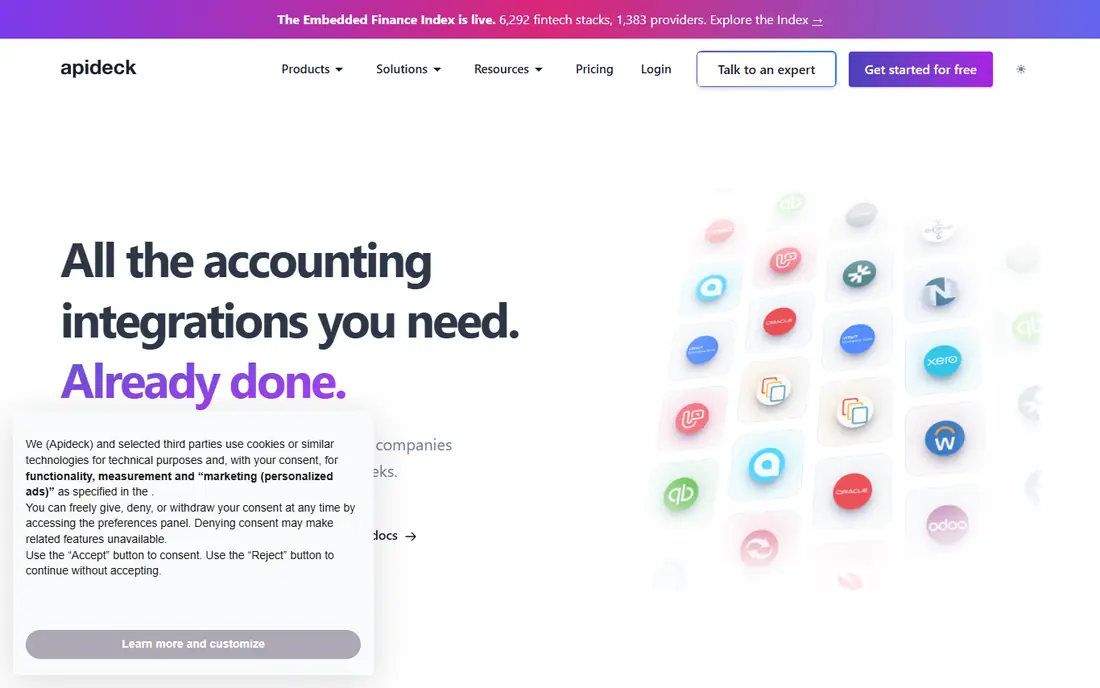
Apideck stands out for teams that want live data instead of a stored copy that refreshes on a schedule. When a customer updates a record in their HR system, Apideck can fetch the current state through its proxy API, which helps for workflows where stale data causes real problems. It also offers an integration marketplace and a white-label vault, so customers can connect their own tools from inside your product.
The trade-off is that the lowest published plan is aimed at smaller consumer counts, and scaling to many customers moves you into higher tiers. Teams should model their price at their expected customer count, not just at launch. For products that value fresh data and a polished customer-facing connection flow, Apideck is worth a close look.
- Real-time data access rather than scheduled syncs
- White-label connection vault
- Broad category coverage
- Entry plan covers a limited number of consumers
- HRIS plus ATS features sit on higher tiers
- Pricing rises with consumer count

Kombo is a specialist, and that focus shows in its catalog. It covers HR, recruiting, payroll, and learning systems, with particular strength in European providers alongside US systems such as Workday, SAP SuccessFactors, and UKG. For a product that serves customers on both sides of the Atlantic, that breadth can save months of one-off integration work.
Because pricing is not published, Kombo is harder to compare on cost without a demo and a quote. Teams that like its coverage should ask early about the platform fee, the per-customer fee, and which features require the enterprise tier. If your roadmap stays inside HR and people data, Kombo deserves a place on the shortlist.
- Strong HRIS, ATS, payroll, and LMS coverage
- Data hosting in the US, Canada, and EU
- Certified partnerships with major HR vendors
- No public pricing, so budgeting requires a sales conversation
- Transforms and some advanced features are gated by plan
Nango takes a different approach from Merge and Apideck. It gives developers the building blocks to create and manage integrations, with proxy access to provider APIs, custom sync logic, and the option to self-host. That control appeals to teams with unusual data needs, custom fields, or providers that a normalized API does not cover well.
The cost of that control is effort. Your team owns more of the mapping, error handling, and maintenance that a managed vendor would handle. For a small product testing HR integrations, the free tier is a low-risk way to start. For a large customer base, compare the engineering time against the higher monthly fee of a managed platform before you commit.
- Free tier for small connection counts
- Self-hosting option
- Control over sync logic and raw API access
- More build and maintenance work than a managed unified API
- HR coverage is narrower than specialists
- Usage costs need careful tracking
Unified.to is built for teams that need more than HR data. It covers dozens of categories, from HR and recruiting to CRM, accounting, and messaging, with live pass-through access and webhook support. The published plans include a large monthly request allowance and unlimited customer connections, which can be attractive if you have many small customers rather than a few large ones.
Usage-based pricing cuts both ways. A quiet month costs the same base fee, but a busy month with heavy syncing can push you past the included allowance. Teams should estimate their request volume from real usage, not from a demo. If you want one vendor across many integration types, Unified.to is a credible option.
- Wide category coverage
- Live pass-through data
- Unlimited customer connections on published plans
- Pricing is usage-based, so high API volume can raise costs
- HR depth varies by provider
- Newer vendor than some rivals
Codat is best known for accounting and financial data, and it belongs on this list for products that need that data next to HR information. A lending or financial product, for example, may need payroll data for verification and accounting data for cash flow in the same workflow. Codat handles the financial side with depth that HR specialists do not match.
For a pure HR integration, Codat is usually not the first choice. Its HR coverage is thinner, and its pricing and onboarding reflect its enterprise financial focus. Choose Codat when financial data is central to your product and HR data is a supporting piece, not the other way around.
- Deep accounting and commerce data
- Useful for lending, underwriting, and financial products
- Mature data models
- HR is not its primary focus
- Pricing is custom
- Implementation can be heavier for simple HR-only use cases
Paragon focuses on the experience your customers see. Its embedded portal lets users connect their tools, manage permissions, and view integration status without leaving your product. Behind that, a workflow builder helps teams define what happens when data changes, which suits products that need more than a simple read of HR records.
Because pricing is custom, Paragon is best evaluated with a concrete use case and a customer count in hand. Teams that care most about a polished, branded integration flow and that have product resources to configure workflows will get the most from it. Teams that only need a simple HR feed may find a specialist faster to ship.
- White-labeled connection portal for customers
- Workflow builder for integration logic
- Managed sync and actions
- Custom pricing with no public entry point
- HR depth depends on the connectors you enable
- Setup takes planning
Rutter gives developers one API for several business systems, including commerce platforms, accounting tools, and HR systems. That mix suits products that pull order, payment, and people data together, such as a platform serving small businesses that want one view of operations. Its documentation is aimed at developers who want to move quickly.
The limitation is focus. If HR data is your core product, a specialist with deeper HRIS and payroll coverage will likely cover more providers and edge cases. If HR is one of several data types you need, Rutter can reduce the number of vendors you manage. Check its HR provider list against your top five customer systems before you decide.
- Unified APIs across commerce, accounting, and HR-adjacent systems
- Developer-friendly docs
- Useful for multi-system products
- HR is one category among several, not the sole focus
- Pricing requires a sales conversation
- Smaller HR catalog than specialists
How we picked these
We compared official product pages, pricing pages, integration catalogs, and public comparisons from vendors and review sites. We looked for products that exist and work in October 2026, that offer a real API for HR or adjacent business data, and that a software team could plausibly use as a Finch replacement. We weighted provider coverage, data freshness, pricing transparency, and how much build work each platform leaves to your team.
What to check before you switch
Start with your top customer systems, not with a vendor's total connector count. Ask each vendor whether your five most common HR and payroll providers are supported, whether reads and writes are both available, and how often data refreshes. A vendor with 200 connectors is of little help if it lacks the one system your largest customer uses.
Next, model total cost at three customer counts: today, in six months, and at your next funding or growth milestone. Per-account pricing, per-consumer pricing, and usage-based pricing produce very different bills as you grow. Also confirm data hosting regions, security certifications, and how the vendor handles custom fields, since HR data often includes fields that standard models miss.
Finally, run a pilot with real data in a sandbox, then with one friendly customer. Test error handling, webhook delivery, and what happens when a provider changes its API. The pilot will reveal more than any feature table, and it gives your team a realistic migration timeline.
FAQ
What is the closest Finch API alternative?
Merge and Apideck are the closest managed alternatives for most teams, since both offer normalized HRIS and payroll APIs with broad provider coverage. Kombo is closer if your focus is HR, payroll, and recruiting data in Europe as well as the US. The right pick depends on which providers your customers use and whether you need other categories too.
Is there a free Finch API alternative?
Nango offers a free tier for a small number of connections, which makes it the most accessible starting point on this list. Most managed unified APIs charge a monthly platform fee, so a free tier usually means you will do more of the integration work yourself. Test with the free tier before you commit to a paid plan.
Do these alternatives support payroll writes?
Support for writes varies by vendor and by provider. Finch is known for payroll deductions and related writes, and not every alternative matches that depth on every system. Ask each vendor to confirm write support for your specific payroll providers, and test the exact write operations your product needs during a pilot.
How much do Finch API alternatives cost?
Published entry prices on this list range from free for Nango to $750 per month for Unified.to, with Merge at $650 per month and Apideck at $599 per month. Several vendors use custom pricing, so your final cost depends on customer count, request volume, and plan tier. Always get a quote at your expected scale.
Should I choose a specialist or a broad unified API?
Choose a specialist such as Kombo when HR and payroll data is your core product and depth matters most. Choose a broad platform such as Merge, Apideck, or Unified.to when you plan to add CRM, accounting, or other categories later. A broad platform can save a second vendor relationship, but it may cover HR less deeply than a specialist.