Best Wireless Expense Management Software in 2026: 8 Tools Compared
We compared the best wireless expense management software for auditing carrier bills, tracking mobile lines, and cutting telecom costs for firms in 2026.

- Editor's choice
 Tangoe
Global telecom and mobile management
Starts atSee websiteVisit tangoe.comFull review - Great alternative
 Calero
Enterprise expense management
Starts atSee websiteVisit calero.comFull review - Also consider
 Sakon
Modular telecom expense tools
Starts atSee websiteVisit sakon.comFull review
TL;DR:
- Wireless expense management, or WEM, covers mobile lines, devices, plans, and carrier bills, while broader telecom expense tools also cover fixed lines.
- Bill auditing and inventory accuracy matter most, since savings usually come from finding billing errors and unused lines.
- Pricing models vary widely, from per-line fees to monthly platform fees to a share of recovered savings, so compare totals carefully.
- Managed services suit firms without telecom staff, while software suits firms with analysts who can act on the data.
- Implementation often takes months at enterprise scale, driven by inventory cleanup and carrier account setup.
Quick comparison
| Tool | Best for | Starts at | Free plan? | |
|---|---|---|---|---|
| Tangoe | Global telecom and mobile management | See website | No | Visit |
| Calero | Enterprise expense management | See website | No | Visit |
| Sakon | Modular telecom expense tools | See website | No | Visit |
 Lightyear | AI-driven telecom insights | See website | No | Visit |
 Cimpl | Telecom optimization for mid-size firms | See website | No | Visit |
 WidePoint | Mobile lifecycle management | See website | No | Visit |
 RadiusPoint ExpenseLogic | Managed telecom and utility expenses | See website | No | Visit |
 Visage MobilityCentral | Wireless program management | See website | No | Visit |
The best wireless expense management software
Wireless expense management software helps firms track mobile lines, audit carrier invoices, optimize plans, and allocate costs to the right teams. It matters most when a company manages hundreds or thousands of phones, tablets, and connected devices across carriers. We compared official product pages, feature lists, and pricing reports to build this list.
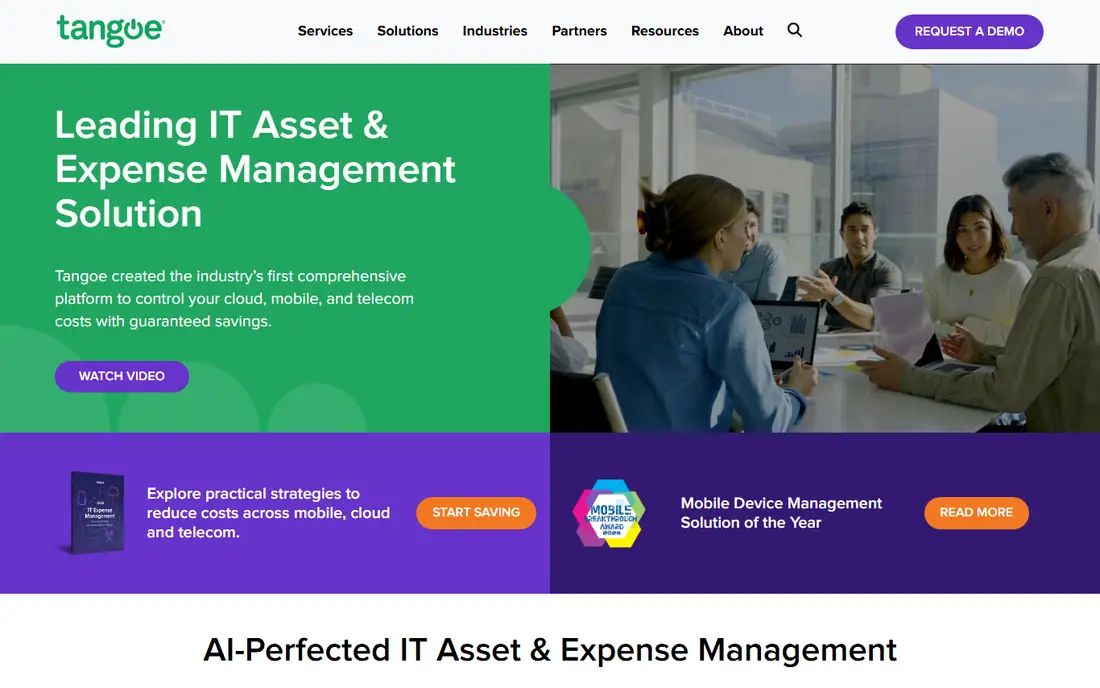
Tangoe is a large telecom expense management provider for firms with global mobile and fixed telecom spend. It collects carrier invoices, validates charges against contracts and inventory, disputes errors, and allocates costs to cost centers. That full lifecycle view helps finance teams see where mobile money actually goes, rather than trusting carrier totals.
The enterprise focus means pricing is by quote and implementation is a project, especially for global accounts with many carriers. Smaller firms may find the platform more than they need. For a large firm with complex, multi-carrier spend, Tangoe scale and audit depth are strong reasons to shortlist it.
- Broad global carrier coverage
- Invoice auditing and optimization
- Managed service options
- Enterprise pricing by quote
- Implementation takes planning
Calero serves enterprises that need one platform for telecom, mobile, and related technology expenses. Invoice management, inventory tracking, cost allocation, and reporting sit together, with managed service options for firms without in-house telecom analysts. That combination suits finance and IT teams that must report spend accurately across departments.
Pricing is by quote, and large estates need a careful implementation plan for inventory and carrier setup. Firms with a small mobile fleet may find simpler tools cheaper and faster. For an enterprise that needs governed, auditable expense data, Calero is a solid core platform.
- Enterprise telecom and mobile expense platform
- Strong reporting
- Managed services available
- Quote-based pricing
- Setup effort for large estates
Sakon offers a modular telecom expense platform that firms can shape to their mobile, fixed, and cloud spend. Modules cover invoice auditing, inventory, procurement, and reporting, so a firm can start with wireless costs and add fixed telecom later. That modularity helps firms that do not want to buy a full suite on day one.
Module scoping matters, since the wrong bundle can leave gaps or add cost for unused features. Pricing is by quote, so firms should get a written scope tied to line counts and carrier numbers. For a firm that wants a flexible, enterprise-grade platform, Sakon modular design is a practical advantage.
- Modular platform for telecom and mobile
- Workflow and reporting depth
- Global reach
- Pricing by quote
- Module choices need careful scoping
Lightyear brings a modern, AI-driven approach to telecom management, with tools for procurement, inventory, and invoice insight. Firms that find legacy telecom platforms dated often prefer its interface and workflow, and its insights help spot savings opportunities without manual spreadsheet work. A demo is available for evaluation.
Pricing is by quote, and as a newer platform it lacks the decades-long track record of some rivals. Firms with very complex legacy estates should test carrier coverage and invoice formats closely. For a firm that wants modern telecom software with fresh design, Lightyear is worth a demo.
- Modern interface with AI-driven insights
- Procurement and inventory tools
- Demo available
- Quote-based pricing
- Newer platform than legacy rivals
Cimpl focuses on telecom optimization, helping firms audit bills, track inventory, and cut waste across mobile and fixed services. Its mid-market fit suits firms too large for spreadsheets but not ready for a full enterprise suite. Reporting and optimization workflows help IT and finance teams act on findings rather than just viewing totals.
Pricing varies by scope and line count, so a written quote is needed for budgeting. Global coverage is also thinner than the largest providers, which matters for firms with many international lines. For a mid-size firm focused on optimization, Cimpl is a focused and practical choice.
- Telecom optimization focus
- Invoice and inventory management
- Mid-market fit
- Pricing varies by scope
- Less global scale than the largest providers
WidePoint focuses on mobile lifecycle management, covering devices, lines, plans, and expenses for firms with large mobile fleets. Its experience with government and enterprise clients shows in compliance and reporting features. Firms that need to manage procurement, deployment, and retirement of devices alongside costs will find that lifecycle view useful.
Pricing is by quote, and the product family spans several offerings, so buyers should confirm exactly which platform and modules a quote covers. Smaller firms may find the enterprise focus heavier than needed. For a large mobile fleet with lifecycle needs, WidePoint is a strong specialist pick.
- Mobile lifecycle focus
- Device and line management
- Government and enterprise experience
- Pricing by quote
- Platform breadth varies by product line
RadiusPoint ExpenseLogic
Best for: Managed telecom and utility expenses
RadiusPoint ExpenseLogic suits firms that want a managed telecom expense service rather than software alone. Its analysts collect carrier invoices, validate charges, dispute errors, and report savings, with coverage across telecom, mobility, and utilities on one platform. That managed model helps firms without dedicated telecom staff still capture billing corrections and cost avoidance.
Fees often blend a base charge with a share of recovered savings, so firms should ask how fees behave in a year with few recoveries. Firms that want to run the software themselves may prefer a pure software vendor. For a firm that wants experts to do the work, RadiusPoint managed approach is appealing.
- Managed service model
- Telecom, mobility, and utility coverage
- Refund and cost-avoidance focus
- Managed fees vary by model
- Less suited to firms wanting software only
Visage Mobile offers MobilityCentral software plus managed services for wireless programs, with audit, optimization, procurement, and fulfillment support. Its wireless-specific focus and long experience in mobile cost management appeal to firms whose main problem is mobile lines, not fixed telecom. The software tracks spending and lines, while services can handle the work for firms without wireless staff.
Pricing requires a quote, and the wireless focus means firms with large fixed-line estates may need another tool for that spend. For a company whose telecom pain is mainly mobile, Visage specialization is a genuine advantage over a general platform.
- Wireless-specific software and services
- Audit, optimization, and procurement support
- Long wireless expertise
- Pricing by quote
- Wireless focus means fixed telecom needs a separate view
How we picked these
We compared official product pages, feature lists, and pricing reports for wireless and telecom expense management tools. We favored tools with carrier invoice auditing, mobile inventory tracking, plan optimization, and cost allocation, and we included both software and managed service models. Where vendors price by quote or by recovered savings, we wrote See website rather than presenting a single rate as standard.
How to choose wireless expense software
Start with an accurate line inventory, since every saving claim depends on knowing what you actually own and pay for. Count lines, devices, plans, and carriers, and note which lines are unused, pooled, or on the wrong plan. A vendor that helps clean that inventory during implementation will deliver more value than one that only reports on messy data.
Next, decide between software and managed service honestly. Software suits a team with telecom analysts who can dispute bills and act on reports, while a managed service suits a team without that staff. Ask how disputes work, who talks to carriers, and how savings are measured, since those answers reveal whether the vendor does the work or only shows the problem.
Finally, get the commercial model in writing. Confirm whether fees are per line, per invoice, a flat platform fee, or a share of savings, and ask what happens when line counts fall. Implementation timelines for enterprise estates often run three to six months, so plan carrier access and inventory work early rather than expecting instant savings.
FAQ
What is wireless expense management software?
It is software that tracks mobile lines, devices, and plans, audits carrier invoices, and helps firms cut wireless costs. It centralizes billing data, validates charges against contracts, and allocates costs to teams or cost centers.
How is WEM different from telecom expense management?
WEM focuses on wireless and mobile costs, while telecom expense management, or TEM, covers fixed lines, voice, and data as well. Many TEM platforms include WEM features, so firms should check whether mobile, fixed, or both are covered.
How much can wireless expense management save?
Savings vary by fleet size, billing accuracy, and plan fit, and vendors often cite billing corrections and unused-line removal as the main sources. Treat any savings promise as an estimate until a vendor audits your actual invoices and inventory.
Should we choose software or a managed service?
Software suits firms with telecom analysts who can act on reports and dispute bills. A managed service suits firms without that staff, since the vendor analysts do the auditing, disputes, and reporting work.
How long does implementation take?
Small fleets can go live faster, while enterprise implementations often run three to six months, driven by inventory cleanup and carrier account setup. A timeline that skips inventory work usually means that work has been deferred, not removed.
Do these tools work with all carriers?
Coverage varies by vendor and region, so confirm your exact carriers, invoice formats, and countries before signing. Ask for a carrier coverage list and test invoice imports during a trial or pilot.