Best Voice AI for Customer Service in 2026: 8 Platforms Compared
We compared the best voice ai for customer service on price per minute, voice quality, latency, integrations and human handoff, so teams can automate calls.

- Editor's choice
 Retell AI
Production call automation
Starts at$0.07 per minuteVisit retellai.comFull review - Great alternative
 Vapi
Developer control
Starts at$0.05 per minute plus modelsVisit vapi.aiFull review - Also consider
 Bland AI
High-volume outbound
Starts at$0.14 per minuteVisit bland.aiFull review
TL;DR:
- Retell AI is the simplest production choice for many teams, with pay-as-you-go pricing from $0.07 per minute.
- Vapi suits engineering teams that want low-level control, while Bland AI suits high-volume outbound programs.
- ElevenLabs leads on voice quality, and PolyAI leads for large enterprises that need managed delivery.
- CloudTalk, Goodcall and Dialpad suit smaller teams that want voice AI inside a phone system, not a separate developer platform.
- Always test handoff to a human, disclosure to callers and call recording consent before launching at scale.
Quick comparison
| Tool | Best for | Starts at | Free plan? | |
|---|---|---|---|---|
| Retell AI | Production call automation | $0.07 per minute | Free trial | Visit |
| Vapi | Developer control | $0.05 per minute plus models | Free trial | Visit |
| Bland AI | High-volume outbound | $0.14 per minute | Free trial | Visit |
 ElevenLabs | Premium voice quality | $22 per month | Yes | Visit |
 PolyAI | Enterprise voice experience | See website | No | Visit |
 Synthflow | No-code scaled deployments | See website | Free trial | Visit |
 CloudTalk | AI inside a phone system | $99 per month | Free trial | Visit |
 Goodcall | Local service businesses | $79 per month | Free trial | Visit |
The best voice ai for customer service
Voice AI answers calls, books appointments, takes orders and routes complex cases to people. The best platform depends on call volume, technical skill and whether calls are inbound, outbound or both. We compared official pricing pages, latency claims, compliance notes and public reviews.
Retell AI is built for production call automation across inbound and outbound use cases. Accounts include concurrent call capacity, SIP trunking to carriers, batch calling and post-call analysis, with voices from providers including ElevenLabs and OpenAI. The headline rate of $0.07 per minute makes budgeting clearer than many rivals, though the all-in rate depends on the language model, voice and telephony you choose.
Retell suits teams that want to launch quickly without a large platform fee, then scale. It is less of a fit for a business that wants a fully managed service with no internal owner. Assign someone to review transcripts weekly, tune prompts and check handoff quality, since voice AI performance improves fastest with regular review.
- Pay-as-you-go from $0.07 per minute
- No platform fee on the base plan
- Drag-and-drop builder and analytics
- Total cost rises with model and telephony choices
- Enterprise compliance needs a higher tier
- Developer help still helps for complex flows

Vapi gives engineering teams low-level control over transcription, language models, voices and telephony. That flexibility helps teams building custom agents for specific workflows, languages or back-end systems. The platform fee starts at $0.05 per minute, with model, voice and carrier costs added on top, so the real rate often lands well above the headline figure.
Vapi is not the best pick for a non-technical owner who wants a working receptionist this week. It rewards teams that can test prompts, measure latency and manage telephony. For a product or engineering-led company that treats voice as a core feature, Vapi offers control that simpler platforms cannot match.
- Deep API control
- Wide model and voice choice
- SIP support and multi-provider telephony
- All-in cost is higher than the base rate
- Needs engineering time
- Call logs have limited retention on lower plans
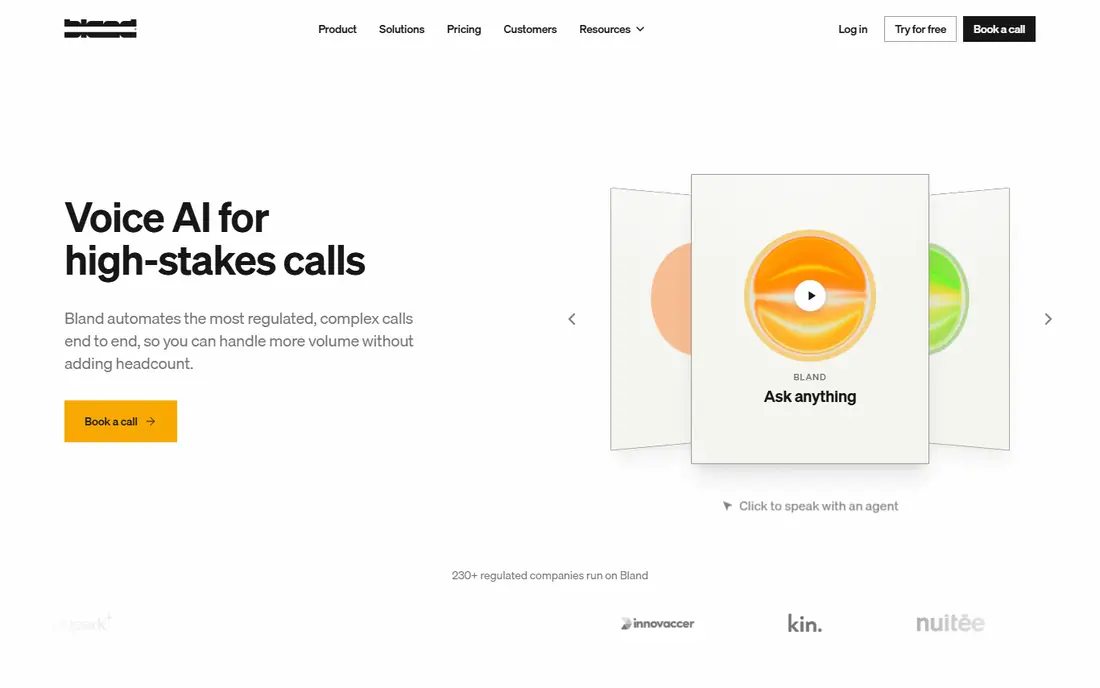
Bland AI focuses on conversational voice agents with low latency and high-volume outbound capacity. Its per-minute pricing is easier to model than a stack of separate model and voice charges, which helps teams planning large campaigns. Bland supports phone calls, transfers and integrations for sales, support and operations use cases.
The builder is more developer-oriented than drag-and-drop rivals, and some compliance features require enterprise plans. Small inbound teams may also find simpler receptionist tools cheaper. For outbound programs that need thousands of calls with consistent quality, Bland is a strong contender.
- Fast response times
- Strong outbound scale
- One fairly flat per-minute rate
- Less no-code polish than some rivals
- Enterprise compliance is an add-on
- Transfer time can bill separately
ElevenLabs started as a voice synthesis company and now offers a full conversational AI platform. Its voices sound natural and expressive, which matters for luxury brands, healthcare and financial services where tone shapes trust. Plans start at $22 per month for limited conversational minutes, with larger plans for scale.
The credit model can hide the true cost, since language model charges sit on top of voice credits in some setups. Teams should run a real call-volume test and read the invoice before committing. When voice quality is the main buying reason, ElevenLabs is often worth the extra accounting work.
- Outstanding voice quality and expression
- Conversational AI platform
- SIP trunking support
- Credit system makes true per-minute cost harder to track
- Language model costs add up
- HIPAA needs enterprise pricing
PolyAI builds managed voice assistants for large enterprises, with a focus on natural conversation design and reliable handoff. It suits contact centers that handle high volumes in several languages and need service levels, security reviews and dedicated support. The platform is designed around enterprise voice experience rather than self-serve experimentation.
Pricing is by quote and typically runs into six figures per year for large programs, so small businesses should look elsewhere. Deployment also takes longer than a self-serve platform. For a large brand where a poor voice experience damages trust, PolyAI managed delivery can justify the cost.
- Managed enterprise delivery
- Strong voice experience design
- Multilingual support
- Quote-only enterprise pricing
- Long sales and deployment cycle
- Overkill for small teams
Synthflow helps non-technical teams build voice agents with a visual builder, templates and testing tools. That makes it a good middle ground between a simple receptionist app and a developer platform. Teams can design flows, connect calendars and CRMs, and review call outcomes without writing code for every step.
Pricing depends on minutes, features and support level, so the effective rate needs a quote for larger volumes. Voice quality is solid but less distinctive than ElevenLabs. For a growing company that wants to deploy several agents without hiring voice engineers, Synthflow is a practical choice.
- Mature drag-and-drop builder
- Vendor support for scaled rollouts
- Wide integration options
- Effective per-minute cost varies by plan
- Some advanced features need higher tiers
- Voice choice is more limited than Vapi
CloudTalk combines a business phone system with an AI receptionist, so human agents and AI share routing, call history and CRM records. When the AI escalates, the human sees the transcript before taking over. AI Receptionist plans start at $99 per month for 200 minutes, with larger plans for higher volume, while the phone system itself starts separately.
That split billing is the main catch. Model both costs together before comparing CloudTalk with a standalone voice platform. For teams already using CloudTalk, or teams that want voice, chat and CRM data in one place, the combined system can be simpler than stitching tools together.
- AI receptionist inside a full phone system
- Shared routing and CRM records
- Calendar booking during calls
- Phone system and AI billed separately
- AI minutes are capped by plan
- Setup needs care for complex routing
Goodcall targets local service businesses such as home services, clinics and salons that miss calls while working on site. Plans start at $79 per month for a set number of callers, with unlimited minutes within that caller count, which prevents surprise minute bills. Setup is simpler than developer platforms, with appointment booking and message handling built in.
Goodcall is less suited to complex enterprise flows, custom integrations or very high call volumes beyond plan limits. For a small local business that mainly needs every call answered and booked, Goodcall offers predictable pricing and fast time to value.
- Flat monthly price for local businesses
- Unlimited minutes within caller limits
- Easy setup
- Caller limits per plan
- Less developer control
- Enterprise features are limited
How we picked these
We compared official pricing pages, per-minute rates, builder types, telephony options and public reviews for voice AI platforms serving customer service in 2026. We included developer platforms, no-code tools, managed enterprise options and phone-system AI so different team sizes can compare fairly. We noted where headline rates exclude model, voice or carrier costs rather than presenting them as all-in totals.
How to launch voice AI without annoying customers
Start with a narrow use case, such as after-hours answering, appointment booking or order status, and measure it before expanding. Tell callers they are speaking with an AI assistant, give a clear path to a human, and record calls only with proper consent and privacy notices. Test accents, background noise and interruptions, since real calls are messier than demos.
Measure what matters after launch
Track answer rate, booking rate, handoff rate, caller satisfaction and repeat calls on the same issue. Review failed calls weekly and fix prompts, knowledge and routing before adding new use cases. A voice agent that books well but frustrates callers on edge cases will cost more in lost business than it saves in agent time.
FAQ
How much does voice AI cost per minute?
Usage platforms often start near $0.07 per minute for the platform, with all-in rates roughly $0.08 to $0.31 per minute depending on model, voice and telephony. Monthly receptionist plans start near $79 to $99 per month for capped minutes or callers. Always model your expected minutes, not just the headline rate.
Will customers know they are talking to AI?
They should. Tell callers at the start that they are speaking with an AI assistant and offer a human option. Clear disclosure builds trust, meets many state and carrier rules, and reduces frustration when the AI cannot help.
Can voice AI replace human agents completely?
No, and it should not try. Voice AI handles routine, high-volume calls well, while humans should handle complaints, complex cases, sensitive topics and high-value sales. The best setups use AI to answer fast and hand off cleanly with a transcript.
What is latency and why does it matter?
Latency is the delay between a caller finishing speaking and the AI responding. Lower latency feels more natural and reduces callers talking over the agent. Published figures vary by model and setup, so test with real calls before choosing on latency claims alone.
Is voice AI compliant with privacy and health rules?
Some platforms offer HIPAA, SOC 2 and GDPR support, often on higher tiers or with a signed agreement. Confirm the exact compliance scope, data retention, recording consent and where call data is stored before using voice AI for health, finance or other sensitive calls.
How long does it take to launch a voice agent?
A simple receptionist can launch in days, while a custom enterprise agent with CRM integrations and compliance review can take weeks or months. Start with one workflow, test it with real callers, and expand only after handoff and accuracy look strong.