Best Value Inventory Management Software Pricing in 2026: 9 Tools Compared
We compare best value inventory management software pricing in 2026, from free Zoho Inventory to Cin7 and Fishbowl, with honest value notes for small sellers.

- Editor's choice
 Zoho Inventory
Small sellers on a budget
Starts at$29 per monthVisit zoho.comFull review - Great alternative
 Sortly
Visual item tracking
Starts at$49 per monthVisit sortly.comFull review - Also consider
 inFlow
B2B and wholesale sellers
Starts at$99 per monthVisit inflowinventory.comFull review
TL;DR:
- Zoho Inventory is the value benchmark, with a free plan and a $29 per month tier that covers most small sellers.
- Sortly is the cheapest visual way to track physical items, but check whether purchase orders and stock counts sit on your tier.
- inFlow suits B2B sellers and wholesalers, while Cin7 and Fishbowl cost more but add warehouse and manufacturing depth.
- Value is not just the monthly fee: order caps, user limits, and add-on costs decide the real price at your volume.
Quick comparison
| Tool | Best for | Starts at | Free plan? | |
|---|---|---|---|---|
| Zoho Inventory | Small sellers on a budget | $29 per month | Yes | Visit |
| Sortly | Visual item tracking | $49 per month | Yes | Visit |
| inFlow | B2B and wholesale sellers | $99 per month | Free trial | Visit |
 Katana | Small manufacturers | $299 per month | Yes | Visit |
 Cin7 | Multichannel brands | $349 per month | Free trial | Visit |
 Fishbowl | QuickBooks manufacturers | $229 per month | No | Visit |
 Ordoro | Ecommerce shipping plus stock | $349 per month | Free trial | Visit |
 Square for Retail | Single-location retail | Free | Yes | Visit |
 KORONA POS | Retail POS plus inventory | $59 per terminal per month | Free trial | Visit |
The best value inventory management software pricing
Value in inventory software means the features you actually use, at a price your order volume justifies. A free tool with a low order cap can cost more in workarounds than a $29 plan, while a $349 platform can be good value for a brand shipping thousands of orders. The nine tools below are ranked by value at their target size, not by lowest price alone.
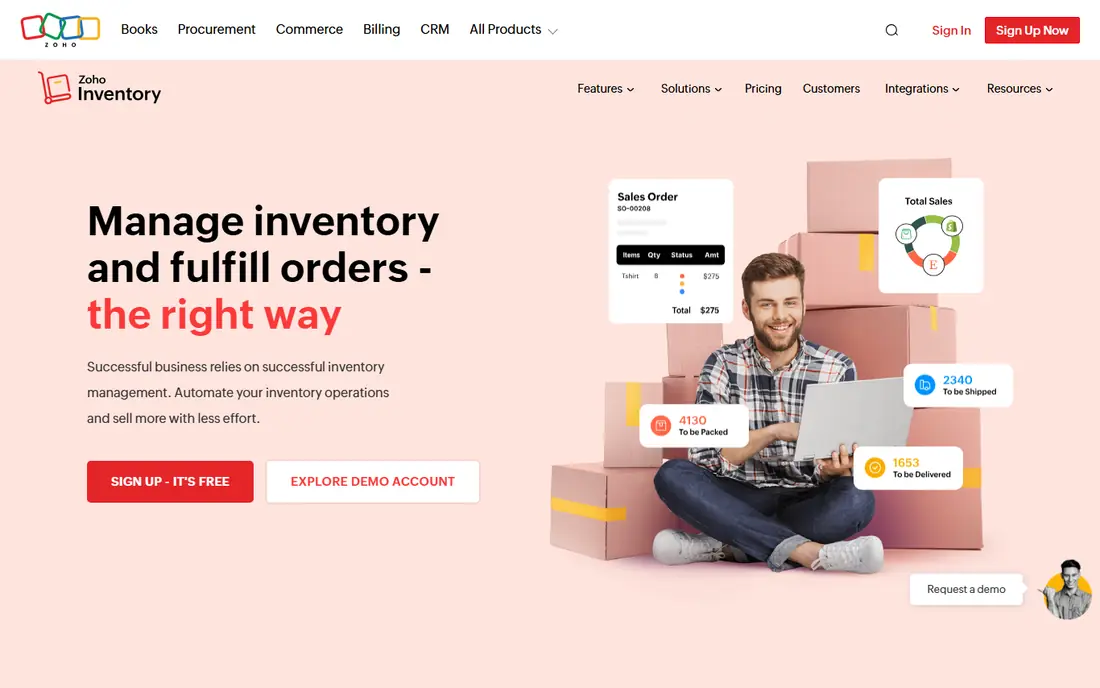
Zoho Inventory is the value benchmark for small sellers. The free plan covers up to 50 orders per month, and Standard at $29 per month billed annually adds more orders, users, and warehouses, plus purchase orders, sales orders, and channel integrations for major marketplaces. For an online seller or small wholesaler, that tier covers the core job without paying for warehouse automation you do not need.
The limits are order and feature caps, so a fast-growing seller should model the next tier early. Zoho Inventory also works best inside the Zoho ecosystem, though it integrates with other tools too. For most small businesses watching every dollar, start here and move up only when order volume or warehouse needs force it.
- Free plan plus $29 Standard tier
- Multi-channel order sync
- Purchase orders and warehousing basics
- Order caps on lower tiers
- Advanced features need higher plans

Sortly tracks physical items visually: photograph an item, tag its location, and scan it with a phone to check stock. That model suits equipment, supplies, materials, and small retail stock far better than a spreadsheet, and the free plan covers a limited item count for testing. Advanced starts at $49 per month, with higher tiers adding users and features.
Check tier details carefully, since purchase orders, stock counts, and full barcode support sit on higher plans in some listings. Sortly is best value when your main job is knowing what you have and where it is, not running high-volume order fulfillment. For order-heavy ecommerce, Zoho Inventory gives more per dollar.
- Photo-based visual tracking
- Mobile barcode scanning
- Simple setup
- Advanced plan omits purchase orders and stock counts on some tiers
- Barcode features are tier-gated

inFlow is built for B2B sellers, wholesalers, and small manufacturers that need structured orders, quotes, and invoicing alongside stock control. Its showroom feature lets trade customers browse and order, which few value-priced rivals offer. Plans start at $99 per month billed annually, with monthly billing higher, and a 14-day trial lets you test the workflow.
That entry price is a jump from Zoho, so inFlow is good value only when B2B features matter. A pure retail seller may pay for showroom and wholesale tools it never uses. For wholesalers, though, inFlow packs more relevant structure per dollar than a generic tracker, and its invoicing depth saves a separate billing tool.
- B2B showrooms
- Invoicing and quotes
- Strong order and stock structure
- Higher entry price than Zoho
- Monthly billing costs more than annual
Katana, now known as Katana MRP, combines inventory with light manufacturing: bills of materials, production orders, and raw material tracking, alongside sales and purchasing. Core starts at $299 per month, with a free plan for limited use, which makes it pricey for resellers but reasonable for makers who would otherwise pay for separate inventory and production tools. Its Shopify and accounting integrations suit small product brands.
Pure resellers should skip it, since manufacturing features add cost without benefit. Katana is best value for small manufacturers and makers who need production planning inside their inventory system. Compare its total against a separate inventory plus spreadsheet setup before deciding, since the bundled workflow is where the value lies.
- Manufacturing and BOM tracking
- Production planning
- Free plan for small SKU counts
- Expensive for pure resellers
- Overkill without production needs
Cin7 Core starts at $349 per month and targets multichannel brands that sell across marketplaces, their own store, and wholesale. It automates purchasing, stock allocation, warehouse work, and order routing, with hundreds of integrations and built-in EDI on higher tiers. For a brand outgrowing basic tools, that depth prevents stockouts and overselling across channels.
The price only makes sense above roughly $1 million in annual revenue or at high order volume, and setup takes longer than a simple tracker. Cin7 is best value at scale, where automation saves staff time and prevents costly errors. Smaller sellers should start with Zoho Inventory and move to Cin7 when channel complexity, not just volume, demands it.
- Deep multichannel automation
- 700 plus integrations
- Warehouse and EDI tools
- High entry price
- Implementation time for complex setups
Fishbowl is the classic inventory companion for QuickBooks users who need manufacturing, warehouse management, and asset tracking beyond QuickBooks itself. Essentials starts at $229 per month billed annually for two users, with Growth and higher tiers adding users and features. Its real-time assembly tracking and barcode warehouse tools suit manufacturers and distributors with physical stockrooms.
There is no free plan, sales are demo-led, and higher tiers jump in price, so budget carefully. Fishbowl is best value for QuickBooks-based manufacturers that need warehouse depth without moving to a full ERP. Retailers without manufacturing needs will find cheaper options in this list.
- Deep QuickBooks integration
- Manufacturing and warehouse depth
- Asset tracking
- No free plan
- Higher tiers cost much more
- Demo-led sales
Ordoro combines inventory management with shipping automation for multichannel ecommerce brands. Its inventory app starts at $349 per month, with a 15-day trial, and it automates order forwarding, stock updates, and shipping label creation across channels. For a brand that ships daily, merging stock and shipping saves the sync errors that come from separate tools.
The entry price is high for a small seller, and total cost depends on shipping volume and add-ons. Ordoro is best value for ecommerce brands where shipping and stock must stay in step every day. Smaller sellers should compare Zoho Inventory plus a separate shipping tool before paying for the combined platform.
- Shipping and inventory in one place
- Order automation
- Forecasting tools
- High entry price for inventory app
- Shipping volume affects total cost
Square for Retail gives single-location stores inventory inside the point of sale they already use. The free tier covers stock tracking, counts, and basic reporting at the counter, with paid tiers adding purchase orders, vendor management, and advanced reporting. For a shop that sells mainly in person, that integration is the value: stock updates as you sell, with no separate system to sync.
Multichannel sellers and warehouses will outgrow it, since its depth lags Cin7 and Fishbowl. Square for Retail is best value for brick-and-mortar stores already running Square, where the free tier may cover the whole job. Check paid tier pricing per location before scaling to several stores.
- Free POS-native inventory
- Easy stock counts
- Hardware ecosystem
- Advanced inventory features need paid tiers
- Weaker for multichannel warehouses
KORONA POS pairs point of sale with inventory management for brick-and-mortar retailers, starting at $59 per terminal per month on its Core plan, with a free trial. It handles stock, suppliers, and multi-terminal stores, and its offline mode keeps selling during internet outages, which matters for busy counters. For a store with several terminals, one subscription covering POS and stock is simpler than two vendors.
Per-terminal pricing adds up as terminals grow, and its ecommerce depth is thinner than Cin7 or Ordoro. KORONA POS is best value for retail stores that need reliable POS plus inventory in one system, especially multi-terminal shops. Pure online sellers should look at Zoho Inventory or Ordoro instead.
- POS and inventory in one subscription
- Good for multi-terminal stores
- Offline mode
- Per-terminal pricing adds up
- Less ecommerce depth than Cin7 or Ordoro
How we picked these
We compared official pricing pages, feature pages, and documentation for each tool, plus public reviews, and kept only products that exist and work today for inventory management. We favored tools with clear public pricing or a free tier, and we noted where pricing was per terminal, per location, or billed annually, since those details change real cost. We did not claim hands-on testing. This guide is general information, not financial advice, and prices should be rechecked on vendor sites before purchase.
What to check before you pay
Start with your order volume and channel mix, not the feature list. Count monthly orders, sales channels, warehouses, and users, then check each tool's caps at that level. A $29 plan with a low order cap can force an upgrade sooner than a $49 plan with headroom, so model two years of growth, not just month one.
Next, test the workflows you run daily: receiving stock, counting, picking, and reconciling a sale across channels. Check barcode scanning on your phones or scanners, and confirm integrations with your store, marketplace, and accounting tool. Finally, confirm what is included in the quoted price: users, locations, warehouses, and support, since add-ons for those items are where value-priced tools often get expensive.
FAQ
What is the cheapest good inventory software?
Zoho Inventory is the cheapest strong option, with a free plan and Standard at $29 per month billed annually. Square for Retail is free for single-location stores already using Square, and Sortly offers a free visual tier. The cheapest good choice depends on whether you sell online, in store, or track equipment.
How much should a small business pay for inventory software?
Most small sellers pay from free to $99 per month, with $29 to $49 covering core needs. Multichannel brands and manufacturers pay $229 to $349 per month for deeper automation. Pay for the tier that fits your order volume and channel count, and re-evaluate when volume doubles.
Is free inventory software enough for a small business?
Often yes at the start, especially with Zoho Inventory's free tier or Square for Retail's free POS inventory. Free tiers carry order, item, or user caps, so they suit low-volume sellers. When caps force workarounds or stock errors, a paid tier usually pays for itself in saved time.
What is the difference between Sortly and Zoho Inventory?
Sortly is a visual tracker for physical items, locations, and equipment, best when knowing what and where matters most. Zoho Inventory is an order and stock system for sellers, with purchase orders, sales orders, and channel sync. Choose Sortly for asset tracking and Zoho Inventory for selling.
When should I move from a cheap tool to Cin7 or Fishbowl?
Move when channel complexity, warehouse work, or manufacturing depth exceeds your current tool, not just when order volume rises. Signs include frequent overselling, manual stock reconciliation, and separate spreadsheets for production or warehousing. At that point, the automation in Cin7 or Fishbowl usually outweighs its higher monthly fee.