Best User Feedback Tool in 2026: 8 Tools Compared
We compared the best user feedback tool options for votes, roadmaps and in-app surveys, with current pricing, free plans and honest trade-offs for teams.
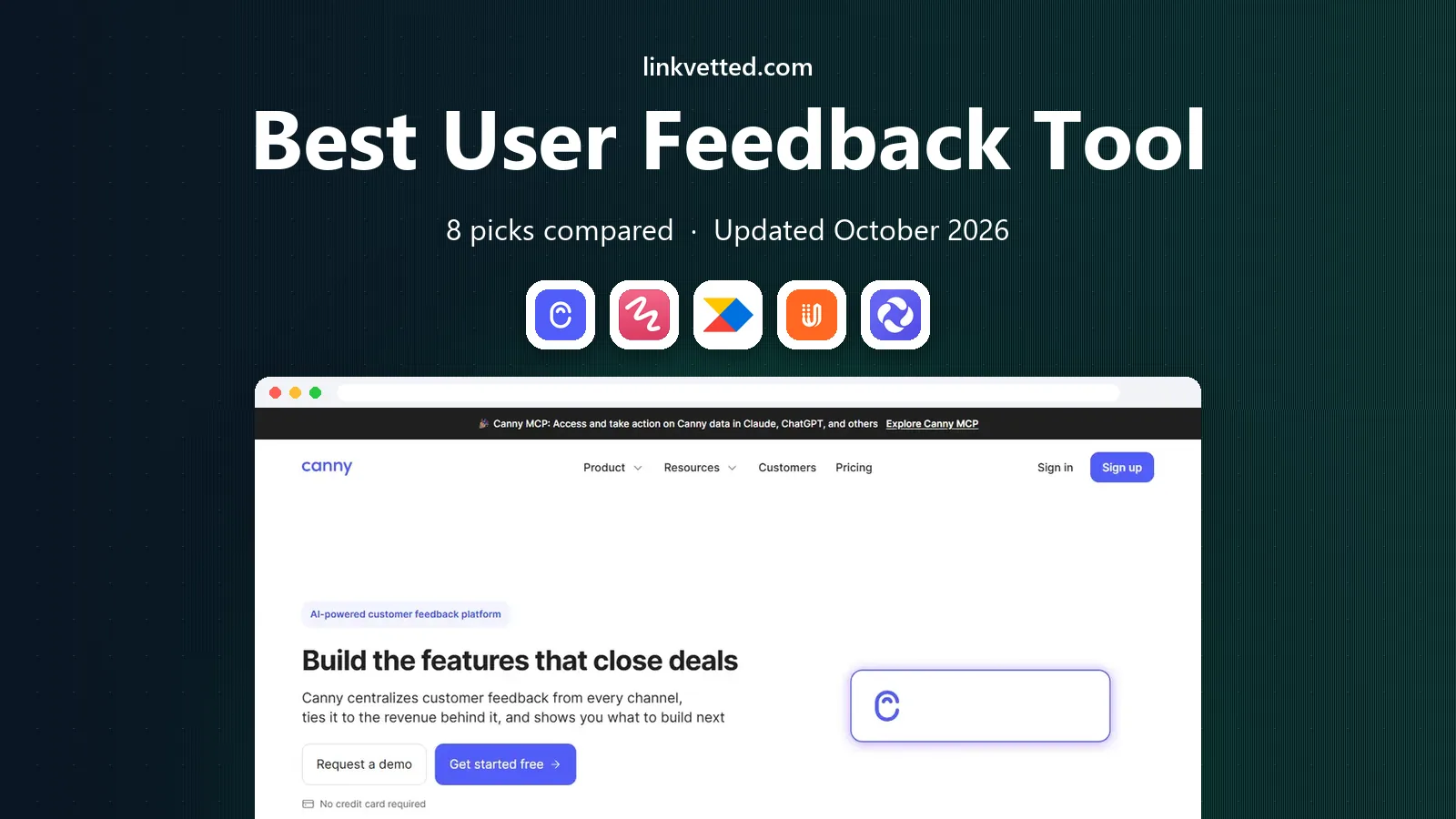
- Editor's choice
 Canny
Public voting boards and roadmaps
Starts at$79 per monthVisit canny.ioFull review - Great alternative
 Frill
Simple full feedback loop
Starts at$25 per monthVisit frill.coFull review - Also consider
 Productboard
Product planning and insights
Starts at$19 per maker per monthVisit productboard.comFull review
TL;DR:
- Canny and Frill suit most small and mid-size SaaS teams that want a public board, voting and a changelog in one place.
- Productboard and UserVoice fit larger product teams that need planning, prioritisation and insight management, but they cost more and take longer to set up.
- If budget is tight, Sleekplan, Upvoty and a free Canny plan cover the core loop of collecting ideas and closing it with updates.
- Watch the pricing model closely, because per-tracked-user, per-seat and flat pricing lead to very different bills as your audience grows.
Quick comparison
| Tool | Best for | Starts at | Free plan? | |
|---|---|---|---|---|
| Canny | Public voting boards and roadmaps | $79 per month | Yes | Visit |
| Frill | Simple full feedback loop | $25 per month | Free trial | Visit |
| Productboard | Product planning and insights | $19 per maker per month | Yes | Visit |
 UserVoice | Enterprise feedback management | See website | No | Visit |
 Featurebase | Feedback plus support in one tool | $29 per seat per month | Yes | Visit |
 Sleekplan | Budget boards with surveys | $13 per month | Yes | Visit |
 Upvoty | Low-cost voting boards | $15 per month | Free trial | Visit |
 Nolt | Clean minimal boards | $29 per month | Free trial | Visit |
The best user feedback tools
A good feedback tool does more than collect requests. It helps you sort them, decide what to build and tell users what changed. We compared official feature pages, pricing pages and public reviews to find tools that cover that full loop.

Canny is the default pick for many SaaS teams, and for good reason. Its boards are easy for customers to use, voting feels natural, and the roadmap and changelog widgets make it simple to show progress without writing a separate update each time. Admin tools for merging duplicate requests and tracking who asked for what keep a busy board from turning into a mess.
The catch is pricing. The free plan covers a small number of tracked users, and paid plans scale with that count, so a popular product can see costs climb even if only a small team manages the board. If your audience is large, check the tracked-user limit before you commit, and consider whether you need every admin on a paid seat.
- Mature voting boards
- Public roadmap and changelog
- AI tools for sorting feedback
- Paid pricing rises with tracked users
- Advanced plans are a jump in price

Frill appeals to teams that want the whole loop without enterprise complexity. You get idea boards, a public roadmap, announcements and a widget for collecting feedback inside your product, all for one flat monthly price. That predictability is a real advantage over tools that charge per user or per tracked customer.
Setup is fast, and the interface stays out of the way for both your team and your users. The trade-off is depth. Frill is less suited to teams that need detailed insight repositories, complex scoring models or deep analytics across many sources. For a startup or small SaaS team, that simplicity is a strength. For a large product organisation, it may feel thin.
- Flat monthly pricing
- Boards, roadmap and announcements included
- Quick to set up
- Lighter analysis and planning depth
- No permanent free plan
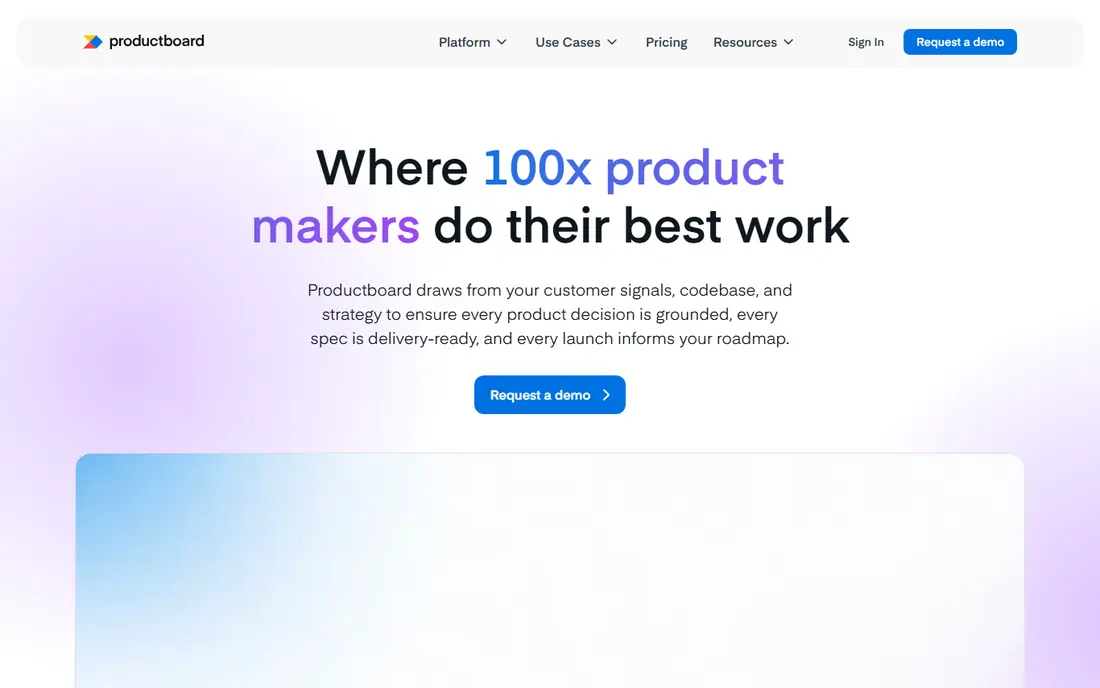
Productboard is less of a simple voting board and more of a product workspace. Feedback from customers, sales and support can be gathered into one insight hub, linked to features and scored before it reaches a roadmap. That structure helps teams explain why one request was chosen over another, which matters when stakeholders disagree.
Smaller teams sometimes find Productboard heavier than they need, and the maker-based pricing means you should count who actually builds roadmaps rather than everyone who views them. When used well, though, it is one of the strongest options here for turning scattered feedback into a defensible plan.
- Strong prioritisation and roadmapping
- Central insight repository
- Many integrations
- Needs product operations discipline
- Costs add up with more makers
UserVoice has been in this market longer than most rivals, and that shows in its enterprise controls. Large teams can segment feedback by customer, product area or account value, and run prioritisation workflows that smaller tools do not attempt. If you manage feedback across many products or business units, that structure can be worth the cost.
The downside is access. Pricing is custom and aimed at larger budgets, and there is no free plan to test the full product at leisure. Teams that only need a board and a roadmap will find simpler, cheaper tools do the job. UserVoice makes most sense when governance, scale and account-level insight matter more than speed of setup.
- Long track record with large organisations
- Segmentation and prioritisation workflows
- Broad integrations
- Custom pricing only
- Interface feels dated in places
Featurebase tries to replace two tools at once by combining feedback boards with a help centre and customer support features. For a small team, that consolidation saves money and keeps customer conversations in one place. Users can vote on ideas, read help articles and contact support without jumping between products.
The interface is clean and modern, and the free plan gives small teams a genuine starting point. The risk is scope creep in pricing, because per-seat billing rises as support, product and success staff all need access. Check who truly needs a seat, and whether the support features are strong enough to replace your current help desk.
- Feedback boards plus help centre and support tools
- Modern interface
- Free plan available
- Seat costs grow as more teams join
- Newer than some rivals
Sleekplan is a sensible pick when the budget is small but a bare voting board is not enough. It adds surveys and satisfaction tracking to the usual board, roadmap and changelog mix, so you can ask follow-up questions without buying a separate survey tool. That combination suits indie products, agencies and early-stage SaaS teams.
It does not match Canny or Productboard on depth, integrations or enterprise administration. If you need advanced permissions, complex analytics or a large integration library, you will outgrow it. For most small teams, though, the low price and included surveys make it hard to beat.
- Low starting price
- Feedback boards plus surveys
- Free plan for small projects
- Fewer enterprise controls
- Smaller integration range than larger rivals
Upvoty keeps things deliberately narrow. You get feedback boards, voting, a roadmap and a changelog, without the extra layers that push other tools into higher price bands. That focus makes it quick to launch and easy for customers to understand, which helps response rates on a new board.
The limits show up when you want deeper analysis or many integrations. Upvoty is not built to be a full insight platform, and teams that need that depth should look at Productboard or Canny instead. As a low-cost way to start collecting and acting on feedback, it does its core job well.
- Low starting price
- Focused voting and roadmap features
- Simple setup
- Lighter analytics
- No permanent free plan
Nolt stands out for design. Its boards look polished with little customisation, and users can post and vote without friction. For teams that care about how a public board reflects their brand, that polish matters. Sync with Jira and Linear also helps engineering teams turn voted ideas into tracked work.
There are two catches to weigh. Pricing is per board, so running separate boards for several products adds up, and Nolt lacks a built-in changelog, so you will need another way to announce releases. If you run one main product and announce updates elsewhere, Nolt is a strong, attractive choice.
- Minimal, attractive boards
- Single sign-on included
- Jira and Linear sync
- No changelog feature
- Priced per board
How we picked these
We compared official feature pages, pricing pages, app listings and public reviews for tools that are actively sold and maintained in October 2026. We favoured tools that cover the full loop of collecting feedback, prioritising it and telling users what shipped, rather than survey-only or analytics-only products. Pricing was taken from vendor pages and third-party pricing summaries where a vendor keeps pricing behind sales, and we marked those cases as See website rather than guessing a figure.
What to check before you choose
Start with the loop, not the board
A board that collects ideas but never reports back will lose trust fast. Check that the tool offers a public roadmap, release announcements or a changelog, and that updating them is quick enough that your team will actually do it. If announcements are awkward, users will assume their feedback went nowhere.
Count the real cost
Feedback pricing hides in different places. Some tools charge per seat, some per tracked user, some per board and some at a flat rate. Estimate your numbers for a year ahead, not just launch week, and include everyone who needs admin access. A cheap headline price can become the most expensive option once your user base grows.
Match depth to team size
A solo founder does not need enterprise segmentation, and a large product team will struggle with a tool that cannot link feedback to accounts or features. Choose the lightest tool that still lets you prioritise honestly and report back. You can move to a deeper platform later, and most of these tools export ideas and votes.
Test with real users
Run a short trial with a real request, not a demo board. Ask a few customers to post, vote and comment, and see whether they understand the board without instructions. Also test the in-product widget on mobile, since many users will meet your feedback tool there first.
FAQ
What is the best user feedback software for a small SaaS team?
Canny and Frill are strong starting points, with Sleekplan as the budget option. Canny offers the most mature boards, Frill offers flat pricing and a full loop, and Sleekplan adds surveys at a lower price. Pick based on whether you value depth, price predictability or survey features most.
What are the best user feedback tools for enterprise teams?
Productboard and UserVoice fit larger teams best. Productboard helps link feedback to planning and prioritisation, while UserVoice offers segmentation and workflows for large organisations. Both need more setup and budget than a simple board, so confirm the team that will run them before buying.
Is there a free user feedback tool worth using?
Yes, Canny, Productboard, Featurebase and Sleekplan all offer free plans or free tiers with limits. Free plans work well for a single product with a modest audience, but tracked-user, seat or feature limits usually push growing teams to a paid plan. Check those limits against your audience size before launch.
How is a feedback board different from a survey tool?
A board collects open ideas and votes over time, while a survey asks a fixed set of questions at one moment. Boards suit ongoing product direction, and surveys suit measuring satisfaction or testing a specific change. Many teams use both, and tools such as Sleekplan bundle a basic survey with a board.
Should feedback be public or private?
Public boards build trust and let users see popular requests, but they also expose your roadmap thinking to competitors. Private boards suit sensitive enterprise feedback or early products. Some tools let you run both, with a public board for general ideas and private collection for key accounts.