Best Trading App in 2026: 8 Apps Compared
Looking for the best trading app? We compared eight brokers on $0 stock commissions, fractional shares, research, and ease of use to help you choose wisely.
- Editor's choice
 Fidelity
All-round beginners and long-term investors
Starts atFreeVisit fidelity.comFull review - Great alternative
 Charles Schwab
Retirement savers and full-service support
Starts atFreeVisit schwab.comFull review - Also consider
 Robinhood
Mobile-first beginners
Starts atFreeVisit robinhood.comFull review
TL;DR:
- The best trading platform for most beginners is Fidelity, thanks to $0 stock and ETF commissions, fractional shares from $1, and strong research and retirement accounts.
- Charles Schwab and E*TRADE suit investors who want a full-service broker with $0 online stock and ETF trades and human support.
- Robinhood, Webull, and Public suit mobile-first traders who want a simple app, while Interactive Brokers suits active and international traders.
- This is not financial advice. Trading carries risk, including loss of capital, and options and margin carry extra risk.
Quick comparison
| Tool | Best for | Starts at | Free plan? | |
|---|---|---|---|---|
| Fidelity | All-round beginners and long-term investors | Free | Yes | Visit |
| Charles Schwab | Retirement savers and full-service support | Free | Yes | Visit |
| Robinhood | Mobile-first beginners | Free | Yes | Visit |
 Webull | Active traders who want free data | Free | Yes | Visit |
 SoFi Invest | Simple investing alongside banking | Free | Yes | Visit |
 E*TRADE | Options and retirement accounts | Free | Yes | Visit |
 Interactive Brokers | Active and international traders | Free | Yes | Visit |
 Public | Multi-asset investing with research tools | Free | Yes | Visit |
The best trading apps
Most major brokers now charge $0 commission on online US stock and ETF trades, so the choice has shifted. The differences that matter are research quality, fractional share rules, retirement accounts, options fees, customer support, and how easy the app is to use without making impulsive trades. The list below covers those differences for ordinary investors and active traders.
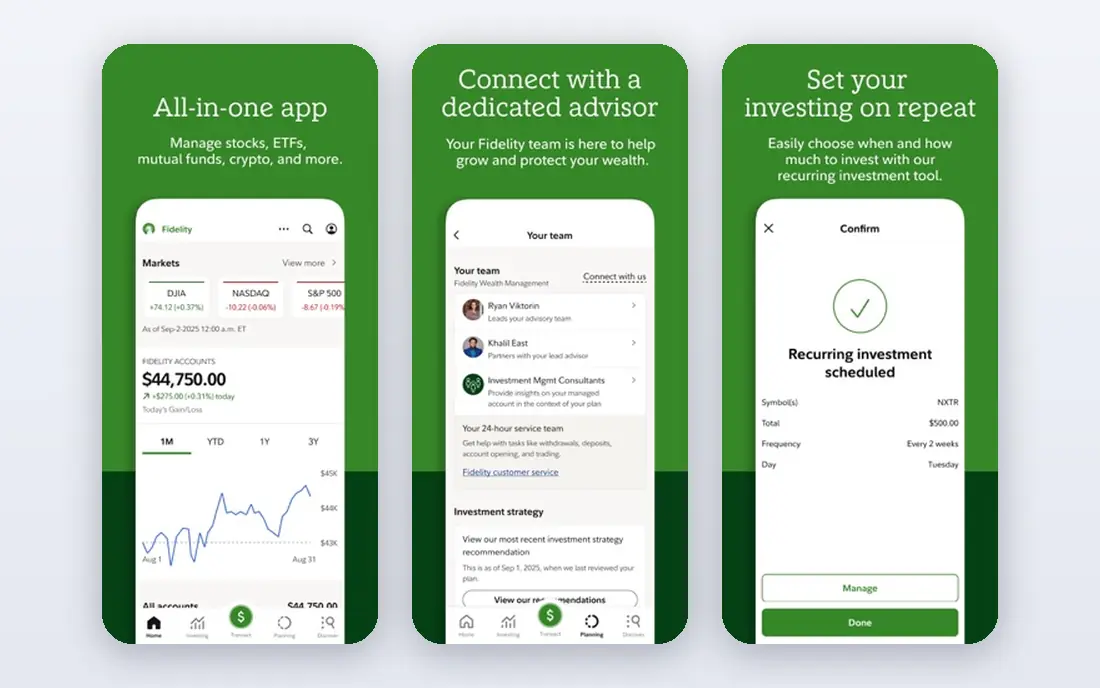
Fidelity is our pick for most people because it does the basics unusually well. You can open a brokerage account with no minimum, trade US stocks and ETFs with $0 online commission, buy fractional shares from $1, and open retirement accounts such as IRAs in the same place. Research, screeners, and educational content are strong, which helps beginners learn without leaving the app to search elsewhere.
The app can feel dense at first, with many menus and tools that a first-time investor may not need. Options traders should note the $0.65 per contract fee in recent fee schedules, which is standard for full-service brokers but higher than Robinhood or Webull. If you want one broker for long-term investing, retirement saving, and occasional trading, Fidelity is the safest all-round choice.
- $0 commissions on US stocks and ETFs
- Fractional shares from $1
- Strong research and retirement accounts
- App can feel dense for brand-new traders
- Options contracts cost $0.65 each in recent fee schedules

Charles Schwab suits investors who want a full-service broker at DIY prices. You get $0 online commissions on US stocks and ETFs, no minimum to open a brokerage account, and access to branches, phone support, and retirement planning tools. Schwab Stock Slices allow fractional investing from $5 in eligible stocks, which helps beginners start with small amounts.
The platform range can feel overlapping, with Schwab.com, the mobile app, and thinkorswim tools serving different users. That breadth is a strength for traders who grow into advanced tools, but it can confuse a first-time investor. If you value human support and a long-term home for retirement accounts, Schwab is a close alternative to Fidelity.
- $0 commissions on online US stock and ETF trades
- Fractional shares from $5 in Schwab Stock Slices
- Branches and phone support
- App and platforms can feel overlapping
- Options contracts cost $0.65 each in recent fee schedules
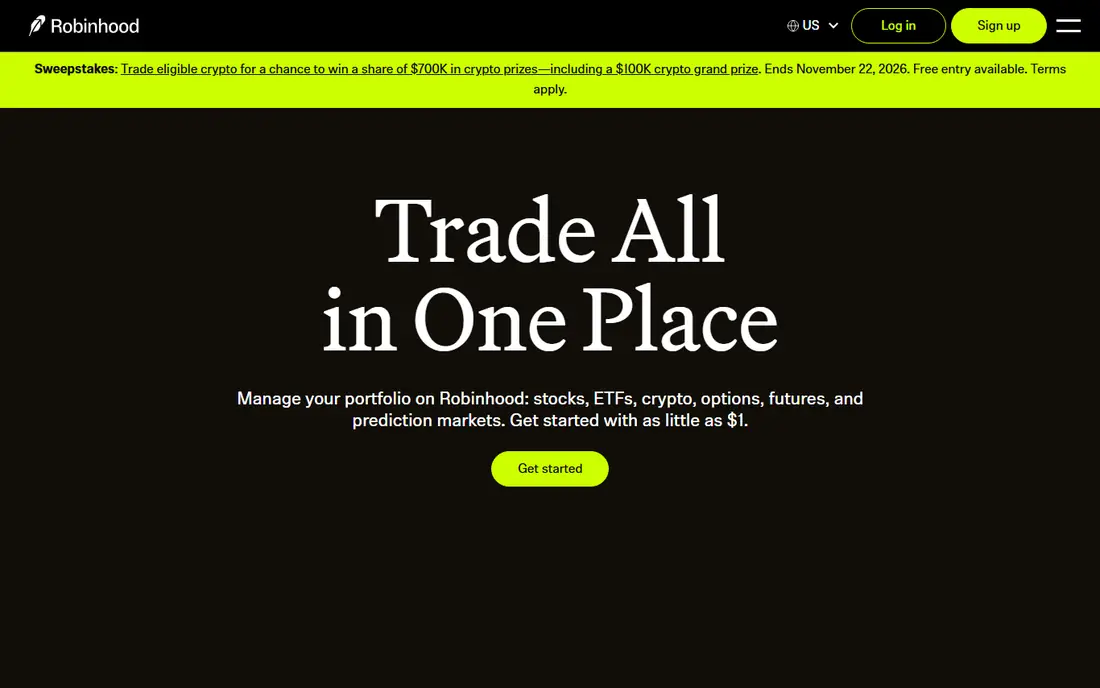
Robinhood is the simplest app on this list to start with. The design is clean, trades take a few taps, and fractional shares from $1 let you buy part of an expensive stock without saving for a full share. Stock and ETF trades carry $0 commission, and options trades carry a $0 contract fee in recent fee schedules, which is lower than most full-service brokers.
The trade-off is depth. Research, screeners, and retirement planning tools are thinner than at Fidelity or Schwab, and the core brokerage offer does not include mutual funds. Robinhood also offers crypto trading and retirement accounts with match offers that change over time, so check current terms. If you want a mobile-first app and you will learn research elsewhere, Robinhood is a clear, low-cost start.
- $0 commissions on stock and ETF trades
- $0 options contract fee
- Fractional shares from $1
- Research tools are thinner than Fidelity or Schwab
- No mutual funds in the core brokerage offer
Webull suits traders who want professional tools without paying for data. You get $0 commissions on US stocks, ETFs, and options, free real-time quotes, paper trading with practice money, and advanced charts and screeners. That combination is rare at this price, and it helps active traders test ideas before risking real money.
The interface is the catch. Charts, indicators, and order types that excite an active trader can overwhelm a beginner, and there are no mutual funds for hands-off investors. Webull also offers fractional shares from $1 on select stocks and ETFs. If you trade often, want free data, and like charts, Webull is a strong pick. If you want simple long-term investing, Fidelity or Schwab will feel calmer.
- $0 commissions on stocks, ETFs, and options
- Free real-time quotes and paper trading
- Advanced charts
- No mutual funds
- Interface can overwhelm beginners
SoFi Invest suits readers who want investing to sit next to banking, not in a separate world. You can open an active investing account with $0 stock and ETF commissions, or use automated investing for a managed portfolio based on your goals. Fractional shares are available from $5 on active investing, and automated investing starts from $50 in recent listings.
The limit is depth. SoFi has fewer advanced charting and research tools than Webull or Interactive Brokers, and the asset range is narrower than at a full-service broker. If you want one app for money, a simple portfolio, and occasional stock picks, SoFi is a friendly choice. If you want deep research or complex options strategies, look at Fidelity, E*TRADE, or Interactive Brokers.
- $0 commissions on stock and ETF trades
- Automated investing option
- Banking, loans, and investing in one app
- Research and advanced trading tools are limited
- Fractional minimum is $5 on active investing
E*TRADE, now part of Morgan Stanley, suits investors who want solid options tools and retirement accounts in one place. Online US stock and ETF trades carry $0 commission, and the options platform offers chains, strategies, and educational content that beginners can learn from. Retirement accounts, including IRAs, are well supported.
The design feels older than Robinhood or Webull, and the mobile app is less slick for quick trades. Options contracts cost $0.65 each in recent fee schedules, which matches Fidelity and Schwab. If options trading or retirement planning is central to your plan, E*TRADE is a dependable, full-featured choice. If you only want simple stock trades on your phone, Robinhood will feel faster.
- $0 commissions on online US stock and ETF trades
- Strong options tools
- Retirement accounts and education
- Design feels older than mobile-first rivals
- Options contracts cost $0.65 each in recent fee schedules
Interactive Brokers is the most powerful broker on this list, and the hardest to learn. IBKR Lite offers $0 commissions on US stock and ETF trades, while the wider platform gives access to global markets, many order types, and tools for active traders. Fractional shares from $1 are available on many US stocks and ETFs, and margin rates for qualified traders are often lower than at retail brokers.
That power comes with complexity. The desktop platform, mobile app, and account settings use terms that beginners may find confusing, and customer support is less hand-holding than at Schwab or Fidelity. Interactive Brokers suits active traders, international investors, and people who will use advanced tools regularly. Beginners should start with Fidelity or Schwab and move here only when they need the extra range.
- IBKR Lite offers $0 US stock and ETF commissions
- Access to many global markets
- Low margin rates for qualified traders
- Steep learning curve
- Platform can overwhelm beginners
Public suits investors who want several asset types in one app without juggling brokers. You can trade stocks, ETFs, options, crypto, and bonds, with $0 commissions on stocks and ETFs in recent listings. Research tools, company pages, and AI-assisted summaries help beginners understand a company before buying, and the social feed shows what other investors are discussing, with clear risk warnings.
Public has no branch network, so support is online, and fee details for options and crypto should be checked at signup, since they can vary by plan. The social features can also tempt impulsive trading if you follow trends without a plan. If you want a modern, multi-asset app with research built in, Public is a good fit. If you want branches or the deepest retirement tools, Fidelity or Schwab remain stronger.
- $0 commissions on stocks and ETFs
- Stocks, ETFs, options, crypto, and bonds in one app
- Research and AI-assisted tools
- Options contracts cost $0 in recent listings for some plans but fees can vary
- Newer broker with a smaller branch network
How we picked these
We compared official fee schedules, account minimums, and feature pages for major US brokers, along with recent 2026 broker comparisons. We kept only brokers that offer $0 online US stock and ETF commissions, that are open to ordinary US investors, and that cover a clear use case, from beginner investing to active trading. We noted options fees and fractional minimums where they change the cost, and we did not treat a free trade as free investing, since spreads, margin interest, and other fees still apply.
This is not financial advice. Trading carries risk, including the possible loss of capital, and past performance does not guarantee future results. Options and margin trading carry extra risk and are not suitable for every investor. Consider your goals, time horizon, and risk tolerance, and talk to a qualified advisor if you are unsure.
How to choose a trading app without overtrading
Match the broker to your plan, not to a promotion
Long-term investors should favor Fidelity or Schwab for research and retirement accounts. Mobile beginners should favor Robinhood or SoFi for simplicity. Active traders should favor Webull, E*TRADE, or Interactive Brokers for data and tools. A sign-up bonus should not decide a broker you may use for decades.
Check the fees beyond $0 commission
Check options contract fees, margin interest, account transfer fees, and crypto spreads before you trade those products. Check whether fractional shares are available for the stocks you want, and whether retirement accounts, dividend reinvestment, and recurring investments are supported. Those details matter more over time than a headline commission.
Start small and automate the boring part
Start with an amount you can afford to lose, use fractional shares to diversify, and set up recurring investments if your broker supports them. Paper trading on Webull is a useful way to learn order types without risking money. Review your portfolio on a schedule, not every hour, to reduce impulsive trades.
FAQ
What is the best trading app for beginners?
The best trading app for beginners in our list is Fidelity, thanks to $0 stock and ETF commissions, fractional shares from $1, strong research, and retirement accounts. Charles Schwab is a close alternative with similar pricing and strong support. Robinhood and SoFi Invest are simpler mobile options if you prefer a cleaner app.
What is the best trading platform for beginners with no commission?
Fidelity, Charles Schwab, Robinhood, Webull, SoFi Invest, E*TRADE, Interactive Brokers on Lite, and Public all offer $0 commissions on online US stock and ETF trades in recent listings. The best choice depends on research, support, and account types, not commission alone, since that fee is now $0 at all eight brokers.
Which is the best app for trading stocks on a phone?
Robinhood and Webull are the strongest mobile-first options in our list. Robinhood is simpler, while Webull offers deeper charts and free real-time data. Fidelity and Schwab also have capable mobile apps, with stronger research and retirement tools, so choose based on whether you value simplicity or depth.
What is the best trading app for options?
Webull and Robinhood offer $0 options contract fees in recent listings, while Fidelity, Schwab, and ETRADE charge $0.65 per contract. ETRADE and Interactive Brokers offer deeper options tools and strategies. Beginners should learn options risks before trading, since options can lose value quickly.
Can I invest with $1 using these trading apps?
Yes, several brokers on this list offer fractional shares from $1, including Fidelity, Robinhood, Webull, and Interactive Brokers. Schwab Stock Slices start from $5, and SoFi Invest active investing starts from $5. Fractional shares let you buy part of an expensive stock, but they do not remove market risk.
Is trading on an app safe?
Reputable US brokers are regulated and offer SIPC protection for securities in brokerage accounts, up to legal limits, but SIPC does not protect against market losses. Use strong passwords and two-factor authentication, check fees and terms, and remember that trading carries risk. This guide is education, not financial advice.