Best Ticket Selling Platform in 2026: 9 Platforms Compared
We compared the best ticket selling platform for concerts, classes, and community events, covering fees, payouts, seating, and discovery in one guide.
- Editor's choice
 Eventbrite
Discovery and large public events
Starts atSee websiteVisit eventbrite.comFull review - Great alternative
 Ticketmaster
Major concerts and venues
Starts atSee websiteVisit ticketmaster.comFull review - Also consider
 Ticket Tailor
Low flat fees for own-audience events
Starts atSee websiteVisit tickettailor.comFull review
TL;DR:
- Fees are the biggest difference between ticket platforms, because a percentage fee grows with ticket price while a flat fee stays predictable.
- Eventbrite leads for discovery, because buyers already search its marketplace, but its service fee is among the highest in this list.
- Ticket Tailor, TicketSpice, and TicketLeap suit organisers who bring their own audience and want lower per-ticket costs.
- Humanitix suits nonprofits and schools that value its charity model, while DICE and Universe suit music and community events with a mobile-first audience.
- Always separate platform fees from card processing, and check payout timing, because cash after the event is less useful than cash as tickets sell.
Quick comparison
| Tool | Best for | Starts at | Free plan? | |
|---|---|---|---|---|
| Eventbrite | Discovery and large public events | See website | Yes | Visit |
| Ticketmaster | Major concerts and venues | See website | No | Visit |
| Ticket Tailor | Low flat fees for own-audience events | See website | Yes | Visit |
 TicketLeap | Simple setup for small events | See website | Yes | Visit |
 Humanitix | Nonprofits and charity events | See website | Yes | Visit |
 DICE | Music events and mobile fans | See website | No | Visit |
 Universe | Community and social events | See website | Yes | Visit |
 TicketSpice | Seat maps and custom pages | See website | No | Visit |
 SimpleTix | Timed entry and attractions | See website | No | Visit |
The best ticket selling platform
Selling tickets online looks simple until fees, refunds, seating, and payouts enter the picture. A platform that is cheap for a free community class may be costly for a $100 concert, and a marketplace that brings new buyers may be worth a higher fee for a public show. The platforms below cover those trade-offs. Our pick for most independent organisers is Ticket Tailor for low fees, while Eventbrite remains our pick when discovery matters most.
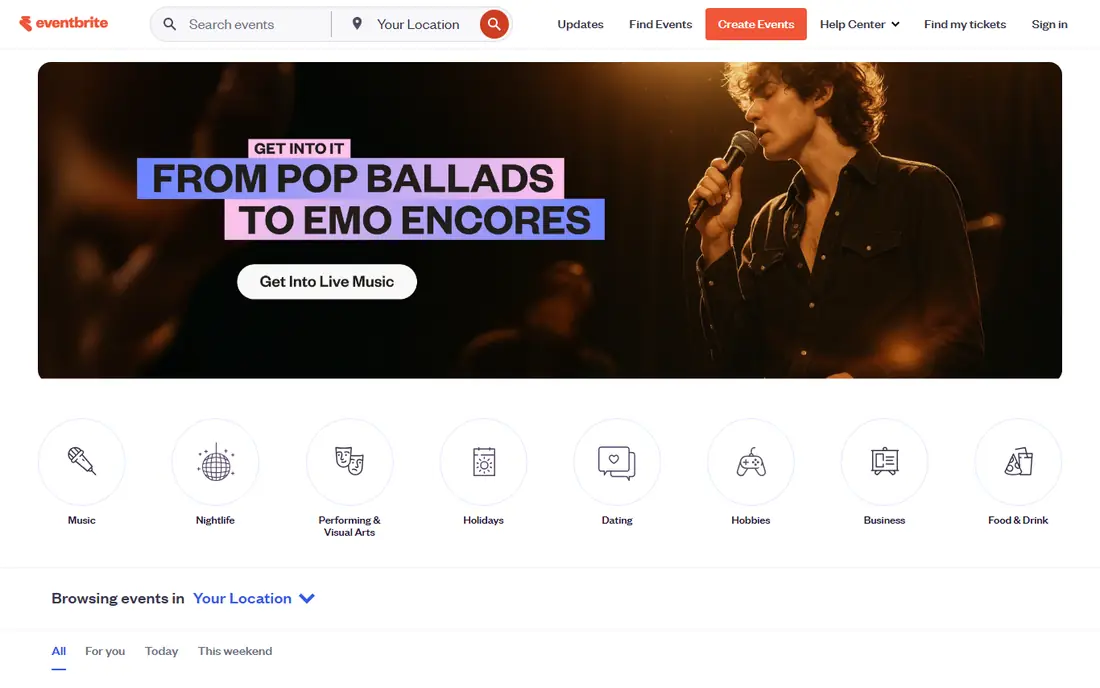
Eventbrite is the best-known ticket platform for a reason: buyers already search it for concerts, classes, festivals, and conferences, so a public event can gain new attendees without paid ads alone. Event pages are easy to build, with multiple ticket types, promo codes, and email tools, and check-in apps work well at the door. Free events are free to list, which helps community organisers.
The cost is the catch. Eventbrite charges a service fee per paid ticket plus a processing fee per order, and that total climbs with ticket price and volume. For a 200-ticket event at $30, the service fee alone can reach several hundred dollars, which is far more than a flat-fee rival. If you bring your own audience, a cheaper platform may save real money. If you need discovery, Eventbrite may earn its fee.
- Large buyer marketplace
- Strong event pages and marketing tools
- Free for free events
- Higher service fee than many rivals
- Processing fee sits on top of the service fee
Ticketmaster dominates major concerts, sports, and large venues, and for those events it is often the only realistic option. Artists and venues use it for primary sales, verified resale, seat maps, and mobile entry, and buyers trust it for high-demand shows. Fraud controls and ticket transfer tools are more developed than on small platforms, which matters when resale and scalping are a risk.
Small organisers should not expect the same experience. Ticketmaster is built for large-scale events, fees are set by venue and promoter agreements rather than a simple public price list, and support runs through those partners. If you run a major venue show, Ticketmaster is the default. If you run a local gig, class, or fundraiser, a smaller platform in this list will be cheaper and simpler.
- Huge buyer reach for major acts
- Venue and artist tools
- Strong fraud and resale controls
- Fees are high and complex
- Not built for small independent organisers

Ticket Tailor appeals to organisers who already have an audience and want to keep more of each ticket sale. Its pay-as-you-go fee is low per ticket, and prepaid credits bring the per-ticket cost down further for regular events. You connect your own Stripe, PayPal, or Square account, so payouts and processing run through a processor you already control, rather than through a platform-held account.
Discovery is the trade-off. Ticket Tailor does not bring the same built-in buyer traffic as Eventbrite, so you need your own email list, social following, or venue audience. Seat maps and advanced timed-entry tools are also thinner than on seating-first platforms. For a regular class, workshop, tour, or community show with your own audience, Ticket Tailor is our pick for value.
- Low pay-as-you-go fees
- Prepaid credits lower costs further
- Your own Stripe or PayPal account
- Less marketplace discovery than Eventbrite
- Seat maps are more limited
TicketLeap is a straightforward choice for small events that need a clean page, simple ticket types, and quick check-in, without a long setup process. Free events cost nothing to list, and paid events use a per-ticket fee plus a transaction fee, which is easy to understand at setup. Organisers praise its simplicity for fundraisers, small concerts, and community gatherings.
The fee structure needs a real calculation, because the per-ticket fee plus transaction percentage can exceed a flat-fee rival on higher-priced tickets. Payout timing also deserves a check, because some payouts arrive after the event rather than as tickets sell. For a one-off small event where ease matters more than squeezing every cent, TicketLeap is a solid pick.
- Easy event setup
- Free for free events
- Simple refund and check-in tools
- Per-ticket fee plus transaction fee adds up
- Payouts can follow the event
Humanitix is a ticketing platform with a charity model: it directs its profits to education charities, and it offers lower fees for verified charities and schools. Features are stronger than the price suggests, with reserved seating, waitlists, gift cards, merchandise sales, and integrations for email and customer tools. Free events are free, which helps schools and community groups.
Standard fees are higher than the cheapest flat-fee options, so a commercial organiser focused only on cost may prefer Ticket Tailor or TicketSpice. For a nonprofit, school, or values-led event, the story and the nonprofit rate can outweigh that gap. If your audience cares where fees go, Humanitix gives you a clear, honest answer to share with them.
- Certified B Corp with profits to charity
- Lower fees for verified nonprofits and schools
- Reserved seating and waitlists
- Standard fee is higher than flat-fee rivals
- Processing fee sits on top for many events
DICE built its name on mobile-first music ticketing, with a fan app that helps people discover shows, buy tickets, and enter with a phone. Tickets are tied to the buyer's device and account, which reduces resale fraud and scalping, and the app experience feels modern compared with email-based tickets. Promoters and venues use DICE for gigs, club nights, and festivals where the audience is young and mobile.
It is not a general-purpose platform for conferences, classes, or seated theatre in the same way as TicketSpice or Eventbrite. Organiser pricing is also less transparent, with terms set by agreement rather than a simple public fee table. For music events with a mobile audience, DICE is a strong pick. For a mixed event programme, pair it with a general platform rather than relying on it alone.
- Mobile-first fan experience
- Strong music discovery
- Fraud-resistant mobile tickets
- Best for music and live events, not conferences or classes
- Organiser pricing is quote-based
Universe, part of the Ticketmaster group, focuses on social and community events with clean pages that share well on social media. It suits parties, meetups, classes, pop-ups, and small festivals where the event page itself does the marketing work. Free events are free to list, and paid plans add lower fees and extra features for regular organisers.
Fees vary by plan, with a percentage plus per-ticket charge that is capped per ticket on some plans, so you should model your exact ticket price and volume before choosing a plan. Advanced seat maps and timed-entry controls are thinner than on TicketSpice or SimpleTix. For a community event that needs a good-looking page and easy sharing, Universe is a friendly pick.
- Clean social event pages
- Easy sharing and discovery
- Free for free events
- Fees vary by plan and ticket price
- Fewer advanced seating tools than seating-first rivals
TicketSpice suits venues and attractions that need real seat selection, timed entry, or a highly customised page. Its page builder gives more control than a template-only platform, and its flat per-ticket fee is predictable for higher-priced tickets, where percentage fees climb fast. Box office tools and reserved seating help theatres, churches, and attractions that sell assigned seats.
There is no free ongoing plan, and card processing sits on top of the platform fee, so total cost needs a full calculation. For general admission events with a simple page, a cheaper flat-fee rival may be enough. For a theatre, gala, or attraction where seat choice and page design matter, TicketSpice is our pick for control.
- Strong seat maps and custom page builder
- Flat per-ticket fee
- Good for theatres and attractions
- No free plan for ongoing use
- Processing fee sits on top of the platform fee
SimpleTix is built for attractions, tours, museums, and timed-entry events, where capacity per time slot matters as much as total tickets sold. It offers seating, timed entry, promo codes, and reporting in a system that handles repeat daily sessions well. Its fee structure, with a per-ticket charge plus a percentage capped per ticket, is predictable for attractions that sell many mid-priced tickets.
Discovery is limited compared with Eventbrite, so attractions need their own marketing, website traffic, or local listings to fill slots. Setup for complex seating or multi-day schedules also takes more care than a simple general admission page. For an attraction, tour, or timed-entry venue, SimpleTix is a strong, practical pick.
- Strong timed entry and seating tools
- Flat-ish fee with a cap
- Good for attractions and tours
- Less marketplace discovery than Eventbrite
- Setup takes more care for complex events
How we picked these
We compared official pricing pages, fee tables, and public documentation for ticket platforms that are current in 2026. We favoured platforms with clear fee structures, working check-in tools, and a track record of serving real events, and we included marketplace, flat-fee, seating-first, and music-first options. We did not claim hands-on event testing. Prices shown as See website mean the vendor sets fees by plan, ticket price, or agreement, so model your exact event before you choose.
How to choose a ticket platform
Run one real scenario before you decide: your ticket price, your expected ticket count, and who pays the fee, you or the buyer. A percentage platform can look cheap on a $10 ticket and costly on a $100 ticket, while a flat fee does the opposite. Check who holds the money, when payouts arrive, and what refund and cancellation tools you get, because those terms matter when a show moves or cancels.
Next, check the buyer experience on a phone. Buy a test ticket, scan it at a mock door, and refund it, so you see the full flow your audience will see. Check seat maps if you sell assigned seats, and check timed entry if you sell slots. A platform that saves $1 per ticket but creates door queues or refund headaches is not a saving.
Fees, payouts, and refunds in plain terms
Separate three costs: the platform fee, the card processing fee, and any monthly plan fee. Some platforms bundle processing into one figure, while others list it separately, so compare totals, not headlines. Ask when money reaches your bank, what holdbacks apply to new organisers, and how refunds and chargebacks are handled. Get those answers in writing for large events.
FAQ
What is the best platform for selling tickets online?
For most independent organisers, Ticket Tailor offers the best value when you bring your own audience. Eventbrite is better when you need marketplace discovery for a public event. The best pick depends on ticket price, volume, seating needs, and whether you already have an audience.
How much do ticket platforms charge?
Fees vary widely. Flat-fee platforms charge under $1 per ticket plus processing, while percentage platforms charge several percent plus a per-ticket fee, plus processing. For a $30 ticket, total fees can range from under $2 to over $3.50 depending on the platform and plan, so model your exact price.
Can I sell free event tickets?
Yes. Eventbrite, Ticket Tailor, TicketLeap, Humanitix, and Universe all allow free events at no platform fee, though you should check limits on free ticket volume for regular organisers. Free events still need a clear page, capacity limits, and a check-in plan.
When do I get paid for ticket sales?
It depends on the platform. Platforms that use your own Stripe or PayPal account often pay as tickets sell, while platforms that hold funds may pay after the event or after a holding period. New organisers may face longer holds, so ask about payout timing before you commit to venue deposits.
Do I need reserved seating tools?
You need them if you sell assigned seats for theatre, galas, or premium sections. General admission concerts, classes, and parties usually do not need seat maps, and a simpler platform will be cheaper. TicketSpice and SimpleTix lead for seating, while Humanitix also offers reserved seating for many events.
What is the best ticket selling platform for nonprofits?
Humanitix is our pick for nonprofits and schools, because of its lower nonprofit rate and its charity model. Ticket Tailor is also strong for nonprofits that want low flat fees and control over payouts. Compare both on your ticket price and volume before you decide.