Best Sustainability Software in 2026: 9 Tools Compared
We compared the best sustainability software for carbon accounting, ESG reporting and supplier data, with pricing and picks for small teams and enterprises.

- Editor's choice
 Persefoni
Audit-grade carbon data, free start
Starts atFreeVisit persefoni.comFull review - Great alternative
 Watershed
Large enterprise climate programs
Starts atSee websiteVisit watershed.comFull review - Also consider
 Greenly
Small and mid-size companies
Starts at$1,950 per user per yearVisit greenly.comFull review
TL;DR:
- Persefoni is the best way to start measuring emissions without a sales call, thanks to a genuinely free Pro tier.
- Watershed is our pick for large enterprises that need audit-grade carbon data and board-ready disclosure in one platform.
- Greenly suits small and mid-size companies, especially in Europe, with plans listed from about $1,950 per user per year.
- Almost no vendor in this category publishes full pricing, so get a written quote scoped to your entities, users, and frameworks before budgeting.
Quick comparison
| Tool | Best for | Starts at | Free plan? | |
|---|---|---|---|---|
| Persefoni | Audit-grade carbon data, free start | Free | Yes | Visit |
| Watershed | Large enterprise climate programs | See website | No | Visit |
| Greenly | Small and mid-size companies | $1,950 per user per year | Free trial | Visit |
 Sweep | Supplier-heavy Scope 3 programs | See website | No | Visit |
 Plan A | EU companies facing CSRD reporting | See website | No | Visit |
 IBM Envizi | Large enterprise ESG analytics | See website | No | Visit |
 Sphera | Enterprises with EHS programs | See website | No | Visit |
 EcoVadis | Supplier sustainability ratings | See website | No | Visit |
 Sustain.Life | Accessible mid-market ESG | See website | Free trial | Visit |
The best sustainability software
Sustainability software covers two different jobs: measuring greenhouse gas emissions across Scopes 1, 2, and 3, and drafting ESG disclosures for frameworks such as CSRD, ISSB, and CDP. Some tools do both, some do one well, and picking the wrong type is the most common buyer mistake. We compared official feature pages, pricing pages, documentation, and public reviews.
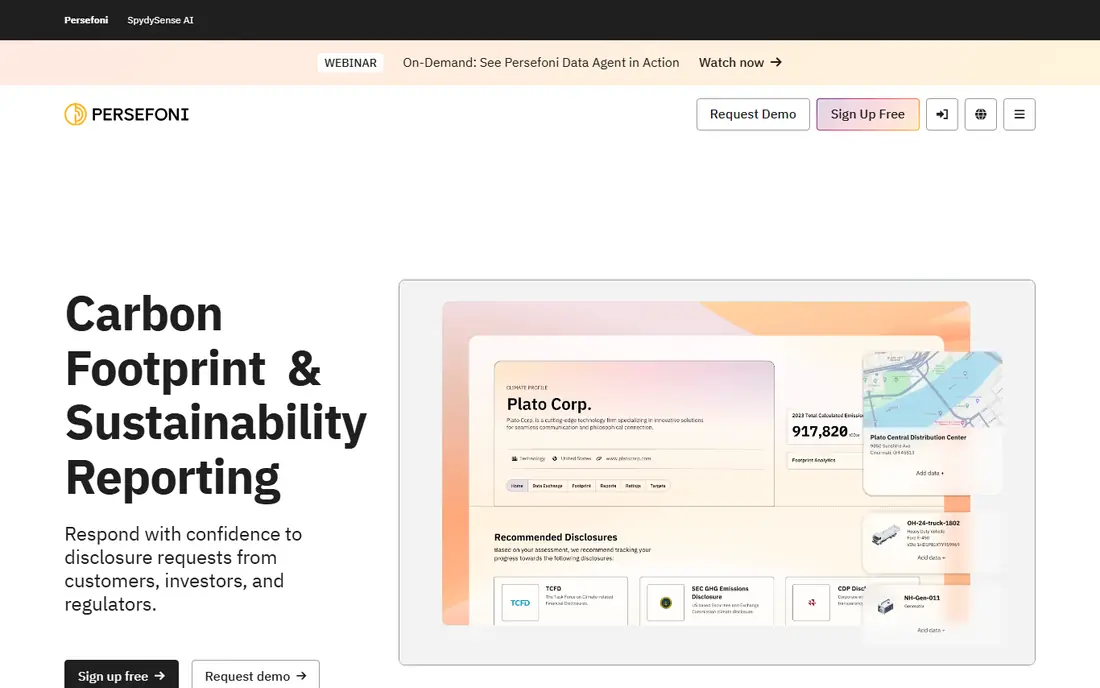
Persefoni is built around financial-grade carbon accounting, which means emissions data is treated with the same care as financial data: traceable, auditable, and tied to a ledger. That rigor matters for banks and investors, and for any company that expects its numbers to be assured. It covers Scope 1, 2, and 3, plus financed emissions for financial institutions, and it includes a report builder for CSRD, ISSB, and CDP.
The free Pro tier is what sets Persefoni apart. A smaller team can start measuring this week without a procurement cycle, then move to a quoted Advanced plan when complexity grows. If you want to leave spreadsheets behind and you need numbers an auditor can trust, start here.
- Free Pro tier for low to medium complexity
- Strong financed emissions
- Built like financial accounting for carbon
- Advanced plan is quote-based
- Aimed at larger organizations as needs grow
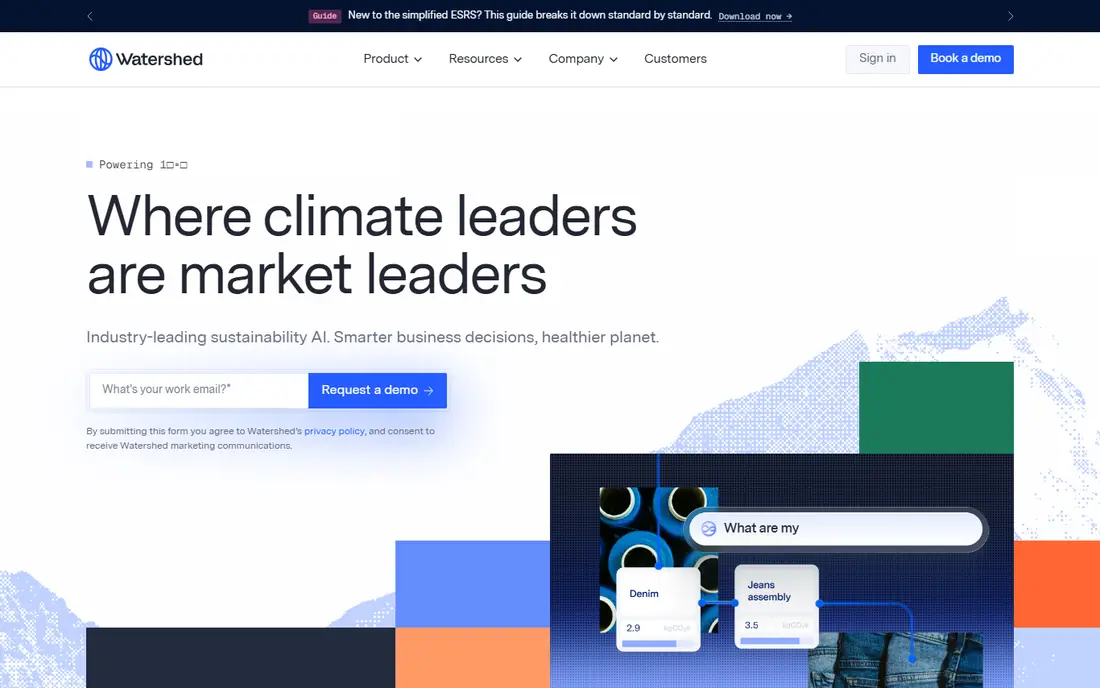
Watershed is the enterprise climate platform that covers measurement, reporting, and reduction in one place. Granular carbon measurement across all scopes feeds into automated ESG report drafting, and the platform connects to a marketplace of vetted carbon removal projects. Its 2026 positioning leans on AI agents for data cleaning and analysis, with human review and transparent calculations kept in the loop.
There is no public pricing and no free tier, so this is a sales-led enterprise buy, with third-party estimates often in the tens to hundreds of thousands of dollars per year. Smaller companies should look at Persefoni or Greenly instead. For a large enterprise that wants one platform from utility bills to board-ready disclosure, Watershed is the current benchmark.
- End-to-end measure, report, and act workflow
- Granular audit-grade data
- Vetted carbon removal marketplace
- No public pricing
- No free tier
- Enterprise-only positioning

Greenly is the most approachable serious option for small and mid-size companies, with plans listed from about $1,950 per user per year. It focuses on getting a company from scattered bills and spreadsheets to a credible footprint quickly, with CSRD support that suits European teams in particular. Its 2026 merger with Normative brings science-based target expertise into the combined platform.
The trade-off is depth. Greenly handles core Scope 3 well, but a company with a very complex supply chain may outgrow it and need Sweep or Watershed later. For a mid-market team that needs a defensible footprint this year, without an enterprise implementation, Greenly is our pick.
- Fast setup for mid-market teams
- Strong EU and CSRD support
- Merged with Normative in 2026
- Scope 3 depth is moderate compared with enterprise tools
- Pricing rises with users
Sweep is built for organizations where most of the footprint sits outside their own walls, in suppliers, products, and business units. Its supplier workflows help collect data where Scope 3 inventories usually stall, and its structure handles complex organizations with many entities. Analyst recognition in 2026, including leader placements, reflects that enterprise depth.
Pricing is quote-based after a demo, so budget conversations start with scoping, not a price list. Teams with a simple footprint will find Sweep more than they need. Teams whose suppliers hold the key data, and who need that data in auditable form, should shortlist it.
- Strong supplier data collection
- Handles many business units
- Recognized by analysts in 2026
- Quote-based pricing
- Needs a demo to scope cost
Plan A is a Berlin-based carbon accounting platform built around decarbonization, not just measurement. It is GHG Protocol compliant and certified, and it targets EU mid-market companies facing CSRD deadlines with reporting workflows designed for European rules. That focus shows in its framework mapping and reduction planning tools.
Pricing is quoted on request, with third-party estimates often in the tens of thousands per year and higher for larger deployments. US companies without EU disclosure duties may find a US-focused tool simpler. EU companies with a CSRD deadline should put Plan A on the shortlist beside Greenly.
- CSRD specialist for EU mid-market
- GHG Protocol compliant
- Decarbonization planning built in
- Quote-based pricing
- Less known outside Europe
IBM Envizi suits large, complex organizations that need to standardize ESG data across many entities, sites, and systems. It pulls utility, waste, and operational data into one analytics layer, supports global reporting frameworks, and fits naturally where IBM is already the enterprise standard. For a multinational with dozens of entities, that standardization is the main value.
Smaller teams will find Envizi heavy and expensive, with quote-based pricing and implementation work to match. It earns its place for enterprises that need scale and governance, not for a single-site company that just needs a footprint. If your IT team already runs IBM, Envizi deserves a demo.
- Strong multi-entity ESG data management
- Deep analytics
- Fits IBM-standard enterprises
- Quote-based pricing
- Heavy implementation for smaller teams
Sphera is a strong pick for industrial companies that already run environment, health, and safety programs on a platform and want emissions tied to the same operational data. That link matters when safety, compliance, and sustainability teams share sites, permits, and incidents, and when emissions data must connect to real plant operations rather than live in a separate spreadsheet.
The breadth is also the cost. Sphera covers a wide ESG and EHS range, so scoping and setup take longer than a focused carbon tool. Companies that only need a carbon footprint should start with Persefoni or Greenly. Companies that need EHS plus emissions in one system should demo Sphera.
- Links emissions to EHS and operational data
- Strong for industrial companies
- Broad ESG coverage
- Quote-based pricing
- Broad scope can mean longer setup
EcoVadis solves a different problem from the carbon tools above: it rates a company's, or its suppliers', sustainability performance for buyers and customers. Many large buyers ask suppliers for an EcoVadis rating, so holding a good rating can affect tender eligibility. Its network and methodology are widely recognized, which is why companies often run EcoVadis beside a carbon accounting tool.
Do not buy EcoVadis expecting it to measure your own Scope 1, 2, and 3 footprint in detail. It complements carbon software, it does not replace it. Use carbon tools for your footprint, and EcoVadis for supply chain credentials and buyer-facing ratings.
- Widely recognized supplier ratings
- Useful for buyer and customer credentials
- Large supplier network
- Rates suppliers, does not replace carbon accounting
- Pricing is quote-based
Sustain.Life aims at the mid-market gap: teams that need real ESG management, not just a carbon calculator, but that cannot justify an enterprise platform. It covers emissions, ESG data, and reporting in a package designed for smaller sustainability teams, with a free trial to test the workflow before committing.
Enterprise buyers with complex assurance needs will still prefer Persefoni or Watershed, and EU specialists may prefer Plan A or Greenly. For a US mid-market company that wants one accessible ESG tool and a trial before paying, Sustain.Life is a sensible shortlist addition.
- Accessible for mid-market teams
- Covers ESG beyond carbon
- Free trial to test fit
- Less enterprise depth than Watershed or Persefoni
- Pricing not published
How we picked these
We compared official feature pages, pricing pages, documentation, and public reviews, and we kept only tools that exist and work today and that truly fit sustainability software, meaning carbon accounting, ESG reporting, or supplier sustainability ratings. General business intelligence tools and generic survey tools did not make the cut. Where vendors do not publish prices, we wrote See website rather than repeating unconfirmed third-party estimates as fact.
We also separated carbon accounting from ESG reporting in the notes, because buyers who mix them up buy the wrong tool. A company that needs CSRD disclosure drafting, one that needs a Scope 3 inventory, and one that needs supplier ratings will end up with different shortlists, even though all three buy under the label of sustainability software.
What to check before you pay
List your frameworks and data owners first. Write down which disclosures you must produce, such as CSRD, ISSB, CDP, or California rules, which entities they cover, and who owns each data source, from utility bills to supplier spend. That list alone will narrow the field, since some tools are built for EU rules and others for US rules, and some handle financed emissions while others do not.
Next, test data collection, not just dashboards. Ask each vendor to walk through how supplier data, utility bills, and travel data enter the system, how emission factors are chosen, and how an auditor can trace a number back to its source. A beautiful dashboard built on shaky data will fail assurance. Finally, get a written quote scoped to your entities, users, modules, and implementation, and ask what happens to your data if you leave.
FAQ
What is the best sustainability software for small businesses?
Persefoni is the best start for small teams, thanks to its free Pro tier, and Greenly is the best paid mid-market pick, especially in Europe. Both let a small team move from spreadsheets to a credible footprint without an enterprise implementation. Get a quote for Greenly before budgeting, since pricing rises with users.
What are the best sustainability apps for carbon accounting?
Persefoni, Watershed, Greenly, Sweep, and Plan A are the strongest carbon accounting tools in this list. Persefoni suits teams that want to start free, Watershed suits large enterprises, Greenly suits mid-market teams, Sweep suits supplier-heavy programs, and Plan A suits EU CSRD reporters. Match the tool to your footprint shape, not just your size.
How much does sustainability software cost?
Enterprise platforms are typically quote-based and often cost tens to hundreds of thousands of dollars per year, depending on entities, users, and modules. Mid-market tools are far cheaper, with Greenly listed from about $1,950 per user per year and Persefoni offering a free tier. Always get a written quote before budgeting.
What is the difference between carbon accounting and ESG reporting software?
Carbon accounting measures greenhouse gas emissions across Scopes 1, 2, and 3. ESG reporting covers the full environmental, social, and governance spectrum and maps data to disclosure frameworks. Many companies need both, and some platforms cover both, but the buying criteria differ, so check each job separately.
Do I need EcoVadis if I have carbon accounting software?
Often, yes, because they solve different problems. Carbon software measures your own emissions, while EcoVadis rates your suppliers, or your company, for buyers and customers. Companies often use both: a carbon tool for the footprint, and EcoVadis for supply chain credentials.