Best Stargazing Apps in 2026: 8 Apps Compared
Compare the best stargazing apps in 2026, from Stellarium and Sky Tonight to Star Walk 2, SkySafari, and Night Sky, with free plans and observing features.
- Editor's choice
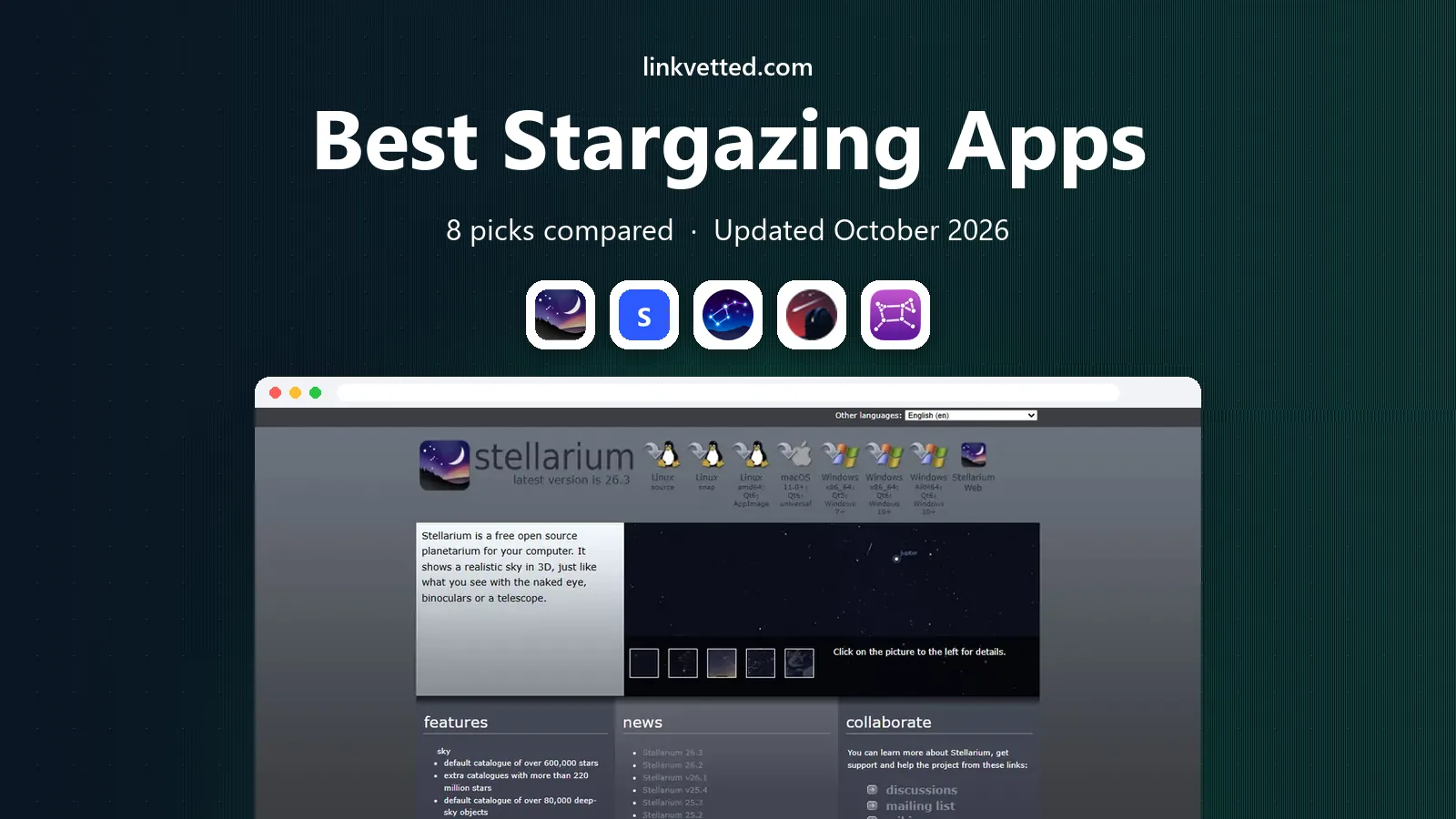
 Stellarium
All round planetarium
Starts atFreeVisit stellarium.orgFull review - Great alternative
 Sky Tonight
Planning what is visible tonight
Starts atFreeVisit skytonight.orgFull review - Also consider
 Star Walk 2
Beginners and AR sky views
Starts atSee websiteVisit starwalk.spaceFull review
TL;DR:
- Stellarium is the best all round free planetarium, with a huge star catalogue and sky cultures from many traditions.
- Sky Tonight is best for planning a night out, thanks to its visible tonight lists, calendar, and stargazing forecast.
- Star Walk 2 and Night Sky suit beginners who want a beautiful point and identify view with augmented reality.
- SkySafari and SkyPortal suit telescope owners, with deeper catalogues and telescope control options.
Quick comparison
| Tool | Best for | Starts at | Free plan? | |
|---|---|---|---|---|
| Stellarium | All round planetarium | Free | Yes | Visit |
| Sky Tonight | Planning what is visible tonight | Free | Yes | Visit |
| Star Walk 2 | Beginners and AR sky views | See website | Yes | Visit |
 SkySafari | Telescope owners and deep catalogues | See website | No | Visit |
 Night Sky | Beautiful AR identification | See website | Yes | Visit |
 SkyPortal | Celestron telescope users | Free | Yes | Visit |
 Heavens-Above | Satellites and ISS passes | Free | Yes | Visit |
 Solar System Scope | Solar system exploration | See website | Yes | Visit |
The best stargazing apps
A good stargazing app should identify what you see, help you plan a clear night, and work well in the dark. These eight cover planetariums, augmented reality views, telescope control, and satellite tracking, with free options for beginners.
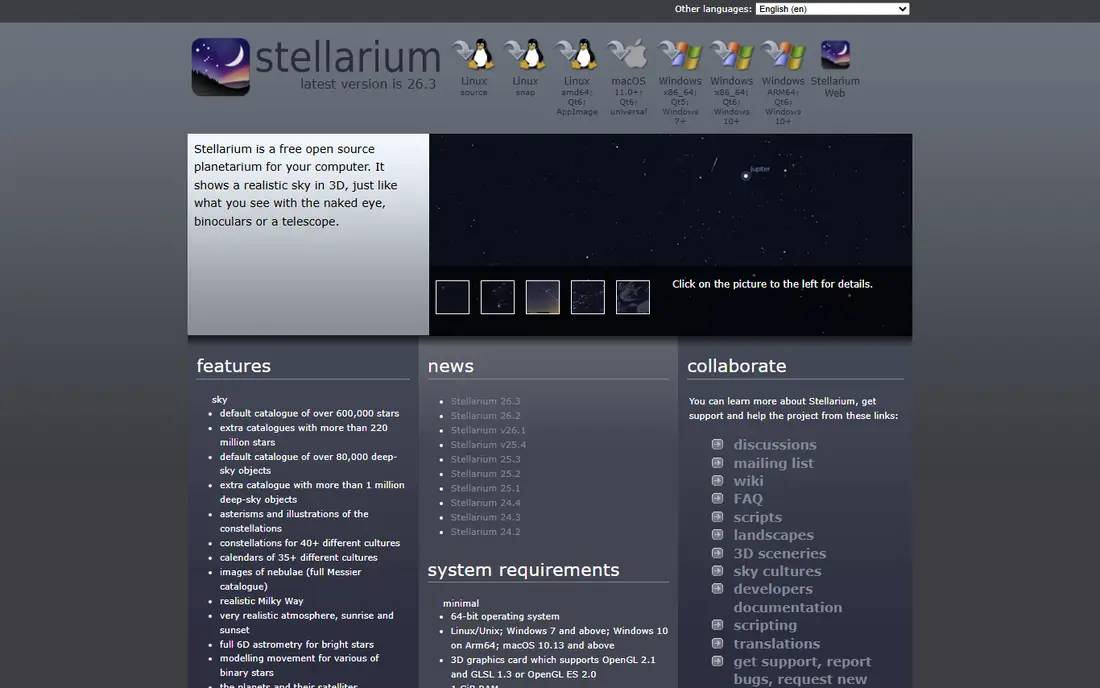
Stellarium is our pick for most stargazers because it is a real planetarium, not just a label overlay. The desktop version shows a realistic sky with stars, planets, nebulae, and constellations, plus time controls that let you see the sky at any date. Extra catalogues expand the star count far beyond the default, and sky cultures let you see constellations as described in many traditions, from Western figures to Inuit, Navajo, and other systems.
Mobile Stellarium is also useful in the field, with a point and identify view and a red night mode that protects dark adaptation. Beginners may find the desktop menus detailed at first, but the core task, searching for an object and seeing where to look, is straightforward. For learning the sky deeply, Stellarium is the strongest free start.
- Free and open source
- Default catalogue of over 600,000 stars
- Constellations for many cultures
- Telescope control
- Desktop version is deeper than mobile
- Interface can feel detailed for first time users

Sky Tonight is built for real observing nights. Point your phone at the sky to identify stars, planets, satellites, and deep sky objects, or open the visible tonight view to see what is worth looking for from your location. The astronomy calendar tracks moon phases, meteor showers, and events, while the time machine lets you plan a future night in advance.
All space objects, constellations, planets, and sky events are available without Premium, according to the app listing, while Premium mainly removes interface limits, opens full lists, and removes ads. That makes the free version genuinely useful for planning. One handed navigation and night mode also help when you are outside in the dark, with a telescope or binoculars in hand.
- Free to download and use
- Visible tonight lists
- Astronomy calendar and time machine
- Works offline
- Premium removes interface limits and ads
- Some lists need Premium for full access

Star Walk 2 is a favourite for beginners because it makes the sky feel approachable. Point your device up, and labels appear over stars, planets, and constellations, with images and short descriptions that explain what you are seeing. It is a good app for families, school nights, and anyone who wants to answer the question, what is that bright star, without learning star charts first.
Serious observers may want more catalogue depth and planning tools, which is where Stellarium and SkySafari take over. Star Walk 2 free version covers identification well, with paid upgrades for extra content. For a first stargazing app, especially for children and new hobbyists, it is an excellent, friendly choice.
- Beautiful augmented reality sky view
- Easy identification for beginners
- Rich object descriptions and images
- Some content needs a paid upgrade
- Less deep for telescope planning than SkySafari
SkySafari is the app many telescope owners keep on their phone. It offers large catalogues of stars and deep sky objects, detailed information for planning, and telescope control for compatible mounts. Observing lists help you plan a session around objects that are visible, well placed, and suited to your telescope size.
It is a paid app, so beginners who only want to identify a few stars should start with Stellarium or Sky Tonight. For observers who own a telescope, attend star parties, or keep a log of objects seen, SkySafari depth justifies the cost. Check the current tier, since basic and pro versions differ in catalogue size and features.
- Deep star and deep sky catalogues
- Telescope control
- Detailed object data and observing lists
- Paid app, with tier prices to check
- Interface is more detailed than beginner apps
Night Sky is another strong augmented reality option, with a clean, visual approach to identifying the sky. Point your phone up, and it labels stars, planets, and constellations in a way that feels intuitive, even for users who have never used a star chart. It is well suited to casual nights in the backyard, camping trips, and teaching children the main constellations.
Like Star Walk 2, it is not the deepest planning tool for telescope owners. Paid features add more content, but the free view covers basic identification. If you value a beautiful, simple AR experience over catalogue depth, Night Sky is a good pick, especially on Apple devices where it has a long history.
- Polished augmented reality view
- Easy constellation identification
- Useful for families and casual stargazing
- Some features need a subscription
- Less suited to deep telescope planning
SkyPortal, from Celestron, is the natural companion for Celestron telescope owners. It can control compatible telescopes, help you find objects, and provide information for planning a session. Even without a telescope, it works as a sky map and object guide, with a database that covers many stars, planets, and deep sky objects.
Users without Celestron equipment may prefer Stellarium for depth or Sky Tonight for planning, since SkyPortal strengths are tied to telescope control. For Celestron owners, though, using the maker own app often means smoother setup and fewer connection problems. It is free, so it is worth installing alongside a general planetarium app.
- Free app from Celestron
- Telescope control for compatible mounts
- Good object database for observing
- Best value with Celestron equipment
- Interface is more functional than beautiful
Heavens-Above is a specialist that every stargazer should know. It predicts passes of the International Space Station, bright satellites, and other objects, with charts showing when and where to look from your location. That makes it ideal for planning a satellite spotting session, photographing a pass, or answering why a bright dot is moving steadily across the sky.
It is not a replacement for Stellarium or Sky Tonight as a general sky guide, since its interface is more functional and focused on passes. Use it alongside a planetarium app: one for stars and constellations, and Heavens-Above for satellites. It is free, and its predictions are a favourite among satellite watchers.
- Free satellite and ISS pass predictions
- Clear pass charts
- Useful for planning satellite spotting
- Less polished as a general planetarium
- Best as a companion app, not a sole sky guide
Solar System Scope takes a different angle from the other apps on this list. Instead of only showing the sky above you, it models the solar system, so you can see planet positions, orbits, and relative sizes, and understand why Mars is bright this month or why Venus appears in the evening. That context helps beginners make sense of what they see outside.
It is less useful as a point and identify tool in the dark, so pair it with Stellarium or Star Walk 2 for observing. For schools, families, and learners who want to understand the solar system as a whole, Solar System Scope is a clear, visual, and engaging free starting point, with paid upgrades for extra features.
- Interactive solar system model
- Good for learning planet positions and orbits
- Works on web and mobile
- Less focused on night sky identification
- Some features need a paid upgrade
How we picked these
We compared official product pages, app listings, and feature details for stargazing apps widely available in October 2026. We looked for sky accuracy, catalogue depth, ease of use in the dark, planning tools, telescope support, and whether a free version is genuinely useful. We also included different styles, from full planetariums to AR identifiers and satellite trackers, because no single app covers every observing need best.
How to choose a stargazing app
Start with one planetarium and one planning app. Stellarium covers learning and depth, while Sky Tonight covers what is visible tonight and when to go out. Add Star Walk 2 or Night Sky if you want a simple AR view for family nights, and add Heavens-Above if satellites interest you. Telescope owners should add SkySafari or SkyPortal, depending on their mount.
Practical tips matter as much as the app. Use red night mode, lower screen brightness, and let your eyes adapt for at least 15 minutes in a dark place. Check the weather, moon phase, and light pollution for your location, and dress warmly for a longer session. A free app, a dark sky, and patience will show you more than an expensive app used in a bright backyard for five minutes.
FAQ
What is the best free stargazing app?
Stellarium is the best free all round stargazing app, with a large catalogue, sky cultures, and desktop and mobile versions. Sky Tonight is also free and excellent for planning what is visible on a given night.
What is the best astronomy app for beginners?
Star Walk 2 and Night Sky are best for beginners, thanks to simple augmented reality views that label stars and constellations when you point your phone at the sky. Stellarium is a good next step when you want deeper catalogues and planning tools.
What is the best stargazing app for telescope owners?
SkySafari is a strong choice for telescope owners, with deep catalogues and telescope control, while SkyPortal suits Celestron telescope users. Stellarium also offers telescope control and is free, so many observers use it alongside a paid app.
Can stargazing apps work offline?
Yes, many apps, including Stellarium and Sky Tonight, work offline for core sky maps once data is downloaded. Check offline settings before heading to a dark site with poor signal, and download any extra catalogues in advance.
Why does my stargazing app show stars in the wrong place?
Check location permissions, compass calibration, and time settings. Move away from metal objects and magnets, calibrate the compass by moving your phone in a figure eight motion, and confirm the app is set to your current location and time.
What is the best free star app for children?
Star Walk 2 and Solar System Scope are good for children, thanks to visual guides, simple labels, and solar system models. Supervise younger children outside at night, and use red night mode to protect dark adaptation.