Best Star Gazing Apps in 2026: 8 Apps Compared
Best star gazing apps for 2026, from AR sky maps to planetarium tools, with clear night modes, satellite alerts, and pricing for beginners and observers.
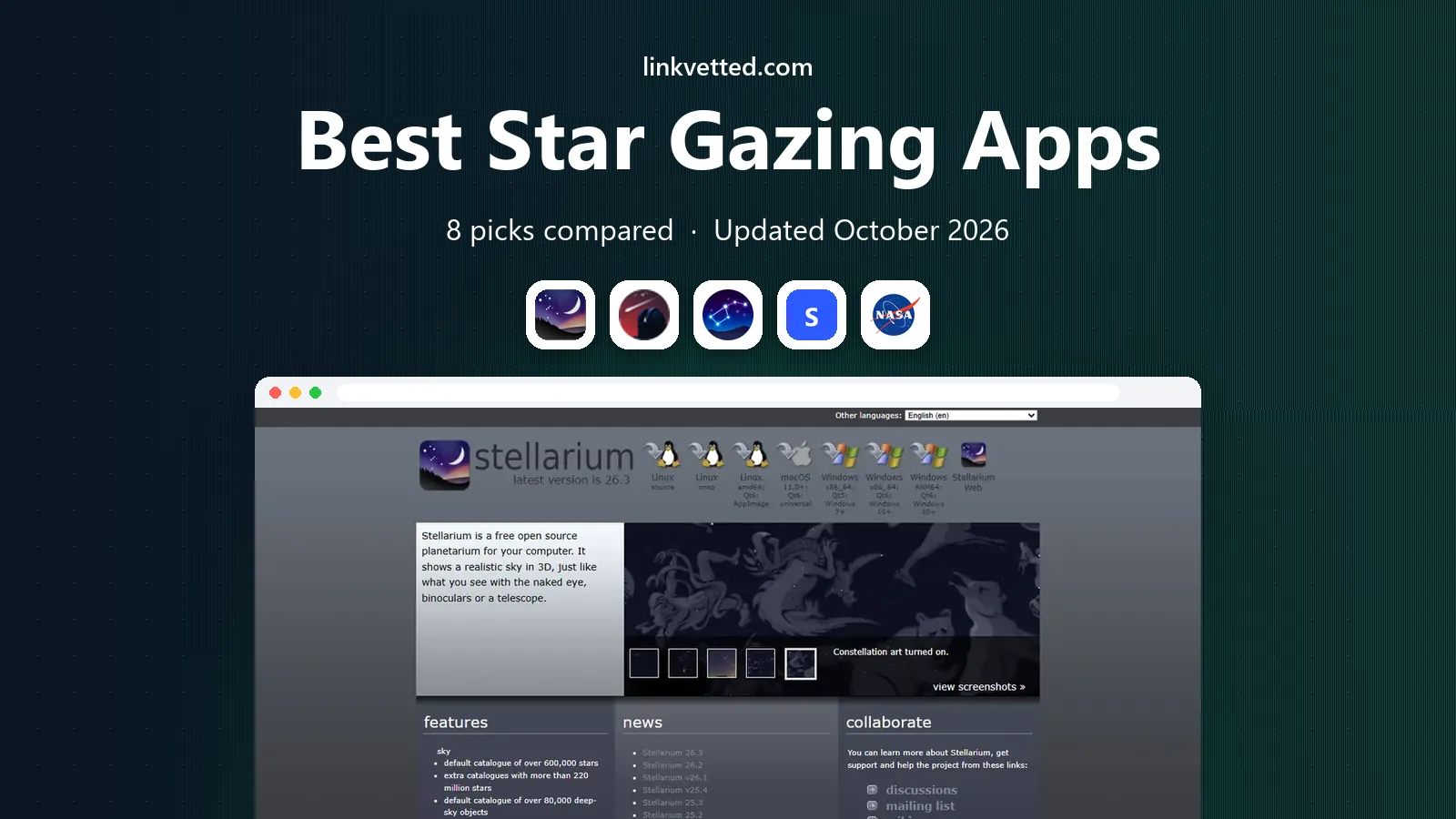
- Editor's choice
 Stellarium Mobile
Beginners and learners who want an accurate sky map
Starts at$0Visit stellarium.orgFull review - Great alternative
 SkySafari
Serious observers and telescope owners
Starts at$0Visit skysafariastronomy.comFull review - Also consider
 Star Walk 2
Casual viewers and families who want visual AR
Starts at$0Visit starwalk.spaceFull review
TL;DR:
- We compared 8 options for best star gazing app, covering different budgets, use cases, and experience levels.
- Stellarium Mobile suits beginners and learners who want an accurate sky map, while SkySafari suits serious observers and telescope owners.
- Prices and free plans change by region and plan, so confirm the current price on the official website before you buy.
- The best choice depends on your workflow, not only on the lowest price or the longest feature list.
- Check contract terms, free limits, and total cost, including add-ons, before you commit to a paid plan.
Quick comparison
| Tool | Best for | Starts at | Free plan? | |
|---|---|---|---|---|
| Stellarium Mobile | Beginners and learners who want an accurate sky map | $0 | Yes | Visit |
| SkySafari | Serious observers and telescope owners | $0 | Yes | Visit |
| Star Walk 2 | Casual viewers and families who want visual AR | $0 | Yes | Visit |
 Sky Tonight | People who want to know what is visible tonight | $0 | Yes | Visit |
 NASA App | Space fans who want images, missions, and ISS sightings | $0 | Yes | Visit |
 Sky Map | Android users who want a simple free identifier | $0 | Yes | Visit |
 ISS Detector | Satellite spotters who want pass alerts | $0 | Yes | Visit |
 Heavens-Above | Observers who want detailed satellite and pass data | $0 | Yes | Visit |
The best star gazing apps
We looked for products that exist now, fit best star gazing app clearly, and offer a fair balance of features, price, and honest limits. The list below starts with broad, widely useful picks and then moves to specialist options.
Stellarium Mobile
Best for: Beginners and learners who want an accurate sky map

For many travelers, Stellarium Mobile stands out for beginners and learners who want an accurate sky map. Stellarium Mobile shows an accurate simulation of the sky, with time controls that let you preview tonight or a future date. For a buyer in this group, the fit is clear, since the core features match the daily need without forcing a larger or more complex system. Price also matters here, with a starting price of $0 and a free plan listed as yes, so check the official site for the current terms in your region.
Its strength is accuracy, since the simulation matches real sky positions for planning and learning. That practical value matters more than a demo feature.
The weakness is paid extras, since Plus features on mobile stores add cost beyond the free base app. If that weakness affects your main use case, compare the next pick on this list before you commit. A short trial, a demo, or a careful read of the pricing page will usually reveal whether the trade-off is acceptable for your budget and workflow.
- Accurate planetarium simulation, time controls, night mode
- Plus features cost extra on mobile stores
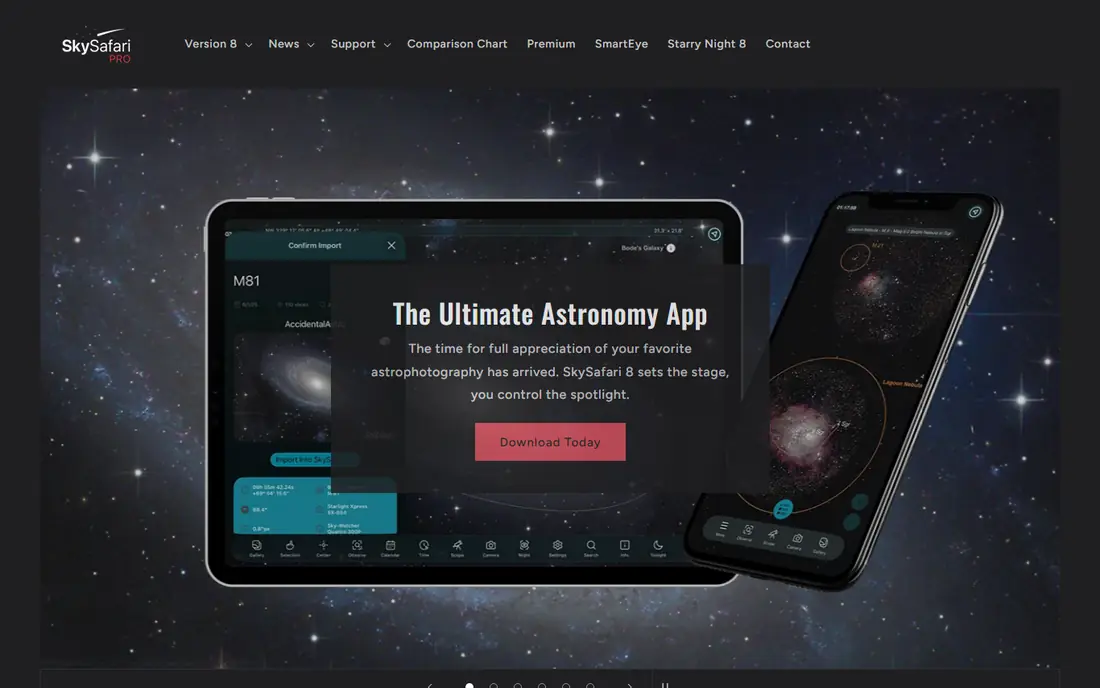
If your priority is SkySafari stands out for serious observers and telescope owners. SkySafari offers a large object catalog, observation planning, and telescope control on paid tiers. For a buyer in this group, the fit is clear, since the core features match the daily need without forcing a larger or more complex system. Price also matters here, with a starting price of $0 and a free plan listed as yes, so check the official site for the current terms in your region.
Its strength is depth, since faint objects, catalogs, and planning tools suit observers who go beyond bright stars. That practical value matters more than a demo feature.
The weakness is density, since the interface can feel dense for a first-time stargazer. If that weakness affects your main use case, compare the next pick on this list before you commit. A short trial, a demo, or a careful read of the pricing page will usually reveal whether the trade-off is acceptable for your budget and workflow.
- Large object catalog, telescope control on paid tiers, planning tools
- Pro features cost extra and the app can feel dense

A clear place to start is Star Walk 2 stands out for casual viewers and families who want visual ar. Star Walk 2 uses AR to label stars and constellations as you point your phone at the sky, with rich constellation art. For a buyer in this group, the fit is clear, since the core features match the daily need without forcing a larger or more complex system. Price also matters here, with a starting price of $0 and a free plan listed as yes, so check the official site for the current terms in your region.
Its strength is visual appeal, since the AR view makes a first night out feel clear and engaging. That practical value matters more than a demo feature.
The weakness is ads, since the free version includes ads and the full version costs extra. If that weakness affects your main use case, compare the next pick on this list before you commit. A short trial, a demo, or a careful read of the pricing page will usually reveal whether the trade-off is acceptable for your budget and workflow.
- Visual AR sky view, constellation art, night mode
- Free version includes ads, full version costs extra
When you compare the options, Sky Tonight stands out for people who want to know what is visible tonight. Sky Tonight lists what is visible tonight, with an AR view and an event calendar for planets, Moon phases, and meteor showers. For a buyer in this group, the fit is clear, since the core features match the daily need without forcing a larger or more complex system. Price also matters here, with a starting price of $0 and a free plan listed as yes, so check the official site for the current terms in your region.
Its strength is tonight planning, since the visible-tonight list answers the most common question fast. That practical value matters more than a demo feature.
The weakness is paid extras, since some advanced features need a paid upgrade. If that weakness affects your main use case, compare the next pick on this list before you commit. A short trial, a demo, or a careful read of the pricing page will usually reveal whether the trade-off is acceptable for your budget and workflow.
- Tonight visibility lists, AR view, event calendar
- Some advanced features need a paid upgrade
One name comes up often because NASA App stands out for space fans who want images, missions, and iss sightings. The NASA App offers images, mission coverage, live events, and ISS sighting information for space fans. For a buyer in this group, the fit is clear, since the core features match the daily need without forcing a larger or more complex system. Price also matters here, with a starting price of $0 and a free plan listed as yes, so check the official site for the current terms in your region.
Its strength is context, since mission stories and images add meaning to what you see in the sky. That practical value matters more than a demo feature.
The weakness is identification scope, since it is not a full AR star identifier on its own. If that weakness affects your main use case, compare the next pick on this list before you commit. A short trial, a demo, or a careful read of the pricing page will usually reveal whether the trade-off is acceptable for your budget and workflow.
- NASA images, live coverage, ISS sighting info
- Not a full AR star identifier on its own
For a first look, Sky Map stands out for android users who want a simple free identifier. Sky Map is a simple Android AR app that labels stars and planets when you point your phone at the sky. For a buyer in this group, the fit is clear, since the core features match the daily need without forcing a larger or more complex system. Price also matters here, with a starting price of $0 and a free plan listed as yes, so check the official site for the current terms in your region.
Its strength is simplicity, since it opens fast, has no ads, and does one job well. That practical value matters more than a demo feature.
The weakness is platform scope, since it is Android only and offers fewer extras than larger apps. If that weakness affects your main use case, compare the next pick on this list before you commit. A short trial, a demo, or a careful read of the pricing page will usually reveal whether the trade-off is acceptable for your budget and workflow.
- Simple AR identification, no ads, open source roots
- Android only, basic design and fewer extras
If you want a calmer choice, ISS Detector stands out for satellite spotters who want pass alerts. ISS Detector alerts you to ISS and satellite passes, with compass and radar views to help you find them. For a buyer in this group, the fit is clear, since the core features match the daily need without forcing a larger or more complex system. Price also matters here, with a starting price of $0 and a free plan listed as yes, so check the official site for the current terms in your region.
Its strength is pass timing, since alerts tell you when and where to look before a pass starts. That practical value matters more than a demo feature.
The weakness is scope, since it focuses on satellites rather than full star and constellation identification. If that weakness affects your main use case, compare the next pick on this list before you commit. A short trial, a demo, or a careful read of the pricing page will usually reveal whether the trade-off is acceptable for your budget and workflow.
- ISS and satellite pass alerts, compass and radar views
- Pro features cost extra, satellite focus only
A practical pick is Heavens-Above stands out for observers who want detailed satellite and pass data. Heavens-Above gives detailed satellite pass predictions and tracking data, with free web and app access. For a buyer in this group, the fit is clear, since the core features match the daily need without forcing a larger or more complex system. Price also matters here, with a starting price of $0 and a free plan listed as yes, so check the official site for the current terms in your region.
Its strength is data depth, since pass times, brightness, and paths are shown in detail. That practical value matters more than a demo feature.
The weakness is design, since the technical interface feels less friendly for casual stargazers. If that weakness affects your main use case, compare the next pick on this list before you commit. A short trial, a demo, or a careful read of the pricing page will usually reveal whether the trade-off is acceptable for your budget and workflow.
- Detailed pass predictions, satellite data, free web and app access
- Interface feels technical for casual users
How we picked these
We searched the web for current products that fit best star gazing app and checked that each one is available now with an official website. We favored products with clear pricing or a clear quote process, a defined audience, and features that match the topic. We left out products that no longer work, that fit only loosely, or that lacked enough public detail to describe fairly. We did not claim hands-on testing, and prices shown here should be confirmed on the vendor site before purchase.
Buying guide
Start with one sky map, then add a specialist
A general sky map covers most nights. Add ISS Detector for satellites or a weather tool for cloud checks only when that need becomes regular.
Protect your night vision
Use night mode, lower screen brightness, and give your eyes time to adapt. A bright phone screen can undo 20 minutes of dark adaptation in seconds.
A simple shortlist method
List your top three needs, then score each product on those needs alone. Drop any product that fails a must-have need, even if it looks strong elsewhere. Then compare total cost and contract terms for the two finalists before you decide.
FAQ
What is the best free star gazing app?
Stellarium Mobile and Sky Tonight are strong free starts, with accurate maps and tonight lists. Sky Map is a simple free option for Android users who want fast identification.
Do star gazing apps need internet?
Most AR and planetarium apps work offline for basic sky maps once data is loaded, but satellite alerts and weather data need a connection. Download maps before a remote dark-sky trip.
Why do stars look different in the app and the sky?
Light pollution, Moon phase, and screen brightness change what you see. A dark site, a Moon-free night, and night mode will bring the app view closer to the real sky.
Can these apps control a telescope?
SkySafari paid tiers support telescope control for compatible mounts, while most free AR apps do not. Check mount compatibility before buying a Pro tier for this purpose.
What is the best app for kids?
Star Walk 2 suits kids with visual AR and constellation art, while Stellarium suits older children who want to learn sky motion. Keep sessions short and pair the app with naked-eye spotting.
Sources
https://www.stellarium.org https://www.skysafariastronomy.com https://www.starwalk.space https://www.vito.com https://www.nasa.gov https://www.sky-map.org https://www.issdetector.com https://www.heavens-above.com