6 Software for Large Datasets Worth Shortlisting in 2026
Best software for large datasets in 2026: 6 contenders with entry costs and free tiers. Short, factual notes on every option. Quick comparison inside.
- Editor's choice
 Databricks
Unified data, analytics and AI work
Starts atSee websiteVisit databricks.comFull review - Great alternative
 Amazon Redshift
AWS-native managed cloud data warehousing
Starts atSee websiteVisit aws.amazon.comFull review - Also consider
 Google BigQuery
Managed warehouse with automatic data and AI
Starts atSee websiteVisit cloud.google.comFull review
Direct answer
If you need unified data, analytics and AI work, Databricks is the first tool to look at here. Listed starting prices: ClickHouse from $0.056 per unit per hour. Amazon Redshift is better for AWS-native managed cloud data warehousing, and Google BigQuery is better for managed warehouse with automatic data and AI. The remaining 3 options are covered below with prices and limits.
TL;DR:
- Databricks takes the first slot, best suited to unified data, analytics and AI work.
- None of the 6 tools, from Databricks to ClickHouse, has a free plan, so budget for a subscription or use a trial.
- ClickHouse fits live analytics on high-volume data.
- Pricing for Databricks, Amazon Redshift, Google BigQuery and others is quote-based, which adds a sales step before you can compare cost.
- A fair warning about Microsoft Azure Synapse Analytics: component complexity needs planning.
Last checked November 2026. Prices and plan details were read from the vendors' own pages in November 2026; vendors change plans often, so confirm the current price on the vendor site before you buy.
Quick comparison
| Tool | Best for | Starts at | Free plan? | |
|---|---|---|---|---|
| Databricks | Unified data, analytics and AI work | See website | Not stated | Visit |
| Amazon Redshift | AWS-native managed cloud data warehousing | See website | Not stated | Visit |
| Google BigQuery | Managed warehouse with automatic data and AI | See website | Not stated | Visit |
| Microsoft Azure Synapse Analytics | Enterprise SQL and big data together | See website | Not stated | Visit |
| Teradata Vantage | Enterprise-scale autonomous data system | See website | Not stated | Visit |
| ClickHouse | Live analytics on high-volume data | $0.056 per unit per hour | Free trial | Visit |
The 6 tools in detail
Choosing software for large datasets usually comes down to price, fit and limits. This LinkVetted guide sets 6 tools side by side on those three points, with the facts kept short and checkable.
Choose Databricks for unified data, analytics and AI work. The breadth of the product means more configuration and skills are needed than with a single-purpose warehouse.
Also, organizations with straightforward SQL reporting needs may find it heavier than necessary. Pricing for Databricks is not stated here, so ask the vendor for current figures. Free options: Not stated.
Where it falls short: Overlaps with narrower warehouse tools.
- Unified product for data
- Warehousing and governance
- Wide scope needs setup and expertise
Think of Amazon Redshift for AWS-native managed cloud data warehousing. Amazon Redshift is a quick, completely managed cloud data warehouse that makes it straightforward and economical to analyze all your data.
From a buyer's view, teams standardized on other clouds may find integration less natural. Also, performance on very large datasets relies on schema and workload design, so continuing tuning is part of the job. No starting price is listed for Amazon Redshift here; confirm pricing on the vendor site. Free access: Not stated.
What to check first: Best value inside the AWS ecosystem.
- Economical analysis of all data
- Straightforward
- Tuning matters for large workloads
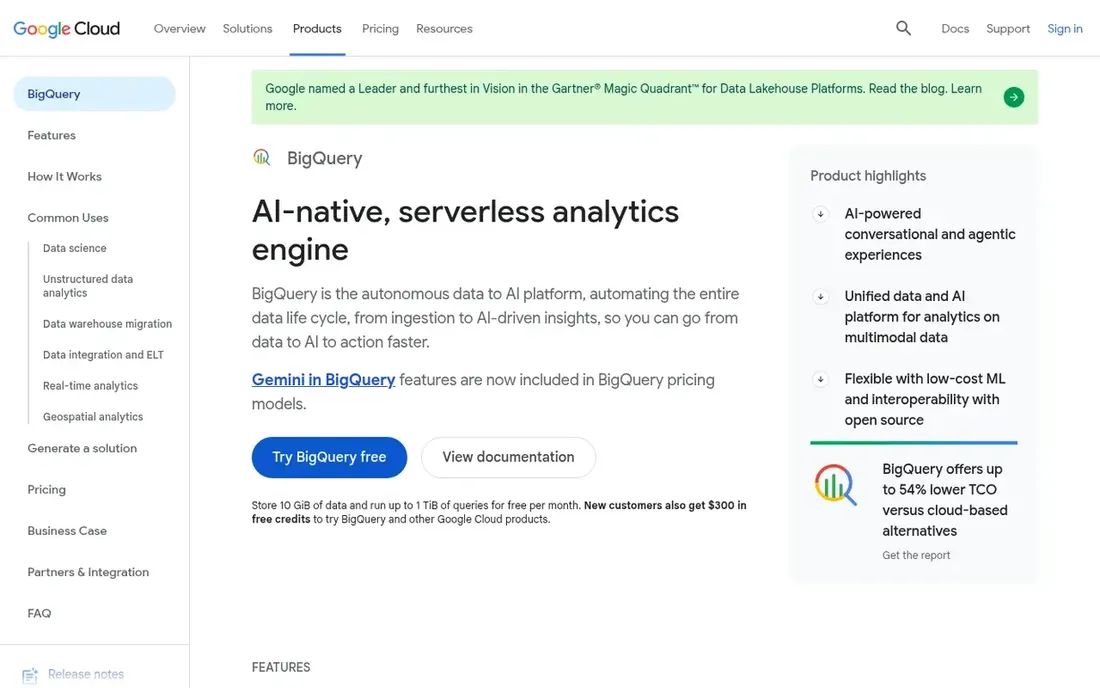
Google BigQuery targets managed warehouse with automatic data and AI. Teams outside Google Cloud or needing tight on-premises control may prefer another choice.
On top of that, query costs also rely on how workloads are structured, so heavy ad hoc use needs governance. In practice, since it is a managed service, fine-grained control over infrastructure is restricted compared to self-managed choices. Check the vendor site for Google BigQuery pricing; none is listed in this comparison. As for free access: Not stated.
Limits to weigh: Costs can be hard to predict at scale.
- Automates the data lifecycle toward AI
- Completely managed cloud data warehouse
- Deepest fit is within Google Cloud
Microsoft Azure Synapse Analytics
Best for: Enterprise SQL and big data together
Microsoft Azure Synapse Analytics makes the most sense for enterprise SQL and big data together. It fits enterprises on Microsoft Azure that want one environment spanning structured reporting and large-scale analytics.
Beyond that, combining multiple services in one workspace brings design and governance overhead, so teams need clear ownership. Microsoft Azure Synapse Analytics does not show a starting price in this comparison, so check the vendor site for current pricing. Free options: Not stated.
Trade-offs to know: Most natural inside Azure.
- Merges SQL warehousing and big data analytics
- Geared toward accelerating time to insight
- Component complexity needs planning
Teradata Vantage
Best for: Enterprise-scale autonomous data system
Teradata Vantage is aimed squarely at enterprise-scale autonomous data system. Teradata Vantage is presented as an AI product for the autonomous era, connecting and scaling across any environment.
Also, the product is oriented toward enterprise deployments, which can feel heavy for smaller teams or focused projects. In daily use, organizations wanting light managed warehousing may find other choices quicker to adopt. Teradata Vantage does not show a starting price in this comparison, so check the vendor site for current pricing. Free options: Not stated.
Points against: Enterprise-oriented engagement model.
- Links and scales across environments
- Long-standing enterprise data system
- Heavier than needed for small teams
ClickHouse
Best for: Live analytics on high-volume data
Choose ClickHouse for live analytics on high-volume data. Running ClickHouse well calls for operational expertise in sizing and tuning.
What to check first: Needs operational knowledge.
It is optimized for analytical workloads instead of as a general transactional database. Entry price for ClickHouse: $0.056 per unit per hour. Trial and free access: Free trial.
Highlights: Aimed at data-intensive workloads.
- Includes analytics
- Open
- Not a general-purpose transactional store
How we chose
We compared the tools on published pricing, free plan or trial availability, feature coverage for software for large datasets, and the limits each vendor documents. Where a price is missing, the vendor does not list one publicly or ties it to a quote. Always confirm before budgeting. Position on the page reflects fit for a typical buyer first, with price clarity and free access breaking ties. Treat it as a guide, not a ruling.
Things to verify first
- Ask Databricks, Amazon Redshift, Google BigQuery and others for a written quote, since no starting price is shown.
- Use real work to test the free trial from ClickHouse, rather than a demo project.
- Before choosing Databricks, weigh its main limit: broad scope needs setup and expertise.
- Ask whether Microsoft Azure Synapse Analytics integrates with your current software, and whether that comes standard or as an add-on.
- Before you load data into Amazon Redshift, check what an export looks like and who can run it.
FAQ
Is Databricks the right pick for everyone comparing software for large datasets?
No single tool suits every team. Databricks comes first because it fits unified data, analytics and AI work, while Amazon Redshift suits AWS-native managed cloud data warehousing and Google BigQuery suits managed warehouse with automated data and AI. Match the tool to your own size, budget and workflow before deciding.
Can I try these tools before paying?
Often, yes. ClickHouse offers a free trial. Use your own data and a real task during the test, and check what the free tier or trial limits before you rely on it. Prices, free plan details and limits for all 6 tools in this software for large datasets roundup sit on the individual cards above.
How should enterprises evaluate Teradata Vantage or Azure Synapse?
Teradata Vantage is positioned for enterprise-scale, autonomous data products spanning environments, and Azure Synapse merges SQL warehousing with big data analytics for Azure-centric estates. Both favor organizations with established data teams. Validate fit, integrations and governance requirements straight with each vendor.
How are the tools for software for large datasets ordered?
Databricks sits first and ClickHouse last because the order follows typical fit for software for large datasets, then price clarity and free access. It is a judgement call, so read each profile for fit and limits.
Does any tool for software for large datasets here have a free plan?
No tool in this list, Databricks and ClickHouse included, has a permanent free plan. ClickHouse offer a trial. Trials and quotes are the usual route, so plan a short evaluation period. Each of the 6 options in this software for large datasets guide has its own card above with the price, free plan and limits.
Sources
- https://www.databricks.com
- https://aws.amazon.com/redshift
- https://cloud.google.com/bigquery
- https://azure.microsoft.com/en-us/products/synapse-analytics
- https://www.teradata.com
- https://clickhouse.com