The 6 Best Skyscraper Content Tools in 2026, Ranked
A practical look at the best skyscraper content tools for research, writing, and outreach, based on vendor documentation and public sources.
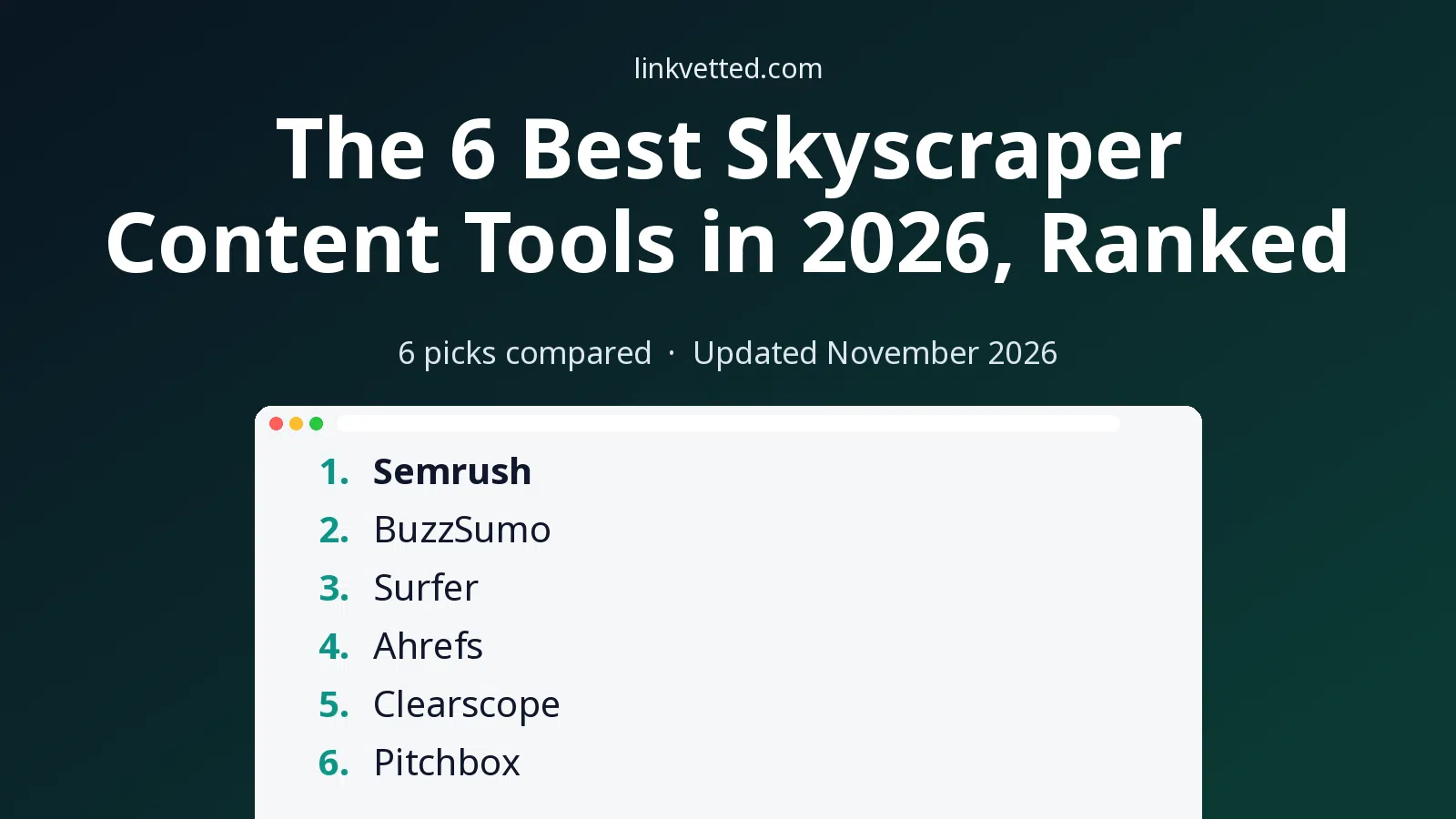
- Editor's choice
 Semrush
Research plus competitor and backlink data
Starts atSee websiteVisit semrush.comFull review - Great alternative
 BuzzSumo
Finding topics that already earn shares
Starts atSee websiteVisit buzzsumo.comFull review - Also consider
 Surfer
Outlining and on-page content optimization
Starts atSee websiteVisit surfer.aiFull review
Direct answer
For most small agencies and in-house teams, Semrush is my first pick for skyscraper content work because its content and keyword research sit next to competitor and backlink data in one place. BuzzSumo is a strong second for finding which topics already earn shares and links. Surfer fits teams that want help shaping an outline and scoring drafts before publishing.
TL;DR:
- Skyscraper content starts with finding pages that already earn links, then making something clearly better for the same search intent.
- A research tool that shows backlinks, shares, and keyword data together saves you from stitching several exports into one spreadsheet.
- Writing and optimization tools help you structure a stronger page, but they do not replace editorial judgment about what makes content worth citing.
- Outreach and prospecting tools matter as much as writing tools, because a better page still needs to be put in front of the right people.
- Check each vendor's current documentation for features and plan limits, since product packaging changes often.
Last checked November 2026. Plan prices are not quoted in this guide because they change often; see each vendor's own pricing page for current figures before you buy.
Quick comparison
| Tool | Best for | Starts at | Free plan? | |
|---|---|---|---|---|
| Semrush | Research plus competitor and backlink data | See website | No free plan | Visit |
| BuzzSumo | Finding topics that already earn shares | See website | Free trial | Visit |
| Surfer | Outlining and on-page content optimization | See website | No free plan | Visit |
 Ahrefs | Backlink-led research for content ideas | See website | No free plan | Visit |
 Clearscope | Editorial teams optimizing content at scale | See website | No free plan | Visit |
 Pitchbox | Running outreach campaigns at volume | See website | No free plan | Visit |
The best skyscraper content tools compared
I put this list together by reading vendor documentation and public sources such as help centers, feature pages, and published guides. I did not run hands-on tests of these products, so treat this as a starting map for your own trial, not a lab report.
Semrush is a broad SEO platform with modules for keyword research, content templates, backlink analysis, and competitor tracking. For skyscraper work it fits teams that want to find a proven topic, check who links to the existing pages, and study the competing content without switching between four separate subscriptions.
In practice you would pull the top pages for a query, look at referring domains for those URLs, and note the angles and formats that seem to attract links. The content template tools can then help shape an outline. It is a research-first workflow, so the writing still happens in your editor of choice.
The main limit is scope. If you only need share counts or a single writing assistant, a full suite is more than you need. Smaller teams should also check current plan limits before committing, since module access differs by tier.
- Keyword, content, and backlink data in one suite
- competitor research views
- content template tools
- Large interface takes time to learn
- plan limits vary by tool
BuzzSumo is built around content discovery. You search a topic and see which articles have traveled well across social platforms, which helps you spot the angles people already care about before you commit to a bigger piece.
For skyscraper content, I would use it early. Find the pages with strong engagement, read them, and ask what is missing: fresher data, a clearer method, better examples, or a more useful format. Then you can compare those URLs in a backlink tool to see whether the engagement also turned into links.
The caution is that shares are a proxy. A post can be widely shared and still attract few editorial links, so pair BuzzSumo with backlink data. The most useful views also tend to sit on paid plans, which you should confirm on the vendor's site.
- Content discovery by topic and engagement
- influencer and author views
- monitoring options
- Engagement is not the same as links
- deeper data sits on higher plans
Surfer is a content optimization tool. You give it a target query, it studies the pages currently ranking, and it produces guidance on terms, headings, and structure. Writers then draft against that guidance and see a score update as they work.
In a skyscraper workflow, Surfer is most useful after research. Once you know the topic and the competing pages, you can use it to make sure your draft covers the subtopics readers expect. The outline builder helps you plan sections before writing, which keeps a long piece from drifting.
The risk is treating the score as the goal. A page can score well and still be dull or thin. Use the guidance for coverage, then edit for clarity and originality. Solo writers on a tight budget may find the plans heavier than they need.
- Outline and structure guidance
- on-page scoring while drafting
- integrates with common editors
- Scores can encourage formulaic writing
- needs a separate research source
Ahrefs is an SEO toolkit best known for backlink data. For skyscraper content it is the tool I would reach for when the question is "which pages on this topic have earned links, and from whom?" You can inspect a URL's referring domains and see the kind of sites that cited it.
That view shapes the brief. If the linked pages are mostly original research and data visualizations, a listicle will struggle to compete. The content gap and keyword tools also help you find related queries the existing pages miss, which is often where a better version starts.
The limits are practical. Credit-based usage means heavy research can eat through a plan, so plan your reports. Ahrefs does not write or optimize drafts, so it pairs with an editor or a separate content tool.
- Strong backlink index and referring domain views
- content gap and keyword tools
- clear URL-level reports
- Credit-based limits need planning
- not a writing tool
Clearscope is a content optimization platform used by editorial and content teams. It analyzes top-ranking pages for a query and recommends terms and topics to include, then grades a draft against that guidance.
For skyscraper projects run by more than one writer, the shared reports and consistent grading help keep quality even. An editor can review a draft against the same standard the writer used, which reduces back-and-forth. It fits a process where research is done elsewhere and Clearscope handles the writing and review stage.
The fit is narrower than a full SEO suite. If you are a solo blogger or you mainly need backlink research, this is likely more process than you need. Confirm current plan structure and seat limits with the vendor.
- Clear content grading and term recommendations
- collaboration features for teams
- reports are easy to read
- Aimed at teams rather than solo users
- still needs separate topic research
Pitchbox is an outreach and link prospecting platform. It helps you build prospect lists, manage email sequences, and track replies. In a skyscraper project, it covers the step after publishing: getting the better page in front of people who linked to the older versions.
The workflow is list building, qualification, personalized pitching, and follow-up. Because skyscraper outreach depends on relevance, the qualification step matters most. A large list of loosely related sites will not help, and the tool cannot fix a weak pitch or a page that is not actually better.
Setup takes time. You need templates, sending settings, and a process for reviewing replies, and deliverability practices matter. Teams that publish occasionally may prefer a simpler email workflow. Confirm current features and limits on the vendor site.
- Prospecting and campaign management in one place
- follow-up sequencing
- reporting on outreach activity
- Setup and list hygiene take real effort
- not a content research tool
How I chose
I started from the jobs a skyscraper content project actually involves: finding proven topics, studying the pages that already earn links, writing something better, optimizing it, and then doing outreach. I then looked for tools that cover one or more of those jobs and checked each vendor's public documentation to confirm what the product does today.
I weighed fit over feature count. A tool that does one step well and is easy to adopt can beat a suite you never fully use. I also noted limits that show up in vendor docs, such as credit-based usage, plan-tier differences, and products aimed at teams rather than individuals. This comparison relies on documentation and public sources, not hands-on testing, so trial the shortlist against your own workflow before you buy.
What to check before you buy
- Confirm the tool covers the step you are missing, whether that is topic discovery, backlink research, drafting, optimization, or outreach.
- Check how usage is limited, such as credits, reports per month, or seats, and match that to your publishing pace.
- Read the vendor's current documentation for the specific features you need rather than relying on older reviews.
- Ask whether the tool exports data cleanly, since skyscraper research usually ends up in a spreadsheet or brief.
- Check integration with your existing editor and email setup so the workflow does not require manual copying.
- Confirm support options and onboarding help, especially if more than one person will use the account.
FAQ
What is skyscraper content?
Skyscraper content is a method where you find a page that already earns links or rankings for a topic, then publish a version that is clearly better for the same search intent. The improvement might be fresher data, more useful examples, better structure, or stronger visuals. The technique is usually credited to Brian Dean, and it depends on research and outreach as much as writing.
Do I need a paid tool to do skyscraper content?
No. You can do a basic version with search results, a spreadsheet, and manual reading of the top pages. Paid tools speed up the research by showing backlinks, shares, and keyword data together, and they help with optimization and outreach. Start with the step that slows you down most, then add tools as the process proves useful.
Which tool is best for finding link-worthy topics?
BuzzSumo is useful for spotting topics with strong engagement, and Ahrefs or Semrush help confirm whether those pages actually earned links. Use them together: engagement shows interest, backlink data shows editorial citation. A topic that does well on both is a stronger candidate for a skyscraper piece than one that only performs on social.
Can content optimization tools replace an editor?
No. Tools like Surfer and Clearscope give useful guidance on coverage and structure, but they grade against existing pages, which can pull drafts toward the average. An editor still decides what makes the piece worth reading and citing. Use the scores as a checklist, not a target, and keep a human review step before publishing.
How do I measure whether skyscraper content worked?
Track the page against the original target: rankings for the main query, referring domains earned over time, and whether outreach replies turned into links or mentions. Set a review point a few months after launch rather than judging in the first weeks. Compare against the pages you set out to beat, and note which angles attracted links so you can repeat them.
Sources
- https://www.semrush.com
- https://buzzsumo.com
- https://surfer.ai
- https://ahrefs.com
- https://www.clearscope.io
- https://www.pitchbox.com