8 Best Shopify Apps to Increase Sales in 2026
Eight best Shopify apps to increase sales in 2026, covering reviews, email, loyalty, upsells and popups, with pricing and honest trade-offs for stores.

- Editor's choice
 Klaviyo
Email and SMS marketing
Starts atFreeVisit klaviyo.comFull review - Great alternative
 Judge.me
Affordable reviews
Starts atFreeVisit judge.meFull review - Also consider
 Loox
Photo and video reviews
Starts at$9.99 per monthVisit loox.ioFull review
TL;DR:
- Klaviyo and Privy cover the highest-value work: capturing visitors and bringing them back by email.
- Judge.me and Loox add social proof at low cost, which helps conversion on product pages.
- Smile.io and Yotpo build repeat buying through loyalty and reviews together.
- ReConvert and Rebuy lift average order value after a shopper has already decided to buy.
- Install one app at a time and measure the result, since a crowded app stack slows a store.
Quick comparison
| Tool | Best for | Starts at | Free plan? | |
|---|---|---|---|---|
| Klaviyo | Email and SMS marketing | Free | Yes | Visit |
| Judge.me | Affordable reviews | Free | Yes | Visit |
| Loox | Photo and video reviews | $9.99 per month | No | Visit |
 Smile.io | Loyalty programs | Free | Yes | Visit |
 Yotpo | Reviews and retention | Free | Yes | Visit |
 ReConvert | Post-purchase upsells | Free | Yes | Visit |
 Privy | Popups and email capture | Free | Yes | Visit |
 Recharge | Subscriptions | $99 per month | No | Visit |
The best Shopify apps to increase sales
Sales apps work at different stages: capture, conversion, order value and repeat buying. This list covers each stage with tools that are live on the Shopify App Store in October 2026 and suited to small and growing stores.
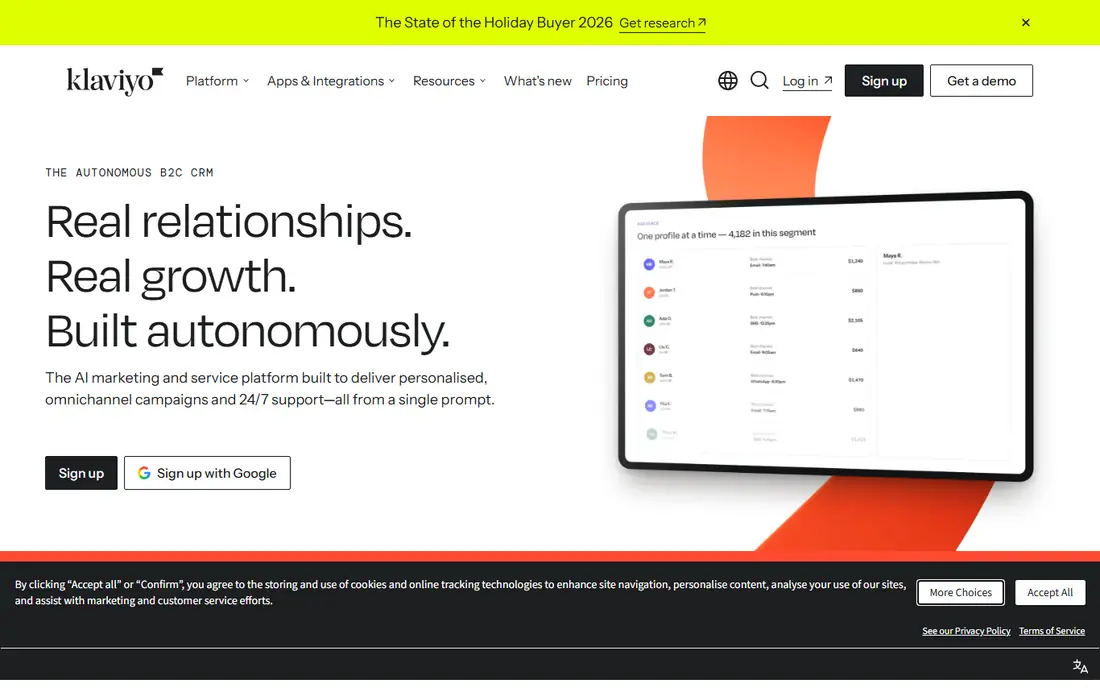
Klaviyo is the default email and SMS tool for many Shopify stores, because it syncs orders, browsing and customer data without manual imports. Abandoned cart, welcome, post-purchase and winback flows are prebuilt, and segmentation uses real purchase behaviour rather than guesswork. For a store with steady traffic, email often becomes its highest-return channel.
The drawback is price at scale. Free covers up to 250 contacts, and paid plans rise as the list grows, with SMS credits billed separately. Small stores should start with core flows and add SMS only when email results justify it. Used with restraint, Klaviyo pays for itself through recovered carts alone.
If Klaviyo appeals to you, check recent user reviews for the exact plan you intend to buy, since free and paid tiers can differ a lot. Look for comments on reliability, billing and support, and weigh recent reviews more heavily than older ones, because pricing and features change often.
- Deep Shopify data sync
- Strong flows for abandoned carts and welcome series
- Predictive analytics
- Costs grow with contact count
- Learning curve for advanced segmentation
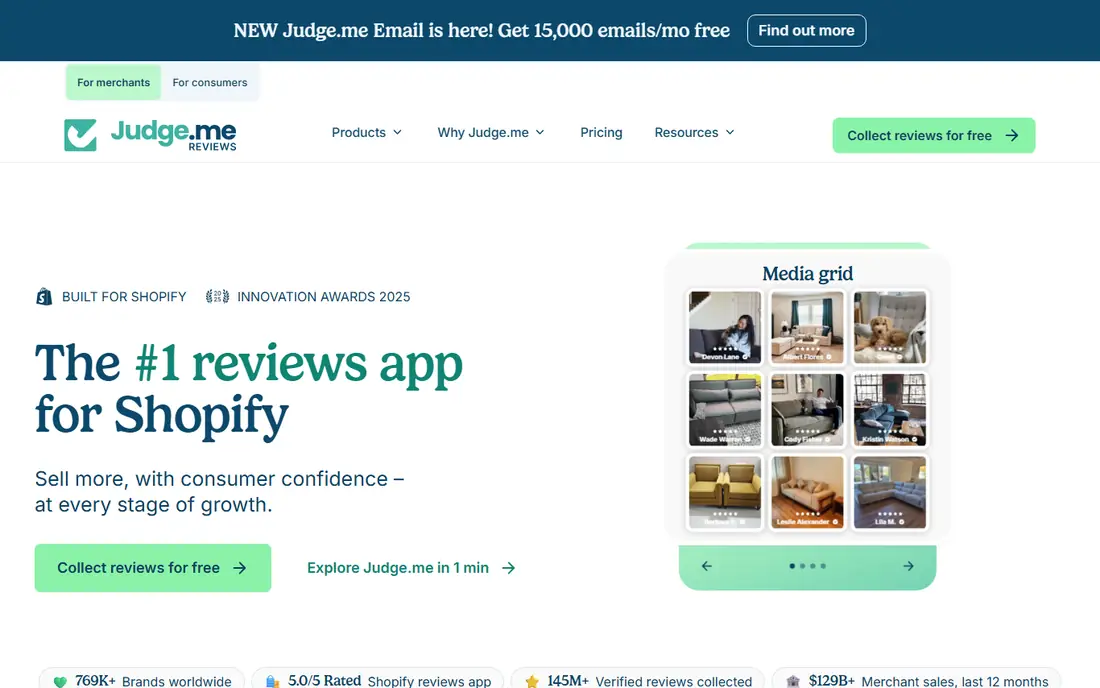
Judge.me collects product reviews by email, shows star ratings on product and collection pages, and supports photo and video reviews on paid plans. Its free plan is unusually generous, with unlimited review requests, which makes it a strong first reviews app for a new store. Google rich snippet support helps search results show stars.
It does not include loyalty or referral features, so stores that want a full retention suite need a second app. Design customisation is simpler than enterprise tools, though most stores will find it enough. For low-cost social proof, Judge.me is hard to beat.
When you trial Judge.me, start with the use case in its best-for line and test one real workflow end to end, rather than clicking through a demo. That test shows whether setup, daily use and support feel right for your team or household, and it gives you a fair basis for comparing it with the other options in this list.
- Free plan with unlimited review requests
- Photo and video reviews on paid plan
- Google rich snippets
- No built-in loyalty
- Design options are simpler than Yotpo
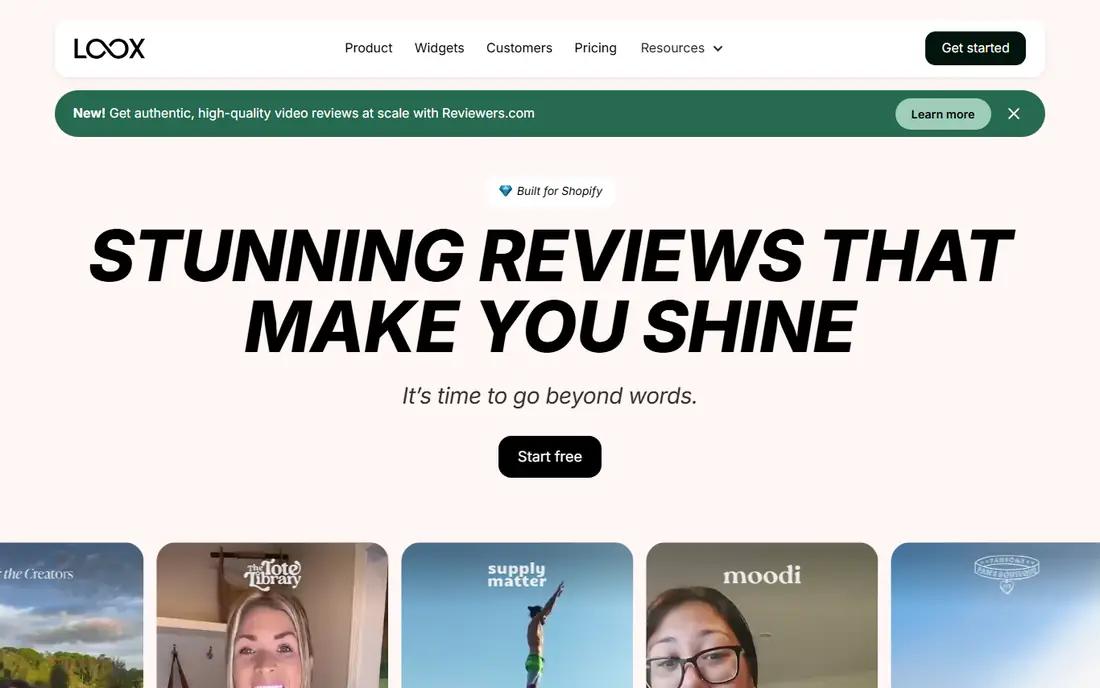
Loox focuses on visual proof. It collects photo and video reviews, displays them in galleries and widgets, and sends automated request emails after delivery. For products where appearance matters, such as apparel, beauty and home goods, a customer photo often persuades better than text alone.
There is no free plan, though a trial is offered, and video reviews sit on higher tiers. Stores with low order volume should check whether review volume justifies the monthly cost. For visual categories with steady sales, Loox is a strong conversion tool.
For Loox, the practical question is fit, not features alone. Check whether its limits, integrations and support hours match how you actually work, and confirm pricing for the size you expect in six months, not just today. A tool that fits now but strains at the next step costs more in switching time later.
- Visual reviews that suit fashion and beauty
- Automated request emails
- Referral add-ons
- Paid from the start
- Video reviews need higher tiers
Smile.io lets a store launch a points program, referral rewards and VIP tiers without custom development. Customers earn points for purchases, reviews and social actions, then redeem them at checkout. The free plan covers small stores, while paid plans add more ways to earn and better branding.
Costs rise with order volume on paid tiers, so a growing store should model the fee against repeat purchase value. Design control is limited on lower plans, though the default widgets look clean. For a first loyalty program, Smile.io is simple, fast and low risk.
We would put Smile.io on a shortlist when its best-for description matches your main job, and trial it beside one rival from this list. Compare the same task in both, note where each one slows you down, and keep the one that staff, family or clients adopt without extra training.
- Points, referrals and VIP tiers
- Free plan for small stores
- Easy Shopify setup
- Paid plans rise with order volume
- Advanced design needs higher tiers
Yotpo combines reviews, loyalty, SMS and subscriptions under one customer profile, which removes the fragmentation of running four separate vendors. Reviews syndicate to Google Shopping, photo and video reviews are supported, and loyalty data feeds email campaigns. Larger stores value that single view.
The trade is cost and complexity. The free tier covers small stores, but the full suite is priced for mid-market and Plus stores. Modular pricing means the total depends on which products you enable. For a growing brand that wants one retention platform, Yotpo is worth the sales conversation.
A good way to judge Yotpo is to ask what happens when something goes wrong. Check support channels, response times, export options and cancellation terms before you commit data or a team to it. Those answers matter as much as the feature list, especially for a tool you plan to use daily.
- Reviews, loyalty, SMS and subscriptions in one platform
- Google Shopping syndication
- Full suite pricing gets expensive
- Modular pricing can confuse
ReConvert turns the thank-you page into a sales tool. After checkout, shoppers see tailored one-click upsells, cross-sells and discount offers, plus post-purchase surveys that feed future marketing. Because the shopper has already paid, friction is low and average order value can rise without new traffic.
Results depend on offer quality. A weak or irrelevant upsell will be ignored, and too many offers can annoy buyers. Start with one relevant add-on per order and test it. For stores with steady orders, ReConvert is a low-cost way to lift revenue per order.
If ReConvert appeals to you, check recent user reviews for the exact plan you intend to buy, since free and paid tiers can differ a lot. Look for comments on reliability, billing and support, and weigh recent reviews more heavily than older ones, because pricing and features change often.
- Thank-you page upsells and surveys
- Drag-and-drop builder
- Free plan to test
- Results depend on traffic and offer quality
- Checkout upsells need care
Privy captures visitors who would otherwise leave without buying. Popups, banners and exit-intent offers collect email and SMS contacts, which Klaviyo or another tool can then nurture. Templates cover discounts, free shipping thresholds and newsletter signup, and setup needs no code.
The risk is overuse. Aggressive popups on every page hurt the shopping experience and can reduce trust. Use one well-timed offer, ideally tied to exit intent or a first-order discount, and measure signup rate against bounce. Done with restraint, Privy grows the list that drives future sales.
When you trial Privy, start with the use case in its best-for line and test one real workflow end to end, rather than clicking through a demo. That test shows whether setup, daily use and support feel right for your team or household, and it gives you a fair basis for comparing it with the other options in this list.
- Popup, banner and spin-to-win templates
- Email and SMS capture
- Shopify integration
- Popups can annoy if overused
- Paid plans scale with contacts
Recharge is built for stores that sell consumables or repeat products by subscription. Customers manage delivery dates, swap products and pause plans in a portal, while the store gains predictable recurring revenue. Bundles, upsells and churn-reduction tools sit in the same platform.
The fee structure needs care: a monthly plan plus transaction fees adds up, and the tool is overkill for a store with no repeat product. For coffee, supplements, pet food and similar categories, subscriptions change the business model. For one-off products, skip it and invest in reviews and email instead.
For Recharge, the practical question is fit, not features alone. Check whether its limits, integrations and support hours match how you actually work, and confirm pricing for the size you expect in six months, not just today. A tool that fits now but strains at the next step costs more in switching time later.
- Subscription management and customer portal
- Bundles and churn tools
- Strong Shopify fit
- Monthly fee plus transaction fees
- Overkill for stores without repeat products
How we picked these
We compared Shopify App Store listings, vendor pricing pages and public reviews for sales apps live in October 2026. We required a clear sales mechanism, such as capture, conversion, order value or repeat buying, and we checked free tiers and starting prices on vendor pages. We did not claim hands-on testing, and we favoured apps with a free plan or trial for small stores.
What to check before you install
Start with your weakest stage. If traffic converts poorly, fix reviews and page proof first. If carts are abandoned, fix email flows. If buyers never return, add loyalty. Installing every app at once makes it impossible to tell what worked, and it slows page load, which hurts conversion on its own.
App stack and page speed
Each app adds scripts to a storefront, so audit speed after each install. Remove apps that do not earn their keep within a month or two. A fast store with three good apps beats a slow store with twelve.
Measuring results
Set a baseline before installing: conversion rate, average order value and repeat purchase rate for the prior month. Compare the same metrics after install, allowing for seasonality. If an app cannot show a lift, cancel it and try a different lever.
FAQ
What are the best Shopify apps to increase sales?
The best Shopify apps to increase sales cover capture, conversion and repeat buying: Klaviyo for email, Judge.me or Loox for reviews, Smile.io for loyalty, and ReConvert for post-purchase upsells. Start with the stage where your store is weakest, and add apps one at a time so you can measure each result.
Are there free Shopify apps that increase sales?
Yes, Klaviyo, Judge.me, Smile.io, Yotpo, ReConvert and Privy all offer free plans or tiers. Free plans usually limit contacts, orders or features, so check limits before relying on them at scale. A free plan is ideal for testing whether an app fits your store.
Do reviews apps really increase sales?
Reviews help conversion by giving shoppers proof from other buyers, especially photo reviews for visual products. They do not fix a weak product or a confusing checkout, so treat reviews as one lever among several. Stores with no reviews at all tend to gain most from a first reviews app.
How many Shopify apps should a small store install?
A small store usually needs three to six well-chosen apps, not dozens. Cover email capture, reviews, loyalty or subscriptions if relevant, and one upsell tool. Audit the stack every few months and remove apps that no longer earn their monthly fee.
What is the best Shopify app for abandoned carts?
Klaviyo is the strongest choice for abandoned cart recovery on Shopify, thanks to its data sync and prebuilt flows. Privy helps by capturing emails before shoppers leave, which makes recovery possible at all. Use both together: Privy captures, Klaviyo follows up.