Best Sales Tax Software for Startups in 2026: 8 Tools Compared
Compare the best sales tax software for startups, with nexus tracking, automated filing, SaaS and ecommerce coverage and startup-friendly pricing in 2026.

- Editor's choice
 Anrok
SaaS startups on Stripe
Starts atSee websiteVisit anrok.comFull review - Great alternative
 TaxJar
Ecommerce startups wanting filing
Starts at$39 per monthVisit taxjar.comFull review - Also consider
 TaxCloud
Lowest-cost US sellers
Starts at$19 per monthVisit taxcloud.comFull review
TL;DR:
- Start with nexus, not filing volume, because you only need to register and file where you have a real tax obligation.
- TaxJar and TaxCloud publish the lowest entry prices in this guide, while Avalara and Anrok suit teams planning larger scale.
- SaaS startups should favor tools built for subscriptions and global VAT, while ecommerce startups should favor marketplace and store links.
- This is general information only, not tax advice, so confirm nexus and registration duties with a tax professional for your sales pattern.
Quick comparison
| Tool | Best for | Starts at | Free plan? | |
|---|---|---|---|---|
| Anrok | SaaS startups on Stripe | See website | No | Visit |
| TaxJar | Ecommerce startups wanting filing | $39 per month | Free trial | Visit |
| TaxCloud | Lowest-cost US sellers | $19 per month | Free trial | Visit |
 Avalara AvaTax | Startups planning global scale | See website | No | Visit |
 Stripe Tax | Startups billing only through Stripe | See website | No | Visit |
 Numeral | Predictable per-filing pricing | $75 per filing | Yes | Visit |
 Kintsugi | Startups worried about hidden nexus | See website | Yes | Visit |
 Zamp | Founders wanting tax handled fully | See website | No | Visit |
The best sales tax software for startups
Sales tax gets messy fast for a startup, because each state sets its own thresholds, rates and filing rules, and digital products face different rules from physical goods. The tools below calculate tax at checkout, track where you cross nexus, and in many cases file and remit for you. We compared official pricing pages, feature pages and public reviews, and we favored tools with a clear answer to one question: does it actually file for you, or only calculate?

Anrok is built for software and subscription companies, which is a different problem from selling physical goods. It tracks nexus across US states and many countries, handles SaaS taxability questions, and files returns in the places where you register. The Stripe link matters for startups that already bill through Stripe, because transaction data flows in without manual exports.
The catch is price structure. Public summaries list starter pricing around $100 per market per month, with custom plans above that, so a startup registering in many markets should model the total before signing. If you sell SaaS and bill through Stripe, Anrok is still a strong first look, because its taxability logic fits your product type.
- Built for SaaS and subscriptions
- Stripe and NetSuite links
- Global VAT coverage
- Quote-led pricing for many plans
- Per-market pricing can add up

TaxJar is a practical pick for ecommerce startups that sell physical goods in the US. The starter plan is listed at $39 per month, with a 30-day trial, and AutoFile can file returns for you where you are registered. Links to Shopify, WooCommerce, BigCommerce and marketplaces keep order data flowing in, and nexus tracking shows where sales are approaching a threshold.
The limit is geography. TaxJar does not cover VAT and GST in the way global tools do, so international sellers will need another solution or a second tool. Also check AutoFile credit limits on your plan, since filing in many states can add cost. For US ecommerce, TaxJar remains a clear, self-serve starting point.
- Published starter price
- AutoFile service
- Wide store and marketplace links
- US-only focus
- Filing credits cost extra on some plans
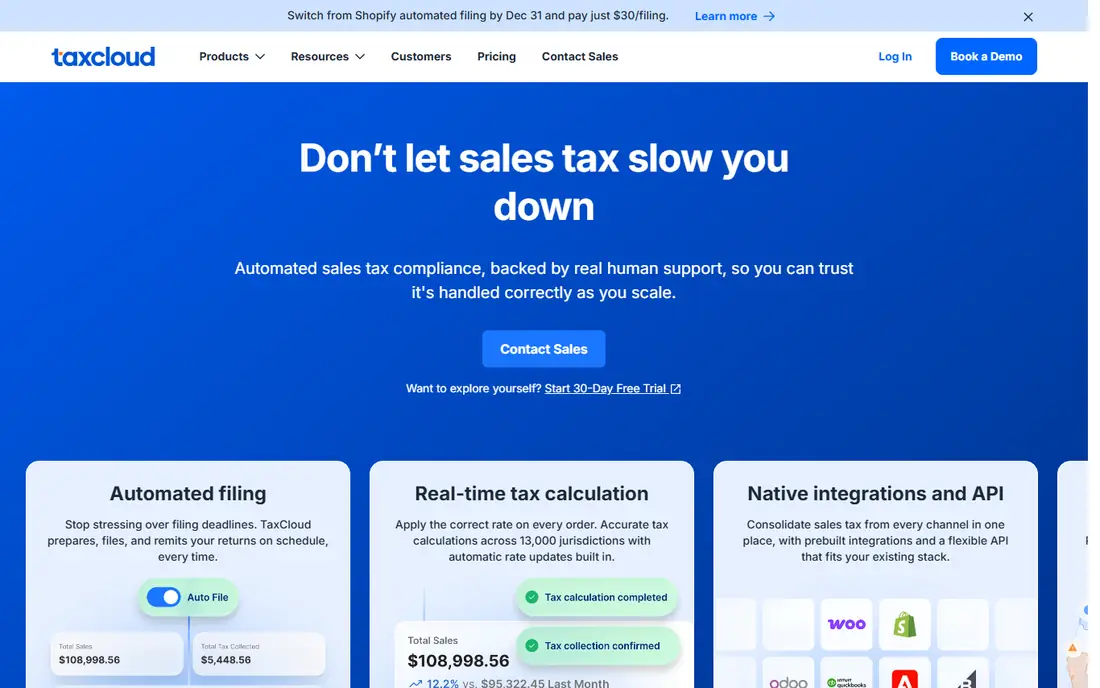
TaxCloud suits startups that want compliant US filing at the lowest published entry price in this guide, $19 per month on its starter tier, with a trial. It calculates tax, tracks nexus and offers a filing service, with free filings in Streamlined Sales Tax states for qualifying sellers. That structure can keep costs down while order volume is still modest.
The trade-off is scope and polish. TaxCloud is US-only, and its filing advantage is strongest in Streamlined states, so sellers concentrated elsewhere should compare the filing price carefully. The interface also feels less modern than newer rivals. For a budget-conscious US seller, the math still works well.
- Low entry price
- Streamlined Sales Tax support
- Filing service option
- US-only
- Strongest in Streamlined states
- Interface feels older
Avalara AvaTax is the engine many startups graduate to, because it covers US sales tax and tax in many countries, links to ERPs and ecommerce platforms, and handles exemption certificates and filing at scale. If you plan to sell globally, hire staff in many states or integrate with an ERP soon, Avalara gives you room to grow without switching tools later.
The catch is that Avalara is built for scale, so onboarding and pricing can feel heavy before you have real volume. Pricing is quoted, and public summaries put smaller-company rates in a wide range, so get a written quote tied to your state count and volume. Early startups may start cheaper elsewhere and move to Avalara when volume justifies it.
- Huge jurisdiction coverage
- ERP and store links
- Mature filing engine
- Quote-only pricing
- Heavier onboarding for small teams
Stripe Tax is the simplest choice if every sale already flows through Stripe. It calculates tax at checkout, supports many countries, and links directly to Stripe billing, so there is no separate order sync to maintain. For a SaaS startup already on Stripe, setup can be fast and the tax logic stays close to the payment flow.
The limit is the payment rail. If you sell through other channels, Stripe Tax alone will not cover those sales, and its pricing is percentage-based, listed at 0.5 percent per transaction for no-code use where registered, which scales with revenue. Check whether a flat subscription tool would cost less at your volume before you commit.
- Native Stripe billing link
- Global coverage
- Simple setup for Stripe users
- Only useful if you bill through Stripe
- Percentage-based pricing
Numeral appeals to founders who hate subscription surprises, because pricing is $75 per filing plus $150 per one-time registration per state, with free sales tax monitoring. You pay for filings you actually make, which suits a startup that is registered in only a few states and wants costs to track activity. Filing and remittance are included in that per-filing model.
The catch is registration cost and scope. Each new state adds a registration fee, and global VAT and GST coverage sits mainly on enterprise plans. If you expand into many states quickly, a flat subscription may beat per-filing math. For a lean US startup with a small state footprint, Numeral is easy to budget.
- Per-filing price is clear
- Free nexus monitoring
- US filing focus
- Registration fees extra
- Global VAT only on higher plans
Kintsugi targets the fear every founder has: nexus you do not know about. Its free exposure monitoring plan watches sales patterns and flags risk, while paid plans move into automated filing. Public summaries list starter pricing from $75 per filing or registration, with premium plans quoted, so confirm your plan total before you rely on it. Coverage spans the US, Canada, EU, UK and many other countries on its feature pages.
The trade-off is vendor age and pricing clarity. Kintsugi is newer than Avalara and TaxJar, so its track record is shorter, and pricing pages change with plan design. Still, for a startup that wants an early warning system plus a path to full filing, the free monitoring tier is a low-risk way to start.
- Free exposure monitoring
- AI-assisted automation
- US and global coverage
- Starter filing pricing varies by plan
- Newer vendor than Avalara
Zamp is for founders who want sales tax off their plate entirely, not just calculated. It pairs software with a managed service, handling nexus analysis, registration, filing and ongoing compliance for US and Canadian sellers. A free nexus analysis gives you a starting point before any paid plan, which helps founders who are unsure where they even owe tax.
The catch is control and price. Zamp quotes plans after a sales call, so you cannot compare a published rate, and hands-off service means less day-to-day control than a self-serve dashboard. If you would rather pay a team to own compliance than learn tax rules yourself, Zamp is worth a quote. If you want to manage filings in-house, a cheaper self-serve tool fits better.
- Managed service approach
- Dedicated tax team feel
- US and Canada coverage
- Quote-only pricing
- Less self-serve control
How we picked these
We compared official pricing pages, feature documentation and public reviews, and we favored tools that state clearly whether they file and remit, not just calculate. We gave weight to nexus tracking, because early registration mistakes are costly, and to links with the billing and store systems startups actually use. We also noted where pricing was quote-only, so readers can tell a published starter price from a sales-led quote.
What to check before you buy
Map your sales first. List where you sell, what you sell, and which channels carry each sale, then ask each vendor which of those sales it covers and files for. Check whether filing is included in the base price or billed per return, and whether registration fees sit on top. Test the checkout calculation on a real product, including a tax-exempt customer if you serve one, and confirm how refunds and credits are handled.
Finally, ask about audit support. A good tool keeps a record of each calculation, filing and payment, so you can answer a state notice without rebuilding history from spreadsheets. Keep that record even if you switch tools later, and confirm data export before you sign a long contract.
FAQ
When does a startup need sales tax software?
When sales cross state thresholds, when you sell in many states, or when manual rate lookups start eating staff time and risking errors. A nexus check is the right first step, even before you buy, because you may only owe tax in a few places at first.
Does sales tax software file returns for me?
Some tools do, including TaxJar AutoFile, Numeral and Zamp, while others mainly calculate tax and leave filing to you or to an add-on. Always confirm filing and remittance in writing for your registered states, since calculation alone does not keep you compliant.
What is nexus in simple terms?
Nexus is the connection that gives a state the right to require you to collect and remit its sales tax, usually based on sales volume, transaction count or a physical presence. Rules differ by state, so a sale that creates nexus in one state may not do so in another.
Is Stripe Tax enough on its own?
It can be enough if all your sales flow through Stripe and you are registered where Stripe Tax supports filing. If you sell through other stores, marketplaces or direct channels, you will need a tool that covers those sales too.
Should a startup use a tax professional as well?
Yes for registration decisions, unusual products and audit notices, even with software in place. Software handles calculation and filing mechanics, but a tax professional can advise on nexus, product taxability and state-specific rules for your business.