8 Best Sales Tax Compliance Software in 2026
Compare the best sales tax compliance software in 2026 on nexus tracking, calculation, filing, and price for US sellers and SaaS teams today today today.

- Editor's choice
 TaxJar
Small e-commerce sellers on Shopify or Stripe
Starts at$39 per monthVisit taxjar.comFull review - Great alternative
 TaxCloud
Growing US sellers that want predictable filing costs
Starts at$19 per monthVisit taxcloud.comFull review - Also consider
 Stripe Tax
Stripe-native SaaS and e-commerce businesses
Starts at0.5 percent per transaction on BasicVisit stripe.comFull review
TL;DR:
- Sales tax software should track nexus, calculate rates at checkout, and file returns, not only show a rate table.
- TaxJar and TaxCloud suit small US sellers, while Avalara and Vertex suit larger firms with complex ERP and multi-state needs.
- Stripe Tax suits businesses already on Stripe, and Kintsugi and Numeral offer low-cost, per-filing models for smaller footprints.
- Pricing models differ sharply, from per-transaction and per-filing to per-state monthly and quote-based annual contracts.
- Count your filing states and order volume before you compare, since those counts decide the true monthly cost.
Quick comparison
| Tool | Best for | Starts at | Free plan? | |
|---|---|---|---|---|
| TaxJar | Small e-commerce sellers on Shopify or Stripe | $39 per month | Free trial | Visit |
| TaxCloud | Growing US sellers that want predictable filing costs | $19 per month | Free trial | Visit |
| Stripe Tax | Stripe-native SaaS and e-commerce businesses | 0.5 percent per transaction on Basic | No | Visit |
 Kintsugi | Startups that want free nexus monitoring to start | Free for monitoring | Yes, free nexus monitoring | Visit |
 Numeral | Sellers with a small filing footprint that want per-filing pricing | $75 per filing | Yes, free nexus monitoring | Visit |
 Anrok | Growth-stage SaaS companies selling subscriptions | See website | No | Visit |
 Avalara AvaTax | Mid-market to enterprise firms with complex ERP needs | See website | No | Visit |
 Vertex | Large enterprises on SAP, Oracle, or complex ERPs | See website | No | Visit |
The best options in this guide
We compared current plans, core features, and limits for each product below, and we kept only products that are available now and fit the topic closely. Prices change, so check the vendor page before you buy, and treat any plan limit as part of the price. Disclaimer: This guide is general information, not tax advice. Sales tax rules vary by state and change often, so confirm your obligations with a tax professional.

For buyers who need small e-commerce sellers that need nexus tracking, calculations, and filings in one US-focused tool.
The clearest strength is its AutoFile service and many store integrations help small sellers file in several states without manual returns.
The trade-off is filing credits beyond the plan cost extra, and sellers with global VAT needs will need another tool.
- Nexus tracking, calculations, AutoFile filings, many integrations
- AutoFile credits extra, US focus, no VAT on core plans
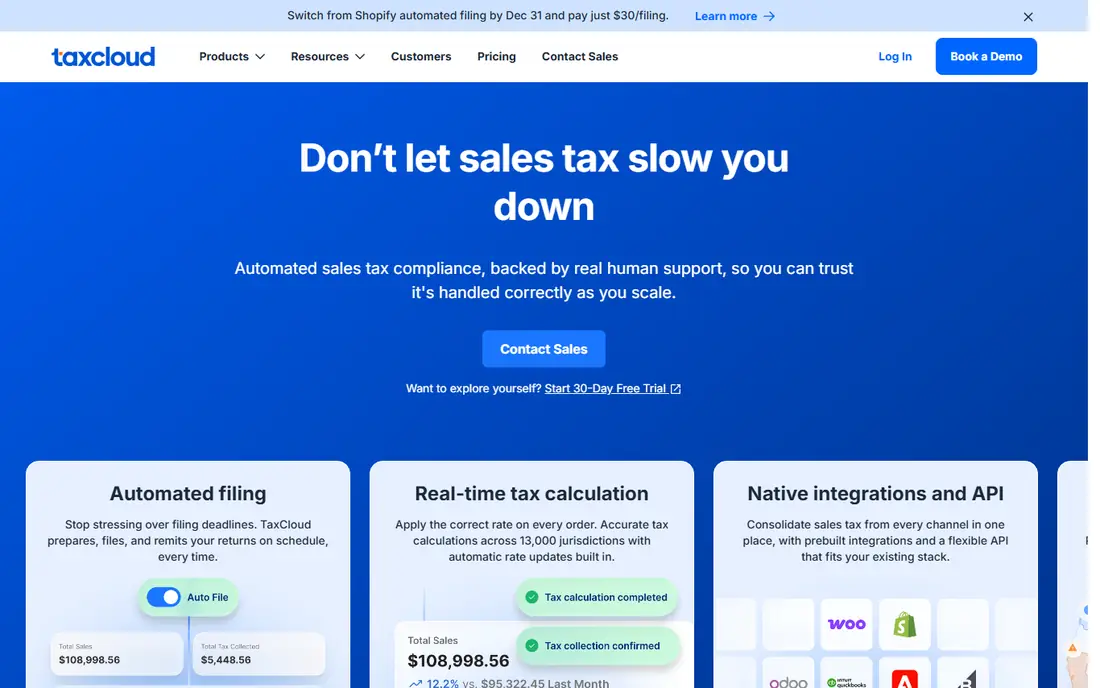
If your main job is growing US sellers that want a filing service with predictable costs, especially in Streamlined Sales Tax states.
Where it stands out is its filing service and Streamlined Sales Tax support suit US sellers that want returns handled without a large enterprise contract.
The main weakness to weigh is it is US-focused, so sellers with international VAT needs will need a separate solution.
- Filing service, Streamlined Sales Tax support, store integrations
- US only, filing fees on top of subscription for some plans

This is a strong match for businesses already billing through Stripe that want tax calculation inside checkout.
Its main advantage in daily use is native Stripe integration means tax calculation sits inside checkout and billing without a separate connector.
Watch out for it only makes sense for Stripe users, and filing requires a paid tier, so total cost rises with transaction volume.
- Native Stripe integration, global tax calculation, easy setup for Stripe users
- Only for Stripe users, filing requires paid tier, per-transaction cost grows with volume
Buyers who want startups and growing sellers that want to monitor nexus for free before paying for filings.
A concrete strength worth noting is its free nexus monitoring helps a startup see exposure early, before it becomes a filing problem.
The honest limitation is as a newer vendor it has less long-term history than Avalara or Vertex, and premium pricing is custom.
- Free nexus monitoring, AI product categorization, per-filing pricing
- Newer vendor, premium features custom priced
Numeral
Best for: Sellers with a small filing footprint that want per-filing pricing
A good fit when sellers with a small number of filing states that prefer paying per filing over a monthly subscription.
What sets it apart in practice is per-filing pricing without a subscription suits sellers with a small footprint who file in only a few states.
A drawback to plan around is its core plans are US-focused, so sellers with broad global VAT needs should check Enterprise terms.
- No subscription required, per-filing pricing, free monitoring
- US focus on core plans, global needs on Enterprise
Consider this option when growth-stage SaaS companies that sell subscriptions in many markets.
The strongest practical point is its SaaS focus helps subscription businesses handle taxability questions that generic tools miss.
The part that may frustrate you is per-market pricing can add up as you register in more places, so model total cost by market count.
- SaaS-focused taxability, global coverage, subscription billing integrations
- Per-market pricing can add up, quote-based for larger plans
Teams with mid-market and enterprise firms with complex ERP systems and many tax jurisdictions.
One feature that earns its place here is its broad ERP integrations and global coverage suit firms that need tax calculation inside existing finance systems.
One weakness stands out pricing is quote-based and implementation costs are extra, so small sellers should expect a larger total than a self-serve tool.
- Broad ERP integrations, global coverage, calculation and filing
- Quote-based pricing, implementation and support costs extra
Small firms that need large enterprises running SAP, Oracle, or other complex ERP systems with global tax needs.
The most useful strength is its enterprise determination engine and ERP depth suit large firms with complex, multi-country tax rules.
The compromise here is pricing is quote-based and implementation is long, so it is not a fit for a small seller that needs a quick start.
- Enterprise tax determination, global coverage, deep ERP integration
- Quote-based enterprise pricing, long implementation
How we picked these
We compared sales tax software by nexus monitoring, rate calculation, filing and remittance, exemption certificate handling, integrations, and pricing model, using vendor pages and recent 2026 comparisons. We kept only tools that are actively sold now and handle US sales tax compliance for sellers or SaaS teams.
We did not treat the lowest headline price as the best value, since filing credits, per-state fees, and per-transaction costs change the total. A tool earns a place here if it covers the full compliance workflow for its target buyer, from monitoring to filing, with clear pricing or a clear quote process.
Choosing sales tax software for your footprint
Start with your footprint, not a feature list. Count the states where you have nexus, the states where you may soon cross a threshold, and your monthly order or transaction volume. Those three numbers decide whether a subscription, per-filing, or per-transaction model is cheapest.
A useful test is to run your real work in the tool for a week, using your own data, clients, or questions, rather than a vendor demo. Note where you hit a limit, where support was needed, and whether reports were clear enough to share. That week of real use usually reveals more than a long feature comparison, and it helps you decide whether a higher plan is needed or a lower plan is enough.
Check what filing really includes
Some tools calculate tax but do not file, while others file and remit for you. Confirm whether filing credits are included, how much extra filings cost, and whether registrations and exemption certificates are included or charged separately.
Test integrations with your store or billing system
Connect your actual store or billing platform during a trial and check whether orders, refunds, and product tax codes flow correctly. A mismatch in product categorization can create wrong rates, even if the tool looks good in a demo.
Model total cost for a year
Add subscription, filing credits, registrations, and per-transaction fees for a full year at your expected volume. A tool that looks cheap at low volume can become costly as you grow, while a quote-based enterprise tool may be cheaper at very high volume.
Start small, then scale
Start on a monthly plan or trial where one is offered, and only move to an annual plan after the tool has proved its fit for at least a month of real work. Annual billing can save money, but it locks you in before you know whether limits, support, or workflow fit your team. When you do scale, check whether extra users, clients, or volume change the price, and keep a note of the renewal date so an annual charge does not surprise you.
FAQ
What is sales tax nexus?
Nexus is the connection to a state that requires you to register, collect, and remit sales tax there. Economic nexus is usually triggered by sales revenue or transaction count in a state, and thresholds vary by state.
Does sales tax software file returns for me?
Some tools do, through AutoFile or a managed filing service, while others only calculate tax and prepare reports. Check whether filing is included, how many filings are included, and what extra filings cost.
Do I need sales tax software if I sell on a marketplace?
Marketplaces often collect tax on marketplace sales, but you may still need to file, track nexus, or handle direct sales outside the marketplace. Check your marketplace and direct sales separately.
How much does sales tax software cost?
Small sellers often pay $19 to $99 per month plus filing fees, per-filing sellers pay about $75 per filing, Stripe Tax charges 0.5 percent per transaction, and enterprise tools are quote-based.
Can sales tax software handle VAT too?
Some tools, such as Avalara, Vertex, and Stripe Tax, cover VAT and GST in many countries, while US-focused tools may not. If you sell internationally, confirm VAT coverage and filing support before you buy.
Sources
https://www.taxjar.com https://taxcloud.com https://stripe.com https://trykintsugi.com https://www.numeral.com https://www.anrok.com https://www.avalara.com https://www.vertexinc.com